
 Worksheets
Ohlsen Cells
Total questions: 58
Worksheet time: 29mins
A selectively-permeable phospholipid bilayer forming the boundary of the cells
cytoskeleton
plasma membrane
nuclear envelope
tonicity

gel-like material, water based (aqueous) system of filaments & microtubules, keeps everything together, shape; labeled #7
cytoplasm
smooth endoplasmic reticulum
golgi apparatus
nuclear envelope

part of the cell containing DNA and responsible for growth and reproduction; labeled #1
cytoskeleton
mitochondria
nucleus
cytoplasm
system of membranes that is found in a cell's cytoplasm and that assists in the production, processing, and transport of proteins and in the production of lipids
cytoskeleton
endoplasmic reticulum
ribosomes
mitochondria

portion of the endoplasmic reticulum studded with ribosomes, assembles proteins; labeled #5
rough ER
smooth ER
golgi apparatus
lysosomes

portion of the endoplasmic reticulum that is free of ribosomes, assembles lipids; labeled #3
rough ER
smooth ER
golgi apparatus
lysosomes

system of membranes that modifies and packages proteins for export by the cell, UPS of the cell; labeled #4
rough ER
smooth ER
golgi apparatus
lysosomes

organelles containing digestive enzymes that break down carbohydrates, lipids, proteins, or nucleic acids; labeled #2
rough ER
smooth ER
golgi apparatus
lysosomes

organelle that is the site of ATP (energy) production; labeled #9
lysosome
peroxisome
mitochondrion
ribosome
having an aversion to water; tending to coalesce and form droplets in water
hydrophilic
hydrophobic
hydroharmonic
htdrophlegyic
having an affinity for water
hydrophilic
hydrophobic
hydroharmonic
hydrophlegyic
2 types of membrane transport
active and passive
active and subjective
passive and subjective
passive and conjunctive
unassisted movement of a solute from an area of high concentration to an area of low concentration, type of passive transport
facilitated transport
osmosis
simple diffusion
solute pumping
movement of specific molecules across cell membranes through protein channels, type of passive transport
facilitated diffusion
osmosis
simple diffusion
solute pumping
hydrolysis of ATP required for movement across the membrane
active transport
passive transport
facilitated diffusion
osmosis

process of capturing a substance or particle from outside the cell by engulfing it with the cell membrane, bringing it into the the cell; phagocytosis and pinocytosis are two special cases; pictured above
endocytosis
exocytosis
solute pumping
osmosis

process of vesicles fusing with the plasma membrane & releasing their contents to the outside of the cell; pictured above
endocytosis
exocytosis
solute pumping
osmosis

organelle that makes proteins; labeled #6
cytoskeleton
golgi apparatus
lysosome
ribosome
organelles containing enzymes that breakdown toxic substances such as alcohols and produce hydrogen peroxide
lysosomes
peroxisomes
ribosomes
golgi apparatus
network of fibers that holds the cell together, helps the cell keep its shape, and aids in movement
cytoskeleton
mitochondria
peroxisomes
golgi apparatus

main energy source that cells use for most of their work, adenosine triphosphate; pictured above
AMP
ADP
ATP
GTP
Osmosis involves the movement of _____ only!
salts
molecules
water
ions
Which of the following would be an example of active transport?
sodium/potassium pump
facilitated diffusion
osmosis
simple diffusion
The transport of proteins through a channel protein would be an example of what type of transport?
solute pumping
simple diffusion
osmosis
facilitated diffusion
A cell responsible for destroying foreign material and waste, like a phagocytic white blood cell, would be expected to have more of what type of organelle in it's cytoplasm?
mitochondria
lysosomes
ribosomes
rough ER

Which of the following shows blood in what would be considered an isotonic solution?
first picture (left)
second picture (middle)
last picture (right)
all three pictures

Which of the following shows blood in what would be considered a hypotonic solution?
first picture (left)
second picture (middle)
last picture (right)
all three pictures

Which of the following shows blood in what would be considered a hypertonic solution?
first picture (left)
second picture (middle)
last picture (right)
all three pictures
Cells are able to be structurally different and perform different functions and jobs because of cell ____.
differentiation
cycle
mitosis
apoptosis
Which of the following is NOT true about the plasma membrane?
It has proteins embedded in it for specialized functions
It only allows water soluble materials to pass through easily.
It is mainly made of a phospholipid bilayer.
It regulates what enters and exits the cell.
A cell that needs a lot of ATP in order to do it's job effectively, like a muscle cell or a kidney cell, would be expected to have more of what organelle in it?
lysosomes
smooth ER
mitochondria
ribosomes
A cell that produces a lot of lipids and detoxifies toxins, like some liver cells, would be expected to have a significant amount of
mitochondria.
lysosomes.
rough ER.
smooth ER.

molecules that make the cell surface fuzzy, sticky and sugar rich; labeled #1
glycoproteins (with oligosaccarhides)
cholesterol
phospholipids
peripheral proteins
Which of the following would NOT be considered part of the nucleus?
nuclear envelope
nucleolus
chromatin
cytoskeleton

The polar phospholipid heads (labeled #4) are _____ while the non-polar tails (labeled #3) are ____.
hydrophobic; hydrophilic
hydrophilic; hydroprobic
hydrophilic; hydrophilic
hydrophobic; hydrophobic
What is true of all cancers?
They are caused by cigarette smoking and vaping.
They are inherited.
They are genetic (caused by damage to DNA).
They respond to a single type of treatment.

lipid responsible for the stability/fluidity of the plasma membrane; labeled #8
cholesterol
phospholipid
glycolipid
triglyceride
Cancers can be caused by ________ of proto-oncogenes and/or _________ of tumor suppressor genes.
activation; activation
activation; inactivation
inactivation; activation
inactivation; inactivation
What would you expect cells to be like if they did not have properly functioning p53, a protein that checks for damaged DNA and can stop the cell cycle and cause the cell to die if the damage cannot be repaired?
The absence of p53 would have no effect on the cells.
The absence of p53 could cause cells to skip mitosis (M phase) and stay in S phase of the cell cycle.
The absence of p53 could cause cells to replicate with damaged DNA that could ultimately lead to cancer.
The absence of p53 inside cells would cause them to divide more rapidly.
Which of the following is NOT an example of diffusion?
A sugar cube is dissolved in hot water and, without being stirred, all of the liquid becomes sweet tasting.
A person blows air molecules into a balloon by exhaling forcefully.
A crystal of blue copper sulfate is placed in a test tube of water. The next day the solid is gone, but the water is evenly colored.
A perfume bottle is opened and soon the odor can be sensed in all parts of the room.
Which of the following is NOT an example of osmosis?
Air molecules escape from a punctured tire as a result of pressure inside.
A fresh potato is peeled, weighed and soaked in a strong salt solution. The next day it is discovered that the potato has lost weight.
Plant seeds soaked in water swell and become several times larger as before soaking.
Garden grass wilts after being exposed to dry chemical fertilizer.
A saltwater fish is placed into pure distilled water. Which of the following events would occur at the cellular level?
Diffusion of salt ions out of the cells would occur.
They would actively pump water into the cell.
They would crenate (shrivel).
They would swell until they lyse (burst).
_________ are the basic structural and functional units of living organisms.
atoms
cells
tissues
organs

During which phase of mitosis do the chromosomes attach to spindle fibers?
anaphase
metaphase
prophase
telophase

During which phase of mitosis do the chromosomes line up down the middle of the cell?
anaphase
metaphase
prophase
telophase

During which phase of mitosis do the chromatids pull apart and migrate to opposite ends of the cell?
anaphase
metaphase
prophase
telophase

During which phase of mitosis do the chromosomes uncoil and the nuclear membrane reappears?
anaphase
metaphase
prophase
telophase
Which of the following is NOT a role of proteins
embedded in the cell membrane?
act as receptors
act as selective channels
form pores for transport
regenerate ATP through cellular respiration
The portion of the cell’s life cycle that does NOT involve cell division is known as
anaphase
interphase
cytokinesis
telophase
What is the name for the carbohydrate-rich area at the cell surface?
glycocalyx
peripheral oligosaccharides
oligocalyx
integral saccharides
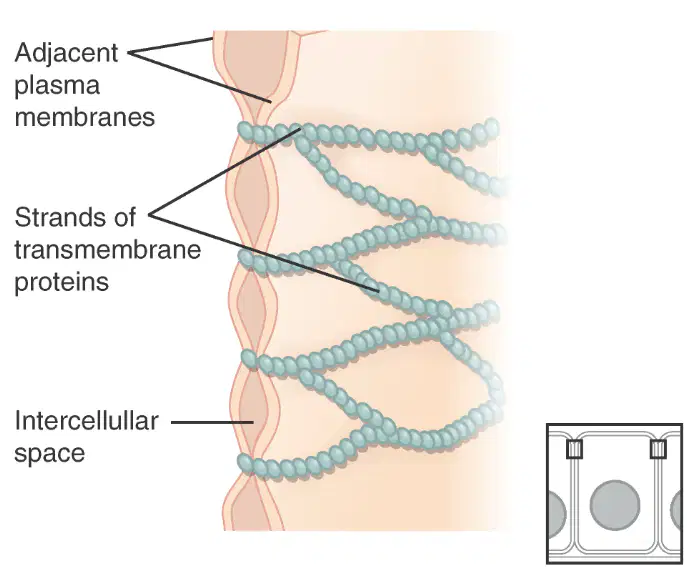
The impermeable, leakproof cell junctions that prevent substances from passing through pictured here are
desmosomes
gap junctions
plasmodesmata
tight junctions
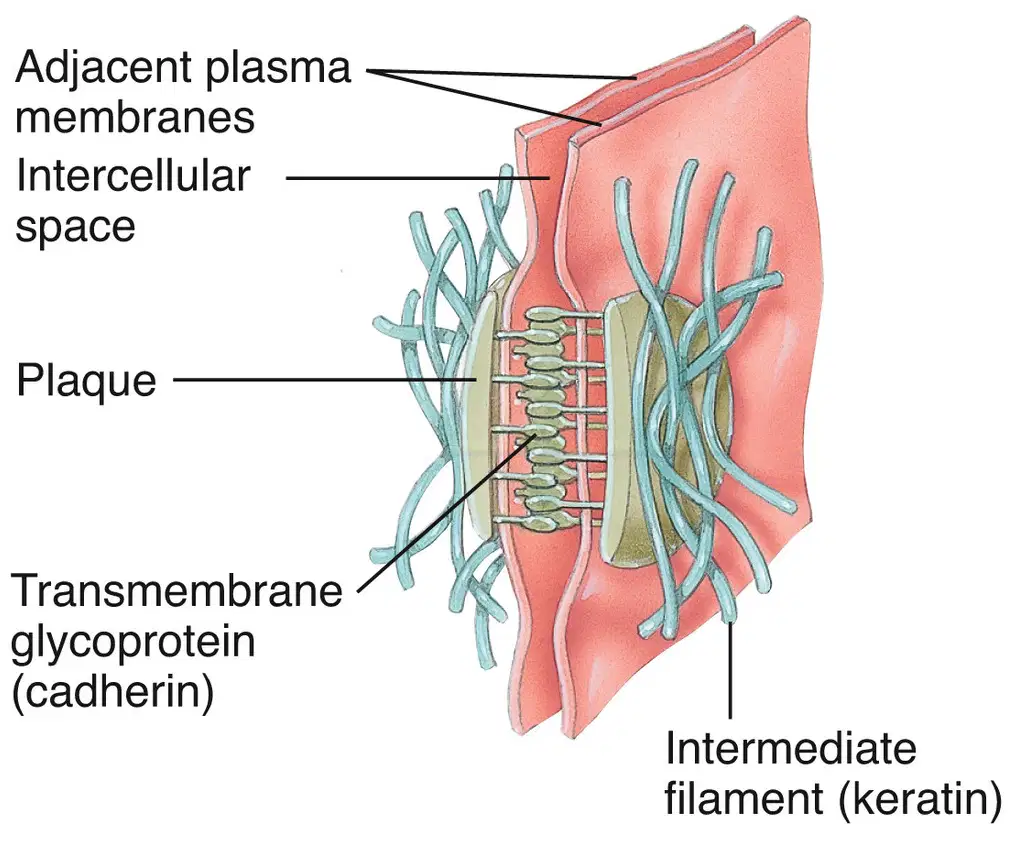
anchoring junctions (like rivets)that prevents cells from being pulled apart pictured here are called
desmosomes
gap junctions
plasmodesmata
tight junctions
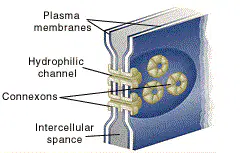
junctions that allow communication pictured here are called
desmosomes
gap junctions
plasmodesmata
tight junctions
Pancreatic endocrine cells manufacture and secrete protein hormones while liver hepatocyte cells detoxify alcohol and other toxins. Which of the following subcellular structures is likely to be more prominent in pancreatic cells than liver cells?
mitochondria
lysosomes
rough endoplasmic reticulum
smooth endoplasmic reticulum
Intravenous (IV) solutions administered to patients are normally isotonic. Which of the following is most likely if an IV of highly concentrated salt water is administered to a patient?
The blood cells will shrivel.
The blood cells will swell.
It will have no effect on the blood cells.
The buffer of the blood will neutralize the tonicity.
A team of biologists develop a new drug, and one team member hypothesizes that the drug is incapable of freely passing across the plasma membrane and requires the help of membrane proteins to enter cells. Which of the following, if true about the drug, best supports this hypothesis?
The drug is a large non-polar molecule.
The drug is a large charged molecule.
The drug is a small non-polar molecule.
The drug is a very small polar molecule.
At the cellular level, the structure (size, shape, arrangement, parts) of the cell helps determine the _______ of that cell.
anatomy
function
orientation
tranference
Macrophages (white blood cells responsible for destroying foreign invaders by phagocytosis) would probably have more of which type of organelle compared to other cells?
centrosomes
lysosomes
ribosomes
smooth ER

