Wayground logo

Free Printable Worksheets

Font size

S
M
L
XL
Worksheets

Genetics Quiz

Total questions: 92

Worksheet time: 3hrs 7mins

Name
Class
Date
1.

Which statement is true?

a)

Your DNA is identical to your siblings.

b)

Your DNA is identical to your father's.

c)

Your DNA is identical to your mother's.

d)

Your DNA is unique to you.

2.

Which of your body cells contain DNA?

a)

Only bone cells

b)

Only sperm and egg cells

c)

Most of the cells throughout your body

d)

Only skin cells

3.

What is the study of genes and inheritance known as?

a)

Genetics

b)

Chemistry

c)

Physics

d)

Astronomy

4.

Where is the majority of DNA stored within a cell?

a)

Chloroplast

b)

Cell wall

c)

Cell membrane

d)

Nucleus

5.

A widow's peak is a dominant trait. If you inherit a RECESSIVE allele from your mother and a DOMINANT allele from your father, what type of hairline will you have?

a)

Widow's peak hair line

b)

Straight hair line

6.

Attached earlobes are a recessive trait. If you receive a DOMINANT allele from each of your parents, what kind of earlobes will you have?

a)

Attached earlobes

b)

Detached (free) earlobes

7.

A cleft chin is a dominant trait. If you receive a RECESSIVE allele from each of your parents, what type of chin will you have?

a)

Cleft chin

b)

Smooth chin

8.

You inherit half of your DNA from your mother and half from _______?

a)

Your father

b)

Your pet hamster

c)

Your grandmother

d)

Your sister

9.

Check any/all phenotypes described below

a)

Tall

b)

Green eyes

c)

Hh

d)

Spotted fur

e)

bb

10.

Check any/all genotypes described below

a)

Rr

b)

Striped shell

c)

Curved beak

d)

TT

e)

Curly hair

11.

An organism's genetic code is also called what?

a)

Genotype

b)

Phenotype

12.

An organism's observable physical features are also called what?

a)

Genotype

b)

Phenotype

13.

You inherit a recessive allele from your mother and a dominant allele from your father. Which allele will be expressed?

a)

The recessive allele

b)

The dominant allele

14.

Which of the following features is NOT inherited?

a)

Skin color

b)

Tatoo

c)

Hair texture

d)

Color blindness

15.
Aa, DD, bB, yy are all examples of
a)
genotypes
b)
phenotypes
16.
Which of the following genotypes is homozygous dominant?
a)
A
b)
Aa
c)
AA
d)
aa
17.
Which of the following genotypes is heterozygous?
a)
Bb
b)
BB
c)
bb
d)
B
18.
In a flowering plant species, red flower color (R) is dominant over white flower color (r). What is the genotype of any red-flowering plant resulting from this species?
a)
rr
b)
R
c)
RR
d)
RR or Rr
19.
What you see, or the physical appearance.
a)
Genotype
b)
Phenotype
c)
Homozygous
d)
Heterozygous
20.
Which of the following is a phenotype?
a)
Aa
b)
red hair
c)
heterozygous
d)
DNA
21.
How many alleles (letters) do each person carry for a trait?
a)
1
b)
2
c)
3
d)
4
22.
How many alleles (letters) does a child get from each parent for each trait?
a)
1
b)
2
c)
3
d)
4
23.
A dog gives birth to 5 puppies. What percentage of the chromosomes does each puppy share with the mother?
a)
25%
b)
50%
c)
75%
d)
100%
24.
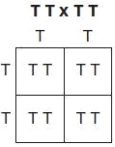
W=white hair
w= non-white hair
If you cross a horse with WW and a horse with ww what fraction of the offspring would be expected to have white hair?
a)
none
b)
3/4
c)
1/2
d)
all
25.
One form of a gene is called_______________
a)
a DNA
b)
a Phenotype
c)
a trait
d)
an allele
26.
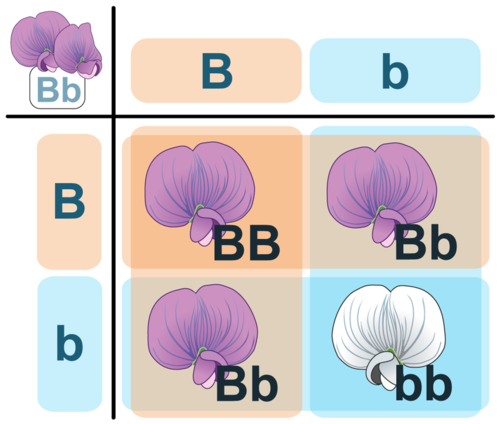
In this punnett square, which is the dominant trait?
The B stands for bud.
a)
purple flower bud
b)
white flower bud
c)
dominant
d)
recessive
27.
Heterozygous is when...
a)
the alleles are the same
b)
the alleles are different
c)
the alleles are absent
d)
the alleles are present
28.
G = green, g = yellow
The genotype for a yellow plant is...
a)
GG
b)
Gg
c)
gg
d)
all of the choices result in yellow
29.
Which of the following alleles is homozygous (purebred) recessive?
a)
Tt
b)
tt
c)
TT
d)
t
30.
The study of heredity and the variation of inherited characteristics 
a)
gene
b)
genetics 
c)
meiosis 
d)
hybrid 
31.
this image is an example of
a)
codominance
b)
dominance
c)
incomplete dominance
32.
this image is an example of
a)
codominance
b)
dominance
c)
incomplete dominance
33.
G = green, g = yellow
The genotype for a yellow plant is...
a)
GG
b)
Gg
c)
gg
d)
all of the choices result in yellow
34.
In a punnet square where are the parent alleles written?
a)
Top and inside the boxes
b)
Only on the left and right side of the boxes. 
c)
outside of the boxes (top and left side)
d)
All on the top side of the boxes
35.

A dominant allele is represented by a ______ letter.

a)

lower-case

b)

capital

36.

A recessive allele is represented by a ______ letter.

a)

lower-case

b)

capital

37.

Blue-eyed is a ______.

a)

genotype

b)

phenotype

38.

Bb is a ______.

a)

genotype

b)

phenotype

39.

In a Punnett square, a lower case letter stands for a ____________ allele.

a)

dominant

b)

recessive

c)

homozygous

d)

heterozygous

40.

Hair color, height, eye color and freckles are examples of human traits. What do we call the physical expression of the genetic material of an organism?

a)

genetics

b)

heredity

c)

genotype

d)

phenotype

41.

In animals, shaggy fur is dominant to short fur. The Punnett Square shows the genotypes of the offspring of a shaggy fur animal and a short fur animal. What were the genotypes of the parents?

a)

FF and FF

b)

Ff and ff

c)

ff and ff

d)

Ff and Ff

42.

In animals, shaggy fur is dominant to short fur. According to the genotypes shown, what percent of offspring will have short fur?

a)

0

b)

25

c)

50

d)

75

e)

100

43.

Which of the following genotypes is homozygous dominant?

a)

A

b)

Aa

c)

AA

d)

aa

44.

Which of the following genotypes is heterozygous?

a)

Bb

b)

BB

c)

bb

d)

B

45.

The genotypes AA and Aa always show up as the __________ phenotype.

a)

dominant

b)

recessive

46.

In plants, tall (T) is dominant to short (t). Perform the following cross: Tt x Tt. What is the probability of producing a short plant?

a)

0%

b)

25%

c)

50%

d)

75%

47.

In a heterozygous genotype, the ___________ allele takes over in the phenotype.

a)

recessive

b)

dominant

48.

T = tall and t = short

In the punnett square shown, what belongs in the missing square

a)

tt

b)

Tt

c)

Bb

d)

TT

49.

Heterozygous is when...

a)

the alleles are the same.

b)

the alleles are different.

c)

the alleles are absent.

d)

the alleles are present.

50.
What ratio of the offspring from the cross shown will be homozygous recessive for the trait of tallness? 
a)
0 in 4
b)
1 in 4
c)
2 in 4
d)
4 in 4
51.
Which of the following alleles is homozygous (purebred) recessive?
a)
Tt
b)
tt
c)
TT
d)
t
52.

If a black guinea pig (BB) and a white guinea pig (bb) mate, there is a ______ chance that a white guinea pig will be born.

a)

0%

b)

25%

c)

50%

d)

75%

e)

100%

53.
In mitosis, the two resulting cells are
a)
different from the starting cell and identical to each other.
b)
different from the starting cell and different from each other.
c)
identical to the starting cell and different from each other.
d)
identical to the starting cell and identical to each other.
54.
Mitosis is useful for the creation of new cells which is important for all of the following EXCEPT
a)
organism growth.
b)
repair of damage.
c)
replacement of worn out cells.
d)
generation of gametes.
55.
Have you ever heard of a skin graft? Skin cells can be harvested from one area and be grown in order to help burn victims or other skin injuries. Which process would result in the development of more skin cells in this treatment? 
a)
Mitosis
b)
Meiosis
c)
Crossing Over
d)
Interphase
56.
In meiosis, the four resulting cells are 
a)
identical to the starting cell and different from each other.
b)
different from the starting cell and different from each other. 
c)
identical to the starting cell and identical to each other.
d)
different from the starting cell and identical to each other.
57.
This picture shows which process? 
a)
mitosis
b)
meiosis
c)
the cell cycle
58.
Fruit fly body cells have 8 chromosomes. After mitosis, you would expect a resulting fruit fly daughter cell to have ...
a)
16 chromosomes.
b)
46 chromosomes.
c)
8 chromosomes.
d)
4 chromosomes.
59.
What is it called when a sperm and egg meet?
a)
meiosis
b)
fertilization
c)
cell division
d)
mitosis
60.
What causes genetic variation in meiosis?
a)
chromosomes lining up
b)
crossing over of chromosomes
c)
separation of chromosomes
d)
chromosomes pulling apart
61.
A male shark has 40 chromosomes in each of its sex cells. How many would be present in its body cells?
a)
20
b)
40
c)
80
d)
160
62.
The cells produced via meiosis are called:
a)
sex cells
b)
somatic cells
c)
body cells
d)
skin cells
63.
If a body cell in a butterfly contains 24 chromosomes, a butterfly egg would contain
a)
3
b)
6
c)
12
d)
24
64.
When a cell divides in mitosis, what do we call the 2 new cells?
a)
mother cells
b)
father cells
c)
daughter cells
d)
son cells
65.
In which type of cells will mitosis occur?
a)
egg cells
b)
sperm cells
c)
jail cells
d)
Body cells except the sperm and egg cells
66.
Before cells can divide, what must be copied?
a)
mitochondria
b)
cytoplasm
c)
DNA
d)
Cell Wall
67.
The cells produced via meiosis are called:
a)
sex cells (gametes)
b)
somatic cells
c)
body cells
d)
skin cells
68.
After meiosis is complete how many cells will there be?
a)
1
b)
2
c)
3
d)
4
69.
Why is sexual reproduction better than asexual reproduction?
a)
It gives an advantage to organisms to be different than the rest, if the environment changes.
b)
It is better for all organisms to be the same.
c)
It happens faster.
d)
It helps skin cells divide faster to heal wounds.
70.
When you start with 1 cell, at the end of mitosis, how many identical cells will you have?
a)
1
b)
2
c)
3
d)
4
71.

Which process does the picture show and what type of cells are produced?

a)

mitosis, gametes

b)

mitosis, body cells

c)

meiosis, gametes

d)

meiosis, body cells

72.

If the body cells in cats have 38 chromosomes, how many chromosomes will be in the sperm cells of a cat?

a)

76

b)

19

c)

38

d)

you cannot tell

73.
Which of the following does NOT describe meiosis?
a)
sexual reproduction
b)
reduction division
c)
increases genetic variation
d)
produces identical copies
74.
Which is the best definition of DNA?
a)
a spiral ladder
b)
something in your cells
c)
the recipe for making an organism
75.
What percentage of chromosomes are handed down by a sperm cell?
a)
75%
b)
25%
c)
50%
d)
100%
76.
After meiosis is complete, the new cells:
a)
are all identical
b)
are all different
c)
are half identical and half different
d)
are all stretched out
77.
Humans have how may chromosomes ?
a)
112
b)
46
c)
8
d)
67
78.
Human eggs and sperm are _____, and each has ____ chromosomes.
a)
diploid, 23
b)
diploid, 46
c)
haploid, 23
d)
haploid, 46
79.
Most of the cells in the human body are produced by
a)
mitosis
b)
meiosis
80.
Why do we need meiosis?
a)
To double the number of chromosomes going into sex cells
b)
To halve the number of chromosomes going into sex cells
c)
To triple the number of chromosomes going into sex cells
d)
To not change the number of chromosomes going into sex cells
81.
The physical appearance of an organism based on traits
a)
Genotype
b)
Phenotype
c)
Meiosis
d)
Genetics
82.
The allele combinations
a)
genetics
b)
mitosis
c)
genotype
d)
phenotype
83.
Hair colour is an example of
a)
genotype
b)
phenotype
84.
Having the genes for baldness is an example of
a)
genotype
b)
phenotype
85.
How tall you are is an example of
a)
genotype
b)
phenotype
86.
Alternative forms of a gene are called
a)
Alleles
b)
Homozygous
c)
DNA
d)
Genetics
87.

Variation in the cells/organisms produced...

a)

Mitosis

b)

Meiosis

88.

Chromosomes are made from protein and what other molecule?

a)

Ammonia

b)

ATP

c)

DNA

d)

Carbon Dioxide

89.

How many pairs of chromosomes are in a human being?

a)

23

b)

44

c)

89

d)

72

90.

Where are chromosomes found in a cell?

a)

In the neutron of the cell.

b)

In the nucleus of the cell.

c)

In the proton of the cell.

d)

In the cell membrane of the cell.

91.

If we were to look inside a normal male bone cell, how many total chromosomes would we find?

a)

1

b)

2

c)

23

d)

46

92.

Why is DNA important?

a)

it is very small and very complicated

b)

it's in everything

c)

it serves as the blueprint for traits of all living things

d)

because we eat it every day for energy