

Wayground logo

Free Printable Worksheets

Font size

S
M
L
XL
Worksheets

Tides and Gravity

Total questions: 49

Worksheet time: 49mins

Name
Class
Date
1.

A[n] ___________ tide occurs when the sun, Earth, and the moon are inline.

a)

spring

b)

high

c)

low

d)

neap

2.
What type of tides would this arrangement of earth-moon-sun create?
a)
neap tide
b)
spring tide
c)
new moon tide
d)
full moon tide
3.
What type of tide would this arrangement of earth-moon-sun create?
a)
full moon tide
b)
new moon tide
c)
neap tide
d)
spring tide
4.
What causes tides?
a)
gravity
b)
wind
c)
spring
d)
neap
5.

What is a high tide?

a)

Sea pulled TOWARD the moon where Earth is CLOSEST to the moon

b)

Sea pulled AWAY from the moon where Earth is FARTHEST to the moon

c)

Sea pulled AWAY from the moon where Earth is CLOSEST to the moon

6.
Tides are caused by
a)
strong winds that blow over ocean waters.
b)
the interaction of Earth, the moon and the sun.
c)
the shifting of the plates on the ocean floor.
d)
variations in the salinity of ocean water
7.

You visited the beach at 12 pm (lunchtime) and it is low tide. If you return 6 hours later, what tide will you see?

a)

high

b)

low

c)

none

d)

spring

8.
The Moon has a greater influence on Earth tides than the Sun because...
a)
it is smaller than the Sun
b)
it revolves around the Earth
c)
it is closer to the Earth
9.

_______are daily changes in ocean water.

a)

Waters

b)

Tides

c)

Colors

d)

Earths

10.
What moon phases occur with spring tides?
a)
New moon and first quarter
b)
First and third quarter
c)
New and full moon
d)
Full moon and third quarter
11.
What type of tide is represented in the picture?
a)
Neap tide because of the tidal bulges
b)
Spring tide because the sun and moon are working together pulling on Earth.
c)
Spring tide because of where the Earth is in its orbit.
d)
Neap tide because the sun and moon provide opposite forces on the Earth.
12.
Why do we have tides here on Earth?
a)
We have tides because of how the moon's gravity pulls on different parts of the Earth.
b)
We have tides because the Earth's oceans move.
c)
We have tides only because of the sun's gravity pulling on Earth.
d)
We have tides because of how the Earth revolves around the sun.
13.

Which type of tide is represented in the picture?

a)

Neap because the sun and moon are working opposite each other.

b)

Neap because of the tidal bulges.

c)

Spring because the sun and moon are lined up and working together.

d)

Spring because that is where the Earth is its orbit.

14.

What moon phases occur with neap tides?

a)

New and full moon

b)

First and new moon

c)

Third and full moon

d)

First and third quarter

15.
Spring tides are the highest of the high and lowest of the low tides we see on Earth. They are extreme
a)
True
b)
False
16.
An object in motion will continue in motion unless acted upon by an outside force is ______________.
a)
tides
b)
gravity
c)
eclipses
d)
inertia
17.

Gravity is the force by which a planet or other body draws objects toward its center. The force of gravity keeps all of the planets in orbit around the sun. What does the force of gravity depend on?

a)

mass and weight

b)

weight and speed

c)

mass and distance

d)

speed and distance

18.

The rotation is responsible for what we call _________; the tilt on the axis influences the ________.

a)

a day; a year

b)

a day; seasons

c)

a year; seasons

d)

a day; the phases of the moon

19.

Both the Moon and the Sun influence the tides on Earth. The moon has a much greater influence though. Why is that?

a)

because the Sun is much less dense

b)

because the Sun is gaseous, not solid

c)

because the Sun is so far away from Earth

d)

because the Sun is less massive than the Moon

20.

As the planets have larger orbits, what happens to their orbital speed around the sun?

a)

The larger planets further from the sun have greater orbital speeds.

b)

The orbital speeds remain the same regardless of distance from the sun.

c)

The orbital speeds of the planets decreases as they get further from the sun.

d)

The orbital speed depends on numerous factors not just distance from the sun.

21.

If Earth were not tilted on its axis, what change would we experience?

a)

Day length would be less than 24 hours.

b)

Both sides of the moon would be visible.

c)

Temperatures would be constant year round.

d)

The length of the year would be more than 365 days.

22.

Large tides, called spring tides, are experienced in the Earth's oceans when the moon is in position

a)

A

b)

B

c)

A and C

d)

B and D

23.

The temperature around Earth's equator stays about the same throughout the year. Why does this happen?

a)

The temperature around Earth's equator stays about the same throughout the year. Why does this happen?

b)

The equator receives less direct sunlight during the year.

c)

The equator receives about the same amount of sunlight all year long.
d)

The equator receives about the same amount of sunlight all year long.

24.
Who said that falling objects fall at the same rate?
a)
Galileo
b)
Kepler
c)
Brahe
d)
Copernicus
25.
Gravity attracts all objects towards one another.
a)
False
b)
True
c)
It depends
d)
I don't care
26.
Any object with mass is surrounded by a gravitational field.
a)
True
b)
Sometimes
c)
False
d)
Never
27.
The force of gravity is also known as
a)
Mass
b)
Weight
c)
Distance
d)
Acceleration
28.
As distance between two objects increase the pull of gravity 
a)
Increases
b)
Decreases
c)
Stays the same
29.
The force of gravity acting on an object is the object's ______.
a)
mass
b)
matter
c)
weight 
d)
terminal velocity 
30.
Who said that falling objects fall at the same rate?
a)
Galileo
b)
Kepler
c)
Brahe
d)
Copernicus
31.
Gravity attracts all objects towards one another.
a)
False
b)
True
c)
It depends
d)
I don't care
32.
Any object with mass is surrounded by a gravitational field.
a)
True
b)
Sometimes
c)
False
d)
Never
33.
The force of gravity is also known as
a)
Mass
b)
Weight
c)
Distance
d)
Acceleration
34.
As distance between two objects increase the pull of gravity 
a)
Increases
b)
Decreases
c)
Stays the same
35.
The force of gravity acting on an object is the object's ______.
a)
mass
b)
matter
c)
weight 
d)
terminal velocity 
36.
Which of the following will not change in different gravitational fields?
a)
weight
b)
force
c)
mass
d)
pounds
37.
An object is falling but is not accelerating. What do you know?
a)
Gravity is stronger than air resistance
b)
Air resistance is stronger than gravity
c)
Air resistance is equal to gravity
d)
Forces are unbalanced
38.
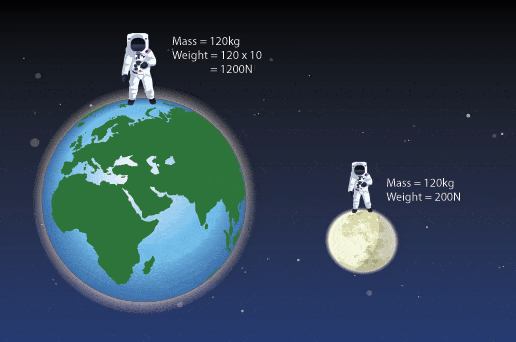
Where would you have to travel to reduce your weight but not lose any mass?
a)
The moon
b)
The Sun
c)
Jupiter
d)
Saturn
39.
Both of these are measured in Netwons
a)
Force and acceleration
b)
Force and weight
c)
Mass and weight
d)
Mass and acceleration
40.
When does a falling object experienced balanced forces?
a)
Terminal velocity
b)
During free fall
c)
When it first starts to fall
d)
Just before it hits the ground
41.
This FORCE pulls things.  It PULLS things into orbit around the sun. 
a)
Newton
b)
gravity
c)
weight
d)
path
42.
A person would weigh more on Jupiter than on the Earth because . . .
a)
Jupiter has more mass, and therefore more gravity
b)
Jupiter has less mass, and therefore more gravity
c)
Jupiter has more mass, and therefore less gravity
d)
Jupiter has less mass and therefore less gravity
43.
A person weighs _____ on the Earth than they do on the Moon. 
a)
less
b)
more
c)
the same
44.
Gravity on Mars’ surface is much lower than it is here on Earth. This is because the mass of mars is ______ than Earth.
a)
less
b)
more
c)
the same
45.
What is the SI unit used to measure force? 
a)
pounds 
b)
grams 
c)
newtons 
d)
kg/ m2
46.
A person would weigh more on Jupiter than on the Earth because . . .
a)
Jupiter has more mass, and therefore more gravity
b)
Jupiter has less mass, and therefore more gravity
c)
Jupiter has more mass, and therefore less gravity
d)
Jupiter has less mass and therefore less gravity
47.
A person weighs _____ on the Earth than they do on the Moon. 
a)
less
b)
more
c)
the same
48.
Gravity on Mars’ surface is much lower than it is here on Earth. This is because the mass of mars is ______ than Earth.
a)
less
b)
more
c)
the same
49.
Most of the Universe is _____
a)
filled with planets
b)
filled with stars
c)
filled with gas and dust
d)
pretty empty
