
 Worksheets
Early Earth, Darwin and endosymbiosis, cladograms/phylogeny
Total questions: 60
Worksheet time: 1hrs 6mins
how well an organism can survive and reproduce in its environment
fossil
fitness
inherited trait
the principle that, among the range of inherited trait variations, those contributing to reproduction and survival will most likely be passed on to succeeding generations
fitness
natural selection
evolution
a group of organisms that are closely related and can mate to produce fertile offspring
population
crowd
species
body part that is similar in function as a body part of another organism but is structurally different
analogous structure
homologous structure
vestigial structure
study of the distribution of organisms around the world
herpetology
biogeography
evolution
the gradual change in a species over time
natural selection
evolution
adaptation
inherited characteristic that increases an organism's chance of survival
adaptation
evolution
fitness
difference, variety; a condition of having many different types or forms
homologous
vestigial
diversity
structures that have different mature forms in different organisms but develop from the same embryonic tissues
vestigial structure
analogous structure
homologous structure
the formation of new and distinct species in the course of evolution.
speciation
special
adaptation
differences in physical traits of an individual from the group to which it belongs
adaptation
variation
homologous structure
remnant of a structure that may have had an important function in a species' ancestors, but has no clear function in the modern species.
homologous structure
analogous structure
vestigial structure
have the ability to interbreed.

Endosymbiotic Theory is the idea that ______ cells could have evolved from_____cells
prokaryotic, eukaryotic
eukaryotic, animal
prokaryotic, plant
eukaryotic, prokaryotic
How did one type of prokaryote get inside of another type of prokaryote
Acts as a ligand
One engulfed the other
Fused in as a vesicle
snuck in as a retrovirus
Early bacteria that could make its own energy evolved into
Mitochondria
Chloroplast
ATP
ADP
Early bacteria that could perform photosynthesis evolved into
Mitochondria
Chloroplast
ATP
ADP
Eukaryotic cells can have
Only chloroplast
Only mitochondria
both mitochondria and chloroplast
neither chloroplast nor mitochondria
Evidence for endosymbiosis includes
Mitochondria and Chloroplast are the same color
Mitochondria and Chloroplast are the same size
Mitochondria and Chloroplast are the same structure
Mitochondria and Chloroplast have the same pH
Evidence for endosymbiosis includes
Mitochondria and chloroplast have their own Lysosomes
Mitochondria and chloroplast have their own vesicles
Mitochondria and chloroplast have their own RNA
Mitochondria and chloroplast have their own DNA
Mitochondria and Chloroplast are similar to prokaryotic cells like bacteria in what way?
They have the same lifespan
They divide the same way
They are the same color
They have the same shape
Mitochondria and Chloroplast are similar to prokaryotic cells like bacteria in what way?
Their DNAs are copies of each other
Their DNAs both have uracil
Their DNAs are circular
Their DNAs both have short lifespans
What is an endosymbiont?
The process of creating energy inside of a cell
An organism that lives inside another organism
An ancient water bacteria that killed a strain of Irish potatoes
The event in which nutrients are oxidized and turned into CO2
Why do mitochondria and chloroplasts have DNA in them?
They were once prokaryotic cells.
They produce their own DNA through photosynthesis.
They receive the DNA from the nucleus.
They process the DNA of the cell.
What did the host cell receive from its endosymbiont (cell living inside of it)?
Shelter
Energy
Motility/movement
Reproduction
What did the endosymbiont (cell living inside another) receive from its host cell?
Shelter
Motility
Energy
Reproduction
Put these events in time order:
Event A: colonization of land
Event B: multicellular eukaryotes
Event C: single-celled eukaryotes
Event D: prokaryotes
A, B, C, D
B, C, D, A
D, C, B, A
D, C, A, B
Geological changes on Earth MOST impacts
the creation and destruction of habitats for living things
the carbon cycle
how rock breaks down
the process of photosynthesis
How can volcanoes change Earth's surface?
They can cause continents to break apart
They can add new crust to the ocean floor
They can cause warm shallow seas to form
When most of the major groups of animals first appear in the fossil record.
Law of Superposition
The Great Dying
Great Cambrian Explosion
Era
Events in Earth's crust that were the result of violent or sudden changes.
Uniformitarianism
Law of Superposition
Catastrophism
The Great Dying
Early Autotrophs were most likely?
chemosynthetic
photosynthetic
abiotic
Multicellular
What is the significance of the Ediacaran organisms?
They are absolutely without a doubt the ancestors to modern animals.
They are the first multi-cellular organisms that ever lived on Earth.
They evolved the predator-prey ecological relationship.
What group of organisms replaced dinosaurs after their extinction?
Insects
Mammals
Amphibians
Squids
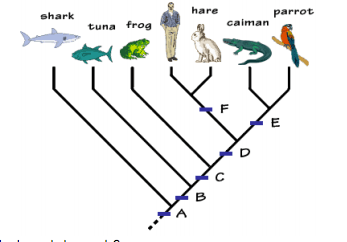
On the cladogram, which organism is the closest relative of the parrot?
Frog
Hare
Caiman
Parrot
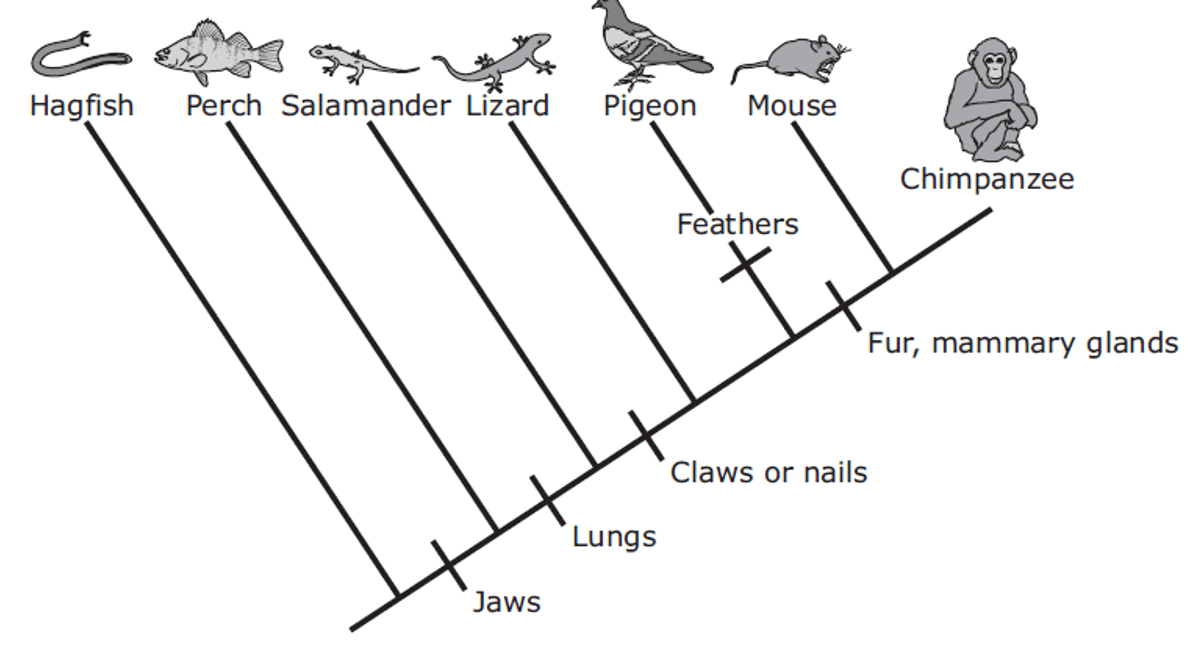
All the animals to the right of the salamander would have the common characteristic of...
Fur
Claws or nails
Lungs
Jaws
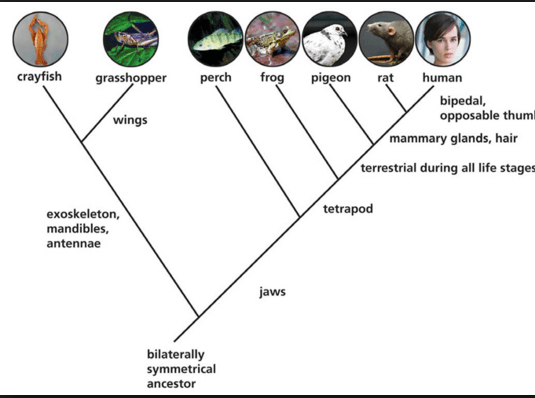
According to the cladogram, which organism is most distantly related to the human?
crayfish
grasshopper
perch
frog

The lizard has all these derived characteristics EXCEPT
Jaws
Lungs
Bipedal

What is the common ancestor of Letters A, B, C, D, E?
1
2
3
What is the purpose of a cladogram?
To map the ancestral relationships and shared traits of different organisms.
To trace the inherited traits of a single species over time.
To check the likelihood of an offspring having a particular trait.
To monitor mutations that arise among different populations.

What do both the squirrel and lion have in common that the other animals do not?
They are both vertebrates
They both have lungs
They are both mammals
They both lose their canine teeth.

