
 Worksheets
Relative and Absolute Dating
Total questions: 55
Worksheet time: 2hrs 48mins
States that younger rocks lie above older rocks if the layers have not been disturbed
superposition
cross-cutting
unconformity
uniformitarianism
A break in the geologic record that is made when rock layers are ERODED over a long period of time
superposition
relative dating
unconformity
cross-cutting
What is the law of superposition?
The age of sedimentary rock not found in the original layers.
Metamorphic rock is younger than the nearby igneous rock.
Sedimentary rock in it's original position is older than layers above it.
Metamorphic rock is older because it was deposited to nearby sedimentary rock.

Analyze the seashell found in the white layer. Which statement is true of the rock layer that contains this fossil?
It could also contain a fossil from the bottom layer.
It is older than the layers below it.
It is younger than the layers above it.
It is older than the layers above it.

What are the relative ages of the features in order from oldest to youngest?
Limestone, Basalt, Fault, Siltstone
Siltstone, Fault, Basalt, Limestone
Limestone, Fault, Basalt, Siltstone
Limestone, Siltstone, Fault, Basalt

Which rock layer in the diagram seems to be the oldest?
F
B
E
A

According to the law of superposition, which layer is the youngest?
F
B
E
A

Which of the following is the oldest?
Layer L
Intrusion H
Intrusion D
Layer E
How does sedimentary rock usually form?
Vertically
Folding
Diagonally
Horizontally

Layer B on side #1 (left) is a match to which layer on side #2 (right)?
z
y
w
there is no match

Is intrusion V older or younger than layer W?
younger
older

What is the correct order of the rock layers from oldest to youngest?
B, C, D, E, A
E, D, C, B, A
A, B, C, D, E
B, C, D, A, E

What is the correct order of the rock layers from oldest to youngest?
F, E, C, B, A, D
F, E, D, C, B, A
A, B, C, D, E, F
D, F, E, C, B, A
What law states that any geologic feature that cuts across other layers is younger than layers it cuts across?
Law of superpostion
Law of layers
Law of inclusion
Law of crosscutting

Layer D on site #1 (left) is a match to which layer on site #2 (right)?
z
y
w
there is not a match
Unstable atoms that decay (change) and are considered radioactive
Isotope
Half-Life
Absolute Dating
Radiometric Dating
Length of time for half the atoms of an isotope to decay
Isotope
Half-Life
Radiometric Dating
Absolute Dating
Scientists use radiometric dating (radioactive decay) to measure...
relative time (dating)
absolute time (dating)
half-lives
time of day

By saying "my dad is 48 and I am 13", it would be...
relative dating (time)
absolute dating (time)
law of superposition
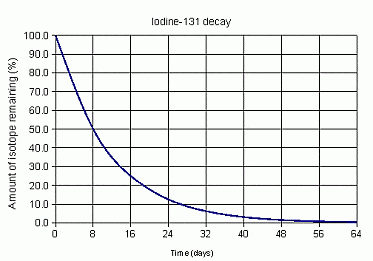
The % of the parent isotope remaining after 2 Half Lives.
50%
25%
12.5%
6.25%
The % of the parent isotope remaining after 1 Half Life.
50%
25%
12.5%
6.25%
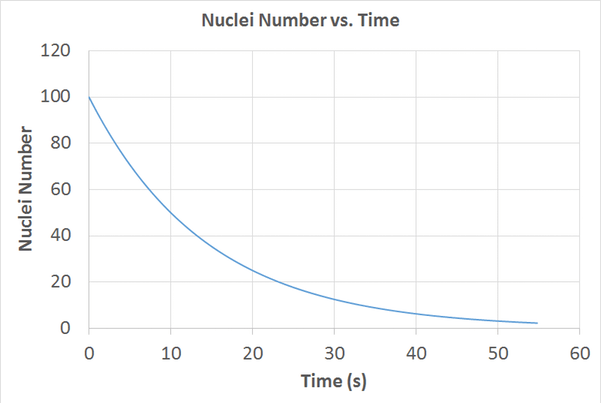
What is the Half life of this isotope?
5 seconds
10 seconds
15 seconds
20 seconds
What is the half life of Carbon-14?
5730 yrs
1.2 billion years
713 million years
1.3 billion years


a fossil found in a narrow time range but widely distributed around the earth; used to date rock layers.
Petrified
Mold
Cast
Index
Trace Fossil
If you will study the relative age of a rock layer, which indicator below is the more appropriate to use?
The thickness of the layer
The chemical makeup of the layer
The distance of the layer extends over the Earth
The position of the layer compared to other layers
Where do the oldest rocks found in an undisturbed rock profile?
at the bottom
in the middle
on the top
anywhere
Radiometric dating is used to estimate how geologic rocks are formed and infer the ages of fossils contained within those rocks. In which of the given rocks is Radiometric dating least useful?
basaltic
granitic
metamorphic
sedimentary
The element that is the product of radioactive decay is known as the...
daughter element
half-life
parent element
carbon-14
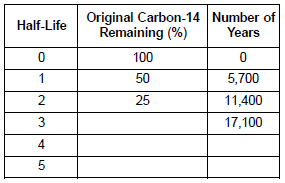
After 22,800 years, approximately what percentage of the original carbon-14 remains?
15%
12.5%
6.25%
3.125%
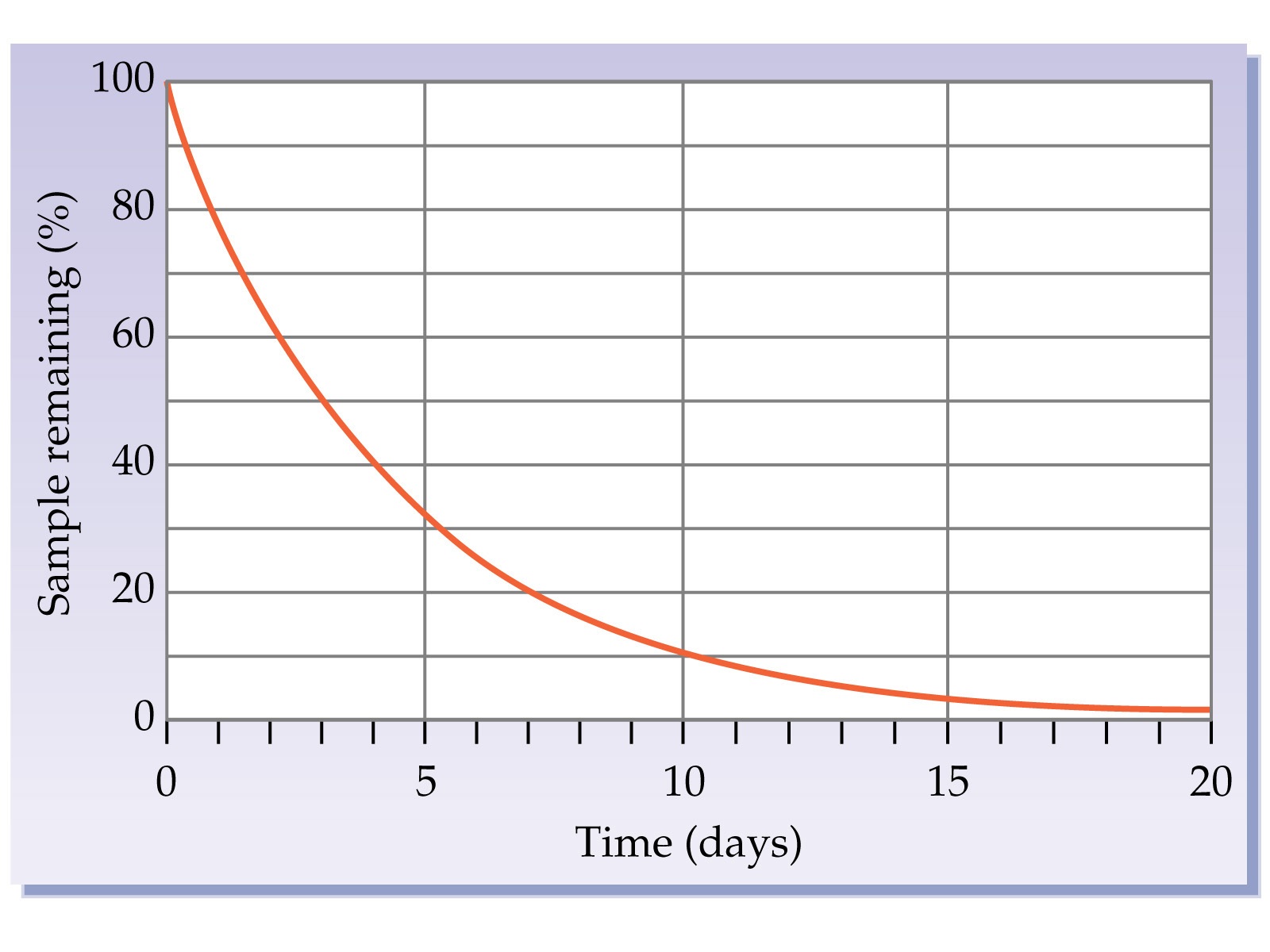
What is the Half Life of this isotope?
3 days
5 days
8 days
10 days

The solid black sections of the bars on the graph represent the percentages of
carbon-14 from the original sample that has not decayed
lead-206 decay product resulting from the radioactive decay
nitrogen-14 decay product resulting from the radioactive decay
uranium-238 from the original sample that has not decayed

