wayground logo

Free Printable Worksheets

Font size

S
M
L
XL
Worksheets

BIOL 1215 Chapter 9

Total questions: 97

Worksheet time: 1hrs 24mins

Name
Class
Date
1.

Simon looks at an image of a slide and notices that all of the chromosomes are lined up in along the middle of the cell. He is likely looking at a cell that is in

a)

prophase

b)

metaphase

c)

anaphase

d)

telophase

2.

Which statement best describes chromosomes?

a)

They carry out cellular respiration

b)

They consist of the pigment chlorophyll

c)

Their structure is only visible during interphase

d)

They consist of tightly coiled strands of DNA and proteins

3.

What is different between how plant and animal cells use the cell cycle?

a)

Plant cells use the cell cycle for energy, while animal cells use the cell cycle for sugar.

b)

Plant cells are able to complete the cell cycle without using O2, but animals can not.

c)

Plant cells create a cell plate since they are very rigid.

d)

Animal cells create a cell plate since they are very flexible.

4.

During which phase of mitosis does cytokinesis begin?

a)

prophase

b)

metaphase

c)

anaphase

d)

telophase

5.
What is the cell cycle?
a)
The gradual development of something, especially from a simple to a more complex form.
b)
The study of heredity and the variation of inherited characteristics.
c)
The branch of biology that deals with the relations of organisms to one another and to their physical surroundings.
d)
The series of events that take place in a cell leading to its division and duplication of its DNA to produce two daughter cells.
6.
What happens in the first part of Interphase?
a)
Mitosis
b)
Cell Growth
c)
DNA Replication
d)
Anaphase
7.
What part of the cell cycle results in the splitting of the new cells?
a)
Interphase
b)
Mitosis
c)
Metaphase
d)
Cytokinesis
8.
True or False. 
After a cell goes through cytokinesis, it starts mitosis all over again.
a)
True
b)
False
9.
What phase is this cell in?
a)
Cytokinesis
b)
Mitosis
c)
Prophase
d)
Metaphase
10.
What phase is this cell in?
a)
Mitosis
b)
Interphase
c)
Anaphase
d)
Telophase
11.
What phase is this cell in?
a)
Mitosis
b)
Cytokinesis
c)
Prophase
d)
Telophase
12.
What phase is this cell in?
a)
Mitosis
b)
Interphase
c)
Prophase
d)
Telophase
13.
What part of the cell cycle is this cell in?
a)
Mitosis
b)
Interphase
c)
Telophase
d)
Cytokinesis
14.
In what phase does chromatin condense to form chromosomes?
a)
Mitosis
b)
Interphase
c)
Prophase
d)
Anaphase
15.
In what phase do the chromosomes get pulled apart into sister chromatid to opposite sides of the cell?
a)
Prophase
b)
Interphase
c)
Metaphase
d)
Anaphase
16.
During what phase of the cell cycle does the cell prepare for mitosis?
a)
G1 phase
b)
S phase
c)
G2 phase
d)
M phase
17.
During what phase of the cell cycle does the cell grow?
a)
G1 phase
b)
S phase
c)
M phase
d)
Cytokinesis
18.
Put the following stages of the cell cycle in order: G2, S, G1, M. 
a)
G1, S, G2, M
b)
S, G1, G2, M
c)
G1, M, G2, S
d)
M, G1, S, G2
19.
Put the following in order: G2, G1, S, mitosis, cytokinesis. 
a)
G1, G2, S, Mitosis, cytokinesis
b)
G1, S, G2, Mitosis, cytokinesis
c)
G1, G2, S, cytokinesis, mitosis
d)
G1, S, G2, cytokinesis, mitosis
20.
Put the following actions in order: DNA replicates, cell grows, cell divides, cell prepares for mitosis. 
a)
DNA replicates, cell grows, cell prepares for mitosis, cell divides
b)
cell grows, cell prepares for mitosis, DNA replicates, cell divides
c)
cell grows, DNA replicates, cell prepares for mitosis, cell divides
d)
DNA replicates, cell prepares for mitosis, cell grows, cell divides
21.
Why would it be important to replicate DNA before a cell divides in mitosis or meiosis?
a)
In order for genetic information to be transferred into daughter cells.
b)
In order for the cell to be able to increase in size.
c)
In order for the DNA to be contained in the nucleus.
d)
In order for the cell to re-order the DNA sequencing in the new cells.
22.
Uncontrollable cell growth is known as _____
a)
Obesity
b)
Cancer
c)
Diabetes
d)
Hepatitis
23.

Cancer creates abnormal cells by disrupting

a)

The rate of transition through the cell cycle

b)

Red blood cell formation

c)

DNA replication

d)

ATP synthesis

24.

Name the phase:

a)

Prophase

b)

Metaphase

c)

Anaphase

d)

Telophase

25.

Which of the following is a difference between sexual and asexual reproduction?

a)

regeneration is exclusive to sexual reproduction

b)

asexual reproduction occurs only in haploid organisms

c)

sexual reproduction includes the development of unfertilized eggs

d)

sexual reproduction is more likely to increase the chance of genetic variation than is asexual reproduction

26.

Most prokaryotic organisms reproduce mainly by the process of

a)

regeneration

b)

binary fission

c)

budding

d)

production of spores

27.

Sister chromatids are

a)

found only when a cell is not actively dividing

b)

tightly linked together at the centromere

c)

formed when chromatids separated during cell division

d)

made only of DNA

28.

When a eukaryotic cell is not dividing, its genetic material can be found in the form of very long thin fibers called

a)

chromatin

b)

chromosomes

c)

the nucleolus

d)

RNA

29.

During prophase of mitosis, each chromosome of a eukaryotic cell consists of a pair of identical structures called

a)

chromatid

b)

sister chromosomes

c)

DNA transcript

d)

sister chromatids

30.

The diploid chromosome compliment of human somatic cell consists of how many chromosomes?

a)

14

b)

23

c)

46

d)

58

31.

Eukaryotic cells spend most of their cell cycle in which phase?

a)

interphase

b)

prophase

c)

metaphase

d)

anaphase

32.

The process by which the cytoplasm of a eukaryotic cell divides to produce two cells is called

a)

mitosis

b)

cytokinesis

c)

binary fission

d)

telophase

33.

If the S-phase was eliminated from the cell cycle, the daughter cell would

a)

have half the genetic material found in the parental cell

b)

be genetically identical

c)

be genetically identical to the parent cell

d)

synthesize the missing genetic material on their own

34.

The phase of mitosis during which the nuclear envelope fragments and the nucleoli disappear is called

a)

interphase

b)

prophase

c)

metaphase

d)

telophase

35.

Which of the following is likely to account for the differences between plant cell and animal cell cytokinesis?

a)

plant cells lack microfilaments needed for cleavage furrow

b)

animal cells lack chloroplasts

c)

plant cell division must maintain the integrity of the cell wall

d)

plant and animal cells do not have a common ancestor

36.

The cell cycle control system

a)

receives messages from the outside of the cell that influence cell division

b)

triggers and controls major events in the cell cycle

c)

is influenced by growth factors that bind to cell receptors

d)

all of the above

37.

Which of the following is NOT a function of mitosis in humans?

a)

repair of wounds

b)

growth

c)

production of reproductive cells

d)

multiplication of body cells

38.
Which of the following explains why a cell's size is limited?
a)
a. volume increases faster than surface area
b)
b. surface area increases faster than volume
c)
c. homeostasis is disrupted by a cell that is too large
d)
d. both a and c are correct
39.
As a cell grows, its ___ increases more than its ___.
a)
length, volume
b)
width, surface area
c)
volume, surface area
d)
none of these
40.
the football shaped structure consisting of thin fibers
a)
spindle
b)
centromere
c)
chromatid
d)
chromosome
41.
sequence
a)
C,D, B, A, F, E
b)
D,A,F,C,E,B
c)
B,E,C,F,A,D
d)
C,B,D,A E,F
42.
A student view onion cells under a microscope and notices the cells are reproducing by mitosis.
Which hypothesis is supported by this?
a)
the cells all have the same chromosomes
b)
the cells each have a unique genetic make-up
c)
the cells produce identical gametes
d)
the cells split to form stem cells
43.

Undifferentiated cells that can become one or more specialized types of cell are called_________

a)

Stem Cells

b)

Somatic Cells

c)

Body Cells

d)

Zygotes

44.

What is a gene?

a)

A section of DNA with instructions for making a protein

b)

A section of DNA with instructions for making a carbohydrate

c)

One nucleic acid chain that codes for DNA

d)

One protein chain that codes for DNA

45.

How are the centromere and telomere different?

a)

The centromere is the center of the chromosome, the telomeres are the ends

b)

The centromere is at the ends of the chromosomes, the telomere is at the center

c)

The centromere is larger than the telomere

d)

The telomere is larger than the centromere

46.

Centrioles form _______ during Prophase

a)

Spindle Fibers

b)

Chromosomes

c)

Sister Chromatids

d)

Chromatin

47.

What is the end result of mitosis?

a)

2 identical body cells

b)

2 gametes

c)

2 zygotes

d)

2 different body cells

48.

Why do cells remain small in size? (Select ALL that apply)

a)

Maintain high surface area to volume ratio

b)

More energy efficient

c)

Easier to destroy if something goes wrong

d)

Smaller cells divide quicker

49.

What is the role of protein kinases?

a)

remove phosphate groups to deactivate enzymes

b)

trigger apoptosis

c)

add phosphate groups and energy to activate enzymes

d)

stop the cell cycle

50.
Which description is true about cell cycle regulation?
a)
Changing concentrations of Cdk result in binding to cyclin
b)
Changing concentrations of cyclin result in binding to Cdk
c)
MPF complex formation decreases with increased Cdk levels
d)
MPF complex formation decreases with increased cyclin levels
51.

In which stage of the cell cycle are cells most susceptible (likely to experience) to mutations?

a)

G1

b)

S

c)

G2

d)

G0

52.

Which of the following correctly describes cells that are in the G0 phase?

a)

Mature nerve and muscle cells are unable to divide and are permanently in G0.

b)

Many cells enter G0 when they reach the checkpoint during the M phase.

c)

Cells in G0 are growing and preparing for cell division.

d)

DNA replication occurs during G0.

53.
The graph represents the amount of DNA in the nucleus of each cell during the cell cycle.
Which region represents the G2 phase?
a)
I
b)
II
c)
III
d)
IV
54.
The graph represents the amount of DNA in the nucleus of each cell during the cell cycle.
Which region represents the G2 phase?
a)
I
b)
II
c)
III
d)
IV
55.
How does the concentration of cyclin dependent kinases (Cdk) change as the cell proceeds through the cell cycle?
a)
Cdk concentration remains constant.
b)
Cdk concentration increases during interphase and decreases during mitosis.
c)
Cdk concentration decreases during interphase and increases during mitosis.
d)
Cdk concentration correlates directly with MPF concentration.
56.
What phase is  shown in the picture?
a)
anaphase 1
b)
anaphase 2
c)
metaphase 1
d)
telophase 1
57.
The process of crossing over occurs in what phase of meiosis?
a)
anaphase 1
b)
prophase 1
c)
prophase 2
d)
telophase 1
58.
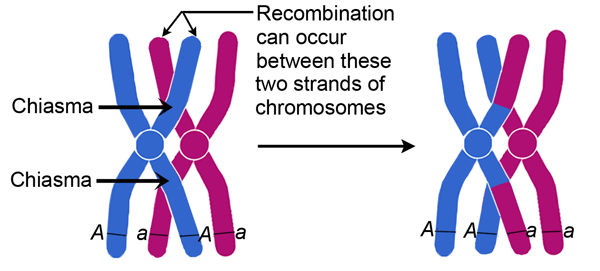
This image shows chromosomes during Prophase 1. Which of the following correctly describes the process shown?
a)
segregation of sister chromatids
b)
condensation and segregation of alleles
c)
mutationin which the DNA content of the gene is altered
d)
crossing - over in which alleles are exchanged
59.
What phase is shown here?
a)
Prophase II
b)
Metaphase I
c)
Metaphase II
d)
Anaphase I
60.
What phase is shown here?
a)
Metaphase II
b)
Telophase I
c)
Telophase II
d)
Metaphase I
61.
What phases is shown here?
a)
Prophase II
b)
Prophase I
c)
Anaphase II
d)
Interphase I
62.
What phase is shown here?
a)
Telophase II
b)
Anaphase II
c)
Metaphase I
d)
Interphase I
63.
What phase is this?
a)
Interphase II
b)
Prophase I
c)
Metaphase I
d)
Anaphase II
64.
Asexual reproduction and mitosis occur in...
a)
Body Cells
b)
Sex Cells or Gametes
65.
How many daughter cells are produced at the end of meiosis?
a)
1
b)
2
c)
3
d)
4
66.
How many chromosomes are in the new cells of meiosis?
a)
46
b)
23
67.
What is one reason why we need meiosis?
a)
To double the number of chromosomes going into sex cells
b)
To halve the number of chromosomes going into sex cells
c)
To triple the number of chromosomes going into sex cells
d)
To not change the number of chromosomes going into sex cells
68.
What is one of the advantages, of reproducing sexually versus asexually?
a)
survival of the fittest
b)
overproduction
c)
genetic variation
d)
cloning
69.

If the diploid number of carrots is 18, the haploid number is

a)

18

b)

9

c)

27

d)

36

70.

The chromosomes that pair up during meiosis, are called __________ chromosomes.

a)

heterozygous

b)

haploid

c)

homologous

d)

diploid

71.
Meiosis makes sperm and egg cells. In humans, sperm and egg cells each have _____ chromosomes. Therefore a fertilized human egg cell (sperm and egg cell combined) would create a cell with _____ chromosomes.
a)
23, 46
b)
46, 23
c)
2, 4
d)
50, 100
72.

At the end of mitosis you have _____ cells.

a)

identical

b)

different

c)

identical twins

d)

variety

73.

The products of meiosis are genetically...

a)

different.

b)

identical.

74.

What are homologous chromosomes?

a)

Pairs of chromosomes with different genes on each.

b)

Pairs of chromosomes with the same genes on each.

c)

Pairs of chromosomes with no genes.

d)

Pairs of chromosomes with the wrong genes on each.
75.
Why is meiosis important for sexual reproduction? 
a)
It allows the zygote formed from fertilization to have triple the chromosome number of the organism. 
b)
It allows gametes to have twice the original number of chromosomes of the organism.
c)
It allows gametes to have half the original number of chromosomes of the organism.
d)
It allows the zygote formed from fertilization to have half the original number of chromosomes of the organism.
76.
How would the DNA in a horse muscle cell compare with the DNA in a horse sperm cell?
a)
The sperm cell would have twice the DNA as the muscle cell.
b)
The sperm cell would have half as much DNA as the muscle cell.
c)
The sperm cell and muscle cell would contain the same amount of DNA.
d)
The muscle cell would have four times the DNA as the sperm cell.. 
77.
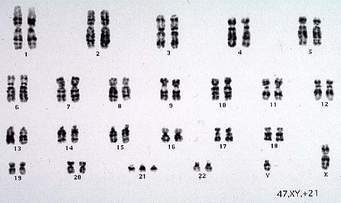
a)
This karyotype shows Trisomy 21
b)
This karyotype has no abnormality
c)
This karyotype is missing a sex chromosome (monosomy x)
d)
This karyotype is from a gamete
78.
Based on the Karyotype shown, at which chromosome pair can we identify a genetic disorder? 
a)
Chromosome pair 5
b)
sex chromosomes
c)
Chromosome pair 21
d)
There are no chromosomal disorders
79.
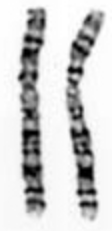
A pair of identical chromosomes shown in a karyotype, one inherited from mom, and one inherited from dad are called
a)
sister chromotids
b)
centromeres
c)
homologous chromosomes
d)
autosomes
80.

What would you call the failure of one or more pairs of homologous chromosomes or sister chromatids to separate normally during meiosis?

a)

nondisjunction

b)

anaphase I

c)

nondiploidy

d)

karyotype

81.
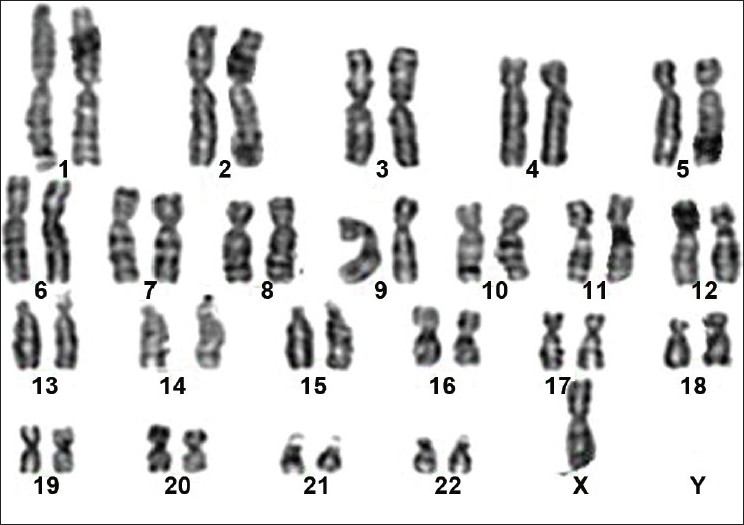
Determine the sex of the individual whose karyotype is displayed in the image.
a)
female
b)
male
82.
Determine the sex of the individual whose karyotype is displayed in the image.
a)
female
b)
male
83.
Which structure is labeled as B in the diagram?
a)
Centromere
b)
Chromosome
c)
Sister chromatids
84.
Which structure is labeled as A in the diagram?
a)
Centromere
b)
Chromosome
c)
Sister chromatids
85.
A sperm contains
a)
Both an X and a Y chromosome
b)
Two X chromosomes
c)
An X OR a Y chromosome
d)
only a Y chromosome
86.
An egg contains
a)
22 autosomes and an X chromosome
b)
22 autosomes and an Y chromosome
c)
44 autosomes and 2 X chromosomes
d)
44 autosomes and an X and a Y chromosome
87.

Chromosome pairs 1-22 are referred to as

a)

sex chromosomes

b)

sister chromatids

c)

a karyotype

d)

autosomes

88.
Klinefelter's Syndrome has the karyotype notation of 
a)
47XX+21
b)
47XXY
c)
45XO
d)
44XX
89.
A person with Turner syndrome has only one X chromosome. This means one of their gametes was missing a chromosome.
Which of the following is why gametes sometimes lack a complete chromosome?
a)
Incomplete dominance
b)
Nondisjunction
c)
Inversion mutation
d)
Substitution mutation
90.
A male shark has 40 chromosomes in each of its sex cells. How many would be present in its body cells?
a)
20
b)
40
c)
80
d)
160
91.
Where do mutations occur?
a)
DNA and RNA
b)
DNA 
c)
RNA
d)
mRNA and tRNA
92.

Name the mutation that happens when an extra base has been added to the sequence of bases.

a)

Substitution

b)

Deletion

c)

Inversion

d)

Insertion

93.
When one base replaces another, this is a common type of mutation called what?
a)
Insertion
b)
Substitution
c)
Inversion
d)
Deletion
94.

Deletion

a)

A

b)

B

c)

C

95.

Substitution

a)

A

b)

B

c)

C

96.

Insertion

a)

A

b)

B

c)

C

97.

Occurs when the DNA change does not alter the amino acid sequence of the polypeptide.

a)

Frameshift Mutation

b)

Insertion

c)

Missense mutation

d)

Silent Mutation