
 Worksheets
NGSS Bio/Earth Final Exam Semester 1
Total questions: 86
Worksheet time: 2hrs 0mins

What is the carrying capacity of the graph?
1000
8000
800
600
This may cause a population to increase
increase of food supply
removal of predators
removal of disease
all of these

The largest number of individuals that an environment can support long term is...
carrying capacity
emigration
immigration
population density

Something that regulates the size of a population is called...
a limiting measure
a limiting factor
carrying capacity
biodiversity
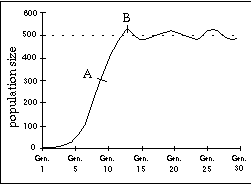
What is the carrying capacity of the graph?
around 500
more than 800
less than 300
around 700
When death rate is equal to birth rate...
population increases
population decreases
population stays the same.
population rapidly increases then becomes stable
When the death rate rises and the birth rate lowers...
population increases
population decreases
population stays the same
all of these
When birth rate is high and death rate is low...
population increases
population decreases
population stays the same
all of these
What is the carrying capacity of the graph?
1000
8000
800
600
This may cause a population to increase
increase of food supply
removal of predators
removal of disease
all of these


If the carrying capacity of a predator decreases, what will happen to the carrying capacity of the prey?
Will Increase
Will Decrease
Will stay the same

The graph to the right shows the interaction of the wolf and moose populations on Isle Pekie. If the moose population continues to increase, the wolves' food supply will increase. What will most likely happen to the wolf population as a result?
It will decrease.
It will increase.
It will remain the same.
A scientist was studying a population of fish in a pond over a period of 10 years. He observed that
the population increased each year for 3 years, and then remained nearly constant for the rest of
the study. The best explanation for this observation is that the population had
stopped reproducing
reached carrying capacity
mutated into a different species
run out of food and all died
What are factors that affect carrying capacity?
Biotic only
Biotic and abiotic
Depends on the ecosystem
Abiotic only
What is interdependent relationship?
A condition that occurs when two or more organisms compete for the same resources within an ecological community
All the biotic and abiotic factors and the interactions among them in a given area
The maximum number of organisms an ecosystem can support
A relationship in which two organisms are mutually dependent on each other for survival

Which statement best describes the predator-prey relationship displayed on this graph?
There is no relationship between the predator and prey.
When the prey population increases, the predator population decreases.
When the prey population increases, the predator population increases.
when the predator population increases, the prey population increases.
Which of the following is a biotic factor that would affect the carrying capacity of a population?
Soil
Predator
Rainfall
Sunlight
What are factors that affect carrying capacity?
Biotic only
Biotic and abiotic
Depends on the ecosystem
Abiotic only
What is carrying capacity?
A condition that occurs when two or more organisms compete for the same resources within an ecological community
A relationship in which two organisms are mutually dependent on each other for survivial
All the biotic and abiotic factors and the interactions among them in a given area
The maximum number of organisms an ecosystem can support
What is ecosystem?
A condition that occurs when two or more organisms compete for the same resources within an ecological community
All the biotic and abiotic factors and the interactions among them in a given area
The maximum number of organisms an ecosystem can support
A relationship in which two organisms are mutually dependent on each other for survival
A condition that occurs when two or more organisms compete for the same resources within an ecological community
Interdependent Relationship
Carrying Capacity
Competition
Ecosystem
Which statement best describes the term limiting factors?
All the biotic and abiotic factors and the interactions among them in a given area
A finite resource organisms in an ecosystem require
The biotic and abiotic factors in an ecosystem
The maximum number of organisms an ecosystem can support
All of the organisms of one species living in the same area.
Individual
Population
Community
Ecosystem
Leveling off of the population after the maximum number the environment can support has been reached.
Exponential
Carrying capacity
Linear
Negative
Which of the following would likely be a limiting factor to a population?
Abundance of food
Living near a water source
Presence of a natural predator
Multiple sources for shelter
When rabbits were introduced to Australia, they began to breed exponentially. However, over time their population has begun to decrease due to a limiting factor.
What is most likely the limiting factor in this situation?
Abundant space to breed and live
No available predator in the area
Rabbits choosing not to mate to conserve space
Lack of available food
Which of the following demonstrates population growth when there is limited available water in an area?


Habitat availability increases for a population. How would the carrying capacity of the prey change?
The carrying capacity would increase as more resources become available.
Carrying capacity occurs independent of factors in the environment.
The carrying capacity would decrease as more resources became available.
The carrying capacity is set in an environment and cannot change.

When Yellowstone National Park was created in the late 1800s, wolves were on the decline. The last wolves in Yellowstone were killed in 1926, but in the 1800s, there were between 100-160 wolves in the park. In 1995, gray wolves were reintroduced to the park.
Which graph (drawn in red) below shows a prediction of how the population would change if there was less water available in the ecosystem?


There would be no change to carrying capacity.
carrying capacity is
the number of organisms in an environment
factors that limit population size
the smallest population an environment can support
the largest population an environment can support

According to the graph, what is causing the deer population to decrease
They got sick
The wolf population is decreasing
The wolf population increased
They ran out of food

Predator population lags behind prey population because......
Increase in predators leads to decrease in prey
Increase in predators leads to increase in prey
Increase in predators leads to decrease in producers
Increase in producers leads to increase in prey
What is the carrying capacity of the graph?
1000
8000
800
600
Where is the Serengeti located?
Near the equator, Africa
Near the equator, Asia
Near the poles, Africa
Near the poles, Asia

What Serengeti grazer is this?
Wildebeest
Cape Buffalo
Kudu
Impala

What happens if a population grows past its carrying capacity?
The population keeps growing
The population starts to die off
The entire species will go extinct
The carrying capacity just increases
What is the carrying capacity of the graph?
around 500
more than 800
less than 300
around 700

In this graph we see a population increasing, then ____ as it reaches _____.
increasing more; the top of the graph
leveling off; a lack of food
leveling off; carrying capacity
increasing; for more food

What happened to the buffalo population in the Serengeti between 1960 an 1975
Increased
Decreased
Stayed the same

What continent is the Serengeti located on?
North America
Asia
Africa
Antartica

What happened to the buffalo population in the Serengeti between 1975 and 2000
Increased
Decreased
Stayed the same
Which country is the Serengeti located in?
Tanzania
South Africa
Cameroon
Ghana
What is one animal that you were surprised to find out lived in the Serengeti?
Identify the climate in a grassland.
dry and hot
wet and cold
dry and cold

The Savanna Biome is mostly made up of what?
Trees
Water
Sand
Grass
the variety of life in the world or in a particular habitat or ecosystem
biodiversity
demography
carrying capacity
poaching
The Serengeti ecosystem is a geographical region in Africa, spanning northern Tanzania.
true
false
What do we call a group of organisms of the same species?
population
ecosystem
trophic level
community
Where do wildebeests primarily live?
Amazon Rainforest
Serengeti plains of southeastern Africa
Australian Outback
Siberian Tundra

What do you call an organism that kills another organism for food?
producer
predator
consumer
herbivore
54-63.
Answer the questions below after watching the video
What triggers the wildebeest migration in the Serengeti?
Changes in the weather
Nightfall
Availability of water
Predator movements
Which river do the wildebeests face during their migration?
Mississippi River
Mara River
Amazon River
Nile River
What is the main reason newborn wildebeests are vulnerable to predators?
They are too noisy
They are slow and weak
They are left alone
They are too small
What strategy do female wildebeests use to increase the survival chances of their calves?
Teaching calves to swim early
Hiding their calves in bushes
Migrating to safer areas
Timing births to result in many calves at once
What adaptive strategy do wildebeests use to protect their calves?
Camouflage
Rapid movement
Flooding the area with many births at once
Building shelters
How do termites contribute to the Serengeti ecosystem?
By building mounds that regulate temperature
By scaring away predators
By pollinating flowers
By hunting smaller insects
How do dung beetles benefit the Serengeti ecosystem?
By providing food for birds
By cleaning up waste
All of the above
By aerating the soil
Which animals play a crucial role in maintaining the balance of the Serengeti ecosystem?
Crocodiles and hippos
Elephants and lions
Giraffes and zebras
Dung beetles and termites
What major challenge do wildebeests face at the Mara River?
Strong currents
Crocodiles
Polluted water
Steep banks
What is the outcome of the wildebeest's river crossing?
None are able to cross
Many are eaten by crocodiles
All wildebeests survive
Only young wildebeests cross
What does the term "biodiversity" mean?
different plants in an ecosystem
variety of life in an area
different animals in an ecosystem
humans causing harm
Why did humans decide to make the Serengeti a national park?
protect herds and to preserve them for the future
protect the water supply
provide homes for people
provide a game reserve
Select all that apply: What is an example of a component within an ecosystem?
the Hoh river water
labels
an alligator eating a turtle
phytoplankton within Lake Michigan
Which migratory heard animal is responsible for the Serengeti National Park? This animal was also the reason they changed the boundaries of the park?
Giraffes
Wildebeest
Zebras
Lions
Select all that apply: What are the criteria that humans should consider when deciding to step in and save an ecosystem? (why pick one ecosystem over another?)
Lots of Biodiversity
Endangered Animals in the Area
Valuable Resources
Land with cultural significance
Select all that apply: An ecosystem includes?
Animals
Plants
All living things
The habitat/physical environment
How are ecosystems protected?
Laws
The use of park rangers to protect the area
Open availability to humans without regulation
Limited unsupervised human access
Human decision-making has NO effect on ecosystems.
True
False
What does abiotic mean?
Living
Non-living
What does biotic mean?
living
non-living
What does conservation mean?
Protect and Preserve
Harm
Discard
observe and evaluate
Select all that apply: What were humans doing in the Serengeti Ecosystem before it was created?
Hunting animals for sport
Visiting to help preserve the environment
Locals did not want to leave the ecosystem
Select all that apply: What are potential conservation criteria to look for when choosing an area to conserve/protect and possibly make into a Nationally protected park?
Abundance of Resources
Cultural Significance
Lack of significant resources
Minimal/very little Life (Animal/Plants)
Select all that apply: How do the Wildebeests migrate?
In a circle
Monthly
Weekly
They do not
Which of the following is NOT a necessary factor in creating a model?
Pictures
Components
Interactions
Boundaries
The Serengeti National Park encompasses the entire Serengeti ecosystem?
True
False
The variety of life within an ecosystem is called
The variety of organisms found in a particular ecosystem.
Biodiversity
Symbiosis
Population
Community
Ecosystems are made up of....
abiotic factors only
biotic and abiotic factors
air and nutrients only
Non-living things only
The current extinction event is being caused by
a meteor strike.
an alien invasion.
the increasing amount of hydrogen sulfide gas.
human activities.
Which of the following is NOT a human impact that affects the environment negatively?
Recycling
Water pollution
Air pollution
Deforestation
The study of the environment is called
Ecology
Science
Chemistry
Between 1960 and 1975 the population of buffalo in the Serengeti was doing what?
Migrating
Remaining stable
Increasing
Decreasing
Where is the Serengeti located?
Near the equator, Africa
Near the equator, Asia
Near the poles, Africa
Near the poles, Asia
Which predator did we use in our study to determine if they affected buffalo populations?
Lions
Tigers
Bears
Oh Mys
Based on our study, which of the following are migratory animals?
Bison
Buffalo
Water buffalo
Wildebeest
Migration can help an organism survive because?
There are no predators on the migration.
They can move based on food availability.
They can travel for the seasons.
Tourism doesn't happen in the same locations as the migration.
Carrying capacity can be on graphs by?
Locating the greatest increase
Locating any change
Determining where the line is horizontal
Determining where the line is vertical
Can't be seen on graphs
What Serengeti grazer is this?
Wildebeest
Cape Buffalo
Kudu
Impala
What is the most common precipitation?
sleet
freezing rain
snow
rain
What happens if a population grows past its carrying capacity?
The population keeps growing
The population starts to die off
The entire species will go extinct
The carrying capacity just increases
What is the carrying capacity of the graph?
around 500
more than 800
less than 300
around 700

