
Font size
 Worksheets
Forces and Newton's Laws of motion
Total questions: 50
Worksheet time: 44mins
A force is a _______ or _______ on an object.
pull
touch
push
motion
Two equal forces acting in opposite directions on an object
Inertia
Balanced Force
Push
Unbalanced Force
Forces are measured in:
Inertia
Grams
Tons
Newtons
The tendency for an object's motion to remain unchanged:
Newton's 3rd Law
Unbalanced Force
Gravity
Inertia
The sum (total) of all forces acting on an object:
Unbalanced Force
Balanced Force
Newtons
Net Force
The greater the mass of an object, the more force it will take to accelerate the object.
Newton's 1st Law of Motion
Newton's 2nd Law of Motion
Newton's 3rd Law of Motion
An object in motion will stay in motion until acted on by an unbalanced force. An object at rest will stay at rest until acted on by an unbalanced force.
Newton's 1st Law of Motion
Newton's 2nd Law of Motion
Newton's 3rd Law of Motion
For every action, there is an equal and opposite reaction
Newton's 1st Law of Motion
Newton's 2nd Law of Motion
Newton's 3rd Law of Motion
The result of a push or pull on an object:
Force
Motion
Inertia
Speed
Only one force can act on an object at a time.
True
False
A force must be physically touching an object in order to act on it.
True
False
A lamp sitting on a table is demonstrating Newton's ___ Law.
1st
2nd
3rd
4th
A force that causes an object to slow down when it touches another object is _________.
gravity
friction
inertia
Newton
Newton's 2nd Law says the acceleration of an object depends on its _______ and ______. (Choose two answers)
force or applied force
weight
gravity
mass
if an object stays still or continues moving at the same speed and in the same direction, it is a _______ force.
weak
strong
balanced
unbalanced

What will be the effect on the boy in the picture if the driver stops quickly?
Because of inertia he will remain in the same position.
He will be pushed back into the car seat.
He will move from one side of the car seat to the other.
He will move forward pressing against the seatbelt.
Sitting at the top of a steep hill on a roller coaster (not moving), is an example of:
Acceleration
Inertia
Speed
Velocity
According to Newton’s second law of motion, force is equal to mass times ______________________.
inertia
weight
acceleration
direction

The picture is an example of Newton's...
1st Law
2nd Law
3rd Law
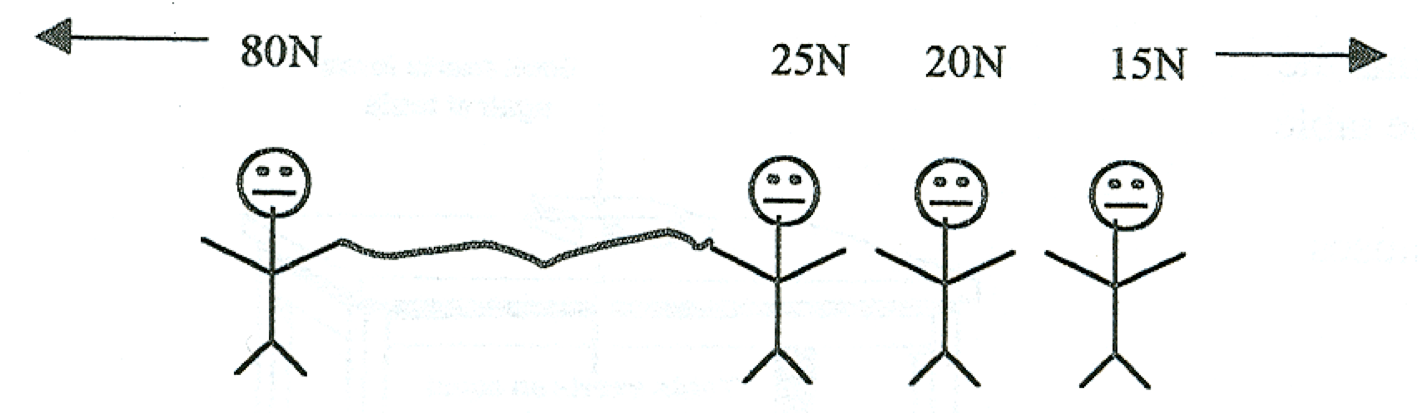
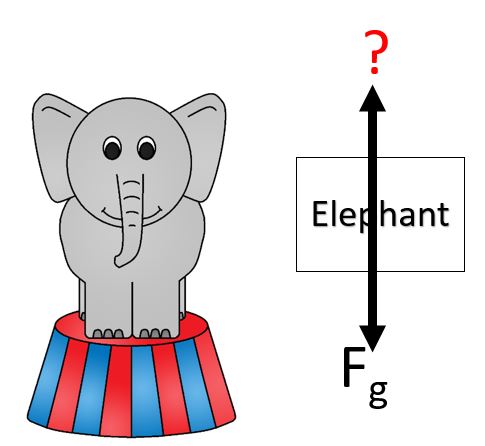
A force exerted by a surface perpendicular to the surface.
Normal
Friction
Gravity
Tension
A pulling force exerted along a rope, string, wire, cable...
Friction
Gravity
Normal
Tension
The gravitational attraction between an object and the Earth.
Friction
Weight
Normal
Tension
A swimmer pushes backward on the water in order to move forward. This is an example of Newton's ________ Law.
1st
2nd
3rd
A shopping cart accelerates more slowly when full. This is an example of Newton's ________ Law.
1st
2nd
3rd
Inertia is proportional to the ______ of an object.
Mass
Weight
Force
Velocity
What happens to the mass of an object if you double the force pushing on it?
Mass will remain the same.
Mass will double in magnitude
Mass will decrease to 1/2 of its original.
Mass will decrease to 1/4 of its original.
Football A has a greater mass than football B. Which football will have greater acceleration when both are thrown with the same force in the same direction?
Football A
Football B
They will have the same acceleration
Mass has no effect on acceleration
A box is placed on a table which rests on the floor. The box pushes on the table; the reaction force to the box's push on the table is the table's push on the floor.
True
False
You are in a train traveling on a horizontal track and notice that a piece of luggage starts to slide directly toward the front of the train. From this observation, you can conclude that this train is
speeding up.
slowing down.
changing direction.
speeding up and changing direction.
slowing down and changing direction.

You push on box G that is next to box H, causing both boxes to slide along the floor, as shown in the figure. The reaction force to your push is
the push of box G on box H.
the push of box H on box G.
the push of box G against you.
the upward force of the floor n box G.
the acceleration of box G.
An object accelerates 2 m/s2 when a force of 12 newtons is applied to it. What is the mass of the object?
24 kg
20 kg
5 kg
6 kg
An object with a mass of 5 kg has a force of 40 newtons applied to it. What is the resulting acceleration of the object?
2 m/s2
8 m/s2
0.5 m/s2
6 m/s2
An object with a mass of 5 kg has a force of 20 newtons applied to it. What is the resulting acceleration of the object?
2 m/s2
8 m/s2
4 m/s2
6 m/s2

