wayground logo

Free Printable Worksheets

Font size

S
M
L
XL
Worksheets

Cell Bio Quiz

Total questions: 153

Worksheet time: 2hrs 53mins

Name
Class
Date
1.

What is the main purpose of the cell membrane?

a)

regulation of what enters and leaves

b)

protection of the cell

c)

Keeps the cell's surface clean

d)

destroys viruses

2.

What is the other name for the Cell Membrane?

a)

Phospholipid Bilayer

b)

Fluid Mosaic Model

c)

Fluidity Mural Model

d)

Phospholipid Layer

3.

Why is membrane called the Fluid Mosaic Model?

a)

The Phospholipids can move laterally like the flow of water

b)

It is permeable to water and all other liquids

c)

Its not called the Fluid Mosaic Model

d)

It was credited to be similar to Pablo Picasso's murals

4.

Which portion of the Phospholipid is Hydrophobic?

a)

Head

b)

tail

c)

whole structure

d)

It's all hydrophilic

5.

What does ampipathic mean?

a)

containing both hydrophobic and hydrophilic regions

b)

containing both hydrophobic regions

c)

similar to be water like or not

d)

similar to acting like oil

6.

What is the difference between peripheral and transmembrane proteins?

a)

Peripheral = on top of bilayer

Transmembrane = on the bottom of bilayer

b)

Peripheral = goes through the membrane

transmembrane = on top of the membrane

c)

Peripheral = on top and bottom of the membrane

transmembrane = goes through the whole membrane

d)

Peripheral = top of the membrane

transmembrane = no such thing as integral proteins

7.

Can Hydrophobic molecules go through the membrane

a)

Yes

b)

No

8.

Can hydrophilic molecules go through the membrane?

a)

Yes

b)

No

c)

It can but not so easily

9.

Can ions go through the membrane?

a)

No

b)

Yes

10.

Main differences between active and passive transport?

a)

Passive: Low to High

Active: Hight to Low

b)

Passive: High to Low

Active: Low to high

c)

Passive: does not require ATP

Active: ATP is required

d)

Passive: ATP is required

Active: does not require ATP

11.

Diffusion is a form of...

a)

Active Transport

b)

Passive Transport

12.

Which of the following is NOT a type of passive transport?

a)

Osmosis

b)

Diffusion

c)

Endocytosis

d)

Facilitated Diffusion

13.
Diffusion is the movement of molecules from
a)
an area of equilibrium to an area of high concentration.
b)
an area of low concentration to an area of high concentration.
c)
an area of high concentration to an area of high concentration.
d)
an area of high concentration to an area of low concentration.
14.

The movement of water through a semi-permeable membrane is called ___________.

a)

active transport

b)

respiration

c)

osmosis

d)

diffusion

15.

Which type of movement requires cellular energy?

a)

osmosis

b)

active transport

c)

diffusion

d)

facilitated diffusion

16.
What type of transport is this?
a)
Endocytosis
b)
Exocytosis
c)
Diffusion
d)
Sodium-Potassium Pump
17.
What type of transport is this?
a)
Endocytosis
b)
Diffusion
c)
Exocytosis
d)
Osmosis
18.
What type of organelle is used during endocytosis and exocytosis?
a)
Endoplasmic Reticulum
b)
Golgi Body
c)
Vesicle
d)
Lysosome
19.

Which type of transport can get rid of cellular wastes?

a)

Protein Pumps

b)

Endocytosis

c)

Exocytosis

d)

Facilitated Diffusion

20.

Which type of transport uses protein channels to help the particles move across the cell membrane?

a)

endocytosis

b)

osmosis

c)

facilitated diffusion

d)

exocytosis

21.

Which of these solution types has the highest concentration of solute particles?

a)

Hyptonic

b)

Isotonic

c)

Hypertonic

22.

In which solution will water move into a cell?

a)

Hypertonic

b)

Hypotonic

c)

Isotonic

d)

Equilibrium

23.
Which cell is placed into a hypotonic environment? 
a)
A
b)
B
c)
C
d)
D
24.

In the given scenario, what will happen? An egg with a dissolved shell is placed in pure water for 48 hours.

a)

Water will move in and out of the cell equally, and the cell with neither shrink nor swell.

b)

The egg will gain water and swell.

c)

The egg will lose water and shrink.

25.
 An animal cell placed in a hypertonic (salty) solution will
a)
Stay the same
b)
Shrink- get smaller
c)
Swell- get bigger
26.

Ideally, your cells should be in a(n) _______ solution to maintain equilibrium.

a)

isotonic

b)

hypertonic

c)

hypotonic

d)

isometric

27.

What is Phagocytosis?

a)

Eating

b)

Drinking

c)

A cell taking in a large object that it will eventually digest

d)

The act of grabbing some liquid

28.

One type of Phagocytosis is endocytosis?

a)

True

b)

False

29.

What is the process of drinking?

a)

Phagocytosis

b)

Pinocytosis

c)

Cellular respiration

d)

Photosynthesis

30.

What is Pinocytosis?

a)

Eating

b)

Drinking

c)

A cell taking in a large object that it will eventually digest

d)

The act of grabbing some liquid

31.

Basic pinocytosis involves:

a)

A cell taking in very small drops of extracellular fluids

b)

Taking in drops of fluid that are outside of the cell

c)

Is an amoeba eating a bacterium

d)

Is a cell taking in a large object

32.

The process of breaking down a glucose molecule to release energy is called ___________.

a)

Glycogenolysis

b)

Gluconeogenesis

c)

Glycolysis

d)

Hydrolysis

33.

Which of the following biological processes will occur under both aerobic and anaerobic conditions in humans?

a)

Fermentation

b)

Lactation

c)

glycolysis

d)

Citric acid cycle

34.

Glycolysis occur in the ___________ of a cell.

a)

Golgi complex

b)

Mitochondria

c)

Cytosol

d)

ribosomes

35.

How many pyruvate molecules are formed by the glycolysis process of one moelcule of glucose?

a)

One

b)

Two

c)

four

d)

Six

36.

Which of the following products is not created by glycolysis?

a)

ATP

b)

NADH

c)

PYruvate

d)

Lactaic acid

37.
cellular respiration
a)
the chemical reaction between oxygen and glucose that releases energy into cells
b)
the body system that takes in oxygen and releases carbon dioxide
c)
a group of atoms joined together in a particular way
d)
the body system that takes in food and breaks it down
38.
energy
a)
the ability to make things move or change
b)
the chemical reaction between oxygen and glucose that releases energy into cells
c)
the body’s use of molecules for energy and growth
d)
a claim supported by evidence
39.
metabolism
a)
the body’s use of molecules for energy and growth
b)
the chemical reaction between oxygen and glucose that releases energy into cells
c)
a claim supported by evidence
d)
the chemical reaction between oxygen and glucose that releases energy into cells
40.

A --> B + C

a)

Anabolic

b)

Catabolic

41.

A + B --> C

a)

Anabolic

b)

Catabolic

42.

Absorb energy.

a)

Anabolic Pathways

b)

Catabolic Pathways

43.

Simple Molecules --> Complex Molecules

a)

Anabolic Pathways

b)

Catabolic Pathways

44.

The breakdown of glucose molecules to release energy.

a)

Anabolic Pathways

b)

Catabolic Pathways

45.

Protein Synthesis, Photosynthesis, and other Biosynthetic pathways.

a)

Anabolic Pathways

b)

Catabolic Pathways

46.

Where is the energy for most anabolic pathways from?

a)

The Sun

b)

Catabolic Pathways

c)

Enzymes

d)

Increased Temperature

47.
A chemical reaction that builds a larger molecule from two smaller molecules
a)
catabolic
b)
anabolic
48.
A chemical reaction in which a larger molecule is broken down into smaller molecules
a)
catabolic
b)
anabolic
49.

These reactions occur when smaller molecules are bound together to create larger ones.

a)

anabolic reaction

b)

metabolism

c)

competitive inhibitor

d)

catabolic reaction

50.

The type of reaction that occurs when a molecule is broken down by an enzyme.

a)

Denatured

b)

Catabolic reaction

c)

Anabolic Reaction

d)

Decomposition

51.
DNA replication involves unwinding two strands of parent DNA, copying each strand to synthesize complementary strands, and releasing the parent and daughter DNA so now there are two copies of the original strand. Which of the following accurately describes this process?
a)
This is an anabolic process
b)
This is a catabolic process
c)
This is both anabolic and catabolic
d)
This is a metabolic process but is neither anabolic nor catabolic
52.
Which statement is true about the ENTROPY?
a)
Entropy refers to DISORDER, the unusable energy that escapes a system.
b)
Entropy refers to the balance of temperature among two or more systems.
c)
Entropy refers to the average kinetic energy of the molecules.
d)
Entropy refers to the inability to destroy or create energy. 
53.
The first law of thermodynamics is a restatement of the
a)
Zeroth law of thermodynamics
b)
law of heat addition
c)
principle of entropy
d)
conservation of energy
54.
Two identical blocks of iron, one at 10 degrees C and the other at 20 degrees C, are put in contact. Suppose the cooler block cools to 5 degrees C and the warmer block warms to 25 degrees C. This would violate the
a)
first law of thermodynamics.
b)
second law of thermodynamics.
c)
both of the above
d)
none of the above
55.

The energy required to start a chemical reaction is ___.

a)

endothermic

b)

exothermic

c)

activation

d)

released

56.

An _______ reaction is when more energy is released than is absorbed. This energy can be in the form of light, heat, electricity, etc.

a)

endothermic

b)

endergonic

c)

exothermic

d)

exergonic

57.

In a _____ reaction, the products have more energy than the reactants.

a)

exergonic

b)

endergonic

58.

In a _____ reaction, the reactants have more energy than the products.

a)

endergonic

b)

exergonic

59.

An _______ reaction is when more energy is absorbed than is released. This energy can be in the form of light, heat, electricity, etc.

a)

endothermic

b)

endergonic

c)

exothermic

d)

exergonic

60.
What is the function of ATP in living things?
a)
provides energy for cells
b)
stores genetic information
c)
provides structure in the nucleus
61.
Which structures shown in the Figure make up the ADP molecule?
a)
A and B
b)
A, B and C
c)
A, B, C, and D
d)
C and D
62.
What does the "TP" in ATP stand for?
a)
2 phosphates
b)
tri (3) phosphates
c)
Two proteins
d)
tri (3) proteins
63.
Which of the following can be compared to a battery in need of recharging?  (empty wallet)
a)
ADP
b)
ATP
c)
Ribose
d)
Adenosine
64.
What is the function of ATP in living things?
a)
provides energy for cells
b)
stores genetic information
c)
provides structure in the nucleus
65.
What are the parts of the ATP molecule?
a)
adenine, thylakoids, stroma
b)
stroma, grana, chlorophyll
c)
adenine, ribose, phosphate groups
d)
NADH, NAHPH, FADH
66.
Which bond of the ATP molecule is broken in order to release energy?
a)
A
b)
B
c)
C
d)
D
67.
Which structures shown in the Figure make up the ATP molecule?
a)
A and B
b)
A, B and C
c)
A, B, C, and D
d)
C and D
68.
Using the figure, which parts of the molecule must the bonds be broken to form an ADP molecule?
a)
A and B
b)
B and C
c)
C and D
d)
all of the above
69.
Which of the following results in the storage of energy in terms of the ATP/ADP cycle?
a)
The breaking of the bond between the 5-carbon sugar and the 1st phosphate group
b)
The addition of a phosphate group
c)
The removal of a phosphate group
d)
The addition of glucose 
70.
Where is the energy stored in ATP molecules
a)
In the Ribose Sugar
b)
In the Adenine group
c)
In the Phosphate bonds
d)
In the Bank
71.
Connects monomers to form a polymer
a)
Dehydration synthesis
b)
hydrolysis
72.
Breaks up polymers, forming monomers
a)
dehydration synthesis
b)
hydrolysis
73.
Water is used to break bonds between polymers
a)
dehydration synthesis
b)
Hydrolysis
74.
Joins amino acids to form a protein
a)
Dehydration synthesis
b)
hydrolysis
75.
Nucleic Acids breaks up to form nucleotides
a)
Dehydration synthesis
b)
Hydrolysis
76.
The process of removing water in order to form a bond between monomers is called....
a)
Dehydration Synthesis
b)
Hydrolysis
77.
The following figure is illustrating
a)
Dehydration Synthesis
b)
Hydrolysis
78.
The following figure is illustrating
a)
Dehydration Synthesis
b)
Hydrolysis
79.
The following figure is illustrating
a)
Dehydration Synthesis
b)
Hydrolysis
80.
The following figure is illustrating
a)
Dehydration Synthesis
b)
Hydrolysis
81.
Enzymes are considered to be 
a)
Lipids
b)
Carbohydrate
c)
Protein
d)
Nucleic Acid
82.
What is the purpose  of an enzyme?
a)
give permission for the reaction
b)
raise activation energy
c)
speed up reactions
d)
control how many reactions occur
83.
Where do substrates bind on an enzyme?
a)
voltage-gated channels
b)
surface receptor
c)
calcium channels
d)
active site
84.
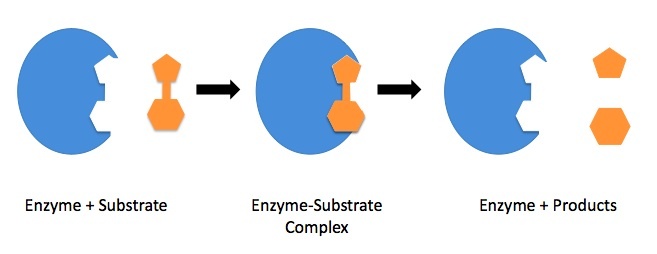
What is structure A?
a)
Substrate
b)
Active site
c)
Enzyme
d)
Products
85.
What 3 letters do enzymes typically end in?
a)
-ose
b)
-ase
c)
-ese
d)
-tic
86.
At 40 degrees Celsius, your biological enzymes will...
a)
Functional optimally
b)
Denature
c)
Wait until the temp. increases
d)
Wait until the temp. decreases
87.
What makes an enzyme substrate specific?
a)
Size
b)
Shape
c)
Name
d)
Location it is found in
88.
The part of the enzyme that the substrate bonds to is called the _____.
a)
active site
b)
activation energy
c)
bond site
d)
peptide bond
89.
What is a substance called if it speeds up a chemical reaction?
a)
reusable
b)
catalyst
c)
specific
d)
fragile
90.
What is indicated by letter A?
a)
enzyme
b)
product
c)
substrate
d)
active site
91.

What is indicated by letter C?

a)

enzyme

b)

product

c)

substrate

d)

active site

92.

What is indicated by letter B?

a)

enzyme

b)

product

c)

substrate

d)

active site

93.
What happens when enzymes are heated to a high temperature?
a)
The enzymes die.
b)
The shapes of the enzyme are altered denature
c)
The enzymes' amino acid sequence changes.
d)
The enzymes remain the same
94.

Can a change in pH alter the active site of an enzyme

a)

yes

b)

no

95.
At 40 degrees Celsius, your biological enzymes will...
a)
Functional optimally
b)
Denature
c)
Wait until the temp. increases
d)
Wait until the temp. decreases
96.
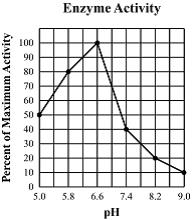
Which of the following conclusions can be drawn from this graph?
a)
The optimum pH of the enzyme is 6.6.
b)
The optimum pH of the enzyme is 5.8
c)
The enzyme’s activity increases as pH increases 5.0 to 9.0
d)
The enzyme’s activity is greater around pH of 8.0 .
97.
Blocking Active site of an enzyme
a)
competitive inhibition
b)
allosteric inhibition
98.
When a molecule can occupy the same active site as the substrate, a situation called __________________ can result
a)
Competitive lnhibition
b)
Allosteric Regulation
c)
Non-Competitive Inhibition
d)
Feedback Inhibition
99.

For the enzyme-catalyzed reaction shown in Figure 6.2, which of these treatments will cause the greatest increase in the rate of the reaction, if the initial reactant concentration is 1.0 micromolar?

a)

doubling the activation energy needed

b)

cooling the reaction by 10°C

c)

doubling the concentration of the reactants to 2.0 micromolar

d)

doubling the enzyme concentration

100.

In Figure 6.2, why does the reaction rate plateau at higher reactant concentrations?

a)

Feedback inhibition by product occurs at high reactant concentrations.

b)

Most enzyme molecules are occupied by substrate at high reactant concentrations.

c)

The reaction nears equilibrium at high reactant concentrations.

d)

The activation energy for the reaction increases with reactant concentration.

101.

What's going on in this picture?

a)

The enzyme is taking the red substrate and turning it blue

b)

The enzyme's active site is blocked by a competitive inhibitor

c)

The enzyme can't function if too many substrates are trying to bind

d)

This is an example of an anabolic enzyme reaction

102.

An activor or inhibitor binding place that is not the active site, causing the enzyme to change conformation (shape) is an example of ...

a)

competative inhibition

b)

allosteric control

c)

optimum conditions

d)

induced fit

103.

Oxidation is the _________ of electrons.

a)

loss

b)

gain

c)

sharing

d)

transfer

104.

Reduction is the ___________ of electrons.

a)

loss

b)

gain

c)

sharing

d)

transfer

105.

What is the correct equation for cellular respiration?

a)

oxygen + sugar -> carbon dioxide + water + Energy

b)

carbon dioxide + sugar + Energy -> carbon dioxide + water

c)

carbon dioxide + water -> oxygen + sugar + Energy

d)

carbon dioxide + water + Energy -> oxygen + sugar

106.

What is important about cellular respiration?

a)

It produces energy from the sun.

b)

It forms sugar.

c)

It transforms sugar into a usable form of energy (ATP)

d)

Only plants perform this process.

107.

What's the chemical formula for glucose?

a)

6C6H12O6

b)

C12H6O12

c)

C6H12O6

d)

CHO

108.

One molecule needed for cellular respiration is

a)

carbon dioxide

b)

glucose

c)

water

d)

chlorophyll

109.

One molecule produced by animals during cellular respiration is

a)

carbon dioxide

b)

glucose

c)

oxygen

d)

chlorophyll

110.
Where does glycolysis take place?
a)
Cytoplasm
b)
Stroma
c)
Thylakoid
d)
Mitochondria
111.
What is the name of the 1st step of cellular respiration?
a)
Glycolysis
b)
Kreb's Cycle
c)
ETC
d)
Anaerobic respiration
112.
This process releases chemical energy from sugars and other carbon-based molecules to make ATP when oxygen is present.
a)
photosynthesis
b)
light-independent reaction
c)
cellular respiration
d)
light-dependent reaction
113.
Glucose is broken down during which process
a)
Krebs cycle
b)
Calvin cycle
c)
Glycolysis
d)
Photosynthesis
114.
Which is not a waste product of cellular respiration?
a)
Water
b)
Heat
c)
Carbon Dioxide
d)
Oxygen
115.

Which statement is true regarding cellular respiration?

a)

The reactants of cellular respiration are identical to the reactants of photosynthesis.

b)

The reactants of cellular respiration are obtained from the products of photosynthesis.

c)

The products of cellular respiration are the same as the products of photosynthesis

d)

Cellular respiration only occurs in autotrophs, photosynthesis occurs only in heterotrophs.

116.

A decrease in the amount of oxygen available will....

a)

not have an effect on the amount of energy produced during cellular respiration

b)

decrease the amount of glucose produced during cellular respiration

c)

cause the amount of water produced during cellular respiration to increase

d)

decrease the amount of energy produced during cellular respiration

117.

Which of the following structure is where cellular respiration (Kreb's Cycle and Electron Transport Chain) occurs in the cell?

a)

nucleus

b)

cytoplasm

c)

mitochondria

d)

vacuoles

118.

What type of respiration requires oxygen?

a)

Aerobic

b)

Anaerobic

119.

How many ATP are produced in aerobic respiration?

a)

2

b)

33

c)

4

d)

36

120.
Where does the Krebs Cycle take place?
a)
mitochondria
b)
chloroplast
c)
cytoplasm
d)
nucleus
121.

Where does Glycolysis occur inside the cell? (first step in the overall process)

a)

Cytoplasm

b)

Mitochondria

c)

Chloroplast

d)

Nucleus

122.

Which stage of the cellular respiration process produces the most ATP?

a)

Glycolysis

b)

Acetyl CoA

c)

Kreb's Cycle

d)

Electron Transport Chain

123.
Fermentation involves
a)
aerobic respiration
b)
anaerobic respiration 
124.
Fermentation is cellular respiration without which molecule?
a)
CO2
b)
O2
c)
C6H12O6
125.
When respiration occurs with oxygen, it is called _______
a)
anaerobic
b)
aerobic
c)
light-dependent
d)
fermentation
126.

What are the waste products from fermentation? (Choose all that apply)

a)

starch

b)

carbon dioxide

c)

glucose

d)

alcohol

127.
How are lactic acid and alcoholic fermentation similar?
a)
They have the same products
b)
They have the same reactants
c)
They both require oxygen
d)
They occur in the same organisms
128.
After intense activity, your muscles feel sore because of 
a)
the accumulation of NAD+
b)
the accumulation of lactic acid 
c)
the accumulation of ATP
d)
the accumulation of carbon dioxide
129.

In the electron transport chain, Oxygen acts as...

a)

a carrier of electrons, passing electrons down the chain

b)

a reducing agent

c)

the final electron acceptor

d)

a coenzyme

130.

When protons are pumped outside the matrix, across the inner membrane...

a)

water is made

b)

a concentration gradient of H+ ions (protons) is created

c)

NADH gets reduced

d)

CO2 is produced

131.

The electrons that are transferred through the electron transport chain initially belonged to

a)

NADH

b)

FADH2

c)

ATP

d)

Oxygen

e)

NADH and FADH2

132.

The movement of protons (H+ ions) through ATP synthase occurs from the...

a)

matrix to the intermembrane space

b)

matrix to cytoplasm

c)

intermembrane space to the matrix

d)

intermembrane space to the cytoplasm

e)

cytoplasm to the intermembrane space

133.

True or False: Water is produced as a byproduct during this stage of cell respiration.

a)

True

b)

False

134.

The process that enables ATP synthase to function is...

a)

endocytosis

b)

active transport

c)

pinocytosis

d)

osmosis

e)

diffusion

135.

What does FADH2 and NADH bring to the electron transport chain?

a)

Oxygen

b)

Water

c)

Electron

d)

ATP

136.

ATP synthesis by ATP synthase is driven by

a)

H+ movement

b)

electron movement

c)

NADH movement

d)

FADH2 movement

137.

Please indicate the correct equation(s) for Cellular Respiration. (2 answers)

a)

Glucose + Oxygen --> Carbon Dioxide + Water + Energy

b)

C6H12O6 + O2 --> CO2 + H2O + ATP

c)

Carbon Dioxide + Water + Energy --> Glucose + Oxygen

d)

C6H12O6 + 6 O2 --> 6 CO2 + 6 H2O + ATP

138.
The conversion of glucose to two molecules of pyruvate is the result of what process?
a)
the krebs cycle
b)
glycolysis
c)
the electron transport chain
d)
oxidative phosphorylation
139.
What does ATP synthase do?
a)
Create ATP in chemiosmosis.
b)
Break down ATP in chemiosmosis.
c)
Break down NADPH. 
d)
Create NADPH.
140.
What enzyme in the ETC is responsible for generating the ATP molecules?
a)
ATPase
b)
ATP synthase
c)
Hexokinase
d)
none of the above
141.

When protons are pumped outside the matrix, across the inner membrane...

a)

water is made

b)

a concentration gradient of H+ ions (protons) is created

c)

NADH gets reduced

d)

CO2 is produced

142.

Please identify the proper locations for each step of cellular respiration.

a)

Glycolysis = Cytoplasm

b)

Glycolysis = Mitochondria

c)

Citric Acid Cycle = Cytoplasm

d)

Citric Acid Cycle = Mitochondria

e)

Oxidative Phosphorylation = Cytoplasm

143.
Before entering Krebs Cycle, pyruvate is:
a)
Oxidized
b)
Reduced
c)
Isomerized to Acetyl-CoA
d)
Phosphorylated
144.
The number of ATP molecules produced out of Krebs Cycle is:
a)
2
b)
3
c)
4
d)
0
145.
How many FADH2 molecules are produced by 1 molecule of glucose?
a)
1
b)
2
c)
3
d)
4
146.
How many FADH2 molecules are produced by 1 turn of the Krebs Cycle?
a)
1
b)
2
c)
3
d)
4
147.
How many NADH molecules are produced by a molecule of glucose through the Krebs' Cycle?
a)
2
b)
3
c)
4
d)
6
148.
Which of the following is not a requirement for the Krebs Cycle?
a)
NAD+
b)
FAD+
c)
Water
d)
Pyruvate
149.
How many CO2 molecules are produced by the Krebs Cycle for a molecule of glucose?
a)
2
b)
4
c)
6
d)
3
150.
Krebs Cycle takes place in the:
a)
Cytoplasm
b)
Matrix
c)
Ribsome
d)
InterMembrane Space
151.
Krebs Cycle is part of_______________ respiration.
a)
Aerobic
b)
Anaerobic
152.
Prior to entering the Krebs Cycle, each pyruvate molecule loses electrons, hydrogen ions, and a carbon, forming an energy-rich molecule of
a)
Acetyl-CoA
b)
Citrate
c)
Oxaloacetate
d)
Malate
153.
After the Krebs Cycle only a small portion of the energy of glucose has been converted to ATP. At this point the majority of usable energy is contained in
a)
NADH and FADH2
b)
Carbon Dioxide 
c)
Acetyl-CoA
d)
Citrate