
 Worksheets
Physics I semester 1 Review
Total questions: 155
Worksheet time: 5hrs 48mins

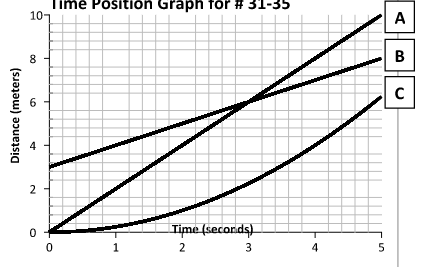
On this position vs time graph, describe the motion of A.
constant velocity forward
constant velocity backward
Speeding up
Slowing down
velocity is zero
On this position vs time graph, describe the motion of B.
constant velocity forward
constant velocity backwards
speeding up
slowing down
velocity is zero
On this position vs time graph, describe the motion of C.
constant velocity forward
constant velocity backward
Speeding up
slowing down
velocity is zero

On this velocity vs time graph, describe the motion of A.
constant velocity forward
constant velocity backward
speeding up
slowing down
On this velocity vs time graph, describe the motion of C.
constant velocity forward
constant velocity backward
speeding up
slowing down
On this velocity vs time graph, describe the motion of D.
constant velocity forward
constant velocity backward
speeding up
slowing down

On this position vs time graph, what is the velocity?
40 m/s
8 m/s
5 m/s
0 m/s

On this position vs time graph, what is the velocity from 15 to 40 seconds?
-4 m/s
-10 m/s
-25 m/s
-100 m/s

What is the velocity at 12.5 seconds?
0 m/s
2 m/s
10 m/s
20 m/s
What is the acceleration during interval A?
0 m/s/s
2 m/s/s
10 m/s/s
20 m/s/s
What is the acceleration during interval B?
0 m/s/s
2 m/s/s
10 m/s/s
20 m/s/s
What is the acceleration during interval C?
0 m/s/s
-2 m/s/s
-1.33 m/s/s
-20 m/s/s
What is the displacement from 0-10 seconds?
10 m
10 m
100 m
200 m
What is the displacement from 15-30 seconds?
150 m
-150 m
True or False: Inertia is the tendency of an object to resist changes in motion.
For every action force, there is an equal and opposite reaction force
For every action force, there is an equal and opposite reaction force
For every action force, there is an equal and opposite reaction force
The amount of inertia an object has
The amount of weight in an object

In this right triangle what is c?
theta
hypotenuse
adjacent side
opposite side
Which is the correct ratio for the sine ratio?
hypotenuseadjacent
hypotenuseopposite
opposite adjacent
adjacent opposite
What is a common way to remember the definitions of the trig ratios?
SAH COH TOA
SOA COH TOA
SOH CAH TOA
ADJ OPP HYP

What acts on a projectile in the y direction that causes an object to travel in a parabolic arc?
Friction
Gravity
Tension
No force acting.
Mark all of the following objects that are actually projectiles.
An object moving through the air and not touching any surfaces
A falling skydiver with an open parachute
Any object falling with no air resistance
A football kicked toward the goal posts
An airplane flying through the air
When a ball is projected horizontally, what is its initial vertical velocity?
0
9.8
-9.8
not enough information given

What is the horizontal acceleration of a projectile?
0 m/s2
9.8 m/s2
-9.8 m/s2
4.9 m/s2
What is the direction of the acceleration for any projectile?
The direction the projectile is traveling.
Down
Up
Sideways
The path followed by a projectile is also known as its
trajectory
range
height
vertical displacement

If a ball thrown straight up into the air takes 4 seconds to reach the top (peak), how long will it take to travel from the peak back to the original position?
0s
1s
3s
4s

Victor Velocity is standing on top of the roof of his house, firing stones with his slingshot over a level field. He is aiming straight outward, horizontally. If Victor pulls back harder on the sling to shoot a stone, which of the following quantities will be changed?
The vertical displacement of the stone.
The distance the stone travels, and the horizontal velocity.
The time it takes the stone to strike the ground, and the horizontal velocity.
The acceleration on x and y respectively is
0 m/s2, -9.8 m/s2
9.8 m/s2, 0 m/s2
I don't know it is not given in the problem
321 m , and 45.0 m

In the diagram, which letter represents the vertical displacement Δy ?
A
B
C
D

In the diagram, which letter represents the horizontal displacement Δx ?
A
B
C
D

A ball rolls off a table and strikes the floor, as shown. If the time the ball spent in the air was 0.58 s. What is the horizontal displacement?
1.7 m
1.2 m/s
2.1 m
0.58 s

A skateboarder rolls off a bridge into the river as shown. If the skateboarder was originally moving at 7.0 m/s. What is the acceleration (a) as he falls to the ground?
7.0 m/s
0 m/s
9.8 m/s2
5.5 m
Not enough information given.
A skateboarder rolls off a bridge into the river as shown. If the skateboarder spent 0.79 s in the air, What is his horizontal initial velocity?
7.0 m/s
0.79 s
9.8 m/s2
0 m/s
Not enough information given.
A baseball is thrown at a 22.5° angle and an initial velocity of 65 m/s. Assume no air resistance. What is the vertical component of the ball’s velocity? What is the horizontal component of the ball’s velocity? What is the problem solving for?
angle on y and x axis
displacement on y and x axis
time
velocity on y and x axis
A baseball is thrown at a 22.5° angle and an initial velocity of 65 m/s. Assume no air resistance. How far did the ball travel horizontally when it hit the ground? What is the problem solving for?
time
angle
distance or displacement on the x axis
distance or displacement of the y axis
While drag racing out of our school parking lot, I time myself at a speed of 40 meters per second seven seconds after starting. What was my acceleration during this time?
2.3m/s2
280m/s2
5.7m/s2
none of these answers are true
If I accelerated from 0-40m/s in 7 seconds, how far have I gone during this seven seconds?
70 meters
140 meters
210 meters
280 meters
Gabe kicks the soccer ball with a velocity of 14m/s at an angle of 16 degrees. How far did the ball go?
3.5 m
5.3 m
10.5 m
13.5 m
A car is traveling to the right with a speed of 29m/s when the rider slams on the accelerator to pass another car. The car passes in 110 m with constant acceleration and reaches a speed of 34m/s. We want to find the acceleration of the car as it sped up. What equation should you choose?
v=vo+at
x=vot+1/2at2
v2=vo2+2ax
x=1/2(v+vo)t
Rocket-powered sleds are used to test the human response to acceleration. If a rocket-powered sled is accelerated to a speed of 444 m/s in 1.83 seconds, then what is the distance that the sled travels?
Choose the appropriate equation.
v=vo+at
x=vot+1/2at2
v2=vo2+2ax
x=1/2(v+vo)t
If Michael Jordan has a vertical leap of 1.29 m, then what is his takeoff speed if his acceleration is -9.8 m/s2 and his velocity at the top of his leap is 0 m/s? Choose the appropriate equation
v=vo+at
x=vot+1/2at2
v2=vo2+2ax
x=1/2(v+vo)t
An engineer is designing the runway for an airport. Of the planes that will use the airport, the lowest acceleration rate is likely to be 3 m/s2. The takeoff speed for this plane will be 65 m/s. All airplanes will start from rest. Assuming this minimum acceleration, what is the minimum allowed length for the runway?
Choose the appropriate equation.
v=vo+at
x=vot+1/2at2
v2=vo2+2ax
x=1/2(v+vo)t
A car starts from rest and accelerates uniformly over a time of 5.21 seconds for a distance of 110 m. Determine the acceleration of the car. Choose the appropriate equation.
v=vo+at
x=vot+1/2at2
v2=vo2+2ax
x=1/2(v+vo)t
The unit we use to measure acceleration is ___.
m/s
m
s
m/s2
The unit we use to measure speed is ___.
m/s
m
s
m/s2
The unit we use to measure distance is ___.
m/s
m
s
m/s2
The unit we use to measure time is ___.
m/s
m
s
m/s2
Which of the following symbols represents velocity when time is zero (Initial Velocity)?
v
v0
a
x
Which of the following symbols represent velocity at any time (Final Velocity)?
v
v0
a
x
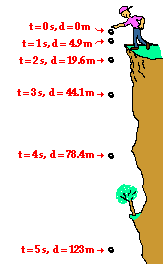
In order for something to speed up, the signs of its velocity and acceleration must be...
The Same
Opposite
Acceleration must be positive. Velocity can be negative or positive.

A car goes from rest to 30 m/s. If it takes the car 40 seconds to reach that speed then what is the car's rate of acceleration?
1.33 m/s2
0.75 m/s2
10 m/s2
0 m/s2

A dog basks in the sun when he sees a squirrel and bolts after it. If the dog accelerates at 1.6 m/s/s, how far does he run in 3 seconds?
4.8 meters
45 meters
1.6 meters
7.2 meters
A golf ball is dropped from the top of the bleachers 11 meters from the ground. Determine the final speed of the ball just before it hits the ground.
6 m/s
9 m/s
12 m/s
15 m/s

On a mysterious planet, alien physics students conduct an experiment to determine the acceleration caused by gravity, "g" , on their planet. They drop a rock from the ceiling 2.7 meters high and record the time it takes to hit the ground to be 0.61 seconds. Find the value of "g"
7.3 m/s/s
14.5 m/s/s
9.8 m/s/s
11.8 m/s/s
The initial upward velocity of a golf ball is 60 m/s. How long will it take the ball to return to the ground?
0 seconds
-6.12 seconds
6.12 seconds
12.24 seconds

A car is traveling at a constant speed of 2.5 m/s. If it travels for 100 sec, how far will it travel?
500 m
1000 m
125 m
250 m
A boat travels 12.0 m while it reduces its velocity from 9.5 m/s to 5.5 m/s. What is the boat’s acceleration while it travels the 12.0 m?
-2.5 m/s/s
2.5 m/s/s
-10 m/s/s
10 m/s/s
A ball is dropped from a building. How fast is it traveling after falling for 1.77 s?
17.35 m/s
-17.35 m/s
-30.3 m/s
4.17 m/s
A car is slowed with a constant acceleration of 2.00 m/s/s until it stops after 10.0 s.
How fast was the car going before it started to slow down?
4.47 m/s
-20 m/s
200 m/s
20 m/s
A cliff diver jumps from 84m cliff. How long will it take the diver to hit the water?
17.14 s
4.14 s
8.28 s
9.8 s
A kangaroo jumps to a maximum height of 1.5 m. What is its initial velocity?
2.71 m/s
-29.4
29.4 m/s
5.4 m/s
A ball is tossed in the air. What is the acceleration on its way up?
9.8 m/s2
There is no acceleration
-9.8 m/s2
0 m/s2
A ball is tossed in the air. What is the acceleration at its max height (V=0)?
9.8 m/s2
There is no acceleration
-9.8 m/s2
0 m/s2
A ball is tossed in the air. What is the acceleration on its way down?
9.8 m/s2
There is no acceleration
-9.8 m/s2
0 m/s2
A ball is tossed in the air. What is the velocity at its max height?
Not enough information to answer
-9.8 m/s2
0 m/s
9.8 m/s2
On a Velocity vs. Time graph, the area under the curve represents:
Displacement
Velocity
Time
Acceleration
On a Velocity vs. Time graph, the slope of the line represents:
Displacement
Velocity
Time
Acceleration

At what point is vy= 0 m/s?
A
B
C
D
None of these points
At what point is vx= 0 m/s?
A
B
C
D
None of these points
Which vector pair (arrow pair) correctly represents the acceleration and velocity at point P?


Who do you agree with?
Anita: “A projectile’s vx changes because of gravity, and its vy remains constant.”
Barry: “Both vx and vy are constant.”
Chris: “A projectile has no acceleration in the vertical dimension but it does accelerate horizontally.”
Dave: “A projectile has vertical acceleration and a constant horizontal velocity”

Suppose Lemming A runs off the edge of the cliff at 2 m/s and Lemming B runs off the edge at 1 m/s. Which will hit the ground first?
A
B
Both at the same time
Suppose Lemming A runs off the edge of the cliff at 2 m/s and Lemming B runs off the edge at 1 m/s. Which will hit the ground farther from the base of the cliff?
A
B
Both at the same distance
A ball is thrown into the air at some angle, with initial velocities vx (horizontal) and vy (vertical). At the very top of the ball’s path:
What is its velocity in the horizontal direction?
vx
Greater than vx
Zero
A ball is thrown into the air at some angle, with initial velocities vx (horizontal) and vy (vertical). At the very top of the ball’s path:
What is its velocity in the vertical direction?
vy
Greater than vy
Zero
In the absence of air resistance, the angle at which a thrown ball will go the farthest is?
90°
30°
60°
45°

A package is dropped from an airplane, where will the package hit the ground?
A
B
C
Which angle would offer the largest vertical component of initial velocity?
0o
30o
45o
60o
90o
Which angle would offer the largest horizontal component of initial velocity?
0o
30o
45o
60o
90o
Which angle causes a projectile to have the greatest range?
0o
30o
45o
60o
90o
A projectile takes 2 seconds to reach its peak height. Assuming it lands at the same height of launch, this means its total air time is...
1 second
2 seconds
3 seconds
4 seconds
None of these
If Mrs. Obregon throws her phone, horizontally, out a window 1 m above the ground, which equation can you use to determine how long it takes to reach the ground?
Δx=vt
vf2=vi2+2ax
vf=vi+at
x=vit+21at2

Which best describes the horizontal motion of a projectile, assuming no air resistance?
Acceleration of -10 m/s2
Acceleration of -5 m/s2
An increasing acceleration every second
Constant velocity

Which best describes the vertical motion of a projectile, assuming no air resistance?
Acceleration of -10 m/s2
Accelerations of -5 m/s2
An increasing acceleration every second
Constant velocity

A marble traveling at 3 m/s rolls off the edge of a 1 m high table. What is its initial vertical speed?
-10 m/s
0 m/s
-3 m/s
-15 m/s

A player kicks a ball across the field. At the very top, about what is the acceleration of the ball?
It is accelerating to the right
There is no acceleration at the top
10 m/s2 up
10 m/s2 down

A cannon is fired horizontally from a 5.0 m tall tower. How much time will it take until the projectile hits the ground?
0.5 s
1.0 s
2.0 s
5.0 s
A ball rolls off of a horizontal table and falls to the ground. The instant the ball leaves the table its vertical velocity is...
-9.8 m/s
-5 m/s
0m/s
9.8 m/s
A ball is rolling across a table with a horizontal velocity of 2m/s. It rolls off a table that's 2m tall. How far does the ball land away from the table (Δx)?
1.26 m
4.13 m
0.98 m
3.45 m
A ball is thrown horizontally from a height of 1.5 m and lands 5 m away. What is the time of flight of the ball?
.31 sec
.55 sec
.176 sec
.30 sec

If you throw a baseball straight up, what is it's velocity at the highest point?
-9.8 m/s2
-9.8 m/s
0 m/s2
0 m/s
If a ball is thrown with an initial horizontal velocity of 12 m/s, what will the horizontal velocity be when the ball is at the top of its trajectory?
0 m/s
6 m/s
12 m/s
24 m/s
What is the horizontal acceleration of a projectile?
0 m/s2
9.8 m/s2
-9.8 m/s
0 m/s

If I throw a crayon straight up at 12m/s, what is the velocity of the crayon when I catch it at the same height?
-6 m/s
-12 m/s
-18 m/s
-24 m/s
Which of the following shows a box that is experiencing a net force of 20 N to the right?

Option 1

Option 2

Option 3
Two arrows are launched at the same time with the same speed. Arrow A at an angle greater than 45 degrees, and arrow B at an angle less than 45 degrees. Both land at the same spot on the ground. Which arrow arrives first?
arrow B arrives first
arrow A arrives first
it depends on the initial speed
they both arrive together
A student rolls a coin off of a high horizontal platform, in a projectile experiment. The coin moves 20 centimeters horizontally (while also falling down) during the 1st second of its projectile motion. How far will the coin move horizontally during the 2nd second of its projectile motion?
40 cm
80 cm
20 cm
10 cm
A projectile is fired horizontally from a height of 20 meters above the ground, with an initial velocity of 7.0 m/s. How far does the projectile travel horizontally before it reaches the ground?
3.5 m
7 m
14 m
20 m
140 m
A group of students wish to determine the launch speed of a specific 'launcher' device that they are using in a projectile experiment. The group is using the launcher to launch a ball horizontally from the top of their lab table, to land on the floor below. The group has already measured the height of the table, relative to the floor below. Which one of the following sets of additional measurements would be adequate to allow the group to determine the ball's launch speed, without taking any extraneous/unnecessary measurements?
Only the horizontal distance moved by the ball during its motion.
The horizontal distance moved by the ball during its motion, as well as the time the ball falls
The time the ball falls for, as well as the mass of the ball.
Only the horizontal distance moved by the ball during its
The horizontal distance moved by the ball during its motion, the time the ball falls for, and also the mass of the ball.
A ping-pong ball rolls forward 6 meters, and bounces backward 3 meters. It traveled a total displacement of:
The slope of a velocity-time graph represents __________.
acceleration
displacement
speed
distance

This position vs. time graph shows an object...
not moving
moving with constant velocity
moving with changing velocity
Which of these position vs. time graphs shows an object changing direction?


Which of these velocity vs. time graphs shows an object changing direction?


Select the two correct statements that describe the object's motion.
The object is moving in the positive direction.
The object is moving in the negative direction.
The object is moving at a constant speed.
The object is speeding up.
The object is slowing down.

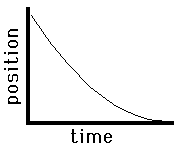


What is happening to the object according to this graph?
Nothing, it is not moving.
Constant positive velocity
Positive acceleration
Negative acceleration

What is happening to the object according to this graph?
Nothing, it is not moving.
Constant positive velocity
Positive acceleration
Negative acceleration
The slope of a VT Graph represents what?
Velocity
Time
Acceleration
What I ate for breakfast.

Which VT graph matches this PT graph?


Which VT graph matches this PT graph?

Which VT graph matches this PT graph?

Which VT graph matches this PT graph?

Which of these velocity vs. time graphs corresponds to the position vs. time graph?
I don't know

Which two velocity vs. time graphs show the same acceleration?
B & C
A & C
A & D
B & D
I don't know

What is the acceleration vs. time graph that corresponds to this position vs time graph?


I don't know
An object accelerates at a rate of 50 m/s^2 from a force of 20 N. What is its mass?
0.4 kg
1000 kg
2.5 kg
30 kg
I don't know
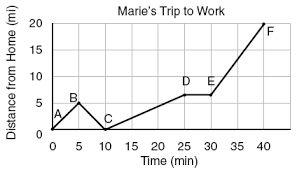
When was Marie driving the fastest?
C to D
D to E
E to F
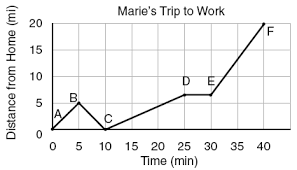
During what period of time was Marie stopped?
0-5 minutes
5-10 minutes
10-25 minutes
25-30 minutes
Which of the following show an object moving in the negative direction? (SELECT ALL THAT APPLY)


Use the picture above to choose the most accurate description of the object's motion
object is speeding up in the positive direction
object is slowing down in the positive direction
object is speeding up in the negative direction
object is slowing down in the negative direction

Which of the following velocity time graphs matches the position time graph above?



