wayground logo

Free Printable Worksheets

Font size

S
M
L
XL
Worksheets

Cell transport summative

Total questions: 107

Worksheet time: 1hrs 17mins

Name
Class
Date
1.

What are the two types of cell transport?

a)

Passive and Active

b)

Active and Facilitated

c)

Passive and Facilitated

d)

None of the above

2.

In passive transport, substances move across the cell membrane ________ the concentration gradient

a)

AGAINST

b)

ALONG

c)

WITH

d)

BETWEEN

3.

Which example describes diffusion?

a)

Water moving across a semi-permeable membrane

b)

Baking cookies and smelling them throughout the house

c)

Ions moving through an ion channel

d)

All of the above

4.

What macromolecule is embedded into the lipid bilayer and helps to transport molecules?

a)

Carbohydrate

b)

Lipid

c)

Protein

d)

Nucleic Acid

5.

Which describes a hypotonic environment?

a)

Too much water in the cell will cause the cell to burst - the percentage of water is higher outside the cell than inside the cell

b)

Too little water in the cell will cause the cell to shrink - the percentage of water is lower outside the cell than inside the cell

c)

Concentrations of water are equal inside and outside the cell

6.

Which describes a hypertonic environment?

a)

Too much water in the cell will cause the cell to burst - the percentage of water is higher outside the cell than inside the cell

b)

Too little water in the cell will cause the cell to shrink - the percentage of water is lower outside the cell than inside the cell

c)

Concentrations of water are equal inside and outside the cell

7.

Which describes an isotonic environment?

a)

Too much water in the cell will cause the cell to burst - the percentage of water is higher outside the cell than inside the cell

b)

Too little water in the cell will cause the cell to shrink - the percentage of water is lower outside the cell than inside the cell

c)

Concentrations of water are equal inside and outside the cell

8.

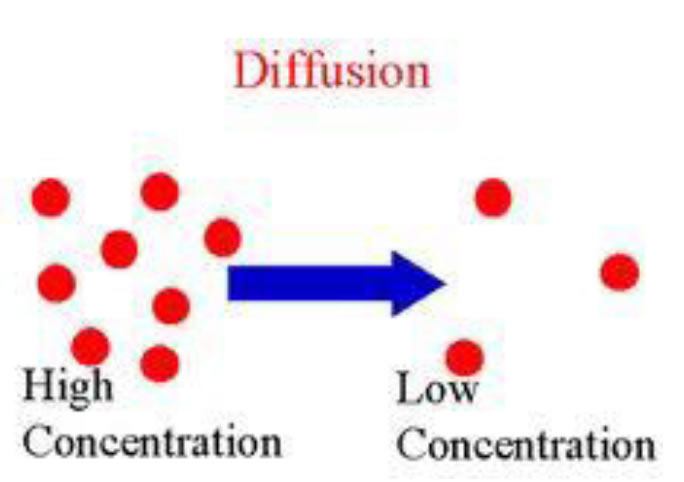
The movement of particles from an area of high concentration to an area of low concentration

a)

active transport

b)

osmosis

c)

diffusion

d)

random movement

9.

When material passes into and out of a cell at equal rates and there is no difference in concentration between the inside and outside of the cell, the cell is in a state of...

a)

dynamic equilibrium

b)

diffusion

c)

osmosis

d)

active transport

10.

If a cell is placed in an environment with MORE oxygen OUTSIDE the cell than inside, the cell will...

a)

gain oxygen

b)

lose oxygen

c)

gain water

d)

lose water

11.

The movement of materials that does NOT require energy is called...

a)

active transport

b)

passive transport

c)

massive transport

d)

proactive transport

12.

The movement of materials that requires energy is called...

a)

active transport

b)

passive transport

c)

massive transport

d)

proactive transport

13.

The movement of materials from an area of low concentration to an area of high concentration would require...

a)

glucose

b)

energy (ATP)

c)

fish

d)

chips

14.

A process in which cells surround and engulf substances that are TOO BIG to enter the cell is known as...

a)

Pinocytosis

b)

Phagocytosis

c)

Endocytosis

d)

Receptor-mediated

15.

When a cell forms a vesicle around unwanted particles and expels it OUT of the cell.

a)

Pinocytosis

b)

Endocytosis

c)

Receptor-mediated

d)

Exocytosis

16.
All living things want to remain in...
a)
chaos
b)
homeostasis
c)
limbo
d)
plasmolysis
17.
This is a ____.
a)
Golgi body
b)
plasma membrane
c)
lysosome
d)
cell wall
18.
Why will a plant die if you water it with a salt water?
a)
hypotonic solution
b)
hypertonic solution
c)
isotonic solution
d)
silly solution
19.
Water has diffused ___________ of this cell.
a)
into 
b)
in and out of
c)
out of
20.
If the sodium concentration inside a cell is greater than outside the cell, how can a cell take in more sodium?
a)
osmosis
b)
diffusion
c)
active transport
d)
passive transport
21.
Which is an example of how humans maintain homeostasis in bad environmental conditions?
a)
sweating in the heat
b)
shivering in the heat
c)
digesting amino acids
d)
regulating glucose levels
22.
Which process involves the movement of molecules from high concentration to low concentration?
a)
Endocytosis
b)
Active transport
c)
osmosis
d)
phagocytosis
23.
if you put a plant in salt water it will ...
a)
swell because water diffuses into the cells
b)
swell because water diffuses out of the cell
c)
shrivel because water diffuses out of the cell
24.
Two different solutions are separated by a membrane permeable only to water. How will molecules move?
a)
solutes will move by dissolving
b)
water will move by active transport
c)
solutes will move by osmosis
d)
water will move by osmosis
25.
Your gums are swollen. How will rinsing with warm salt water help the swelling?
a)
swollen gums will absorb the salt
b)
salt lowers the temp
c)
salt goes against the concentration gradient
d)
water in the gums has diffused out of the cells
26.
Cells need to bring in molecules to carry out cellular processes. Often, this requires moving the molecules across the cell membrane against the concentration gradient. How do these molecules get into the cell?
a)
passive transport by diffusion
b)
active transport using ATP 
c)
passive transport by osmosis
d)
 osmosis
27.
A person with swollen gums rinses his mouth with warm salt water, and the swelling decreases. Which of the following has occurred?
a)
The swollen gums have absorbed the saltwater solution.
b)
The saltwater solution lowers the temperature of the water in the gums.
c)
The salt in the solution has moved against the concentration gradient.
d)
The water in the gums has moved out due to the high concentration of salt in the solution. 
28.
The cell membrane of the red blood cell will allow water, oxygen, and carbon dioxide to pass through. Because other substances are blocked from entering, this membrane is called
a)
perforated
b)
semi-permeable
c)
non-conducive
d)
permeable
29.
 Look at the diagram of a cross-section of a cell membrane below. The cell membrane controls movement of materials into and out of the cell. The following particles are moving from high concentration to low concentration and are using a carrier protein. How would you describe this type of movement across the membrane? 
a)
simple osmosis
b)
active transport
c)
simple diffusion
d)
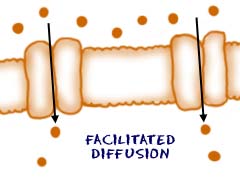
facilitated diffusion
30.
Look at the cross section of a cell membrane of a eukaryotic cell. H+ ions are being pumped from a low concentration to a high concentration. How do you describe this type of transport across the cell membrane?
a)
active transport
b)
passive transport
c)
facilitated diffusion
d)
co-transport
31.
The diagram below represents a cell and some molecules in its environment. Which molecule would require the use of energy in order to be brought into the cell?
a)
1
b)
2
c)
3
d)
4
32.
Which activity can occur without the use of energy?
a)
contraction of muscle tissue
b)
protein synthesis in a cell
c)
active transport of minerals
d)
movement of water across a membrane
33.
The diffusion of water across a selectively permeable membrane is called 
a)
active transport
b)
facilitated diffusion
c)
osmosis
d)
phagocytosis
34.
During diffusion molecules tend to move 
a)
   up the concentration gradient
b)
 from an area of lower concentration to an area of higher concentration
c)
 in a direction that doesn’t depend on concentration
d)
 down the concentration gradient
35.
Movement of particles from high to low concentration. 
a)
Passive Transport
b)
Active Transport
36.
Osmosis is a form of ______________. 
a)
Passive Transport
b)
Active Transport
37.
a)
Passive Transport
b)
Active Transport
38.
What is it called when molecules move across the cell membrane from an area of high concentration to an area of low concentration through a carrier protein?
a)
Diffusion
b)
Osmosis
c)
Active Transport
d)
Facilitated Diffusion
39.
This picture represents what type of cell transport?
a)
endocytosis
b)
exocytosis
c)
osmosis
d)
passive transport
40.
Osmosis is the movement of _____ across a membrane.
a)
food
b)
energy
c)
oxygen
d)
water
41.
Which is true about active transport?
a)
It requires energy
b)
it does not require energy
c)
It moves substances down the concentration gradient
d)
it moves material from high to low concentration
42.
This cell organelle helps organisms maintain homeostasis by controlling what substances may enter or leave cells.
a)
vacuole
b)
nucleus
c)
cell membrane
d)
cell wall
43.
The cell below is in a _________ solution.
a)
Hypotonic
b)
Hypertonic
c)
Isotonic
44.
The cell below is in a _____________ solution.
a)
Hypertonic
b)
Hypotonic
c)
Isotonic
45.
A cell in an isotonic solution will
a)
swell
b)
shrink
c)
stay the same size
d)
impossible to tell
46.
When a cell is placed in a hypertonic solution water
a)
moves from the inside of the cell to the solution
b)
moves from the solution to the inside of the cell
c)
moves equally in and out of the cell
d)
none of these
47.
When a cell is placed in a hypertonic solution water
a)
moves from the inside of the cell to the solution
b)
moves from the solution to the inside of the cell
c)
moves equally in and out of the cell
d)
none of these
48.
A cell will __________________ in a hypotonic solution.
a)
swell and perhaps burst (lyse)
b)
shrink
c)
the size of the cell will not change
d)
the size of the cell will change from large to small and from small to large
49.
Active transport requires _____ to move materials across the cell membrane.
a)
proteins
b)
sunlight
c)
oxygen
d)
energy
50.
When the concentration of particles inside of a cell is the same as the concentration of particles outside of the cell. 
a)
active transport
b)
concentration
c)
diffusion
d)
equilibrium
51.
The process where only water is allowed to pass through the cell membrane from a high to low concentration.
a)
meiosis
b)
respiration
c)
diffusion
d)
osmosis
52.
Cells use energy to move materials across a membrane (low to high concentration).
a)
Active transport
b)
Passive transport
c)
Diffusion
d)
Osmosis
53.
Cell membrane surrounds a particle and encloses it (for large particles)
a)
Endocytosis
b)
Exocytosis
c)
Permeable
d)
In high concentration
54.
Particles are removed from a cell (pushed out).
a)
Endocytosis
b)
Exocytosis
c)
Permeable
d)
In high concentration
55.
Something is ___________ ____________
when some molecules can cross the membrane while others cannot. 
a)
Selectively (or Semi) Permeable 
b)
Totally Transparent
c)
Liquid Licorice 
d)
Heavily Patrolled 
56.
The amount of particles in a given space.
a)
diffusion
b)
concentration
c)
permeable
d)
active transport
57.
When the concentration of particles inside of a cell is the same as the concentration of particles outside of the cell. 
a)
active transport
b)
concentration
c)
diffusion
d)
equilibrium
58.
The process where only water is allowed to pass through the cell membrane from a high to low concentration.
a)
meiosis
b)
respiration
c)
diffusion
d)
osmosis
59.
The movement of molecules from an area of high concentration to an area of low concentration.
a)
Osmosis
b)
Respiration
c)
Diffusion
d)
Active Transport
60.
Cells use energy to move materials across a membrane (low to high concentration).
a)
Active transport
b)
Passive transport
c)
Diffusion
d)
Osmosis
61.
Cells transport material across a cell membrane without using energy (high to low concentration)
a)
Passive transport
b)
Concentration
c)
Endocytosis
d)
Active Transport
62.
Cell membrane surrounds a particle and encloses it (for large particles)
a)
Endocytosis
b)
Exocytosis
c)
Permeable
d)
In high concentration
63.
Particles are removed from a cell (pushed out).
a)
Endocytosis
b)
Exocytosis
c)
Permeable
d)
In high concentration
64.
Compare the concentrations of the sugar in the cell and the solution.  Which is HYPOTONIC?
a)
Cell
b)
Solution
65.
What do the following terms have in common?
-diffusion
-osmosis
-facilitated diffusion
a)
They require energy to move materials
b)
They move from a low concentration to a high concentration
c)
They move move materials DOWN the concentration gradient
d)
They require ATP
66.
Which direction will the dots (solute) move without the use of energy?
a)
into the cell
b)
out of the cell
67.
Facilitated diffusion is the movement of materials into and out of the cell
a)
with the use of energy
b)
with the use of proteins but no energy
c)
by moving water
d)
by using ATP
68.
The  movement of water from a high concentration to a low concentration is called
a)
diffusion
b)
osmosis
c)
facilitated diffusion
d)
active transport
69.
The diagram represents a specialized cell located in the root of a plant. The arrows in the diagram indicate the movement of molecules of oxygen and water into the cell.
Which choice correctly identifies the process responsible for the movement of each type of molecule represented in the diagram?
a)
Water = diffusion
Oxygen = active transport
b)
Water = diffusion
Oxygen = diffusion
c)
Water = active transport
Oxygen = active transport
d)
Water = active transport
Oxygen = diffusion
70.
Which form of transport is being shown in the diagram.
a)
diffusion
b)
osmosis
c)
facilitated diffusion
d)
active transport
71.
The water level increases on the right because
a)
there are less particles on the right
b)
there are more particles on the right
c)
the right side is hypotonic
d)
the right side is isotonic
72.

Which CELL contains MORE particles than are found in the surrounding solution?

a)

Left

b)

Center

c)

Right

73.
When plant cells lose water to their environment the membrane collapses.  This is called
a)
reverse osmosis
b)
active transport
c)
plasmolysis
d)
selectively permeability
74.
In this situation, where the solute is illustrated by red dots, predict if will WATER move into or out of the cell, and how that will affect the cell.
a)
Water will move into the cell and the cell will expand.
b)
Water will move into the cell and the cell will shrink.
c)
Water will move out of the cell and the cell will expand.
d)
Water will move out of the cell and the cell will shrink.
75.

Examine the diagram and determine, based on the concentrations of salt, if salt will move into or out of the cell.

a)

INTO

b)

OUT OF

76.
Which illustration of transport across the membrane requires energy?
a)
A
b)
B
c)
C
d)
D
77.
Semi-permeable mean to allow
a)
all materials across the membrane
b)
only some materials across the membrane
c)
no material to cross the membrane
d)
to allow only water across the membrane
78.
What factor DOES NOT influence whether or not a substance can pass through a membrane?
a)
size
b)
charge
c)
number of atoms
d)
shape
79.

What is the definition of OSMOSIS?

a)

Diffusion of water through a selectively permeable membrane

b)

Molecular structure that surrounds the cell and controls what enters and leaves the cell

c)

Movement of molecules across the cell membrane against the concentration gradient

d)

Movement of molecules across the cell membrane from an area of high concentration to low concentration

80.

What is the definition of LIPID BILAYER?

a)

Molecular structure that surrounds the cell and controls what enters and leaves the cell

b)

Movement of molecules across the cell membrane against the concentration gradient

c)

Diffusion of water through a selectively permeable membrane

d)

Movement of molecules across the cell membrane from an area of high concentration to low concentration

81.

What is the definition of ACTIVE TRANSPORT?

a)

Movement of molecules across the cell membrane against the concentration gradient

b)

Diffusion of water through a selectively permeable membrane

c)

Molecular structure that surrounds the cell and controls what enters and leaves the cell

d)

Movement of molecules across the cell membrane from an area of high concentration to low concentration

82.

Identify the following structure

a)

Phospholipid

b)

Cell

c)

Cell membrane

d)

Protein

83.

What is the name of 'A' found on the structure below

a)

Lipid Bilayer (cell membrane)

b)

Protein

c)

Phosphate hydrophilic heads

d)

Lipid hydrophobic tails

84.

What is the name of 'B' found on the structure below

a)

Protein

b)

Lipic bilayer

c)

Phosphate hydrophilic heads

d)

Lipid hydrophobic heads

85.

What is the name of 'C' found on the structure below

a)

Phosphate hydrophilic heads

b)

Lipid hydrophobic tails

c)

Lipid bilayer

d)

protein

86.

What is the name of 'D' found on the structure below

a)

Lipid hydrophobic tails

b)

Protein

c)

Lipid bi layer

d)

Phosphate hydrophilic heads

87.

Which answer correctly describes the lipid bilayer?

a)

lipids are hydrophobic; phosphates are hydrophobic

b)

lipids are hydrophilic; phosphates are hydrophilic

c)

lipids are hydrophobic; phosphates are hydrophilic

d)

lipids are hydrophilic; phosphates are hydrophobic

88.

Why would the cell need energy to move molecules across the membrane?

a)

the molecule is going against the concentration gradient

b)

the molecule is to large to pass through the membrane

c)

the lipid membrane requires energy anytime something is moving across the membrane

89.

In passive diffusion, substances always move...

a)

from an area of higher concentration to an area of lower concentration

b)

from an area with more of the molecules to an area with fewer of the molecules

c)

from an area of lower concentration to an area of higher concentration

d)

from an area with fewer of the molecules to an area with more of the molecules

90.

What is the definition of FACILITATED DIFFUSION?

a)

Movement of molecules across the cell membrane from an area of high concentration to low concentration

b)

Diffusion of water through a selectively permeable membrane

c)

Movement of molecules across the cell membrane against the concentration gradient

d)

Molecular structure that surrounds the cell and controls what enters and leaves the cell

91.

The following cells have been placed in different solutions.

Make a prediction of what will happen.


(check all that are correct)

a)

Isotonic-- the cell will maintain size

b)

hypotonic-- the cell will increase in size

c)

hypertonic-- the cell will decrease in size

92.
What does “high concentration area” mean?
a)
Spread out
b)
Tightly packed together
c)
Uncrowded
d)
Spacious
93.
When particles move from areas of high concentration to areas less concentrated, this has taken place.
a)
diffusion
b)
mitosis
c)
endocytosis
d)
photosynthesis
94.
What process occurs when WATER diffuses across a membrane?
a)
endocytosis
b)
mitosis
c)
osmosis
d)
nuclear fission 
95.
Which diagram best shows the end result of diffusion?
a)
F
b)
G
c)
H
d)
J
96.

Why are diffusion and osmosis important to cells?

a)

It allows them to take in materials/substances without using energy.

b)

It allows them to reproduce.

c)

It allows them to absorb sunlight.

d)

It allows cells to use all energy.

97.
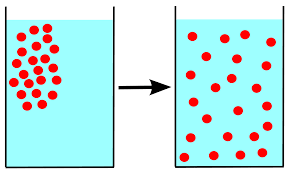
The picture  is an example of _________________.
a)
isotonic
b)
diffusion
c)
osmosis
d)
active transport
98.
When both inside and outside of a cell have the same amount of water it is said that the cell has reached a state of ___________.
a)
osmosis
b)
equilibrium
c)
diffusion
d)
hypertonic
99.

What does selectively-permeable mean?

a)

Allow certain things to enter and leave the cell

b)

Nothing gets through

c)

The cell lets only large substances through

100.
Which way will the water molecules move during osmosis?
a)
Out of the cell, so the cell shrinks.
b)
Out of the cell, so the cell swells.
c)
Into the cell, so the cell shrinks.
d)
Into the cell, so the cell swells.
101.
The picture below is an example of _________________.
a)
osmosis
b)
isotonic
c)
diffusion
d)
active transport
102.
Osmosis is the movement of _____ across a membrane.
a)
food
b)
energy
c)
oxygen
d)
water
103.
During osmosis
a)
water moves from high to low concentration
b)
large or oddly shaped molecules move across a cell membrane
c)
water moves when energy is used
d)
proteins are built
104.

Passive transport requires ________________

a)

concentration gradients

b)

no energy

c)

motion

d)

energy

105.

The diffusion of particles through the cell membrane from high to low concentration is called ....

a)

exocytosis

b)

active transport

c)

passive transport

d)

osmosis

106.

When the smell of perfume spreads throughout a room, it is an example of ....

a)

passive transport

b)

diffusion

c)

active transport

d)

osmosis

107.

If a gummy bear is placed in salt water, the mass of the gummy bear will decrease because water will move out of the gummy bear. What process does this represent?

a)

osmosis

b)

fermentation

c)

respiration

d)

diffusion