wayground logo

Free Printable Worksheets

Font size

S
M
L
XL
Worksheets

Cells Unit Review

Total questions: 101

Worksheet time: 2hrs 0mins

Name
Class
Date
1.

Which of the following items helps scientists study cells?

a)

Microscope

b)

Telescope

c)

Dissecting tools

d)

Beaker

2.

Which of the following makes the results of an experiment valid?

a)

They are repeatable

b)

They are not measurable

c)

They match the hypothesis

d)

They can be used in another experiment

3.

You look at cells through a microscope. Why isn't this considered a scientific experiment?

a)

You are using expensive equipment.

b)

You do not have controls or variables that are being tested.

c)

You are only looking at part of an organism.

d)

Data is recorded in a visual form.

4.

Who is credited with first observing living cells?

a)

Robert Hooke

b)

Theodore Schwann

c)

Anton von Leeuwenhoek

d)

Rudolf Virchow

5.

Which of the following is NOT part of the cell theory?

a)

All living things are made of cells.

b)

The cell is the basic unit of life.

c)

All cells come from other cells.

d)

All cells contain important information for life.

6.

How did the invention of the microscope lead to the development of the cell theory?

a)

The microscope brought the cells to life.

b)

The microscope allowed scientists to discover cells.

c)

The microscope did not affect the cell theory.

d)

The microscope was invented after the cell theory was developed.

7.

John is conducting an experiment with plants. He wants to know which type of soil will help the plants grow the best. He puts them in different types of soil, gives them all the same type and amount of water, places them all in the same location and measures daily. What is his independent variable?

a)

The water.

b)

The sunlight.

c)

The measurements.

d)

The type of soil.

8.
In cells a large oval organelle that contains the cells genetic material in the form of DNA and controls many of the cells activities
a)
organelle
b)
ribosome
c)
cell wall
d)
nucleus
9.
the thick fluid region of a cell located inside the cell membrane or between the cell membrane and nucleus
a)
cytoplasm
b)
cell wall
c)
organelle
d)
golgi apparatus
10.

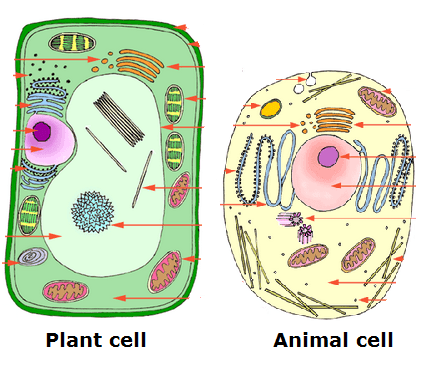
What distinguishes a plant cell from an animal cell? (How do you tell them apart) Hint: There's 3 ways (Check all 3)

a)

Central Vacuole

b)

Mitochondria

c)

Cell Wall

d)

Ribosomes

e)

Chloroplasts

11.

The 3 parts of the Cell Theory are...?

a)

All living things are composed of cells

Cells are the basic units of structure and function in living things

All cells are produced from other cells

b)

All living things are composed of cells

Cells are the basic units of dance and vibes in living things

All cells are destroyed from other aliens

c)

All living things are composed of Jell-O

Cells are the basic units of structure and function in living things

All cells are produced from factories in Canada

d)

All living things are composed of cells

Cells do karate and practice eating whole pies in their free time

All cells are produced from other cells

12.
Every living organism is made up of one or more cells
a)
True
b)
False
13.
Which of the following are NOT found in animal cells
a)
chloroplasts and cytoplasm
b)
chloroplasts and cell wall
c)
cell wall and cell membrane
d)
mitochondria and nucleus
14.
The nucleus is like the ____________ of the cell.
a)
foot
b)
hand
c)
stomach
d)
brain
15.

Which of the following converts food into energy for the cell?

a)

vacuole

b)

mitochondria

c)

cytoplasm

d)

cell membrane

16.
What do vacuoles do? 
a)
They actually do not have an important role
b)
They protect the cell
c)
They are the brain of the cell
d)
storage area for cells; water storage in plants 
17.

Which organelle takes in "sun showers" and helps plants with the process or photosynthesis?

a)

Vacuole

b)

Mitochondria

c)

Cytoplasm

d)

Chloroplast

18.
If you were some bad guy trying to sneak into an animal cell, who would be there to stop you?
a)
nucleus
b)
mitochondria
c)
cell membrane
d)
cell wall
19.
Which of the following, found ONLY in plant cells, provides structure?
a)
cell wall
b)
chloroplast
c)
mitochondria
d)
vacuole
20.
Chloroplasts in plant cells allow the plant to perform a function that animal cells cannot do.  What is the main function of the chloroplasts found in plant cells?
a)
to absorb light energy and manufacture food
b)
to remove waste materials by active transport
c)
to manufacture chemical energy from food
d)
to control the shape of the cell
21.
Which of the following is not part of the cell theory?
a)
cells must contain DNA 
b)
all living things are made from cells
c)
cells can only come from other cells
d)
cells are the basic unit of life
22.
Who was the first  person to see cells under the microscope and give them their name?
a)
Mattias Schleiden
b)
Robert Hooke
c)
Theordor Schwann
d)
Anton van Leeuwenhoek
23.
The basic unit of structure and function in a living things.
a)
chloroplast
b)
nucleus
c)
cell
d)
cell membrane
24.
Animal cells DO NOT have ...
a)
mitochondria
b)
lysosomes
c)
vacuoles
d)
chloroplasts
25.
Where are proteins made in the cell? 
a)
Golgi body
b)
mitochondrion
c)
nucleus
d)
ribosomes
26.
Tiny cell structures that carry out specific functions within the cell...
a)
membranes
b)
nucleus
c)
organelles
d)
animalicules
27.
These are passageways in the cell that carry proteins from one part of the cell to another.
a)
Golgi body
b)
endoplasmic reticulum
c)
ribosome
d)
lysosome
28.
This structure packages and distributes proteins throughout the cell. 
a)
Golgi Body
b)
Lysosome
c)
Ribosome
d)
Mitochondria
29.
The two kinds of cells are prokaryotes and eukaryotes. How are they different?
a)
Prokaryotes have a nucleus.
b)
Eukaryotes have a nucleus.
c)
Prokaryotes are plant cells.
d)
All bacteria are eukaryotes.
30.
What is the process that plant and algae cells use to make food?
a)
chemosynthesis
b)
photosynthesis
c)
decomposition
d)
protein synthesis
31.
You are made up of...
a)
eukaryotic cells
b)
prokaryotic cells
c)
plant cells
d)
bacterial cells
32.
This organelle controls what comes in or out of the cell (selectively permeability).
a)
nucleus
b)
cell wall
c)
cell membrane
d)
vacuole
33.

What is a cell

a)

Cells are the smallest living thing

b)

they are fundamental units of life

c)

and in all living things

d)

cells make up tissue

34.

What type of cell is an animal cell?

a)

Prokaryotic

b)

Eukaryotic

35.

What type of cell is a plant cell?

a)

Prokaryotic

b)

Eukaryotic

36.

What type of cell is a bacterial cell?

a)

Prokaryotic

b)

Eukaryotic

37.

Which scientist discovered bacteria?

a)

Jansen

b)

Hooke

c)

Van Leuwenhoek

d)

Newton

38.

What is the smallest unit of an organism that can perform life functions?

a)

Organ system

b)

Organ

c)

Tissue

d)

Cell

39.

A cell without a true nucleus

a)

Prokaryotic

b)

Eukaryotic

40.

A cell that has a true nucleus

a)

Prokaryotic

b)

Eukaryotic

41.

Variable that is manipulated

a)

Independent

b)

Dependent

42.

The variable that responds

a)

Independent

b)

Dependent

43.

All cells have DNA,cytoplasm, ribosomes, and

a)

Nucleus

b)

Cell membrane

c)

Golgi body

d)

Endoplasmic Reticulum

44.

When conducting a proper experiment, scientists should conduct multiple _______.

a)

hypotheses.

b)

trials.

c)

variables.

d)

controls.

45.
What are the products of photosynthesis?
a)
water and carbon dioxide
b)
oxygen and glucose
c)
oxygen and carbon dioxide
d)
oxygen and water
46.
Plants need ________ for photosynthesis
a)
oxygen
b)
soil
c)
carbon dioxide
d)
sugar
47.
What is photosynthesis?
a)
The process in which humans eat their food
b)
When a photographer takes a photo.
c)
To get your pictures from the photo lab.
d)
The process in which plants make their food.
48.
What is the pigment in chloroplasts that performs photosynthesis?
a)
Chlorosynthesis
b)
Chlorophyll
c)
ADP
d)
Electron Transport
49.
Which of the following is the correct equation for PHOTOSYNTHESIS?
a)
CO+ light + H2O --> O+ Sugar
b)
CO+ sugar + H2O --> O+ light
c)
O2 + light + H2O --> CO+ Sugar
d)
CO+ O2 + H2O --> Light+ Sugar
50.
The purpose of cellular respiration is to produce ?
a)
energy
b)
oxygen
c)
sugar
d)
protein
51.
What main food group do we get most of our energy from?
a)
proteins
b)
carbs
c)
meats
d)
nucleic acids
52.
What is the sugar that carbs are broken down to?
a)
sucrose
b)
maltose
c)
glucose
d)
lactose
53.
What is the energy molecule?
a)
DNA
b)
ATP
c)
RNA
d)
AAA
54.
What is the energy organelle?
a)
nucleus
b)
mitochondria
c)
ribosomes
d)
lysosomes
55.
The waste gas given off by cellular respiration is?
a)
oxygen
b)
carbon dioxide
c)
nitrogen
d)
methane
56.

What is the correct equation for cellular respiration?

a)

oxygen + sugar -> carbon dioxide + water + Energy

b)

carbon dioxide + sugar + Energy -> carbon dioxide + water

c)

carbon dioxide + water -> oxygen + sugar + Energy

d)

carbon dioxide + water + Energy -> oxygen + sugar

57.

What is important about cellular respiration?

a)

It produces energy from the sun.

b)

It forms sugar.

c)

It transforms sugar into a usable form of energy (ATP)

d)

Only plants perform this process.

58.

What's the chemical formula for glucose?

a)

6C6H12O6

b)

C12H6O12

c)

C6H12O6

d)

CHO

59.

Which organ excretes (gets rid of) carbon dioxide?

a)

Lungs

b)

Liver

c)

Heart

d)

Kidney

60.

One molecule needed for cellular respiration is

a)

carbon dioxide

b)

glucose

c)

water

d)

chlorophyll

61.

One molecule produced by animals during cellular respiration is

a)

carbon dioxide

b)

glucose

c)

oxygen

d)

chlorophyll

62.

Cellular respiration is

a)

a chemical reaction and NOT the same as breathing

b)

the movement of air in and out of the lungs

c)

not a chemical reaction

63.

True or False: a test may have more than one independent variable

a)

true

b)

false

64.

What would the independent variable be in an experiment testing which type of paper airplane goes the furthest?

a)

the type of paper used.

b)

the distance each plane flies.

c)

how hard the plane is thrown.

d)

the type of paper airplane.

65.

In any experiment, the independent variable ______________.

a)

remains the same to not mess up the experiment

b)

is purposely changed to test the hypothesis

c)

is known by the scientist before doing the experiment

66.

The variables in an experiment that stay the same are the -

a)

Independent Variable

b)

Dependent Variable

c)

Constants

d)

Control

67.
A student wants to test the effects of type of exercise on heart rate.  What is the dependent variable?
a)
heart rate
b)
type of exercise
c)
amount of exercise
d)
time of day exercise occurs
68.
How many variables can be tested in a controlled experiment?
a)
one
b)
two
c)
three
d)
as many as possible
69.

What are the constant variables?

a)

what we are changing or testing

b)

what we are observing or measuring

c)

what we keep the same to make the experiment fair

70.
Why do we want to test one variable at a time?
a)
Because it is hard to setup a data table with more
b)
To know what is causing the changes
c)
It is what has always been done
d)
No one really knows
71.
A student is planning an experiment to find out how the height from which he drops a ball affects how high the ball bounces. The dependent variable is the _____.
a)
Diameter of the ball
b)
Force acting on the ball
c)
Height that the ball bounces
d)
Height from which the ball is dropped
72.
Mr. S set up an experiment to see how the mass of a ball affects the distance it rolls off a ramp. Identify the independent variable.
a)
Distance traveled by the ball
b)
Height of the ramp
c)
Mass of the ball
73.
This variable in an experiment is the one being deliberately changed by the scientist. 
a)
dependent variable
b)
independent variable
c)
data
d)
control group
74.
Which variable depends on what is done at the beginning of an experiment?
a)
Dependent
b)
Independent
c)
Control
d)
Following
75.

What type of dog food will help my very skinny dog gain the most weight?

What is a constant?

a)

The type of dog food

b)

The amount of food given to the dog

c)

The amount of weight gained

76.

Experiment: Sendel wants to see if taking the backroads to work is faster than taking the highway during rush hour.


In Sendel's driving experiment, what is the control group?

a)

Highway

b)

Backroads

c)

Time she drives to work

d)

Rush hour

77.
This part of the experiment serves as a basis of comparison; the one variable being tested has been omitted. 
a)
experimental group
b)
control group
c)
data
d)
variables
78.

Which of these is the smallest unit of matter?

a)

atom

b)

cell

c)

organ

d)

organism

79.

Two or more atoms bonded together make up a _______.

a)

cell

b)

organ

c)

molecule

d)

organism

80.

Groups of cells working together form _____.

a)

organs

b)

atoms

c)

organisms

d)

tissue

81.

Tissue comes together to form ____.

a)

cells

b)

organs

c)

organisms

d)

organ systems

82.

Several organs work together in an _______.

a)

organ system.

b)

cell.

c)

molecule.

d)

atom.

83.

Organ systems come together in an _____.

a)

atom.

b)

organism.

c)

organ.

d)

organelle.

84.

Which of the following lists the levels of organization of living things, in order from smallest to largest?

a)

cells, atoms, molecules, organs, organisms, organ system, tissue

b)

organism, organ system, organ, tissue, cells, molecules, atoms

c)

atoms, molecules, cells, tissue, organ, organ system, organism

d)

tissue, atom, organism, molecule, cell, organ system, organ

85.
What is the cell cycle?
a)
The gradual development of something, especially from a simple to a more complex form.
b)
The study of heredity and the variation of inherited characteristics.
c)
The branch of biology that deals with the relations of organisms to one another and to their physical surroundings.
d)
The series of events that take place in a cell leading to its division and duplication of its DNA to produce two daughter cells.
86.
Which part of the Cell Cycle takes the longest?
a)
Interphase
b)
Mitosis
c)
Prophase
d)
Cytokinesis
87.
What happens in the first part of Interphase?
a)
Mitosis
b)
Cell Growth
c)
DNA Replication
d)
Anaphase
88.
What part of the cell cycle results in the splitting of the new cells?
a)
Interphase
b)
Mitosis
c)
Metaphase
d)
Cytokinesis
89.
What does DNA Replication mean?
a)
DNA is made.
b)
DNA makes new cells. 
c)
DNA copies itself.
d)
DNA starts the cell cycle.
90.
True or False. 
After a cell goes through cytokinesis, it starts mitosis all over again.
a)
True
b)
False
91.
What phase is this cell in?
a)
Cytokinesis
b)
Mitosis
c)
Prophase
d)
Metaphase
92.
What phase is this cell in?
a)
Mitosis
b)
Interphase
c)
Anaphase
d)
Telophase
93.
What phase is this cell in?
a)
Mitosis
b)
Cytokinesis
c)
Prophase
d)
Telophase
94.
What phase is this cell in?
a)
Mitosis
b)
Interphase
c)
Prophase
d)
Telophase
95.
What part of the cell cycle is this cell in?
a)
Mitosis
b)
Interphase
c)
Telophase
d)
Cytokinesis
96.
True or False.
Mitosis is made up of 5 phases.
a)
True
b)
False
97.
In what phase do the chromosomes line up in the middle of the cell?
a)
Cytokinesis
b)
Metaphase
c)
Prophase
d)
Telophase
98.
In what phase does chromatin condense to form chromosomes?
a)
Mitosis
b)
Interphase
c)
Prophase
d)
Anaphase
99.
In what phase do the chromosomes get pulled apart into sister chromatid to opposite sides of the cell?
a)
Prophase
b)
Interphase
c)
Metaphase
d)
Anaphase
100.
In what phase do the organelles disperse out into the daughter cells, and the cell prepares for cytokinesis?
a)
Prophase
b)
Interphase
c)
Mitosis
d)
Telophase
101.
What can the cell cycle also be called?
a)
Cell growth
b)
DNA Replication
c)
Preparation for Mitosis
d)
Cell Divison