wayground logo

Free Printable Worksheets

Font size

S
M
L
XL
Worksheets

Human body Y8

Total questions: 140

Worksheet time: 2hrs 42mins

Name
Class
Date
1.

The human skeletal system consists of

a)

206 bones

b)

102 bones

c)

2060 bones

d)

1020 bones

2.

The rib cage protects the?

a)

stomach

b)

brain

c)

heart and lungs

d)

ribs

3.

bone marrow produces

a)

bones

b)

marrows

c)

dog food

d)

red blood cells

4.

what do red blood cells carry around the body

a)

oxygen

b)

bone marrow

c)

energy

d)

germs

5.

which of the following are types of joint (select all that apply)

a)

ball and socket

b)

pivot

c)

hinge

d)

fixed

6.

the type of joint is found at the knee is

a)

hinge

b)

ball and socket

c)

pivot

d)

immovable

7.

hips and shoulders have which type of joints?

a)

hinge

b)

pivot

c)

ball and socket

d)

immovable

8.

In a joint, the ends of the bones that are rubbing against each other are covered in what to protect them from friction?

a)

blood

b)

water

c)

ligament

d)

cartilage

9.

A __________ is a band of strong, fibrous, connective tissue that connects the two bones together at a joint.

a)

ligament

b)

elastic band

c)

cartilage

d)

glue

10.

Antagonistic muscles work in pairs and they will ...

a)

contract and tighten together

b)

contract and relax

c)

both contract together

d)

both relax together

11.

biceps work together with _______ in the elbow joint.

a)

triceps

b)

triceratops

c)

abs

d)

gluts

12.

When the biceps contract the triceps

a)

contract

b)

do nothing

c)

wait

d)

relax

13.

what type of muscle are connected to bones?

a)

smooth

b)

skeletal

c)

cardiac

14.
The smallest units or parts of living things; the body's building blocks.
a)
cells
b)
organs
c)
tissues
d)
system
15.
Your large and small intestines are part of this body system.
a)
nervous
b)
digestive
c)
muscular
d)
skeletal
16.
A collection of the same kinds of cells working together to do the same job.
a)
cells
b)
tissues
c)
organs
d)
system
17.
Your body systems work separately and do not effect each other.
a)
true
b)
false
18.
Organs are body parts that have specific jobs.  Your body systems are made up of organs.
a)
true
b)
false
19.
Nourishment; something needed for life and growth.
a)
systems
b)
nutrition
c)
vaccinations
d)
tissues
20.
Roles, jobs, or purposes.
a)
function
b)
cells
c)
stimulus
d)
microscopic
21.

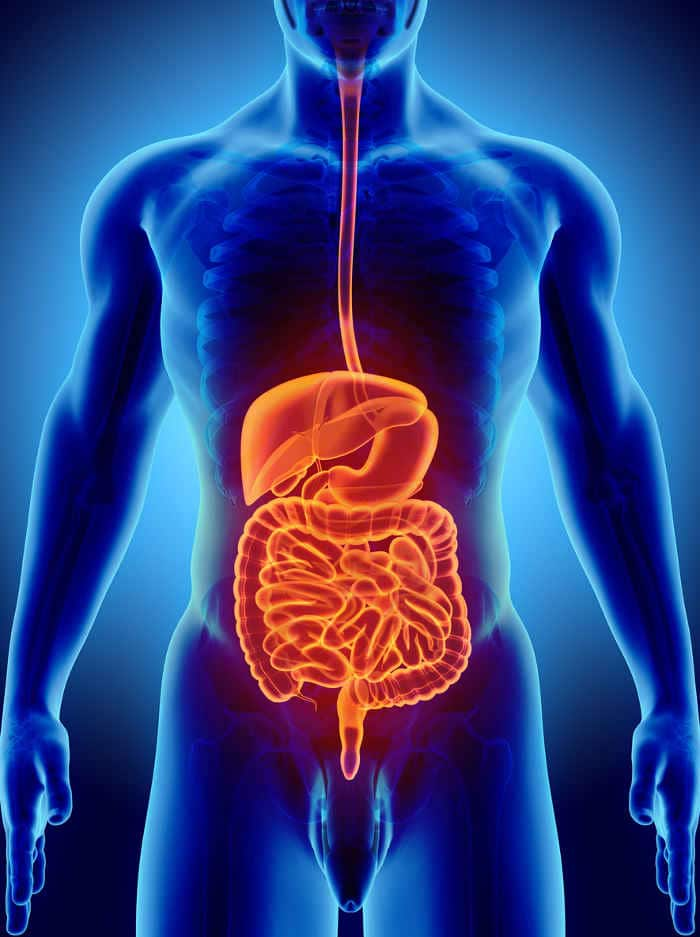
Which human system do you see in the image?

a)

digestive system

b)

respiratory system

c)

circulatory system

d)

nervous system

22.

The system that provides movement, support, and blood cells to the body is?

a)

skeletal system

b)

muscular system

c)

digestive system

d)

urinary stystem

23.

Which type of waste is removed by the respiratory system?

a)

carbon dioxide

b)

bile

c)

urine

d)

amino acids

24.
I take and absorb the nutrients that your body needs from your food and I put it in your bloodstream so your body can use it.  What am I?
a)
lungs
b)
liver
c)
small intestines
d)
large inttestines
25.
I am a muscle located behind your lungs.  I am always moving and I never get tired.  I pump blood to all parts of your body. What am I?
a)
heart
b)
lungs
c)
kidneys
d)
liver
26.
When you eat, I mix your food with chemicals made by your body, then I churn up your food into smaller parts.  What am I?
a)
small intestines
b)
large intestines
c)
liver
d)
stomach
27.
Your body can't use every part of the food you eat. The waste comes to me , and I dry it out so it can leave your body. What am I?
a)
kidneys
b)
small intestines
c)
large intestines
d)
liver
28.
We are a pair of filters that clean you blood.  We take liquid waste from your bloodstream and we send it down to your bladder. What are we?
a)
lungs
b)
liver
c)
kidneys
d)
arteries
29.
We take oxygen that your body needs from the air and put it in your blood and send it out of your body. What are we?
a)
lungs
b)
heart
c)
liver
d)
veins
30.
I hold your body parts in.  I have pores so sweat can escape your body.  I am filled with nerves that help you sense temperature and feel the things around you. What am I?
a)
skin
b)
bones
c)
heart
d)
muscles
31.
I control your muscles and all of the organs in your body.  I make sure you breathe automatically, ensure your heart beats properly, and remind you to blink your eyes. I even hold all of your thoughts and memories. What am I?
a)
muschles
b)
brain
c)
arteries
d)
veins
32.
I am sometimes called your "windpipe." When you breathe air travels through me to your lungs. What am I?
a)
esophagus
b)
trachea
c)
arteries
d)
veins
33.

I am a tube in your throat. When you swallow, food, or drink travels down through me into your stomach. What am I?

a)

trachea

b)

stomach

c)

small intestines

d)

oesophagus

34.

Cells are...

a)

groups of tissues that together carry out a particular function.

b)

groups of organs that together carry out a particular function.

c)

the structural and functional units of all living things.

d)

only found in animals.

35.

Tissues are...

a)

groups of cells that together carry out a particular function.

b)

groups of organs that together carry out a particular function.

c)

the smallest functional units of all living things.

d)

only found in animals.

36.

Molecules are made up of...

a)

cells.

b)

organs.

c)

tissues.

d)

atoms.

37.

When it comes to biological organisation, the highest level is...

a)

cells.

b)

organs.

c)

body systems.

d)

organisms.

38.

The organ you would find in the circulatory system is...

a)

the liver.

b)

the heart.

c)

the bladder.

d)

the large intestine.

39.

Organs are...

a)

groups of cells that together carry out a particular function.

b)

groups of tissues that together carry out a particular function.

c)

groups of body systems that make up an organism..

d)

unicellular.

40.

The body system you would find the small intestine in is the...

a)

circulatory.

b)

respiratory.

c)

digestive.

d)

excretory.

41.

The body system you would find the lungs in is the...

a)

circulatory.

b)

digestive.

c)

nervous.

d)

respiratory.

42.

The picture that best shows a tissue is...

a)
b)
c)
d)
43.

The picture that best shows an organ is...

a)
b)
c)
d)
44.

The picture that best shows a molecule is...

a)
b)
c)
d)
45.

The picture that best shows an organism is...

a)
b)
c)
d)
46.

What do lots of a specific type of cell make up?

a)

Tissues

b)

Organs

c)

Cell membrane

47.

What do multiple different tissues make up?

a)

Cells

b)

More tissue

c)

Organs

d)

Limbs

48.

What do multiple organs make up?

a)

Tissue

b)

Organ Systems

c)

The Human Body

49.

Which two of the below are examples of organ systems?

a)

The Digestive System

b)

The Brain

c)

The Lungs' Pleural Membrane

d)

The Cardiovascular System

50.
What is the organ where water is absorbed from the digested food and returned to the bloodstream?
a)
mouth
b)
small intestine 
c)
esophagus
d)
large intestine
51.
Which organ is a secondary organ that stores bile?
a)
stomach
b)
gallbladder
c)
pancreas
d)
liver
52.
Which organ does most of the chemical digestion of food and allows nutrients to be absorbed into the body?
a)
stomach
b)
esophagus
c)
small intestine
d)
liver
53.
Digestion in animals begins in the ______.
a)
intestines
b)
mouth
c)
stomach
d)
throat
54.
Predict the next digestive system organ in the following sequence: mouth, pharynx, esophagus, stomach, ______
a)
liver
b)
kidneys
c)
small intestines
d)
large intestines
55.
What is the short tube that stores solid waste until it is eliminated from the body through the anus?
a)
rectum
b)
liver
c)
esophagus
d)
stomach
56.
Which secondary organ produces insulin and other digestive juices to further break down the food in the small intestines?
a)
liver
b)
gallbladder
c)
mouth
d)
pancreas
57.
Which type of digestion produces physical change to the food by breaking food into smaller pieces?
a)
chemical
b)
peristalsis
c)
mechanical
d)
saliva
58.

What is the process of wave-like muscle contractions that moves food through the digestive tract?

a)

Pericardium

b)

Peristalsis

c)

Pepsin

d)

Pericoronitis

59.

What are these structures call that are found on the lining of the small intestine?

a)

Gallbladder

b)

Villi

c)

Sphincter

d)

Duodenum

60.
Which enzyme below is involved in the following chemical digestion process?
FATS---->FATTY ACIDS/GLYCEROL
a)
Lipase
b)
Trypsin
c)
Amylase
d)
Pepsin
61.
Where in the body would HCl be found?
a)
Mouth
b)
Esophagus
c)
Liver
d)
Stomach
62.
Which of the following is considered "acidic" on the pH scale?
a)
2
b)
7
c)
8
d)
14
63.
What is the function of an enzyme?
a)
enzymes break themselves into small pieces
b)
enzymes slow down chemical reactions
c)
enzymes speed up chemical reactions
d)
enzymes combine products to form reactants 
64.
What is another name for enzymes?
a)
chemical catalyst
b)
microorganism
c)
biological catalyst
d)
catalyst
65.
The mouth contains salivary glands which produce
a)
polysaccharides
b)
amylases
c)
proteases
d)
lipases
66.
Protein digestion begins in the
a)
mouth
b)
esophagus
c)
stomach
d)
liver
67.

What is the order of the organs in the digestive system?

a)

Oesophagus, Stomach, Large intestine, Small intestine, Mouth

b)

Mouth, Oesophagus, Stomach, Small intestine, Large intestine

c)

Stomach, Large intestine, Oesophagus, Mouth, Small intestine

d)

Mouth, Stomach, Oesophagus, Small intestine, Large intestine

68.

What enzyme breaks down lipids?

a)

Carboyhydrases

b)

Proteases

c)

Lipases

69.

Which letter is the small intestine?

a)

A

b)

B

c)

C

d)

D

e)

E

70.

What are proteins broken down into during digestion?

a)

Fats and glycerol

b)

Protease

c)

Amino acids

d)

Sugars (glucose)

71.

Why do we need carbohydrates in our diet?

a)

Provide energy

b)

For growth and repair

c)

Insulation

d)

Help move food through the gut

72.

What is the role of digestive enzymes?

a)

To absorb nutrients into the blood

b)

To absorb excess water from food that has not been digested

c)

To break down large, insoluble molecules into smaller, soluble molecules

d)

To synthesise larger molecules from the food we eat

73.

What enzyme would break down pasta?

a)

Protease

b)

Carbohydrase

c)

Lipase

74.

What are the digestive enzymes?

a)

Protein, Carbohydrate, Lipid/Fat

b)

Amino acids, sugars, fatty acids and glycerol

c)

Protease, Carbohydrase, Lipase

d)

Protonene, Carbohydronene, Lipene
75.
Enzymes are
a)
nucleic acids
b)
proteins
c)
lipids
d)
carbohydrates
76.
Which of the following binds to the active site of an enzyme? 
a)
substrate
b)
product
c)
codon
d)
none of the above
77.
Based on the graph, what temperature does this enzyme work best? 
a)
15 C
b)
40 C
c)
30 C
78.
Which enzyme takes starch and makes it into glucose
a)
Sucrase
b)
catalase
c)
lactase
d)
Amylase
79.
What does the mouth do in the digestive process?
a)
It takes food and breaks it down chemically and physically
b)
It only breaks down chemically
c)
It lets you breathe while you eat.
d)
It only breaks down physically
80.
Where nutrients go after the small intestine has absorbed them.
a)
bloodstream
b)
stomach
c)
esophagus
d)
kidneys
81.
This enzyme digests carbohydrates
a)
Protease
b)
Carbohydrase
c)
Lipase
d)
Bile
82.
The role of the villi in the small intestine is to....
a)
remove water from the food
b)
absorb nutrients from the food
c)
break protein into amino acids
d)
break protein into starch
83.
With what 3 letters do enzymes typically end?
a)
-ose
b)
-ase
c)
-ese
d)
-tic
84.
Each enzyme only has 1 substrate that will fit its active site.  What is this called?
a)
reusable
b)
catalyst
c)
specific
d)
fragile
85.
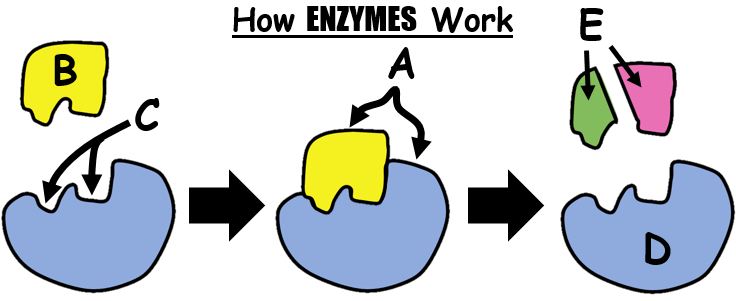
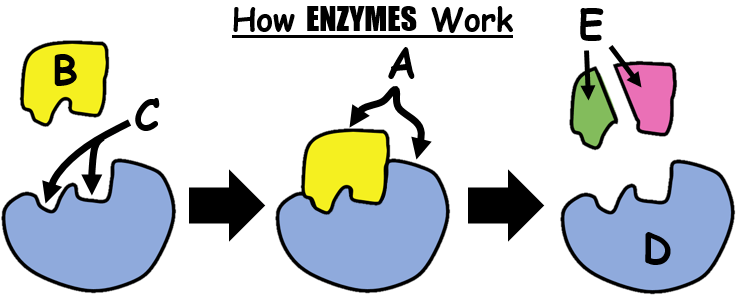
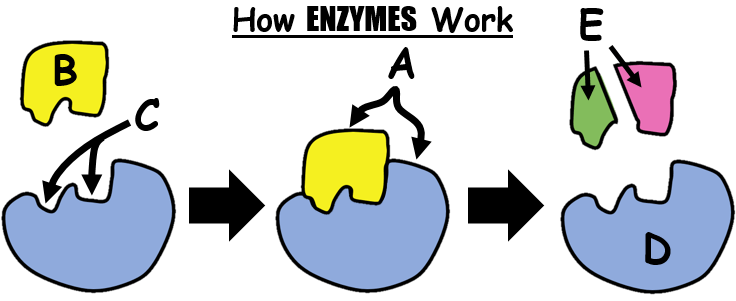
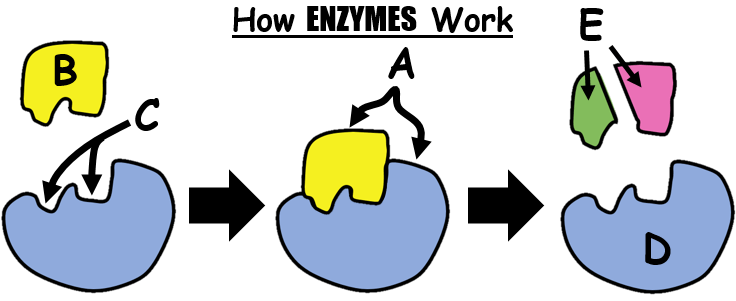
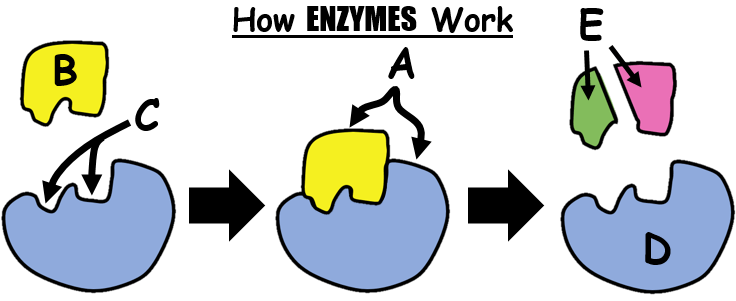
In the diagram, what is letter A? 
a)
product
b)
substrate
c)
enzyme-substrate complex
d)
active site
86.
Letter D...
a)
active site
b)
enzyme
c)
substrate
d)
products
87.
Letter B...
a)
active site
b)
enzyme
c)
substrate
d)
products
88.
Letter C...
a)
active site
b)
enzymes
c)
substrate
d)
products
89.
Letter E...
a)
active site
b)
enzyme
c)
substrate
d)
products
90.

What happens when enzymes are heated to a high temperature?

a)

The enzymes die.

b)

The shape of the enzyme are changed and it denatures

c)

The enzymes' amino acid sequence changes.

d)

The enzymes remain the same

91.
When the eyeball is too long causing Nearsightedness
a)
Myopia
b)
Hyperopia
c)
Asigmatism
d)
Presbyopia
92.
When the eyeball is too short, causing Farsightedness
a)
Hyperopia
b)
Myopia
c)
Glaucoma
d)
Astigmatism
93.
Area of the retina that doesn't contain any photoreceptors (your blind spot)
a)
Optic Nerve
b)
Optic Disc
c)
Ciliary body
d)
Cornea
94.
What is this?
a)
Ciliary Body
b)
Suspensory Ligaments
c)
Sclera
d)
Choroid
95.
What is this?
a)
Choroid
b)
Lens
c)
Sclera
d)
Ciliary Body
96.
What is this?
a)
Lens
b)
Pupil
c)
Iris
d)
Cornea
97.
What is this?
a)
Optic Nerve
b)
Optic Disc
c)
Retina
d)
Sclera
98.
What is this?
a)
Cornea
b)
Choroid
c)
Cones
d)
Lens
99.
What part of the eye is the colored, muscular portion of the eye which controls pupil size?
a)
iris
b)
lens
c)
choroid
d)
ciliary body
100.
Which part of the eye is the outer white part of the eye?
a)
cornea
b)
iris
c)
ciliary body
d)
sclera
101.
What part of the eye focuses light on the retina?
a)
lens
b)
retina
c)
pupil
d)
ciliary body
102.
What part of the eye is a clear protective structure that allows light to enter the eye?
a)
iris
b)
retina
c)
cornea
d)
choroid
103.
What part of the eye sends nerve impulses to the brain
a)
optic nerve
b)
iris
c)
cornea
d)
sclera
104.

Respiration takes place in

a)

the cells

b)

the lungs

c)

the heart

d)

the brain

105.

Is respiration the same as breathing?

a)

Yes

b)

No

106.

For respiration to take place glucose needs to react with substance A. Select substance A.

a)

Carbon dioxide

b)

Water

c)

Oxygen

d)

Ozone

107.

When respiration takes place, energy is produced along with another two substances B and C. Select substances B and C.

a)

Carbon dioxide

b)

Water

c)

Oxygen

d)

Ozone

108.

The glucose used during respiration is provided by our

a)

digestive system

b)

respiratory system

c)

circulatory system

109.

The oxygen used during respiration is provided by our

a)

digestive system

b)

respiratory system

c)

circulatory system

110.

The glucose and oxygen used during respiration is delivered to each and every cell by the

a)

digestive system

b)

respiratory system

c)

circulatory system

111.

While exercising our body needs to produce

a)

more energy

b)

less energy

112.

During exercise our body needs to produce more energy by respiration thus it needs

a)

less oxygen

b)

more oxygen

113.

During exercise our body needs to produce more energy by respiration thus it needs more oxygen. Our breathing rate

a)

increases

b)

decreases

114.

Do plant cells carry out respiration

a)

Yes

b)

No

115.

What type of respiration requires oxygen?

a)

Aerobic

b)

Anaerobic

c)

both above

d)

None of the above

116.

Which type of respiration is most efficient?

a)

Aerobic

b)

Anaerobic

117.

Where does cellular respiration occur?

a)

Nucleus

b)

Mitochondria

c)

Vacuole

d)

Chloroplast

118.
What cells in the body may undergo lactic acid fermentation during exercise? 
a)
Muscle cells
b)
Fat cells
c)
Liver cells
d)
Skin cells
119.
Which compounds are produced by the two main types of fermentation? 
a)
NAD+ or ATP
b)
alcohol or lactic acid
c)
glucose or carbon dioxide
d)
ADP or ATP
120.
Which of the following statements is true?
a)
Animal cells use cellular respiration and plant cells only use photosynthesis
b)
Animal cells use photosynthesis and cellular respiration and plants just use photosynthesis
c)
Animal cells use cellular respiration, plant cells use both cellular respiration and photosynthesis
d)
Animal and plant cells both use cellular respiration and photosynthesis
121.
Why is yeast used to bake bread? 
a)
The waste gas, CO2, makes bread rise
b)
The alcohol produced makes bread dangerous
c)
The yeast consumes O2, causing bread to rise
122.

Happens without oxygen

a)

aerobic

b)

anaerobic

c)

both

123.

May cause muscle cramps

a)

aerobic respiration

b)

anaerobic respiration

c)

both

124.

AKU ADALAH KETUA DARI AVANGERS

a)
b)
c)
d)
e)
125.
Fungi, Plants, and Animals
a)
Unicellular organisms 
b)
Multicellular organisms
126.
Multicellular Organisms
a)
Made of 1 cell
b)
Made of more than 1 cell
127.

one cell

a)

unicellular

b)

multicellular

c)

neither

128.
5. Based on this image is the Euglena multicellular or unicellular?
a)
1. Multicellular
b)
2. Unicellular
129.

bacteria

a)

unicellular

b)

multicellular

c)

neither

130.

A spider is an example of...

a)

Unicellular Organism

b)

Multicellular Organism

c)

Neither

d)

Both

131.

The coronavirus is an example of...

a)

Unicellular Organism

b)

Multicellular Organism

c)

Neither

d)

Both

132.
This is a tube about 12cm long with c-shaped rings of cartilage to keep it open
a)
Nasal cavity
b)
Trachea
c)
Mouth Cavity
d)
Pharynx
133.
Two short tubes that carry air into the lungs
a)
Trachea
b)
Bronchioles
c)
Lungs
d)
Bronchi
134.
Clusters of tiny air sacs that allow the exchange of oxygen and carbon dioxide
a)
Pharynx
b)
Diaphragm
c)
Alveoli
d)
Lungs
135.
Lung volume might vary because of
a)
Activity level
b)
All of these
c)
Smoking
d)
Asthma
136.
Muscular structure that helps to expand and contract the lungs, forcing air in and out
a)
Pharynx
b)
Nasal cavity
c)
Alveoli
d)
Diaphragm
137.
Smaller tubes within the lungs
a)
Bronchioles
b)
Bronchi
c)
Lungs
d)
Alveoli
138.
What is the function of the respiratory system
a)
Take in O2 only
b)
Remove CO2 only
c)
Take in O2 ad remove CO2
d)
Make sugar
139.
Made up of spongy, elastic tissue that stretches as you breathe
a)
Alveoli
b)
Lungs
c)
Nasal Cavity
d)
Pharynx
140.
Alveoli increase the surface area in the lungs to allow...
a)
More nutrients to be absorbed
b)
You to breathe faster
c)
You to breathe slower
d)
More O2 and CO2 to exchange