
 Worksheets
Organic chemistry
Total questions: 58
Worksheet time: 52mins

-COOH is the functional group for...
alcohols
esters
carboxylic acids
amides

-COO is the functional group for...
alcohols
esters
carboxylic acids
amides

-OH is the functional group for...
alcohols
esters
carboxylic acids
amides
alkene + ? --> alcohol
hydrogen
oxygen
water
carbon dioixde
alcohol + ? --> carboxylic acid
hydrogen
oxygen (oxidising agent)
water
carbon dioixde

Name the polymer formed from this monomer
chloroethene
chloroethane
dichloroethene
dichloroethane
C5H12 + Br2 --> C5H11Br + HBr
This reaction is called____________________.
Substitution
Addition
Cracking
Combustion

Which reaction is not an electrophilic addition ?
A
B
C
D

Which of these always applies to a nucleophile
A
B
C
D
Bromine reacts with ethene to form 1, 2-dibromoethane.
What is the correct description of the organic intermediate in this reaction ?
It has a negative charge
It is a free radical
It is a nucleophile
It is an electrophile

A
B
C
D

Which pair of homologous series have the same C:H ratio in their general formula
1) Aldehydes and Ketones
2) Carboxylic acids and esters
3) Alkenes and Ketones
A
B
C
D

A
B
C
D

A
B
C
D

A
B
C
D

Name this carboxylic acid
ethanoic acid
prpoanoic acid
butyl butanoate
butanoic acid

Name this ester
ethyl ethanoate
propyl ethanoate
methyl ethanoate
ethyl methanoate

what is IUPAC name of following structure tert. butyl alcohol?
2 - methoxy propane
2 - methyl 2 - propanol
2 - methyl propanol
2 - methoxy butane

What is IUPAC name of following structure?
Butan - 1,4 - dioic acid
Prop - 1,3 - dioic acid
Pent - 1,4 - dioic acid
ethan - 1,2 - dioic acid


Select the correct name of the following formula. C6H10
Hexane
Hexene
Hexanol
Hexyne
Select the correct name of the following formula. C6H11NH2
Hexanamine
Hexene
Hexenol
Hexenamine

A
B
C
D


Name the following molecule:
3,3-dimethyl-1-butanol
3,3-methyl-1-butanol
2,2-dimethyl-4-butanol
3,3,3-trimethyl-1-propanol
Which is the structures with IUPAC nomenclature
2,2,4-trimethylpentane
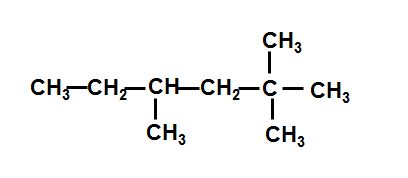
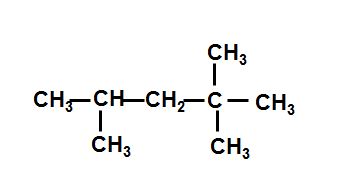
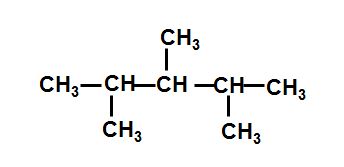
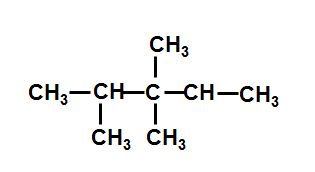

molecule with the same molecular structure but different structural formula
fats
lipids
fossil fuels
isomers
Reagent needed to change an alcohol to an alkene
concentrated H2SO4
KOH (alc)
water/dilute H2SO4
Cr2O72-/H+
When the HBr is added to propene the product/ products formed is/are
2-bromopropane
Propanamine
1- bromopropane
2-bromopropane and 1- bromopropane
Type of reaction (unbalanced).
CH3CH2OH → CH2=CH2
acid base
substitution
elimination
oxidation
Turns MnO4- from purple to brown
alkane
alcohol
amine
alkene
Which reagent is needed to change CH3CH=CH2 to CH3CHClCH3
Cl2 (aq)
HCl
SOCl2
PCl3
Colour change when Br2 water is added to Butene
purple to brown
purple to colourless
orange to green
orange to colourless
Nucleophile is a species that should have
Positive charge
A pair of electrons to donate
Electron deficient species
How many sigma and pi bonds are present in CH2=C=CHCH3
6 sigma and 2 pi
9 sigma and 2 pi
7 sigma and 4 pi
The stability of carbocation follows the order:
Primary> Secondary>Tertiary> Methyl
Secondary>Tertiary> Primary> Methyl
Tertiary > Secondary> Primary > Methyl
Chemical species bearing a negative charge on carbon and possessing eight electrons in its valence shell are called ------------.
Carbocations
Carbanions
Free radicals
Heterolytic fission results in the formation of-
Cations
Anions
Both cations and anions
Nucleophiles donate its pair of electrons to electron deficient species and hence behave as:
Lewis bases
Lewis acids
Bronsted acids
The change in hybridization affects electronegativity of carbon. Arrange C(sp3), C(sp2) and C(sp) in the increasing order of electronegativity.
C(sp3)<C(sp2) <C(sp)
C(sp3)< C(sp) <C(sp2)
C(sp)< C(sp2) <C(sp3)
Carbocations have ------------- shape with positively charged carbon being sp2 hybridised.
Tetrahedral
Trigonal planar
linear

What is the name for this compound?
4 - propylnonane
4 - ethylnonane
4 - propyloctane
4 - ethyloctane


Give the IUPAC name for the following compound:
1,1-dethyl-2,2-dimethylpropane
2,2-diethyl-1,1,1-trimethylethane
3-ethyl-2,2-dimethylpentane
3-ethyl-4,4-dimethylpentane

Give the IUPAC name for the following compound:
3-ethyl-5-isopropyl-4,8-dimethylnonane
3-(3-methylbutyl)-7-ethyl-2,4-dimethyheptane
7-ethyl-5-isopropyl-2,6-dimethylnonane
5-(3-methylbutyl)-3-ethyl-4,6-dimethyheptane
Which one of the following mechanisms is not involved in the reaction sequence below?
CH3CH3 → CH3CH2Cl → CH3CH2OH → CH2=CH2 → CH3CH2Br
electrophilic addition
electrophilic substitution
nucleophilic substitution
free-radical substitution
Which of the following is NOT true about nucleophiles?
donates an electron pair to an electrophile to form a chemical bond
all molecules or ions with a free pair of electrons or at least one pi bond can act as nucleophiles
nucleophile are Lewis acids by definition
a nucleophile becomes attracted to a full or partial positive charge
Which of the following statement is INCORRECT about electrophiles?
Electrophiles are positively charged or neutral species having vacant orbitals
The electrophiles are attacked by the most electron-populated part of one nucleophile
Electrophiles are Lewis base
What is the mechanism of the reaction between ethane and chlorine in sunlight?
Free radical substitution
Free radical addition
Electrophilic substitution
Electrophilic addition
Which of the following free radical is the most stable?


A
B
C
D
How to determine that a molecule exhibit cis-trans isomerism?
Restricted rotation in a carbon-carbon single bond of alkenes
Each carbon of a site of restricted rotation has 2 different atoms or groups attached to it
Exist in cyclic compouds only
Similar chemical properties
Isomerism that arises out of the difference in spatial arrangement of atoms or groups about the doubly bonded carbon atoms are called?
Structural Isomerism
Stereoisomerism
Geometrical Isomerism
Optical Isomerism
types of stereo-isomerism are optical isomerism and
cis-isomerism
trans-isomerism
cis-trans isomerism
all of them
A polar molecule will have
A difference in electronegativity
The same electronegativity
Symmetry

