wayground logo

Free Printable Worksheets

Font size

S
M
L
XL
Worksheets

SEMI- FINAL EXAM. IN GENERAL ZOOLOGY

Total questions: 100

Worksheet time: 3hrs 54mins

Name
Class
Date
1.

Which shows a correct Heterozygous pairing of alleles?

a)

Aa

b)

aA

c)

AA

d)

aa

2.

Which shows a correct Homozygous recessive pairing of alleles?

a)

Aa

b)

aA

c)

AA

d)

aa

3.

If a parent’s Genotype was Dd what possible combination of alleles couldnit give to it’s offspring?

a)

Only D

b)

D & d

c)

Only d

4.
What is a phenotype
a)
The genetic make up (code)
b)
The physical trait
5.

Which of the following describes heredity?

a)

A tiger teaching its young how to hunt

b)

A tree making food by photosynthesis

c)

Bacteria dividing into to make a new bacteria

d)

An animal eating a plant

6.

Penguins live in the Antarctic, which of the following is an adaptation that allows the penguin to survive the very cold region?

a)

Swimming under water

b)

Black and White body color

c)

Extra fatty layer for warmth

d)

Little wings

7.

Due to climatic change the turtles who lay their eggs close to shore will not hatch. Which of the following are true.

a)

Near shore turtles will survive more than far shore turtles

b)

Far shore turtles will survive more than near shore turtles

c)

All turtles will survive about the same

d)

None of the above is true

8.

Fire ants which are not native to Texas will aggressively attack bird's eggs that have a nest on the ground. Which is most likely to happen due to the fire ants arrival to Texas?

a)

Tree nesting bird population will decrease

b)

Tree nesting bird population will increase

c)

Ground nesting bird population will increase

d)

Ground nesting bird population will decrease

9.

What advantage do organisms that reproduce sexually have or organisms that reproduce asexually?

a)

Organisms that reproduce sexually can reproduce faster

b)

Organisms that reproduce sexually don't need a mate

c)

Organisms that reproduce sexually have a better chance of survival if the environment changes

d)

Organisms that reproduce sexually are exactly like their parents.

10.

If global climate changed to no snow where the snowshoe hare lives, what will probably happen to the snowshoe hare's fur color in the winter (after several generations)?

a)

The fur will stay white

b)

The fur will be brown all year

c)

The snowshoe hare will not be affected at all

d)

The fur will be light brown.

11.

The purpose of placing a celery stalk in water with food coloring added to the water is

a)

it will show how water is pulled up the xylem tissue

b)

it will show how water is pulled up the phloem tissue

c)

it will show how a celery stalk loses turgor pressure

d)

it shows nothing

12.

Sexual reproduction happens in

a)

plants only

b)

animals only

c)

some plants and animals

d)

only in one celled organisms

13.

___________ reproduction happens when sex cells from both parents join.

a)

Asexual

b)

Sexual

c)

Binary fission

d)

Budding

14.

Amoebas, hydras, and yeast reproduce asexually so

a)

offspring is exactly like their parents

b)

offspring is not like either parent

c)

offspring take a long time to be born

d)

offspring will survive if something wipes their parent out

15.

Inherited traits are controlled by

a)

nucleus

b)

chromosomes

c)

genes

d)

cells

16.

Budding is asexual reproduction because

a)

the genetic material is the same as both parents

b)

the genetic material is the same as one parent

c)

the genetic material is different from both parents

d)

the genetic material is the different than both parents

17.

Vines grow more in the rain forest because

a)

there are more trees in the rain forest

b)

vines need sun and grow up trees to get more sun

c)

vines need support and can't grow on the ground

d)

because vines are plants

18.

The Galapagos Finches have different beaks because

a)

it is an adaptation to the food type available in the bird's habitat

b)

they come from a different species of bird

c)

the beak stretches farther

d)

they use it to fight different birds

19.

If a chicken farmer wanted to increase hens that produce more eggs, he would

a)

feed the hens more

b)

give hens more antibiotics

c)

breed hens that produce more eggs than other hens

d)

keep the rooster away

20.
the children or young, such as babies or puppies, that are the result of reproduction
a)
offspring
b)
parents
c)
genes
d)
code
21.

long, twisted strand of a molecule that stores genetic material

a)

nucleus

b)

DNA

c)

cells

22.

Molecule in the shape of a double helix, found in pairs in the nucleus of each cell

a)

nucleus

b)

DNA

c)

trait

23.

the genotype "aa" would result  in a
a)
recessive trait
b)
dominant trait
24.
rods or x-shaped structures made up of the DNA molecule, found in pairs
a)
traits
b)
offspring
c)
chromosomes
d)
genes
25.

a structure in cells that controls all cell activity and reproduction, brain of the cell

a)

nucleus

b)

egg

c)

mitochondria

d)

cytoplasm

26.
T = tall, and  t = short. 
So a plant with the genotype
"Tt" would be
a)
medium sized
b)
tall
c)
short
27.
characteristics, such as facial features, eye color, hair color, skin color, or height
a)
traits
b)
genes
c)
codes
d)
offspring
28.
section of the DNA molecule that controls and determines the traits of an organism
a)
chromosome
b)
nucleus
c)
code
d)
gene
29.
H = brown hair, h = red hair, 
So genotype "Hh" results in
a)
brown hair
b)
red hair
c)
 Brownish red hair
d)
Reddish brown hair
30.
What Is Heredity?
a)
The transmission of genetic characters from parents to offspring.
b)
Something to do with genes
c)
The study of Genetics
d)
None of the above
31.
What's Genetics?
a)
None of the Above 
b)
Characteristics inherited by family
c)
100% of a gene or genes 
d)
The science of heredity, dealing with resemblances and differences of related organisms resulting from the interaction of their genes and the environment.
32.
The arctic fox lives in the tundra where it gets very cold in the winter. In summer, its coat is brownish or gray. In winter, its coat is bright white. Which of these is most likely the cause of this color change?
a)
a new learned behavior
b)
the amount of sunlight
c)
the type of food
d)
changes in the environment
33.
Which of the following explains why some animals hibernate?
a)
Animals hibernate as a defense against predators.
b)
Hibernating is a response to changes in the environment.
c)
Hibernating allows animals to grow faster.
d)
Most animals hibernate to avoid the summer’s heat.
34.
What kind of behavior is fetching a stick?
a)
characteristic
b)
inherited
c)
instinct
d)
learned
35.
Which of the following is NOT an example of an inherited behavior?
a)
bear hibernating
b)
seal tossing a ball
c)
bird building a nest
d)
spider spinning a web
36.
Which of the following best explains the seasonal migration behavior in geese, elk, whales, and butterflies?
a)
They are inherited behaviors.
b)
They are learned behaviors.
c)
They are optional behaviors.
d)
They are environmental behaviors.
37.
Which of the following would make the best topic sentence for a report on animal behavior that is inherited.
a)
Only adult animals can learn different behaviors.
b)
Humans are the only mammals that can learn behaviors.
c)
Animals are born with inherited behaviors called instincts.
d)
An instinct is a behavior an animal has after lots of practice.
38.

What happens if a population grows past its carrying capacity?

a)

The population keeps growing

b)

The population starts to die off

c)

The entire species will go extinct

d)

The carrying capacity just increases

39.

Temperature, light, air, water, and soil are all _____ parts of the environment

a)

alive

b)

biotic

c)

abiotic

d)

living

40.

What is an example of a biotic factor?

a)

skunk

b)

rocks

c)

soil

d)

water

41.

What does biodiversity mean?

a)

Only one species in an area.

b)

The different amount of species in an area

c)

All abiotic life

d)

Nitrogen fixation

42.

A population is...

a)

A group of one species in one area

b)

Multiple species that live in one area

c)

All of the living and nonliving things in an area

d)

None of these

43.

The job or role of a plant or an animal in the ecosystem.

a)

carnivore

b)

niche

c)

consumer

d)

habitat

44.

An animal that eats only plants.

a)

scavenger

b)

omnivore

c)

herbivore

d)

carnivore

45.

An animal that eats both plants and animals.

a)

carnivore

b)

omnivore

c)

herbivore

d)

scavenger

46.

An animal that eats only meat.

a)

herbivore

b)

omnivore

c)

carnivore

d)

scavenger

47.

All the green plants that provide the energy for consumers.

a)

consumers

b)

producers

c)

decomposers

d)

herbivores

48.

A diagram that shows the transfer of energy from one organism to another (who is eaten by what).

a)

ecosystem

b)

environment

c)

food chain

d)

food web

49.

A diagram that shows the transfer of energy in an ecosystem by using several food chains.

a)

ecosystem

b)

food web

c)

environment

d)

food chain

50.
The place where an organism lives is its __________.
a)
habitat
b)
ecosystem
c)
organism
d)
population
51.
All of the living AND non-living things in an area that interact with each other are called a/an __________.
a)
community
b)
habitat
c)
population
d)
ecosystem
52.
A group of different species that live together and interact in an environment are called a/an __________.
a)
community
b)
habitat
c)
population
d)
ecosystem
53.
ALL energy flow for an ecosystem begins with ...
a)
plants
b)
the moon
c)
the sun
d)
algae
54.
Which are located at the very BOTTOM of an energy pyramid? 
a)
producers
b)
consumers - Level 1
c)
consumers - Level 2
d)
decomposers
55.
A relationship where both organisms benefit is called __________.
a)
mutualism
b)
commensalism
c)
parasitism
56.
A relationship where one organism benefits and one organism is harmed is called __________.
a)
mutualism
b)
commensalism
c)
parasitism
57.
A relationship where one organism benefits and one organism is unaffected is called __________.
a)
mutualism
b)
commensalism
c)
parasitism
58.
Organisms that hunt other organisms for food are called __________.
a)
predators
b)
prey
c)
producers
d)
heterotrophs
59.
a living thing that makes its own food
a)
producer
b)
consumer
c)
decomposer
d)
herbivore
60.
a living thing that must eat other living things
a)
producer
b)
consumer
c)
decomposer
d)
carnivore
61.
an organism that breaks down dead plants and animals
a)
producer
b)
consumer
c)
decomposer
d)
onmivore
62.
the path of food energy from one living thing to another
a)
food chain
b)
food web
c)
organism
d)
energy
63.
a connection of food chains that shows many food energy paths
a)
food web
b)
energy web
c)
energy chain
d)
ecosystem
64.
what is needed to do work
a)
energy
b)
organism
c)
prey
d)
food chain
65.
an animal that hunts and eats other animals
a)
predator
b)
prey
c)
herbivore
d)
producer
66.
an animal that is hunted by another animal
a)
predator
b)
prey
c)
producer
d)
carnivore
67.
a living thing - plant, animal, bacteria...
a)
organism
b)
producer
c)
predator
d)
energy
68.
Which of the following best describes an ecosystem?
a)
all the living organisms in an area and their physical surroundings
b)
a region with a distinct climate
c)
all the living organisms of the same species throughout the world
d)
all the living organisms in an area
69.
A pod of dolphins hunting and feeding on a school of fish is an example of
a)
an ecosystem interaction.
b)
a population interaction.
c)
a community interaction.
d)
a biome interaction.
70.
The animal species shown above would most likely be found wild in which of the following biomes?
a)
grassland
b)
temperate forest
c)
tropical rainforest
d)
arctic tundra
71.
The taiga biome that covers most of Alaska is pictured above.  Which of the following only lists biotic factors that can be found in this ecosystem?
a)
freezing temperatures, low precipitation, bogs, and acidic soil
b)
owls, poor soils, moss, and caribou
c)
moss, aspen trees, weasels, and raccoons
d)
birch trees, short summers, lichen ground cover, and bears
72.
What is the ultimate source of energy for all ecosystems?
a)
the Sun
b)
plants
c)
secondary consumers
d)
primary consumers
73.
The energy pyramid below shows a possible amount of energy, in kilocalories, available in the organisms at each trophic level in an ecosystem.  According to the law of conservation of energy, energy can neither be created nor destroyed.  If this is true, why is there less energy in the top of the energy pyramid than there is in the bottom of the energy pyramid?
a)
Energy is lost between each trophic level as heat.
b)
The law of conservation of energy does not apply to ecosystems.
c)
Organisms in the top of the energy pyramid use up energy the fastest.
d)
The extra energy in the bottom is slower to reach the top.
74.
Which of the following interactions is an example of symbiosis?
a)
an insect acts as a pollinator for a plant species
b)
a population of hummingbirds migrates during the summer
c)
a tropical bird performs a courtship dance for a mate
d)
a mother bear feeds and protects her cubs
75.
A farmer plants two species of grass with similar nutrient needs on the same small plot of land.  What kind of interaction will most likely occur between the two species?
a)
parasitism
b)
competition
c)
commensalism
d)
mutualism
76.
The diagram below depicts the water cycle.  Which process is represented by the number 2?
a)
precipitation
b)
evaporation
c)
surface runoff
d)
condensation
77.
The bodies of all living things are based on carbon.  Which of the following is the primary source of carbon in living things?
a)
carbon compounds stored in fossil fuels
b)
carbon compounds in the soil
c)
dissolved carbon dioxide in the biosphere
d)
carbon dioxide in the atmosphere
78.
An increase in the atmospheric levels of carbon dioxide (CO2) is the biggest contributor to which of the following?
a)
El Nino
b)
global warming
c)
wind storms
d)
ozone depletion
79.
Which human activity has had the greatest impact on climate change?
a)
building skyscrapers
b)
deforestation
c)
burning fossil fuels
d)
production of nuclear waste
80.
A __________ is a group of organisms that can reproduce fertile offspring.  Failure to reproduce fertile offspring will cause __________ of the group.
a)
genus, evolution
b)
species, extinction
c)
phylum, extinction
d)
species, evolution
81.
Overpopulation occurs when a population exceeds its carrying capacity.  White-tailed deer are considered to be an overpopulated species in the central United States.  What is one consequence of white-tailed deer exceeding their carrying capacity?
a)
People don't see deer as often in urban areas.
b)
The deer are less healthy and more prone to disease.
c)
There are more predators to eat the deer.
d)
The deer have stopped breeding.
82.
What two factors have been the GREATEST contributors to the exponential growth of the human population during the last two centuries?
a)
plentiful food and a mild climate
b)
the industrial revolution and peace
c)
agricultural developments and peace
d)
good sanitation and medical advances
83.
After a natural disaster such as a hurricane or tornado, what will happen in the damaged ecosystem?
a)
Nothing; it will remain uninhabited.
b)
A new, different ecosystem will evolve.
c)
An ecosystem like the previous one will be re-established.
d)
No one really knows what to expect after a natural disaster.
84.
78% of Earth's atmosphere is nitrogen gas. All living things need nitrogen as a part of DNA and RNA. Yet you and I, and other living things, cannot use the nitrogen in our atmosphere directly. One type of organism is responsible for "fixing" nitrogen or helping to put it in a form so other living things can use it. That organism is
a)
bacteria.
b)
fungi.
c)
plants.
d)
viruses.
85.
Grazing cows disturb the grass and cause insects to fly around the cows as they eat. In turn, birds swoop in and eat the insects. This type of feeding relationship is an example of
a)
commensalism.
b)
mutualism.
c)
parasitism.
d)
predation.
86.
In a simple food chain, small fish eat algae; bigger fish eat the smaller fish; bears eat the bigger fish. 
Using the above scenario, which of these would have the largest amount of energy?
a)
algae
b)
bears
c)
big fish
d)
small fish
87.
The animals that live in this valley have basic needs to survive. ALL BUT one of these non-living features is a basic need of the animals living here.
a)
food.
b)
oxygen.
c)
shelter.
d)
carbon dioxide.
88.
In the organization of living things, a ______________ would include the largest number of individuals.
a)
community
b)
population
c)
ecosystem
d)
species
89.

The marine ecosystem providing the most habitat and with the MOST diversity is

a)

sandy beach

b)

rocky shore

c)

coral reef

d)

kelp forest

90.

The sandy beach has

a)

low diversity, harsh conditions

b)

low diversity, protected and safe conditions

c)

high diversity, harsh conditions

d)

high diversity, protected and safe conditions

91.

Adaptations for attachment and the ability to bend with the waves, as well as to protect against drying out, are part of organisms in this ecosystem:

a)

coral reef

b)

estuary

c)

rocky shore

d)

kelp forest

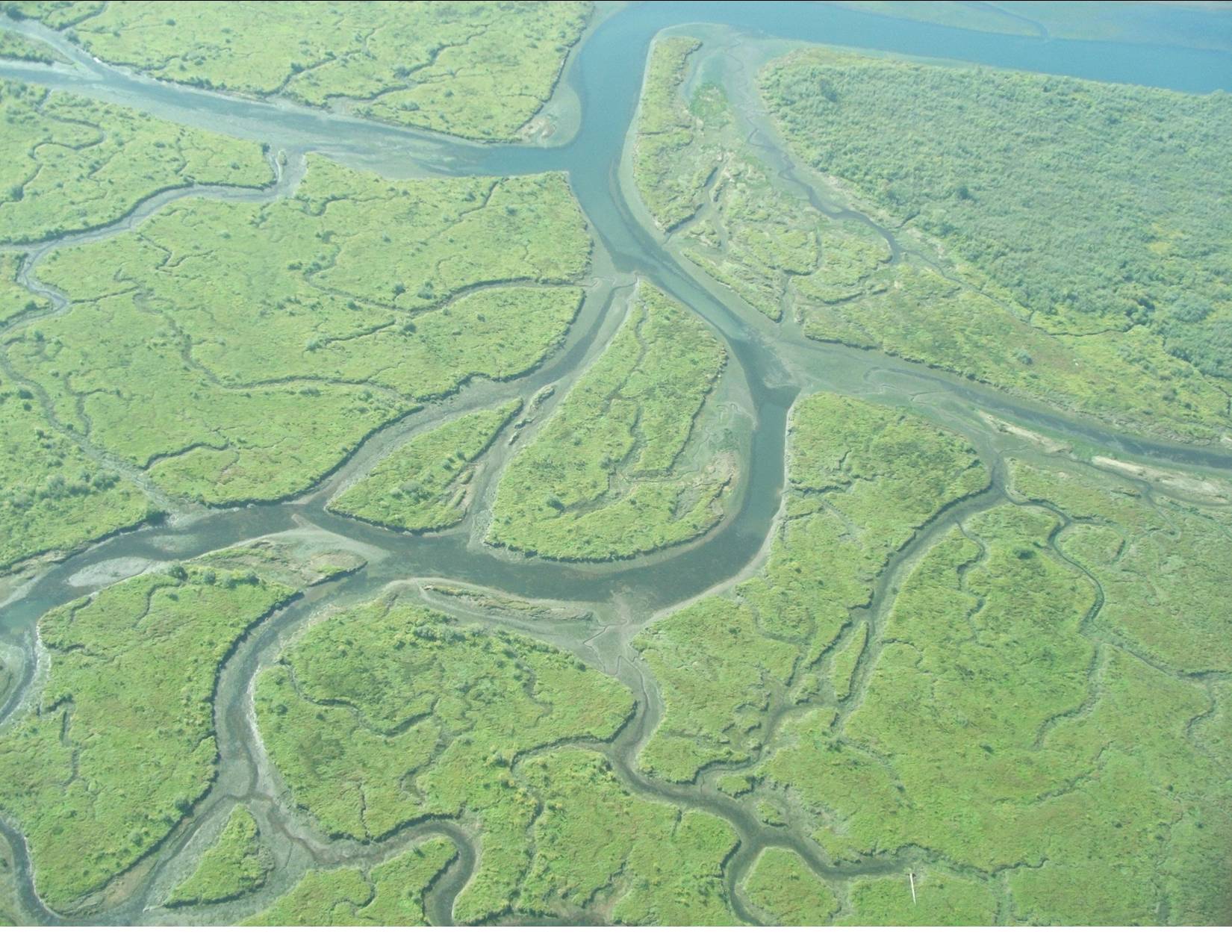
92.

This picture shows a(n)

a)

sandy beach

b)

open ocean

c)

kelp forest

d)

estuary

93.

The BIGGEST function of an estuary is providing

a)

salt products

b)

a nursery for baby organisms

c)

recreation

d)

most of the world's oxygen

94.
Smaller streams and rivers (tiny rivers) that feed into a large river or lake are called ________.
a)
Runoff
b)
Watersheds
c)
Tributaries
d)
River Systems
95.
Water from rain and melting snow that flows over the ground and into streams and storm drains.
a)
River System
b)
Flood Plain
c)
Watershed
d)
Runoff
96.
The health of an ecosystem is directly related to the:
a)
Air quality
b)
Amount of animals in the area
c)
Water quality
d)
Amount of food in the area
97.
Abiotic means: 
a)
Living
b)
Dead
c)
Non-living
d)
Water
98.
All of the following are examples of wetlands except:
a)
Bogs
b)
Prairies
c)
Marshes
d)
Swamps
99.
What kind of plants show you that you are in a bog?
a)
grasses
b)
trees
c)
moss
100.
What kind of plants show you that you are in a swamp?
a)
grasses
b)
trees
c)
moss