wayground logo

Free Printable Worksheets

Font size

S
M
L
XL
Worksheets

Biology Benchmark 3 Review

Total questions: 76

Worksheet time: 57mins

Name
Class
Date
1.

Scientists discover a single-celled organism in pond water that has a nucleus. This organism can move using a flagellum (flagella). Which pair of words can be used to describe this organism?

a)

Prokaryotic and unicellular

b)

Prokaryotic and motile

c)

Eukaryotic and multicellular

d)

Eukaryotic and motile

2.
Characteristics of an organism:
1. Cannot move itself around
2. Absorbs food particles
3. Made of many cells
4. Cells have nuclei
Which word cannot be used to describe this organism?
a)
Eukaryotic
b)
Heterotrophic
c)
Immotile
d)
Unicellular
3.
Scientists are studying an organism that can make its own food. It is made of trillions of cells, and each cell has its own nucleus. Which pair of words could be used to describe this organism?
a)
Autotrophic and prokaryotic
b)
Autotrophic and eukaryotic
c)
Heterotrophic and eukaryotic
d)
Heterotrophic and multicellular
4.
Animals are considered highly motile organisms. This is because animals-
a)
can make their own food
b)
can move themselves around
c)
are composed of a single cell
d)
do not contain nuclei in their cells
5.

Which of the following kingdoms are matched correctly with their domain?

a)

Archaea --> Bacteria, Protists, Fungi

b)

Eukayra --> Bacteria, Protists & Fungi

c)

Eukarya --> Plantae, Animalia & Fungi

d)

Bacteria --> Archaea, Animalia, Protists

6.

Which animal would be classified in the Kingdom Animalia?

a)

Organism 1

b)

Organism 2

c)

Organism 3

d)

Organism 4

7.
Protists are a group of mostly single-celled organisms. All protists are considered eukaryotic. What makes protists eukaryotic?
a)
All protists can make their own food
b)
All protists contain a cell nucleus
c)
Every protist is able to move itself around
d)
Every protist is classifies as unicellular
8.
This domain is characterized by ancient bacteria that can live in extreme environments, such as volcanoes.
a)
Archaea
b)
Bacteria
c)
Eukarya
d)
Prokarya
9.
Organisms in the Kingdom Animalia are mostly unicellular Eukaryotes.
a)
True
b)
False
10.
What are the three domains?
a)
Archaea, Bacteria, and Eubacteria
b)
Archaea, Protists, and Eubacteria
c)
Archaea, Bacteria, and Eukarya
d)
Archaea, Fungi, Animalia
11.
Which is TRUE about the members of the domain Bacteria?
a)
They are multicellular.
b)
They are prokaryotes.
c)
They are only heterotrophic.
d)
The cell walls always contain peptidoglycans.
12.
Which applies to members of the kingdom FUNGI?
a)
They have cell walls of chitin
b)
They have no cell walls or chloroplasts
c)
They include slime molds and giant kelp
d)
They include mosses and ferns
13.
Which applies to members of the kingdom PLANTAE?
a)
They have cell walls of chitin
b)
They have no cell walls or chloroplasts
c)
They include slime molds and giant kelp
d)
They include mosses and ferns
14.
Which applies to members of the kingdom ANIMALIA?
a)
They have cell walls of chitin
b)
They have no cell walls or chloroplasts
c)
They include slime molds and giant kelp
d)
They include mosses and ferns
15.

_____ and _____ are organelles that arose from endosymbiosis

a)

nucleus and cell membrane

b)

mitochondria and chloroplasts

c)

cell wall and chloroplasts

d)

mitochondria and nucleus

16.

The theory of Endosymbiosis explains

a)

The origin of eukaryotes

b)

How bacteria live

c)

How species develop

d)

Why cells rely on one another

17.

Which of the following is NOT evidence to support endosymbiotic theory?

a)

Mitochondria is found outside the cells

b)

Mitochondria and chloroplast reproduce similar to ancient bacteria

c)

Mitochondria and chloroplast have their own cell membrane

d)

Mitochondria and chloroplast have their own genetic material

18.
According to this cladogram, sharks are MOST closely related to which organism? 
a)
Amphibians
b)
Ray finned fish
c)
Crocodiles
d)
Birds
19.

At what point in the cell cycle does DNA replication occur?

a)

During interphase, before a cell undergoes mitosis.

b)

During mitosis

c)

During meiosis

d)

During transcription t

20.

Which choice describes DNA after replication has taken place (this also means the process is semi-conservative)?

a)

one molecule with two original strands and one molecule with two new strands

b)

two DNA molecules, each with one original and one new strand

c)

two molecules, each with two new strands

d)

two molecules, each with two old strands

21.

Which of the following would most likely cause a mutation?

a)

the placement of ribosomes on the endoplasmic reticulum

b)

the insertion of a nucleotide into DNA during replication

c)

the movement of transfer RNA out of the nucleus

d)

the release of messenger RNA from DNA

22.
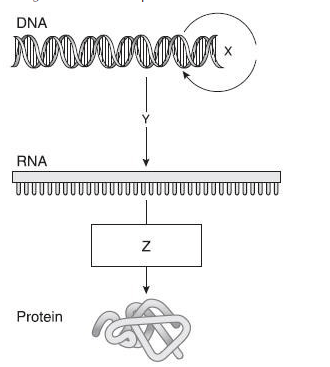
 A diagram of a cellular process is shown below. Which of the following identifies the process shown at point Z?
a)
Translation
b)
Translocation
c)
Replication
d)
Transcription
23.
Which of the following carries amino acids to the site of protein synthesis? 
a)
mRNA
b)
rRNA
c)
tRNA
d)
nRNA
24.
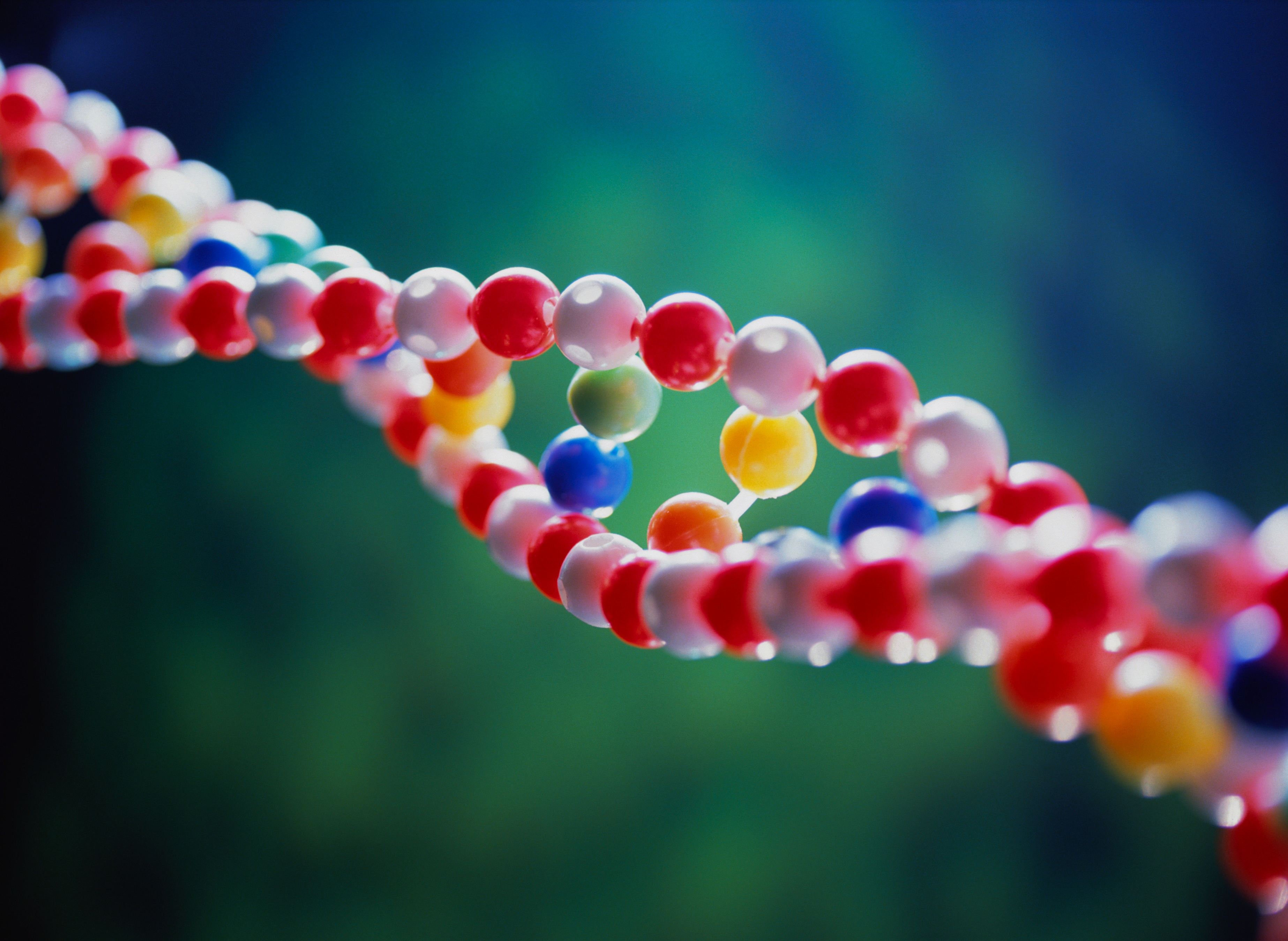
Base your answer to the following question on the structures represented in the diagram below. What is the relationship between these three structures?
a)
 DNA is made up of proteins that are synthesized in the cell.
b)
Protein is composed of DNA that is stored in the cell.
c)
DNA controls the production of protein in the cell.
d)
 The cell is composed only of DNA and protein.
25.

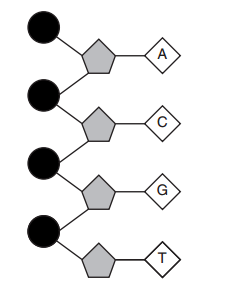
The diagram below represents a portion of a DNA molecule. The letters represent different types of

a)

sugar molecules

b)

nitrogen bases (also called nucleotides)

c)

enzymes

d)

proteins

26.

In DNA replication, which sequence of DNA bases would pair with this partial strand:

CAT TCA CTG ?

a)

AUG TGA CAG

b)

TAC ACU GTC

c)

GTA AGT GAC

d)

CAT TCA CTG

27.

A process in which DNA has the unique ability to make an exact copy of itself and when a mutation could occur.

a)

Replication

b)

Translation

c)

Transcription

28.
Why is DNA important?
a)
it is very small and very complicated
b)
it's in everything
c)
it serves as the blueprint for traits of all living things
d)
because we eat it every day for energy
29.

DNA is the instructions on how to make..

a)

carbohydrates

b)

proteins

c)

phosphates

d)

lipids

30.
Which of the following is not a base found in DNA?
a)
adenine
b)
thymine
c)
cytosine
d)
uracil
31.
What is the process that copies information from DNA into RNA?
a)
protein synthesis
b)
transcription
c)
translation
d)
DNA Polymerase
32.

Which of the following is the complementary mRNA sequence to this DNA strand: AACTGAA

a)

UUGACUU

b)

TTGACTT

c)

AACTGAA

d)

AACUGAA

33.

Translate the mRNA sequence to an amino acid sequence.


AUG-CCC

a)

Met-Pro

b)

Met-His

c)

His-Pro

d)

His-Met

34.
How many base pairs would be needed to chain together 3 amino acids?
a)
3
b)
6
c)
9
d)
12
35.
What is assembled during transcription?
a)
transfer RNA
b)
messenger RNA
c)
DNA replication
d)
court proceedings
36.

What is the end product of translation?

a)

transfer RNA

b)

messenger RNA

c)

Proteins

d)

Spanish Rice

37.

One difference between DNA and RNA is...

a)

they type of phosphate

b)

DNA has the sugar deoxyribose and RNA has ribose.

c)

having C pair with G

d)

Having A's

38.

Why do we need proteins?

a)

They provide the genetic code.

b)

They are the building blocks of living organisms and control biological processes.

c)

They provide energy for the cell.

d)

They provide insulation to living organisms and are the major macromolecule found in cell membranes and cell walls.

39.
A 3 nucleotide sequence of mRNA
a)
codon
b)
anticodon
40.
The site of protein synthesis?
a)
nucleus
b)
ER
c)
Ribosome
d)
Golgi Body
41.

A mutagen is something that causes a mutation. Which of the following is NOT an example of a mutagen?

a)

radiation

b)

chemicals

c)

virus

d)

thymine and adenine

42.
In a molecule of double-stranded DNA, the amount of Adenine present is always equal to the amount of
a)
cytosine
b)
guanine
c)
thymine
d)
uracil
43.
What determines the code, or information, of a DNA molecule?
a)
the shape (structure) of the nitrogen bases
b)
the order (sequence) of the nitrogen bases
c)
the color of the nitrogen bases
d)
the frequency (number) of nitrogen bases
44.
Which organelle is DNA usually found in?
a)
cell membrane
b)
vacuole
c)
chloroplast
d)
nucleus
45.

Mutations that results in one or more changes in the amino acids (different amino acids) are called

a)

Nonsense

b)

Missense

c)

Silent

d)

No go amigo

46.

Mutations that results in a premature STOP (stops before the amino acids have been completed for the protein) are called

a)

Nonsense

b)

Missense

c)

Silent

d)

No go amigo

47.

All of the statements EXCEPT one are true about mutations. Which statement is false?

a)

Mutations must be present in both parents and then passed to offspring.

b)

Mutations can be positive and produce organisms with improved traits.

c)

Mutations can be fatal to the organism that has a mutation, if the mutation is in a critical gene.

d)

Mutations can be silent, and not affect the organism that has them, if the mutation is in a non-critical area.

48.

If you have an extra base at the end of your mutated DNA. What type of mutation occurred?

a)

Substitution

b)

Frameshift

c)

Duplication

d)

Insertion

49.

How many bases are affected in a point - substitution mutation?

a)

one

b)

two

c)

three

d)

every base that is after the substitution

50.

A type of substitution in which there is no change in the amino acids is called a __________________ mutation

a)

Missense

b)

Nonsense

c)

Silent

d)

Deletion

51.

Which of the following would result in a frameshift mutation?

a)

Insertions only

b)

Substitution only

c)

Deletion only

d)

Insertions and Deletions

52.

DNA molecule segment is : TTA CGC AAG

The mutated DNA segment is TTC GCA AG. This is an example of ___ mutation.

a)

Substitution

b)

Deletion

c)

Insertion

d)

Inversion

53.
Normal-
GAG-CTC-GAC-AGA
Mutant
GAG CTC-CAC-AGA
a)
no mutation
b)
substitution
c)
insertion
d)
deletion
54.

Original DNA: ATC CAT

Mutation DNA: ATC GCA T

What mutation occurred?

a)

deletion

b)

insertion

c)

silent

d)

transverse

55.

Which type of mutation is MOST LIKELY to cause the greatest disruption?

a)

Frameshift

b)

Silent

c)

Point

56.
A characteristic that improves an individual's ability to survive and reproduce in a particular environment.
a)
Ancestor
b)
Adaptation
c)
Descendant
d)
Fossil
57.

When humans select a few organisms with desired traits to serve as parents of the next generation. Selective breeding of plants and animals to promote the occurrence of desirable traits in offpsring.

a)

Evolution

b)

Natural Selection

c)

Generation Time

d)

Artificial Selection

58.
An original species from which all other species evolved.
a)
Fossil
b)
Natural Selection
c)
Descendant
d)
Common Ancestor
59.
Change in a kind of organism over time; process by which modern organisms have descended from ancient organisms.
a)
Extinction
b)
Genetic variation
c)
Natural Resources
d)
Evolution
60.
Differences among individuals in the composition of their genes or other DNA segments.
a)
Natural Selection
b)
Derived traits
c)
Genetic Variation
d)
Adaptation
61.
Formation of new species.
a)
Speciation
b)
Trait
c)
Fossil record
d)
Ancestor
62.
A group of similar organisms that can breed and produce fertile offspring.
a)
Fossils
b)
Species
c)
Descendants
d)
Evolution
63.

What is natural selection?

a)

inherited characteristic that increases chances of survival

b)

organisms with traits well suited to their environment survive and reproduce at a greater rate

c)

a growing population causes a scarcity of resources

d)

differences in the DNA sequence

64.
Some organisms that share a common ancestor have features that have different functions, but similar structures.  These are known as
a)
vestigial structures
b)
analogous structures
c)
homologous structures
d)
fossil structures
65.

Evolved from different ancestors, but due to living in similar environments have a similar function.

a)

Homologous structures

b)

Analogous structures

c)

Vestigial structures

d)

All of the above

66.

What characteristic do all the organisms on this cladogram share?

a)

Being bi-pedal & having language

b)

Complex brains

c)

Fully binocular vision

d)

Partial binocular vision & opposable thumbs

67.

An anatomical feature that no longer seems to have a purpose in the current form of an organism

a)

Homologous structure

b)

Analogous structure

c)

Vestigial structure

d)

None of the above

68.

Which of the following is an example of the founder effect?

a)

Bald Eagles are hunted until near extinction, population recovers.

b)

Small group of iguanas floats to an island, starts a new population.

c)

Red fox pups are more likely to survive in a snowy environment if they are born white.

d)

Farmer chooses seeds from largest apples to plant next year. This results in larger apples from year to year.

69.
The Table below shows the # of differences in amino acids in a protein called “Cytochrome C” when comparing humans to other organisms. The protein is used by many plants and animals to convert energy in cells.
List the 4 closest human relatives based on this biochemical comparison.
a)
chimpanzee, horse, rattlesnake, snapping turtle
b)
chimpanzee, gorilla, rhesus monkey, horse
c)
fruit fly, bread mold, tuna fish, snapping turtle
d)
gorilla, rhesus monkey, rattlesnake, gorilla
70.

What is an example of artificial selection?

a)

Letting dogs choose their own mate

b)

Letting plants pollinate on their own

c)

Crossing a labrador and a poodle to create a labradoodle

71.
A  population of cockroaches was sprayed with an insecticide.  Some cockroaches survived and produced a population of cockroaches that was resistant to this spray.  What can BEST be inferred from this example?
a)
species will adapt no matter what the environment
b)
environment has no effect on the survival of an organism
c)
Individuals with favorable variations survive and reproduce
d)
Insecticides cause mutations that are passed on to the next generation
72.
Genetic drift is change in the allele frequency of a population due to...
a)
random chance
b)
natural selection
c)
non-random mating (sexual selection)
d)
artificial selection
73.

How do you "win" at natural selection?

a)

survive

b)

go extinct

c)

survive & reproduce

74.

Which animals have amniotic eggs?

a)

Turtle and Tuna

b)

Turtle and Leopard

c)

Lancelet and Lamprey

d)

Tuna and Slaamander

75.

What number is the common ancestor of C and D

a)

1

b)

2

c)

3

d)

4

76.
Structures or behaviors that help an
organism survive in its surroundings
a)
adaptations
b)
inherited traits
c)
learned behaviors
d)
structural behaviors