Wayground logo

Free Printable Worksheets

Font size

S
M
L
XL
Worksheets

2nd and 3rd Law of Motion

Total questions: 91

Worksheet time: 1hrs 2mins

Name
Class
Date
1.

An evil ewok threw a rock with a force of 24.6N and an acceleration of 6m/s2 at an innocent stormtrooper. What was the rocks mass?

a)

4 Kg

b)

41kg

c)

4.1kg

d)

46kg

2.

Your car has a mass of 2500 kg and a force of 5000 N. How fast will it accelerate?

a)

20 m/s2

b)

2 m/s2

c)

0.5 m/s2

d)

120 N

3.

True or False. 20,000 N= 20,000 kg ⋅ m/s2

a)

True

b)

False

4.

A 20 kg bike accelerates at 10 m/s2. What was the force?

a)

25 Newtons

b)

20 Newtons

c)

200 Newtons

d)

10 Newtons

5.

Jenny applies a 60 N force to a 20 Kg cart, what is the acceleration of the cart if friction can be neglected?

a)

1200 m/s/s

b)

0.33 m/s/s

c)

20 m/s/s

d)

3 m/s/s

6.

What is force?

a)

A push exerted on an object

b)

A push or pull exerted on an object

c)

A pull exerted on an object

d)

Nothing

7.

The mass of a wagon is 40 kg. The wagon accelerates at 8 m/s2 . What is the force?

a)

38.25 Kg

b)

320N

c)

5N

d)

300 N

8.

If an object was accelerating at 10 m/s2, and a force of 10 newtons was required to accelerate it, what was the object's mass?

a)

1kg

b)

10kg

c)

5kg

d)

2kg

9.

What is Newton's 2nd Law?

a)

F=ma

b)

Every action has an equal and opposite reaction

c)

An object at rest stays at rest, an object in motion stays in motion.

d)

Friction

10.
What Unit do we measure Force in? 
a)
Newtons
b)
Joules
c)
Force
d)
Don't know
11.
When mass is 10 kg, acceleration is 2 m/s/s, what is force?
F = ma
a)
5 N
b)
20 N
c)
8 N
d)
12 N
12.
The larger the mass you have the _____ force you need to change its motion.
a)
more
b)
less
13.
What is Newton's First Law
a)
F=ma
b)
Every action has an equal and opposite reaction
c)
An object at rest stays at rest, an object in motion stays in motion. 
d)
Friction 
14.
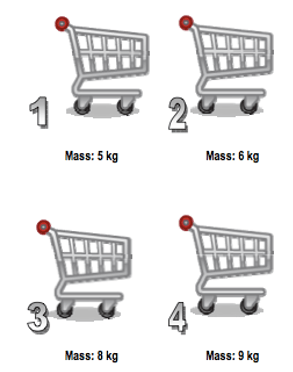
A force of 90N is applied to each cart below, which one will accelerate the fastest?
a)
Cart 1
b)
Cart 2
c)
Cart 3 
d)
Cart 4
15.

A 50-kg crate is pushed with a horizontal acceleration of 20 m/s2. What net force is acting on the crate?

a)

2.5 N

b)

0.4 N

c)

1000 N

d)

30 N

16.

What is the mass of a motorcycle that accelerates at 4 m/s2 when a net force of 400 N is applied to it?

a)

1600 kg

b)

100 kg

c)

0.01 kg

d)

396 kg

17.

A winch is supplying a force of 100 N on a large 50-kg crate to move it along a trailer bed with a friction force of 50 N. What is the acceleration of the crate?

a)

0 m/s2

b)

10 m/s2

c)

1 m/s2

d)

2 m/s2

18.

A 75-kg skydiver who has not yet opened his parachute is falling at terminal velocity. What is the magnitude of air resistance force that is acting on him?

a)

about 75 N

b)

0 N ... air is too light to exert any forces

c)

750 N

d)

10 N

19.
A cannonball with a mass of 10 kg is accelerated at 5 m/sec/sec. What net force was applied to the ball?
a)
50 Newtons
b)
5 Newtons
c)
20 Newtons
d)
9.5 Newtons
20.

A 20 kg bike accelerates at 10 m/s2. What is the force?

a)

25 Newtons

b)

20 Newtons

c)

200 Newtons

d)

10 Newtons

21.

If an object accelerates at 5.0 m/s^2, what will it's velocity be in 5.0 seconds? 

a)
5 m/s
b)
25 m/s
c)
25 m/s faster than its original velocity
d)
20 m/s faster than its original velocity
22.
Acceleration is a change in...
a)
Inertia
b)
Gravity
c)
Velocity
d)
Distance
23.
A magician pulls a tablecloth out from under dishes and glasses on a table without disturbing them.
a)
Newton's 1st Law
b)
Newton's 2nd Law
c)
Newton's 3rd Law
d)
None of them
24.

A person’s body is thrown outward as a car rounds a curve on a highway.

a)

Newton's 1st Law

b)

Newton's 2nd Law

c)

Newton's 3rd Law

d)

None of them

25.
Rockets are launched into space using jet propulsion where exhaust accelerates out from the rocket and the rocket accelerates in an opposite direction.
a)
Newton's 1st Law
b)
Newton's 2nd Law
c)
Newton's 3rd Law
d)
None of them
26.
A picture is hanging on a wall and does not move.
a)
Newton's 1st Law
b)
Newton's 2nd Law
c)
Newton's 3rd Law
d)
None of them
27.
Pushing a child on a swing is easier than pushing an adult on the same swing, because the adult has more inertia.
a)
Newton's 1st Law
b)
Newton's 2nd Law
c)
Newton's 3rd Law
d)
None of them
28.
An object at rest will remain at rest unless acted on by an unbalanced force. An object in motion continues in motion with the same speed and in the same direction unless acted upon by an unbalanced force.
a)
Newton's 1st Law
b)
Newton's 2nd Law
c)
Newton's 3rd Law
d)
None of them
29.
This law is often called "the law of inertia."
a)
Newton's 1st Law
b)
Newton's 2nd Law
c)
Newton's 3rd Law
d)
None of them
30.
A soccer ball accelerates more than a bowling ball when thrown with the same force.
a)
Newton's 1st Law
b)
Newton's 2nd Law
c)
Newton's 3rd Law
d)
None of them
31.
This law is often called "the law of inertia."
a)
Newton's 1st Law
b)
Newton's 2nd Law
c)
Newton's 3rd Law
d)
None of them
32.
A soccer ball accelerates more than a bowling ball when thrown with the same force.
a)
Newton's 1st Law
b)
Newton's 2nd Law
c)
Newton's 3rd Law
d)
None of them
33.
A student leaves a pencil on a desk and the pencil stays in the same spot until another student picks it up.
a)
Newton's 1st Law
b)
Newton's 2nd Law
c)
Newton's 3rd Law
d)
None of them
34.
For every action there is an equal and opposite reaction.
a)
Newton's 1st Law
b)
Newton's 2nd Law
c)
Newton's 3rd Law
d)
None of them
35.
For every action there is an equal and opposite reaction.
a)
Newton's 1st Law
b)
Newton's 2nd Law
c)
Newton's 3rd Law
d)
None of them
36.
The swimmer moves her hand down and to the left and her body goes forward to the right.
a)
Newton's 1st Law
b)
Newton's 2nd Law
c)
Newton's 3rd Law
37.
A rocket is sent into space.  When the power dies out, the rocket will just keep floating and moving in space forever (unless an unbalanced force, such as a meteor, runs into it).
a)
Newton's 1st Law
b)
Newton's 2nd Law
c)
Newton's 3rd Law
d)
None of them
38.
Rockets are launched into space using jet propulsion where exhaust accelerates out from the rocket and the rocket accelerates in an opposite direction.
a)
The Law of Inertia
b)
The Law of Acceleration
c)
The Law of Conservation of Momentum
39.
Rockets are launched into space using jet propulsion where exhaust accelerates out from the rocket and the rocket accelerates in an opposite direction.
a)
The Law of Inertia
b)
The Law of Acceleration
c)
The Law of Conservation of Momentum
40.

Henry sees a basketball and decides to put in motion. What kind of force does Henry use to move the ball?

a)

small

b)

balanced

c)

equal

d)

unbalanced

41.

Which activity would BEST demonstrate Newton's law of Inertia?

a)

A plate sits on a table top.

b)

A lady pushes a grocery cart.

c)

A child jumps on a trampoline.

d)

A boy swings a baseball bat.

42.

When there is an INCREASE in MASS of an object you will have a DECREASE in ______________.

a)

friction

b)

acceleration

c)

force

d)

gravity

43.
Newton's Third Law States...
a)
Objects in motion stay in motion and objects at rest stay at rest
b)
Force is equal to mass times acceleration
c)
For each action there is an equal and opposite reaction
44.
An archer shoots an arrow. The action force is the bowstring against the arrow, the reaction force is...
a)
Air resistance against the bow
b)
the arrow's push against the bowstring
c)
the grip of the archer's hand on the bow
45.
A baseball player bats a ball with a force of 1,000 N. The ball exerts a reaction force (without any additional forces action on it) against the bat of...
a)
Less than 1, 000 N
b)
1,000 N
c)
More than 1,000 N
46.
A rocket pushes exhaust 10, 000 N. Without any other forces acting on the rocket, how much force does the rocket go forward?
a)
15,000 N
b)
1,000 N
c)
10, 000 N
47.
What is the reaction force to a foot pushing down on the floor?
a)
The foot going through the floor
b)
The floor pushing back against the foot
c)
The floor breaking to the foot
48.
According to Newton's Third law the strength or magnitude of forces will be...
a)
smaller
b)
equal
c)
larger
49.

A swimmer pushes on the water and the water pushes on the hand and the swimmer moves forward. What is the ACTION force?

a)

Swimmer pushes on the water

b)

the water pushes on the hand and the swimmer moves forward

50.

A swimmer pushes on the water and the water pushes on the hand and the swimmer moves forward. What is the REACTION force?

a)

Swimmer pushes on the water

b)

the water pushes on the hand and the swimmer moves forward

51.

A bowling ball hits the pins and the pins fall over. What is the ACTION force?

a)

Bowling ball hitting pins

b)

Pins falling over

52.

The swimmer pushes off of the wall of the pool and moves forward. What is the ACTION in this example?

a)

Swimmer pushes off the wall of the pool

b)

Swimmer moves forward

53.

If you apply MORE force to the ground what happens to the ground pushing on you?

a)

The force remains the same

b)

The force increases

c)

The force decreases

54.

If the gymnast decreases the force they exerts on the trampoline, what will the reaction be?

a)

The gymnast will be pushed back by the trampoline with more force and go higher into the air

b)

The gymnast will be pushed back by the trampoline with less force and not go as high into the air

c)

No change will happen to the gymnast

55.

The baseball player wants to hit a homerun. What does he have to do to the force they exert on the ball?

a)

The baseball player will need to apply more force to the bat swinging at the ball

b)

The baseball player will need to apply less force to the bat swinging at the ball

c)

The baseball player should change nothing about his swing

56.

Katniss Everdeen applies 20 N of force back on her bow. What happens to the arrow when she lets go?

a)

The arrow goes backwards

b)

The arrow goes forwards with 20 N

c)

The arrow goes forwards with 30 N

d)

The arrow goes forwards with 0 N

57.
Which law explains how rockets are launched into space?
a)
Newton's First Law of Motion
b)
Newton's Second Law of Motion
c)
Newton's Third Law of Motion
d)
Newton's Fourth Law of Motion
58.
Which law says that for every action there is an equal and opposite reaction?
a)
Newton's First Law of Motion
b)
Newton's Second Law of Motion
c)
Newton's Third Law of Motion
d)
Newton's Fourth Law of Motion
59.
How many Laws of Motion are there?
a)
1
b)
2
c)
3
d)
4
60.
Who was the scientist who gave us the Laws of Motion?
a)
Sir Isaac Newton
b)
Albert Einstein
c)
Galileo Galilei
d)
Aristotle
61.
For every action there is an equal and opposite re-action.
a)
Newton's First Law of Motion
b)
Newton's Second Law of Motion
c)
Newton's Third Law of Motion
d)
Newton's Fourth Law of Motion
62.
Which best explains why we are able to accelerate forward when starting to run?
a)
As one leg moves backward, it provides an equal and opposite force for the other foot to move forward.
b)
No acceleration takes place. Runners are always at a fixed velocity.
c)
The striking foot pushes backward against the ground. The friction with the ground provides an equal and opposite force forward.
d)
The runner's upper body quickly leans forward, causing the entire body to begin accelerating forward
63.
When a large truck pushes a small car with a given force, the small car is applying an equal and opposite force on the truck.
a)
True
b)
False
64.

What happens when two objects, such as a baseball and a bat, collide?

a)

They hit each other with the same force in the same direction.

b)

They hit each other with the same force in opposite directions.

c)

They hit each other with unequal force in opposite directions.

d)

One remains still while the other one moves in the same direction.

65.
Which law explains why when you put a book on a table the table pushes on the book
a)
3rd law
b)
4th law
c)
1st law
d)
2nd law
66.
Which law explains how rockets are launched into space?
a)
Newton's First Law of Motion
b)
Newton's Second Law of Motion
c)
Newton's Third Law of Motion
d)
Newton's Fourth Law of Motion
67.
According to Newton's _____ Law of Motion, when a hammer strikes and exerts force on a nail, the nail exerts an equal force back on the hammer.
a)
First
b)
Second
c)
Third
d)
Fourth
68.
a)
1st
b)
2nd
c)
3rd
69.
The push or pull that acts on an object
a)
action
b)
acceleration
c)
force
d)
inertia
70.

The resistance of an object to any change in its motion is called ______________________.

a)

inertia

b)

friction

c)

gravity

d)

weight

71.

By pushing backwards a roller skater moves forward. This is an example of Newton's

a)

First Law

b)

Second Law

c)

Third Law

d)

Law of Gravity

72.
The ____ of an object is the force of gravity on the object.
a)
mass
b)
weight
c)
volume
d)
density
73.
Acceleration due to gravity, g, is ____ m/sec2.
a)
4.9
b)

9.81

c)
19.6
d)
39.2
74.
The ____ of an object is a fundamental measure of the amount of matter in the object.
a)
mass
b)
weight
c)
volume
d)
dimension
75.

Newton's Third Law is also known as...

a)

The Law of Inertia

b)

The Law of Acceleration

c)

The Law of Conservation of Momentum (Force Pairs)

76.
According to Newton's third law forces come in pairs?
a)
True
b)
False
77.
An object at rest will _______ if no outside forces are applied.
a)
Stay at rest
b)
Increase Velocity
c)
Decrease Mass
78.
A greater applied force is required to move an object with a greater mass than one with a smaller mass.
a)
True
b)
False
79.
The SI units for force are...
a)
Kilograms
b)
Newtons
c)
Meters per second
d)
Pounds
80.
If a baseball and a cannonball are dropped from the same height at the same time, which ball will hit the ground first?
a)
the cannonball
b)
the baseball
c)
The balls land at the same time.
d)
the ball with the larger volume
81.
If an action force is a cue ball (white) hitting a billiard ball (various colors) when playing pool, then the reaction force is
a)
exerted on the table
b)
exerted on all the other billiard balls.
c)
not present
d)
exerted by the billiard ball on the cue ball.
82.
A crumpled piece of paper hits the ground before a flat sheet of paper because
a)
the acceleration of gravity is greater on the  crumpled paper.
b)
there is more air resistance against the flat paper.
c)
the crumpled paper is more massive
d)
the crumpled paper is less massive.
83.
According to Newton’s first law of motion, a moving object that is not acted on by an unbalanced force will
a)
remain in motion.
b)
eventually come to a stop.
c)
change its momentum.
d)
accelerate.
84.
Acceleration is caused by a force acting on a mass.
a)
Newton’s first law of motion
b)
Newton’s second law of motion
c)
Newton’s third law of motion
85.
For a force on an object there is an equal and opposite force.
a)
Newton’s first law of motion
b)
Newton’s second law of motion
c)
Newton’s third law of motion
86.
Without any force to change it, an object at rest stays at rest and an object in motion stays in motion
a)
Newton’s first law of motion
b)
Newton’s second law of motion
c)
Newton’s third law of motion
87.
If a force of 26 N is exerted on two balls, one with a mass of 0.52 kg and the other with a mass of 0.78 kg, which ball will have the greater acceleration?  (F=ma)
a)
The one with a mass of .78 kg will have the greatest acceleration.
b)
The one with a mass of .52 kg will have the greatest acceleration.
c)
They will both accelerate at the same rate.
88.
A 20 kg bike accelerates at 10 m/s2.  what was the force?
a)
25 Newtons
b)
20 Newtons
c)
200 Newtons
d)
10 Newtons
89.
A student pushes a box to right with a force of 10N while a young boy pushes the box to the left with a force of 8N. What is the sum of all forces on the box? 
a)
18N left
b)
18N right
c)
2N right
d)
2N left
90.
If net force acting on object is 0, then the force is considered to be..
a)
Balanced
b)
Unbalanced
c)
Equal in Direction
d)
Distance/Time
91.
Which type of force(s) will cause a change in an object's motion?
a)
gravity
b)
zero net force
c)
balanced forces
d)
unbalanced forces