
 Worksheets
Waves Review
Total questions: 96
Worksheet time: 2hrs 53mins
What are the two types of mechanical waves?
Transverse
Longitudinal
Light and Sound
Transverse and Longitudinal

Red has the _________ wavelength
shortest
longest

Red has the __________ frequency.
high
low

Violet has the __________ wavelength
shortest
longest

Violet has the __________ frequency.
low
high
What would produce the least amount of energy: ___________ wavelength and _____________ frequency.
longest wavelength and low frequency
shortest wavelength and low frequency
longest wavelength and high frequency
shortest wavelength and high frequency
Your test wants to make a sound wave louder? What should you change?
pitch
sound
amplitude
crest
How do you change the pitch?
sound
pitch
amplitude
frequency
Sound waves are longitudinal or transverse waves?
longitudinal
transverse
Light waves are longitudinal or transverse waves?
longitudinal
transverse
Sound waves are mechanical or electromagnetic waves?
mechanical
electromagnetic
Light waves are mechanical or electromagnetic waves?
mechanical
Electromagnetic

The top part of the wave is called the _______________.
Amplitude
Wavelength
Trough
Crest

_________________________ is the distance between a point on one wave and the identical point of the next wave.
Amplitude
Frequency
Crest
Wavelength

Which wave has the longest wavelength?
Red Wave
Orange Wave
Green Wave
Purple Wave

Which wave has the shortest wavelength?
Red
Violet
Orange
Green
Longitudinal waves have:
crests and troughs
crests and compressions
compressions and rarefactions
troughs and rarefactions
Transverse waves have:
crests and troughs
troughs and rarefactions
compressions and contractions
rarefactions and crests
how high (woman's voice) or low (man's voice) a sound is
pitch
wavelength
frequency
transverse
the ______ of a wave is the number of waves that pass a point in a certain amount of time.
pitch
wavelenth
frequency
transerve


What wave interaction?
reflection
refraction
diffraction
interference

What is the wave interaction?
reflection
refraction
diffraction
interference

What type of wave interaction?
reflection
diffraction
constructive interference
destructive interference

What type of wave interaction?
reflection
refraction
diffraction
interference
Which wave is the fastest? ALWAYS
mechanical
electromagentic
same
Electromagnetic waves do not need a ______
sound
medium
place
energy
Electromagnetic and mechanical waves travel at
same speed
different... electromagnetic waves are faster
different .... mechanical waves are faster

Sound waves will travel the fastest through _________
Human fat
Gold
ice
air
Electromagnetic waves move _____________ when going from gases to liquids to solids
slowly
faster
Why does an ambulance sound louder as it approaches you? This has nothing to do with wavelengths. ONLY FREQUENCY
The ambulance compresses air in front of it as it moves causing sound waves with a lower observed frequency.
The ambulance compresses air in front of it as it moves causing sound waves with a higher observed frequency.
The ambulance compresses air in front of it causing sound waves with longer observed wavelengths.
The ambulance compresses air in front of it causing sound waves with shorter observed wavelengths.

Why do the sound waves in the front look different than the sound waves in the back? NOTHING TO DO WITH WAVELENGTH
The observed waves in front have a longer wavelength and produce a higher pitch.
The observed waves in front have a shorter frequency and produce a higher pitch.
The observed waves in front have a longer wavelength and produce a lower pitch.
The observed waves in front have a higher frequency and produce a higher pitch.
If you decrease the what is shown in the picture (wavelength).... what happens
Amplitude increases
Frequency increases
Crest increases
Wavelength increases
As wavelength decreases frequency will
increase
decrease
What is amplitude
how wide the wave is
top of the wave
bottom of the wave
height (how tall the wave is)
What is frequency
number of waves you see
height of the wave
top of the wave
How wide a wave is
When the frequency of a wave is doubled, what happens to its wavelength?
doubled
halved
quartered
unchanged
If you want to match pitch what should stay the same
frequency
amplitude
wavelength
Is light electromagnetic or mechanical?
electromagnetic
mechanical
Is sound electromagnetic or mechanical?
electromagnetic
mechanical
What types of waves can travel through a medium
Only mechanical
only electromagnetic
Both mechanical and electromagnetic
What types of waves can show reflection, refraction, diffraction, constructive and destructive interference.
only mechanical
only electromagnetic
Both mechanical and electromagnetic
Sound travels the fastest through solids, liquids, or gases?
solids
liquids
gases
light travels the fastest through solids, liquids, or gases?
solids
liquids
gases
Why does a siren on an ambulance sound louder as it approaches you?
sound waves travel faster
sound waves have longer wavelengths
Sound waves have a higher frequency in front
Sound waves have a higher frequency behind

Look at the picture. Are the waves behind the car more frequent or less frequent.
more frequent
;less frequent
Look at the picture. Behind the car are the wavelengths longer or shorter?
longer wavelengths
shorter wavelengths
If something loud is approaching you what happens to the pitch?
High pitch
low pitch
Which wave travels the fastest?
mechanical waves
electromagnetic waves


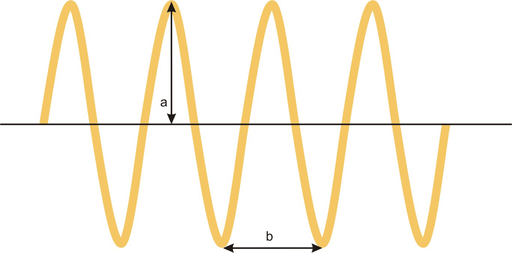

What is represented by letter A?
Crest
Trough
Rarefaction
Compression
Wavelength
What is part C?
Crest
Trough
Rarefaction
Compression
Wavelength
If Amplitude is held constant, what factor determines the energy of a wave?
Frequency
Current
There is no energy, its a wave
Refraction
If wave speed and frequency are held constant, what factor determines the Energy of a wave?
Wave Speed
Frequency
Wave Length
Amplitude
Compression
This is the material that a mechanical wave travels through.
Crest
Trough
Medium
Large
Rarefaction

This is an example of__________________.
Reflection
Refraction
Absorption
Which object does sound NOT travel through the fastest?
A chair
A table
A football
milk

Tightly packed molecules describes a
Solid
Liquid
Gas

Molecules that take the shape of a container describes a
Solid
Liquid
Gas

Molecules that are loosely floating around at far distances describes a
Solid
Liquid
Gas
Travels the fastest through air
Light
Sound
Both
This is a longitudinal wave
Light
Sound
Both
This wave is caused by the vibration of particles
Light
Sound
Both
If lightning strikes you see it before you hear the thunder because...
Sound travels faster than light
Light travels faster than sound
_____ moves slower in a denser medium
sound
light
both
_____ moves faster in a denser medium
sound
light
both
Sound waves travel the fastest in__________.
Solids
Liquids
Gases
a vacuum
Why do sound waves travel slowly through a gas?
Molecules are close together
There are no molecules to interfere with travel
Molecules are more spread out
gas particles move slower than other states of matter
Low temperature makes sound waves travel_________.
Faster
Slower
Temperature has no impact
Light travels the slowest through_______.
Solids
Liquids
Gas
Time
More particle collisions (kinetic energy) means a higher temperature.
True
False
What type of wave is a light wave? (select two)
Mechanical
Electromagnetic
Transverse
Longitudinal
What type of wave is a sound wave? (select two)
Electromagnetic
Mechanical
Transverse
Longitudinal
What would happen to the speed of a light wave as it travels from oil to diamond?
Speeds up
Slows down
nothing


When a wave bends or spreads past a barrier or opening, this is referred to as
Reflection
Refraction
Radiation
Diffraction

Which type of interaction is this?
reflection
refraction
diffraction
interference

Which type of interaction is this?
reflection
refraction
diffraction
interference

How many waves are represented here?
2
3
0
1
Waves with high frequencies must have ________________.
short wavelengths
long wavelengths
large amplitudes
small amplitudes

Which wave has a shorter wavelength?
A
B

Which wave has a higher frequency?
A
B

Which wave has a lower frequency?
A
B

True or False: Waves A and B have the same amplitude.
True
False

Which wave has a more amplitude?
A
B
Which wave has a less amplitude?
A
B
Which wave represents a quieter sound?
A
B
Which wave represents a louder sound?
A
B

