
 Worksheets
Cell Membrane, Biological molecules, and Enzymes
Total questions: 40
Worksheet time: 30mins
Which of the following elements is NOT found in all organic molecules.
Carbon
Hydrogen
Sulfur
Oxygen
Which of the following best describes the function of carbohydrates?
Energy resource for cells
Help speed up chemical reactions
Transport of molecules in/out of the cell membrane
Glucose is a
Lipid
Protein
Simple sugar (monosaccharide)
Complex sugar (polysaccharide)
Which of the following is not a complex sugar (polysaccharide)?
Cellulose
Glycogen
Ribose
Starch
The building blocks of proteins are called
Amino acids
Carbohydrates
Fatty acids
Riboses
Which of the following is NOT a function of proteins
Enzymes: speed up chemical reactions
Energy: stored energy in cells
Transport: movement of molecules into/out of cells
Structure: provides shape to cells and tissues

What cell process is best modeled by the diagram?
osmosis
exocytosis
passive transport
facilitated diffusion
Which statement best describes how channel and carrier proteins in the plasma membrane are similar?
Both allow for the flow of molecules into and out of a cell.
Both directly connect the membrane to the nucleus of a cell.
Both use energy to continuously move water molecules out of a cell.
Both cause the phospholipid bilayer to form a rigid membrane for a cell.
Which type of biological macromolecule is the main component of the plasma membrane?
carbohydrate
lipid
protein
nucleic acid
In a lipid bilayer, ___________ fatty acid tails face each other within the bilayer and form a region that excludes water.
A. Hypotonic
B. Hypertonic
C. Hydrophilic
D. Hydrophobic
In many enzyme reactions, the activity can be blocked if an inhibitor
blocks the enzyme active site
destroys the enzyme
consumes all of the oxygen in the cell
increases the activation energy
Which of the following does NOT affect the activity of an enzyme?
number of times it is used
concentration of substrate
salinity
temperature
pH
Estrogen and testosterone are molecules that are in what group of biomolecules?
nucleotides
carbohydrates
lipids
nucleic acids
Which most directly controls the rate at which food is broken down to release energy?
vitamins
nucleic acids
hormones
enzymes
Amino acids are joined together to form proteins using
peptide bonds
ionic bonds
disaccharide bonds
hydrogen bonds
The various enzymes in our bodies are
nucleic acids
carbohydrates
nucleotides
proteins
A cell uses ATP to pump hydrogen ions (H+) across the inner membrane of its mitochondrion. This type of transport is most likely
endocytosis
facilitated diffusion
osmosis
active transport

Proteins are one of four classes of biological macromolecules. Which of the following statements about proteins is not correct?
Enzymes are specific types of proteins
There are 20 amino acids that make up proteins
All R chains on the amino acids that make up proteins are polar and acidic
Peptide bonds form between amino acids in a dehydration reaction, creating proteins

Which type of macromolecule is made up of Hydrogen (H), Carbon (C), Nitrogen (N) and Oxygen (O)
A. Proteins
B. Carbohydrates
C. Nucleic Acids
D. Lipids
The specific location where the substrates bind to the enzyme is called the
specific site
appropriate site
active site
ignition site
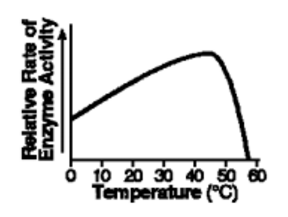


Molecules that bind to enzymes and enhance an enzyme's ability are called:
CoFactors
Competitive Inhibitors
Allosteric Inhibitors

Only a small amount of enzyme is needed for a large amount of substrate because _______
Enzymes do not change at the end of a reaction and as such can be reused
A small amount of enzyme can provide enough energy to continue the reaction
More enzymes are formed while reaction takes place
Enzymes act till completion of a reaction or not at all
Which of the following are the properties of enzyme?
I Enzymes are highly specific.
II All enzymes are denatured at 60°c
III A large number of enzymes is needed to react with large number of substrate.
IV Enzymes lower the activation energy.
I only.
I and IV only.
I, II and III
I, II and IV
What happens to an enzyme when it is denatured?
The activation energy is doubled
The activation energy is lowered
The optimal temperature for enzyme action is doubled
The shape of the enzyme molecule is change

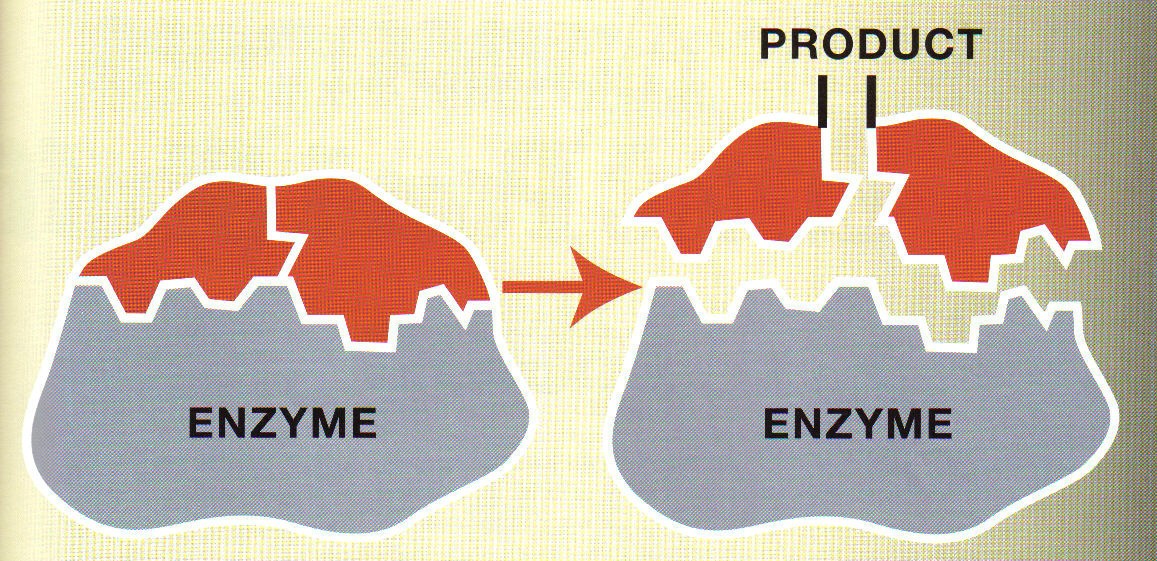
Explain model shown above
The active site is exactly complementary to substrate
The active site is highly specific
The active site is flexible
The active site is rigid
Which of the following would increase the rate of enzyme activity in the presence of a non-competitive inhibitor?
add more substrate
add more enzyme
add more inhibitor
reduce the temperature

