
 Worksheets
Skeletal System Review
Total questions: 92
Worksheet time: 50mins


What are functions of the skeleton?
protection
Make blood cells
movement
all of them
The "soft spots" on an infant's skull are called:
fontanels
osteoclasts
foramens
haversian canals
What is the cranium?
spine
skull
thigh
arm
Epiphyseal plate is also known as the
epiphyseal line
growth plate
kid bone plate
What is yellow bone marrow?
the soft tissue in the bone that makes blood cells
the soft tissue in the bone that stores energy as fat
the hard dense layer of bone
the layer of bone that makes the bones lightweight
Which of the following is not a type of joint found in the body?
Pivot Joint
Gliding Joint
Ball & Socket Joint
Hinge Joint
Tennis Elbow
What condition in the bones makes the bones weak and is most commonly found in older people.
Osteoporosis
Osteogenesis Imperfecta (OI)
Scoliosis
Craniosynostosis
What is an abnormal left or right curvature of the spine?
Osteoporosis
Osteogenesis Imperfecta (OI)
Scoliosis
Craniosynostosis


The type of joint in the picture is located in ....
thumb
neck
skull
humerus
a ____________________ joint.
_______________________.


Long bones have a medullary cavity which has a membranous lining called the _________________.
endosteum
periosteum
yellow bone marrow
compact bone
_____________ form new bone and _____________ break down bone tissue.
osteocytes, osteoblasts
osteoblasts, osteocytes
osteoclasts, osteoblasts
osteoblasts, osteoclasts
The thoracic cage does NOT protects this organ.
Heart
Lungs
Liver
Lower intestine
Which part of the bone is less dense and porous?
Spongy bone
Compact bone
Bone marrow
Periosteum
The main difference in the female skeleton and the male skeleton is found in the ________________,
Leg bones
Skull
Shoulder blades
Pelvis
The presence of an epiphyseal disk indicates that:
the bone is dead
the bone belongs to a female
the bone is no longer growing
the bone is still growing
Osteocytes are located within tiny little chambers called _______ which are linked by ________
medullary cavities / spongy bone
lacunae / canaliculi
endosteum / Haversian canals
lamella / Haversian canals

See image. Which letter represents the osteon?
A
B
C
D

Which letter represents the diaphysis?
A
B
C
D
Freely movable articulations, such as those of the knee or elbow are called:
amphiarthrotic
synarthrotic
diarthrotic
sphenotic

From the diagram, what is number 7?
(a)

From the diagram, what is number 17?
(a)

From the diagram, what is number 8?
(a)
A ball and socket joint occurs between which two structures?
radius and ulna
patella and femur
ilium and femur
lumbar vertebra and sacrum
Which of the following is an example of a sesamoid bone?
phalanges
humerus
patella
vertebrae
The medullary cavity of an 8-year old boy's femur would likely be filled with
periosteum
yellow bone marrow
compact bone tissue
red bone marrow
The tough layer of connective tissue surrounding the bone and allowing for attachment to tendons and ligaments is called
diaphysis
epiphyses
epiphyseal plate
periosteum
When a bone is broken, a large mass of blood forms that is called a(n)
osteocyte
hematoma
osteoclast
callus
You haven't been eating your vegetables or drinking your milk. The calcium in your blood is, therefore, quite low. What hormone will break down your bone to put calcium back into your blood?
PTH
osteoid
calcitonin
hydroxyapatite
Which type of joints are immovable or only slightly movable?
synovial & cartilaginous
synovial & fibrous
cartilaginous & fibrous
fibrous & irregular
Writing a letter uses all of the following types of joints EXCEPT
saddle
ball & socket
hinge
pivot
gliding
Turning your head from side to side uses what type of joint?
saddle
ball & socket
hinge
pivot
gliding


The lateral motion TOWARDS the midline is called ______.
adduction
abduction
circumduction
opposition

Movement AWAY from the mid-line is called _____________.
abduction
adduction
opposition
pronation


Turning the hand so that the palm is upward or facing anteriorly (in anatomical position).
supination
pronation
flexion
dorsiflexion

Harry is a cookie monster. His parents have put the biscuits out of reach, on the top shelf. Harry needs to stand on his "tippy toes" to reach the cookie jar. What is the movement of his ankles?
Plantar Flexion
Extension
Dorsiflexion
Rotation

When Dustin Martin kicks a football the movement of the knee joint in the back swing, before kicking the ball is......
Abduction
Flexion
Extension
Adduction

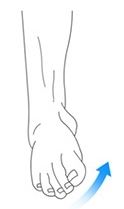
Which movement is shown in the picture?
eversion
rotation
extension
flexion


Your feet are ________ to your knees.
caudal
cephalic
inferior
superior
The head is _____ to the shoulders.
proximal
caudal
superior
inferior

Which shoulder motion is illustrated in the picture?
rotation
adduction
flexion
extension

Identify the joint action being performed.
Circumduction
Lateral Rotation
Medial Rotation
Eversion


A round or oval opening through a bone
process
foramen
fissure
tuberosity


Bone that bear a lots of weight remodel at high rate called
Wolf's Law
Parathyroid gland
Epiphysis
Diaphysis
During infancy and childhood, the single most important stimulus of epiphyseal plate activity is......
calcitonin
parathyroid hormone
alkaline phosphatase
growth hormone
During ossification...
hyaline cartilage turns into bone
fibrocartilage turns into bone
elastic cartilage turns into bone
bone differentiates into cartilage
What is the first stage of bone growth and repair?
Bone Generation
Bone Remodeling
Bony Callus Formation
Hematoma Formation
What is the second stage of bone growth and repair?
Hematoma Formation
Bone Generation
Bony Callus Formation
Bone Remodeling
What is the third stage of bone growth and repair?
Bone Remodeling
Bone Generation
Hematoma Formation
Bony Callus Formation
What is the fourth stage of bone growth and repair?
Bony callus formation
Hematoma Formation
Bone Remodeling
Bone Generation
During Hematoma Formation, What happens at the site of the break?
Blood Clot or a Hematoma
Fibroblasts Produce Collagen Fibres
Osteoblasts Form Spongy Bone
Air gets to it and everything is fine


The shaft of the bone
diaphysis
epiphysis
medullary cavity
matrix

