
 Worksheets
Unit 3: Cell Structure and Function
Total questions: 55
Worksheet time: 44mins
Which of the following statements is part of the cell theory?
Cells are composed mostly of empty space
Cells are generally large enough for the unaided eye to see
All cells are produced from existing cells.
Only animals are made up of cells.

Which type of cell developed first?
Prokaryotic Cells
Eukaryotic Cells
Which cell type tends to be smaller?
Prokaryote
Eukaryote
there is not a size difference
The cells of all organisms contain DNA. In cells of which of the following groups is the cellular DNA enclosed in a nucleus?
Bacteria
Eukaryotes
Prokartotes
Viruses
Which of the following structures is ALWAYS found in both eukaryotic and prokaryotic cells and serves as the basis for common ancestory?
nucleus
mitochondria
ribosomes
cell wall
PROKARYOTIC cells do NOT have compartmentalization meaning they do not have ...
membrane bound organelles
cell membrane
DNA
ribosomes
Which of the following is only found in EUKARYOTIC cells?
nucleus
DNA
cell membrane
ribosomes
CHALLENGE QUESTION: Which of the following provides evidence for the hypothesis that prokaryotes evolved before eukaryotes.
prokaryotes are more complex
prokaryotes have no nucleus and fewer genes
eukaryotes are multicellular which makes them simpler
prokaryotes grow into eukaryotes
Which cell organelle found in algae and plants uses sunlight to produce energy rich compounds?
Osmosis
Ribosome
Nucleus
Chloroplasts
Which of the following structures are present in both plant and animal cells?
cell walls
centrioles
chloroplasts
mitochondria
Which organelles allow plants to support heavy structures such as leaves and flowers?
the cell membranes because they regulate what enters and leaves the cells
the chloroplasts because they convert sunlight into chemical energy
the Golgi apparatus because it packages proteins for storage in the cells
the vacuoles because they are filled with fluid, which provide rigidity
The genes for this organelle are found in the compact region of nucleus known as the nucleolus.
protein
lysosome
golgi
ribosome
Synthesis and packaging of proteins occurs in...
Rough ER
Smooth ER
Lysosome
Plasma membrane
Lysosomes are organelles that contain hydrolytic enzymes. Which of the following is a function of lysosomes?
Lysosomes build lipids, carbohydrates, and proteins.
Lysosomes package lipids, carbohydrates, and proteins.
Lysosomes break down lipids, carbohydrates, and proteins.
Lysosomes store lipids, carbohydrates, and proteins.
......is important in the creation and storage of lipids and steroids.
Smooth ER
Rough ER
Lysosome
Mitochondria
Vesicles from the rough ER are most likely on their way to_____________ .
The peroxisomes
The lysosomes
The Gogi Apparatus
The plant cell vacuoles only.
Cell walls are important plants, fungi and prokaryotes because they....
make energy
make plants green
store milk
support and protect
Vacuoles can be found in both plant and animals cells. Choose the best description of vacuole function.
help maintain shape
make energy
store water, salt, proteins, and carbohydrates
sort and ship
In the Golgi Apparatus macromolecules, such as lipids and proteins, are transported within the cell using____.
Vesicles
Ribosomes
Rough endoplasmic reticulum
DNA
All cells contain cell membranes. Which of the following describes the composition of cell membranes?
Cell membranes are composed of carbohydrate chains, which allow all materials to enter and leave the cell.
Cell membranes are composed of cellulose, which provide rigidity for the cell.
Cell membranes are composed of cytoplasm, which allows proteins to be excreted by the cell.
Cell membranes are composed of phospholipid molecules, which provide a flexible structure.

_______ regulates what enters and leaves a cell.
Cell Membrane
Nucleus
Mitochondria
Cytoplasm
The cholesterol associated with membranes
is attached to proteins and extends into the environment surrounding the cell
helps stabilize the membrane at body temperature
is an abnormality resulting from a diet high in cholesterol
both a and c


Identify cholesterol molecule
structure a
structure b
structure h
structure i
When doctors perform organ transplants, they choose a donor tissue match. Which component is being matched?
membrane phospholipids
cytoskeleton
cell surface carbohydrates
cholesterol

In simple diffusion substances move from an area of _______ concentration to and area of _______ concentration.
lower, even lower
red, purple
lower, higher
higher, lower
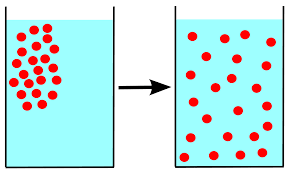
The picture below is an example of _________________.
osmosis
isotonic
diffusion
active transport
Movement of any particle "down" or "with" the concentration gradient is called
diffusion
endocytosis
exocytosis
active transport
Movement of molecules "up" or "against" the concentration gradient (meaning low to high) is called
passive transport
active transport
diffusion
facilitated diffusion
Fill in the blank:
Osmosis is the movement of ________ across a cell membrane from high to low water concentration OR low solute concentration to high solute concentration.
Carbon dioxide
Starch
Water
Oxygen

Osmosis
diffusion of water molecules through a semi-permeable mebrane from an area of low concentration to an area of high concentration
the diffusion of particles from an area of high concentration to an area of low concentration
diffusion of water molecules through a semi-permeable membrane from an area of high concentration to an area of low concentration
the diffusion of particles from an area of low concentration to an area of high concentration
Small, nonpolar, hydrophobic molecules such as fatty acids
easily pass through the membrane's bilayer
very slowly diffuse through the bilayer
require transport proteins
enter through endocytosis
Which of the following substances would have the most trouble crossing the membrane by diffusing through the bilayer?
water
oxygen
carbon dioxide
a sodium ion
Water moves through channels called ________ during osmosis.
Aquaporins
Exocytosis
Isotonic
Holes
Aquaporins are involved in which type of transport?
active transport
facilitated diffusion
phagocytosis
simple diffusion

The illustration shows a model of the transport of solute particles from outside the cell to inside the cell.
What type of cell transport is modeled?
The model illustrates active transport because energy is required to move the solute particles from an area of lower concentration to an area of higher concentration.
The model illustrates diffusion because solute particles are moving from an area of higher concentration to an area of lower concentration.
The model illustrates facilitated diffusion because protein channels allow solute particles to cross the cell membrane.
The model illustrates osmosis because water molecules are moving from an area of higher concentration to an area of lower concentration.
Fusion of membrane-bound vesicle with membrane and dumping contents outside cell is known as
endocytosis
diffusion
osmosis
exocytosis
The main component of cell membranes are
proteins
phospholipids
cholesterol
carbohydrate tags
When organisms maintain a stable internal environment it is known as
homeostasis
differentiation
maintenance
transformation
what is osmoregulation?
Control of water and salt in the body
Control of blood pressure in the body
Control of blood glucose in the body
Animal cells prefer ____ solutions and plant cells prefer _______ solutions for homeostasis.
hypertonic, hypotonic
hypotonic, hypertonic
isotonic, hypotonic
isotonic, hypertonic

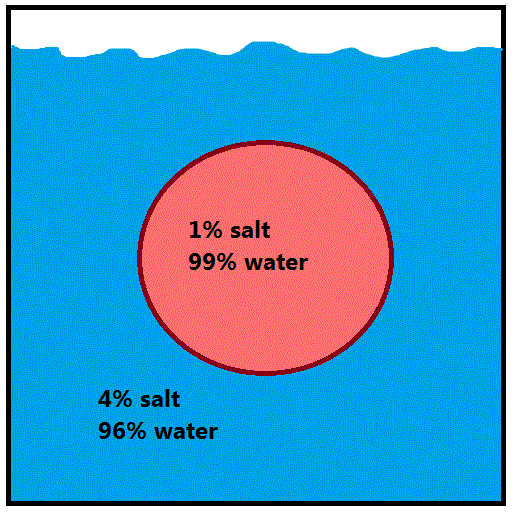
Which Type of solution is the middle cell placed in?
Hypertonic
Hypotonic
Isotonic
Robotonic
Plant cells are happy when they are turgid, which solution would maintain a plant's turgidity?
hypotonic solution
hypertonic solution
isotonic solution
Why can't you drink salt water?
It's hypertonic to your cells
It's hypotonic to your cells
It's isotonic to your cells
It's paratonic to your cells
When given an IV of fluid, why are humans given a salt solution of 0.7M?
It is hypertonic to your own cells
It is hypotonic to your own cells
It is isotonic to your own cells

Dialysis tubing is permeable to water molecules but not to sucrose. Four dialysis tubes are half filled with 5 percent, 10 percent, 20 percent, and 40 percent sucrose solutions, respectively, and two dialysis tubes are half filled with distilled water. The dialysis tubes are all sealed at both ends, and the initial masses are determined. Five dialysis tubes are placed into beakers containing distilled water, and the sixth dialysis tube, containing distilled water, is placed into a 40 percent sucrose solution. The masses of the dialysis tubes are recorded at 30-minute intervals for 90 minutes, as shown in the table below.
A net movement of water into the beaker occurs in which of the following dialysis tubes?
3
4
5
6

The following questions refer to an experiment in which a dialysis-tubing bag is filled with a mixture of 3% starch and 3% glucose and placed in a beaker of distilled water, as shown below. After 3 hours, glucose can be detected in the water outside the dialysis-tubing bag, but starch cannot.
From the initial conditions and results described, which of the following is a logical conclusion?
The initial concentration of glucose in the bag is higher than the initial concentration of starch in the bag.
The pores of the bag are larger than the glucose molecules but smaller than the starch molecules.
The bag is not selectively permeable.
A net movement of water into the beaker has occurred.

Paramecia are unicellular protists that have contractile vacuoles to remove excess intracellular water. In an experimental investigation, paramecia were placed in salt solutions of increasing osmolarity. The rate at which the contractile vacuole contracted to pump out excess water was determined and plotted against osmolarity of the solutions, as shown in the graph. Which of the following is the correct explanation for the data?
At higher osmolarity, lower rates of contraction are required because more salt diffuses into the paramecia.
The contraction rate increases as the osmolarity decreases because the amount of water entering the paramecia by osmosis increases.
The contractile vacuole is less efficient in solutions of high osmolarity because of the reduced amount of ATP produced from cellular respiration.
In an isosmotic salt solution, there is no diffusion of water into or out of the paramecia, so the contraction rate is zero.
A human kidney filters about 200 liters of blood each day. Approximately two liters of liquid and nutrient waste are excreted as urine. The remaining fluid and dissolved substances are reabsorbed and continue to circulate throughout the body. Antidiuretic hormone (ADH) is secreted in response to reduced plasma volume. ADH targets the collecting ducts in the kidney, stimulating the insertion of aquaporins into their plasma membranes and an increased reabsorption of water.
If ADH secretion is inhibited, which of the following would initially result?
The number of aquaporins would increase in response to the inhibition of ADH.
The person would decrease oral water intake to compensate for the inhibition of ADH.
Blood filtration would increase to compensate for the lack of aquaporins.
The person would produce greater amounts of dilute urine

