wayground logo

Free Printable Worksheets

Font size

S
M
L
XL
Worksheets

exam 4

Total questions: 61

Worksheet time: 1hrs 2mins

Name
Class
Date
1.
The chromosomes that pair up during meiosis, are called __________ chromosomes.  
a)
homozygous 
b)
asexual
c)
homologous
d)
genes
2.
A male shark has 40 chromosomes in each of its sex cells. How many would be present in its body cells?
a)
20
b)
40
c)
80
d)
160
3.
What causes genetic variation in meiosis?
a)
chromosomes lining up
b)
crossing over of chromosomes
c)
separation of chromosomes
d)
chromosomes pulling apart
4.

A haploid cell from a male camel has 35 chromosomes. What type of cell is this? Choose all that apply

a)

Sperm

b)

Egg

c)

Heart Cell

d)

Muscle Cell

5.
A dog has 78 chromosomes in its body cells.  What is the diploid number?
a)
78
b)
39
c)
1
d)
100
6.
Nondisjunction can result in 
a)
trisomy conditions
b)
monosomy conditions
c)
additional sex chromosomes
d)
all of these
7.

When a person has ONE extra chromosome in their cells, this is called ________.

a)

trisomy

b)

monosomy

c)

haploid

d)

diploid

8.

Down Syndrome is also known as _________.

a)

Trisomy 18

b)

Trisomy 21

c)

Monosomy X

d)

Trisomy 13

9.
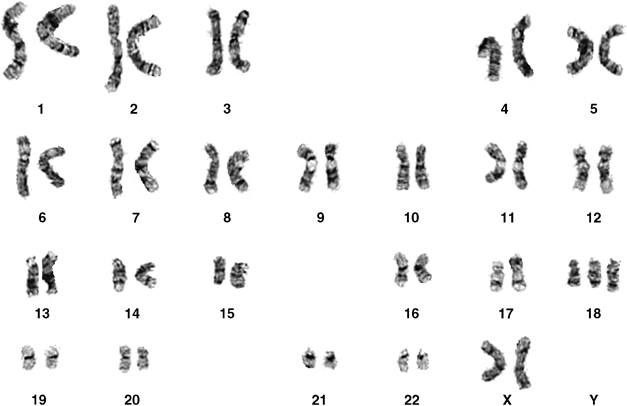
What is the chromosomal condition of the individual whose karyotype is seen in the image?
a)
Monosomy X (Turner's Syndrome)
b)
Trisomy 21 (Down's Syndrome)
c)
Trisomy 13 (Patau Syndrome)
d)
Trisomy 18 (Edwards's Syndrome)
10.
This karyotype was taken from a  _________.
a)
male with Turner's syndrome
b)
male with Klinefelter's syndrome
c)
female with Klinefelter's syndrome
d)
male with Down's syndrome
11.
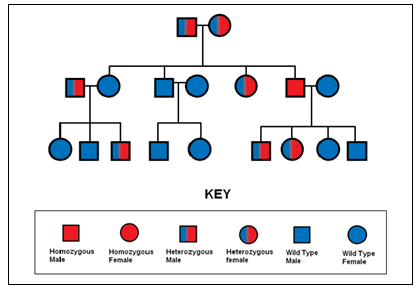
What allele combination should go in the missing box?
a)
AA
b)
Aa
c)
aa
d)
none of these
12.
G = green, g = yellow
The genotype for a yellow plant is...
a)
GG
b)
Gg
c)
gg
d)
all of the choices result in yellow
13.
What percentage of the offspring will have this recessive disease?
a)
0%
b)
25%
c)
50%
d)
75%
14.
If a gene is found only on the X chromosome and not the Y chromosome, it is said to be what?
a)
sex-linked trait
b)
polygenic trait
c)
codominant trait
d)
incomplete dominance trait
15.
A red flowered plant (RR) breeds with a White flowered plant (WW). The gene for petal color in these plants expresses incomplete dominance.  What percentage of the offspring will have pink (RW) flowers?
a)
0%
b)
25%
c)
50%
d)
100%
16.
This type of inheritance pattern shows BOTH traits in possible offspring
a)
complete dominance
b)
incomplete dominance
c)
co-dominance
d)
dominant pattern
17.

Jim has type AB blood. His dad could be type O.

a)

True

b)

False

18.

If one of your parents is blood type A and the other is type B, which of the following blood types could you be?

a)

O

b)

AB

c)

A or B

d)

Any of these

19.

How many alleles does a person carry for a trait?

a)

1

b)

2

c)

3

d)

4

20.

How many alleles does a child get from each parent for a trait?

a)

1

b)

2

c)

3

d)

4

21.

In a pedigree, which shape represents a male?

a)

circle

b)

square

22.

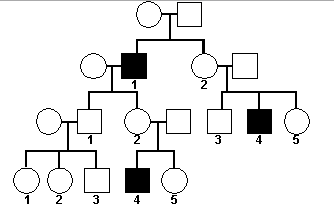
How are individuals III-2 and II-4 related?

a)

Brother and sister

b)

Dad and daughter

c)

Uncle and niece

d)

Grandfather and granddaughter

23.

What is the mode of inheritance shown here?

a)

Recessive because it "skips" a generation

b)

Dominant because it shows up in every generation

24.
Is this trait (the shaded individuals) dominant or recessive?
a)
dominant
b)
recessive
25.
To adjust to a changing environment
a)
Mutation
b)
Adapt
26.
Which term refers to the process by which individuals that are better suited to the environment survive and reproduce therefore passing down their genes to their offspring? 
a)
Evolution 
b)
Variation 
c)
Adaptation
d)
Natural Selection 
27.
Genetic differences between organisms of the same species
a)
Variation
b)
Adaptation
c)
Behavior
d)
Environment
28.
Genetic drift is change in the allele frequency of a population due to...
a)
random chance
b)
natural selection
c)
non-random mating (sexual selection)
d)
artificial selection
29.

Group of organisms all of the same species, living in the same place at the same time.

a)

gene pool

b)

population

c)

species

d)

evolution

30.

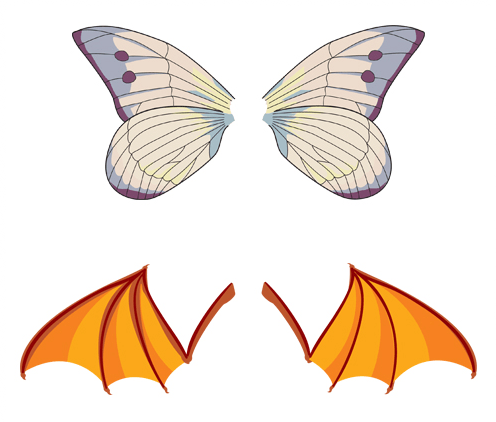
Of the following anatomical structures, which are homologous to the wing of a bat?

a)

the tail of a kangaroo

b)

the flipper of a whale

c)

the wing of a butterfly

d)

the arm of a human

31.

What can be used as evidence for evolution? (select all that apply).

a)

Any common function of structures between species (i.e. birds and insects both have wings)

b)

Body parts of different species that are similar in structure and location.

c)

Similarities of embryos from different species.

d)

Fossil records showing structures and locations of species.

e)

Structures in modern species that are unused and unnecessary, but were used by past species.

32.

What type of evidence of evolution is pictured?

a)

vestigial structures

b)

homologous structures

c)

embryology

d)

DNA studies

33.

The field of biology that classifies organisms is called...

a)

Taxonomy

b)

Phylogeny

c)

Paleontology

d)

Embryology

34.

Based on the figure, which organism is most closely related to the polar bear?

a)

black bear

b)

european brown bear

c)

western north american brown bear

d)

asian brown bear

35.
The two extant species that are closely related to each other are __.
a)
A and B
b)
B and C
c)
C and D
d)
D and E
36.

What type of heredity is shown in the pedigree?

a)

Sex-Linked Dominant

b)

Sex-Linked Recessive

c)

Autosomal Dominant

d)

Autosomal Recessive

37.

If this pedigree shows a recessive disorder, what MUST the genotype of individual 4 be?

a)

HH

b)

Hh

c)

hh

38.
Hemophilia is a recessive sex-linked trait. If H = normal & h = has hemophilia, which genotype represents a male with hemophilia. 
a)
XHY
b)
XHXh
c)
XhXh
d)
Xh
39.

Generation 2 individuals 5 and 6 are

a)

brother and sister.

b)

cousins.

c)

married.

d)

not related.

40.

What is the mode of inheritance shown here?

a)

Sex Linked Recessive

b)

Autosomal Dominant

c)

Autosomal Recessive

41.
What is a phenotype
a)
The genetic make up (code)
b)
The physical trait
42.
Which of the following genotypes is homozygous dominant?
a)
A
b)
Aa
c)
AA
d)
aa
43.
How many boxes would say BB?
a)
1
b)
2
c)
4
d)
0
44.
What is the genotypic ratio here
a)
TT = 25% Tt= 50% tt=25%
b)
all tall
c)
TT= 75% tt = 25%
d)
Tt = 100%
45.

Which is more closely related?

a)

Lamprey and tiger

b)

Gorilla and Human

c)

Salamander and Tiger

46.

Which animals have amniotic eggs?

a)

Turtle and Tuna

b)

Turtle and Leopard

c)

Lancelet and Lamprey

47.

According to this cladogram, sharks are MOST closely related to which organism?

a)

Amphibians

b)

Ray-Finned Fish

c)

Primates

48.

What number is the common ancestor of C and D

a)

1

b)

2

c)

4

49.

What is the common ancestor of Letters A, B, C, D, E?

a)

1

b)

2

c)

3

50.
Structures are similar in appearance but not in structure
a)
Vestigial 
b)
Homologous 
c)
Analogous Structures 
d)
Embryonic 
51.

Which of the following is the collection of life's remains found in sedimentary rock?

a)

natural selection

b)

homologous structures

c)

Charles Darwin

d)

the fossil record

52.

The picture shows a/an ___________

a)

homologous structure

b)

vestigial structure

53.
The opossum and kangaroo both incubate their young in a pouch. This provides evidence that they---
a)
are descended from a common ancestor
b)
Have very similar skeletal structures
c)
belong to the same species
d)
must range great distances to eat
54.

What is this an example of?

a)

Homologous structure

b)

Analogous structure

c)

Vestigial organs

d)

Functional adaption

55.
Study of embryos of various organisms to show a common ancestor because of similarities in development
a)
natural selection
b)
embryology
c)
speciation
d)
evolution
56.
When all of the organisms of a species have died it is called
a)
evolution
b)
extinction
c)
adaptation
d)
natural selection
57.

An anatomical feature that no longer seams to have a purpose in the current form of an organism

a)

Homologous structure

b)

Analogous structure

c)

Vestigial structure

d)

None of the above

58.

After a long time in isolation, Island fruit flies and mainland fruit flies meet. They do not produce viable eggs due to genetic differences. The flies have resulted in two seperate lineages due to:

a)

Gene Pool

b)

Genetic Drift

c)

Gene Frequency

d)

Speciation

59.

Which of these is a result of artificial selection?

a)

fish being able to breathe through their gills

b)

gorillas having black fur

c)

kangaroos having a pouch

d)

apples coming in many different varieties

60.

Extravagant ornamental display is an example of

(a)  

61.

male elk use their antlers and size to compete with each other for the ability to mate with female elk

a)

directional selection

b)

stabilizing selection

c)

disruptive selection

d)

artificial selection

e)

sexual selection