
 Worksheets
AP Biology - Unit 3 Review (combined other quizizzes)
Total questions: 142
Worksheet time: 2hrs 31mins
Which structure is unaffected by denaturation?
Primary
Secondary
Tertiary
Quaternary
Describe why an increase in temperature increases the rate of the reaction.
increase in temperature increases the speed/kinetic energy of particles
increase in temperature activates more enzyme to increase the rate
increase in temperature results in increase in substrate available
increase in temperature allows for a tighter fit in the active site
In order to maintain order and power cellular processes,
energy input must exceed energy loss
energy input equals energy loss
energy loss must exceed energy input
energy loss equals energy input
What is the process of an endergonic reaction being fueled by an exergonic reaction called?
second law of thermodynamics
energy coupling
first law of thermodynamics
endergonic/exergonic switch
Where did photosynthesis first evolve?
prokaryotic organisms
alien organisms
eukaryotic organisms
abiotic processes
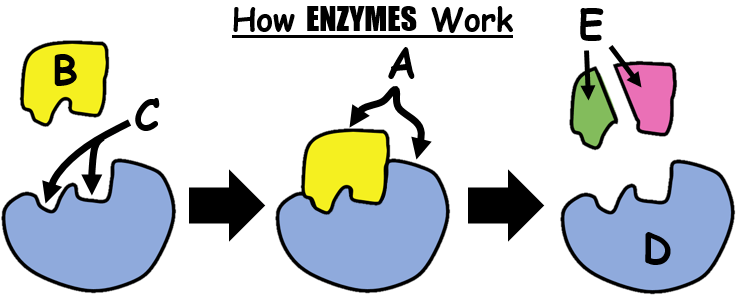
Where on an enzyme does the substrate bind?
active site
allosteric site
C-terminus
N-terminus
Describe the effect on the free energy of doubling the amount of enzyme.
double the free energy
half the free energy
triple the free energy
no effect on free energy
Which environmental conditions are likely to cause denaturation? CHOOSE ALL THAT APPLY!
slight increase in temperature
extreme increase in temperature
slight decrease in temperature
extreme pH change
slight change in pressure
A --> B + C
Anabolic
Catabolic
A + B --> C
Anabolic
Catabolic
Net release of energy
endergonic
exergonic
Net intake of energy
endergonic
exergonic
A + B --> AB + Energy
This is what type of reaction?
exergonic
endergonic
A degradative process such as cellular respiration can also be known as...
catabolic pathway
kinetic pathway
endergonic pathway
anabolic pathway

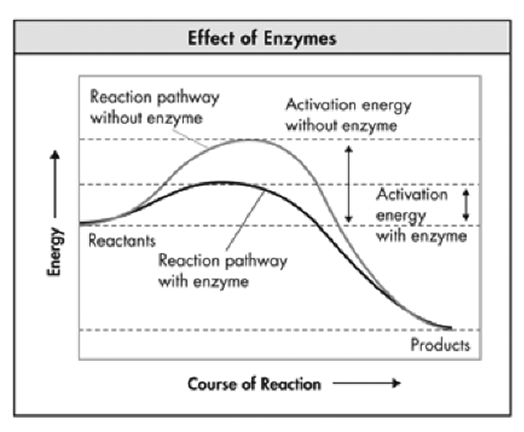
Which statement is true according to the image?
A: endergonic; B: exergonic
A: exothermic; B: endothermic
A: exergonic; B: endergonic
A: endothermic; B: exothermic

Which type of reaction does the graph represent?
anabolic
catabolic
endergonic
ATP phosphorylation
Which molecule has the highest potential energy?
ATP
ADP
AMP
Where is energy stored in ATP?
in the bonds between phosphate
in oxygen
in sugar
in nitrogenous base
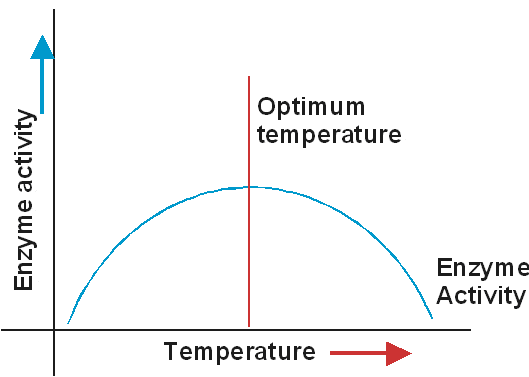
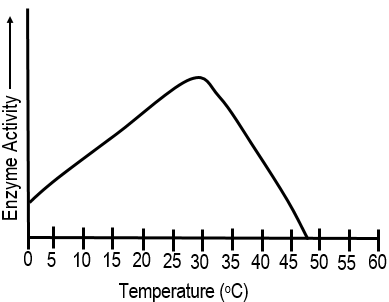

Enzymes in your body probably work best at which of the following temperatures>
25oC
98oC
37oC
210oC
This type of inhibition blocks the active site of an enzyme:
competitive inhibition
allosteric inhibition
noncompetitive inhibition
Each enzyme only has 1 substrate that will fit its active site. What is this called?
reusability
catalysis
specificity
fragility
A molecule that is so similar to the normal substrate that it competes for the active site of the enzyme
Allosteric Inhibition
Competitive Inhibition
Noncompetitive Inhibition
Feedback Inhibition
Which of the following graphs correctly shows the changes in the amount of products in a reaction catalysed by a human enzyme at different temperatures?


Where does the electron transport chain take place?
chloroplasts
prokaryotic plasma membrane
mitochondria
all of the choices
Which of the following are electron carriers for the electron transport chain in cellular respiration?
NADPH
FADH2
NADH
NADH & FADH2
Which process releases energy in glucose to form ATP, NADH, and pyruvate?
Glycolysis
Oxidative Phosphorylation
Krebs Cycle
Fermentation
What is oxidation?
loss of electrons
loss of water
gain of electrons
gain of water
In the electron transport chain of cellular respiration, where is the electrochemical gradient of protons generated?
cytosol
cristae
matrix
intermembrane space
Which process does NOT require oxygen?
Glycolysis
Oxidative Phosphorylation
Krebs Cycle
Aerobic respiration

The point of the Krebs Cycle is to...
Produce high amounts of ATP using a proton gradient
Move high energy electrons through series of proteins to eventually bind with O2, creating water and protons
Break down pyruvate to produce electron carrier molecules, FADH2 and NADH, as well as CO2 and ATP as byproducts
Use ATP and NADPH to produce 6 carbon sugars

Chemiosmosis is best described as...
Moving high energy electrons through carrier molecules toward oxygen
The use of a proton gradient to power ATP Synthase and produce ATP
The breakdown of pyruvate into electron carrier molecules
The enzyme that combines ADP and inorganic phosphate to produce ATP
What is true of glycolysis?
produces a net of 2 ATP
occurs in the mitochondria
produces ATP through oxidative phosphorylation
produces 34ish ATP
all other choices are true
What serves as the final acceptor of the electrons moving down the ETC during cellular respiration?
sulfur
carbon dioxide
ATP
oxygen

Which organisms go through cellular respiration?
[CHOOSE ALL THAT APPLY!]
animals
plants
bacteria
fungi
Which molecule is the reactant of Glycolysis?
water
glucose
carbon dioxide
ATP

What's the chemical formula for glucose?
6C6HO6
C12H6O12
C6H12O6
CHO
The Electron Transport Chain is a series of chemical reactions in which energy is transferred to form a large amount of what molecule?
glucose
oxygen
pyruvic acid
ATP

What type of respiration requires oxygen?
Aerobic
Anaerobic

Select ALL the products of Cellular Respiration?
[CHOOSE ALL THAT APPLY!]
oxygen
glucose
carbon dioxide
water
ATP (energy)
True or False: Only animals can undergo Cellular Respiration.
True
False
What type of respiration does not require oxygen?
Aerobic
Anaerobic
Glycolysis splits glucose into two molecules of pyruvate. How many carbon atoms are in one molecule of pyruvate?
Which of the following is not an end product of the Kreb's cycle?
NADH
CO2
pyruvate
ATP
How does the amount of energy resulting from fermentation compare with that of aerobic respiration?
Aerobic respiration results in less energy.
Aerobic respiration results in more energy.
Each process results in equal amounts of energy.
Neither process produces energy
Which of the following is a product of the Electron Transport Chain?
CO2
O2
C6H1206
H2O
What are the products for the first step of Cell Respiration? (what comes out of step #1)
Pyruvate, NADH, and 2 ATP
CO2, NADH, FADH, and 2 ATP
H2O and 34 ATP
What does it mean to phosphorylate ADP?
To add P, to ADP forming ATP and increasing the free energy of the molecule
Removing a P, from ADP to become AMP and release energy
ADP is being used to power other reactions
ADP is being created by the reaction
Which of the following statements are false?
Glycolysis does not require oxygen
Glycolysis is the first step in both anaerobic and aerobic respiration
Glycolysis occurs in the mitochondria
Glycolysis produces 2 ATP, 2 Pyruvates, and 2 NADH
What is cellular respiration?
the catabolism of glucose to transfer energy to ATP
the breakdown of glucose to release NADH
the breakdown of glucose to release FADH
the breakdown of glucose to release carbon
The Electron Transport Chain (ETC) occurs across the ________ and so extra folds called ________ enable it to occur more often
Mitochondrial matrix, villi
Outer mitochondrial membrane, flagella
Inner mitochondrial membrane, cristae
Cytoplasm, endoplasmic reticulum
During chemiosmosis
H+ ions serve as the final electron acceptor
a concentration gradient is generated when H+ ions are passively transported from the matrix to the inner mitochondrial membrane
energy is released as H+ ions move freely across the mitochondrial membrane
ATP is synthesized when H+ ions move through a channel in ATP synthase
It is possible for both prokaryotes and eukaryotes to perform glycolysis because it occurs in the _____________
mitochondrial matrix
inner membrane
cytoplasm
cell membrane
Anaerobic respiration yields about ______ ATP per glucose whereas aerobic respiration yields about _______ ATP per glucose.
38, 2
2, 38
2, 18
18, 2
The electrons that transfer energy to pump protons across the inner mitochondrial membrane were supplied by
ATP and NADPH
NADH and FADH2
water and oxygen
Which reaction moves the cellular respiration process from the cytoplasm to the mitochondria?
glycolysis ---> pyruvate
pyruvate ---> acetyl CoA
acetyl CoA ---> PGA
PGA ---> PGAL
If an atom gains electrons during a chemical reaction, the atom was:
Catabolized
Without (a) , the electron transport chain cannot function, as there isn't a strongly electronegative molecule at the end to pull the electrons down the chain.
The NADH generated in glycolysis will eventually head to ...
the citric acid cycle
the electron transport chain
pyruvate oxidation
the chloroplast
After glycolysis, pyruvate will go ...
from the cytoplasm to the mitochondrial matrix
from the cytoplasm to the mitochondrial membrane
from the mitochondrial matrix to the cytoplasm
from the mitochondrial membrane to out of the cell
Which steps of respiration occur in the mitochondria?
[CHOOSE ALL THAT APPLY!]
glycolysis
pyruvate oxidation
citric acid cycle
electron transport chain & oxidative phosphorylation
A toxin is introduced that blocks the passage through ATP synthase. Which effects below are likely to occur?
[CHOOSE ALL THAT APPLY!]
ATP production will decrease significantly
the inner membrane space will get more acidic
the inner membrane space will get more basic
the matrix will get more acidic
the ETC will shut down

The light reactions occur in the ________ and the Calvin cycle takes place in the ________.
When is glucose synthesized?

Plants use the following reactants for the light reaction
Water and CO2
Water and NADPH
Water and NADP+
NADPH and ATP
Photosynthesis goal is to
convert light energy into glucose energy
use light energy to make oxygen gas
convert sugar energy into ATP
convert sugar energy into oxygen gas
Rubisco is important in which step of photosynthesis
energizing the electrons in chlorophyll
carbon fixation when CO2 is connected to RUBP during calvin cycle
regeneration phase as RUBP is made during calvin cycle
reduction of the carbon chain during the calvin cycle
If the proton (H+) pump in the thylakoid was not working which molecule could not be made during the light reaction?
NADPH
ATP
Water
Oxygen gas
The NADP+ is
oxidized during the light reaction
reduced during the light reaction
oxidized during the Calvin cycle
reduced during the Calvin cycle
Which of the following would have the least affect on photosynthetic rate?
increase the temp from 20 C to 30 C
increasing the CO2 from 400 ppm to 600ppm
increasing the light intesity from 40 Watts to 60 Watts
increasing the amount of O2 from 20% to 30% in the air
Plants obtain CO2 into the chloroplast by
active transport
diffusion
facilitated diffusion
endocytosis
Photosystems are made of
chloroplasts
chromosomes
chlorophyll
cytoplasm
ATP is made during the light reaction using all of the following EXCEPT
proton pump
hydrogen ion gradient
electron energy from photosystem II
NADPH donating electrons
What is FALSE about the calvin cycle
uses the light reactions products
produces a three carbon sugar (G3P)
produces carbon dioxide
produces NADP+
Photorespiration involves
the production of oxygen gas during the break down of sugar
the breakdown of sugar when CO2 levels are low.
the production of massive amounts of ATP in the thylakoid
water being pulled out of the plant
What does a C4 plant do?
stores CO2 in a separate cell from its photosynthetic cell during the day
stores CO2 in a vacuole during the night.
can't store CO2 so it sufferes photorespiration
can't store CO2 so it speeds up cellular respiration in order to make more CO2
Plants that store CO2 at night as an acid in a vacuole are called
C3 plants
C4 plants
CAM plants
Which plant LACKS CO2 storage method
C3
C4
CAM
What happens to the oxygen levels if a plant were left in the dark over night?
go up due to photosynthesis
go down due to cell respiration
stay the same since stomata are closed
Which plant would have the most oxygen produced in 1 hour?
plant given red light only
plant given blue light only
plant given white light
plant given green light only
An increase in CO2 in the air would most likely
increase photosynthesis
increase cell respiration
increase photorespiration
increase transpiration
The calvin cycle requires what substances from the light reaction?
CO2 and Water
light and CO2
ATP and NADPH
glucose and O2
Photorespiration __________ the rate of photosynthesis.
can dramatically reduce
barely reduces
increases
does not affect
Chlorophyll mostly absorbs...
violet light
green light
red and blue light
yellow light
If photosynthesizing green algae are provided with CO₂ synthesized with heavy oxygen (¹⁸O), later analysis will show that all but one of the following compounds produced by the algae contain the ¹⁸O label. That one is
3-phosphoglycerate.
glyceraldehyde 3-phosphate (G3P).
O₂.
ribulose bisphosphate (RuBP).
ribulose bisphosphate (RuBP).
Which of the following are products of the light reactions of photosynthesis that are utilized in the Calvin cycle?
CO₂ and glucose
H₂O and O₂
ADP, Pi, and NADP⁺
electrons and H⁺
ATP and NADPH
In any ecosystem, terrestrial or aquatic, what group(s) is (are) always necessary?
autotrophs and heterotrophs
producers and primary consumers
photosynthesizers
autotrophs
green plants
A plant has a unique photosynthetic pigment. The leaves of this plant appear to be reddish yellow. What wavelengths of visible light are being absorbed by this pigment?
red and yellow
blue and violet
green and yellow
blue, green, and red
green, blue, and yellow
Which of the following are directly associated with photosystem I?
harvesting of light energy by ATP
receiving electrons from the thylakoid membrane electron transport chain
generation of molecular oxygen
extraction of hydrogen electrons from the splitting of water
passing electrons to the thylakoid membrane electron transport chain
Assume a thylakoid is somehow punctured so that the interior of the thylakoid is no longer separated from the stroma. This damage will have the most direct effect on which of the following processes?
the splitting of water
the absorption of light energy by chlorophyll
the flow of electrons from photosystem II to photosystem I
the synthesis of ATP
the reduction of NADP⁺
What does the chemiosmotic process in chloroplasts involve?
establishment of a proton gradient across the thylakoid membrane
diffusion of electrons through the thylakoid membrane
reduction of water to produce ATP energy
movement of water by osmosis into the thylakoid space from the stroma
formation of glucose, using carbon dioxide, NADPH, and ATP
Are the photosystems light dependent or independent?
Light independent
Light dependent
Where does the plant get H+ to make NADPH
Air
Carbon
Water
Oxygen
ADP + P
ATP
NADPH
NADP+
ADP

Which option best explains how photosystem II produces a high energy molecule?
excited electrons from chlorophyll pass though an ETC and are captured by NADP+ to make NADPH.
excited electrons from chlorophyll pass though an ETC that pumps H+ into the thylakoid. ATP synthase uses the H+ concentration gradient to make ATP.
excited electrons from chlorophyll pass though an ETC that pumps H+ into the thylakoid. The H+ is used to convert NADP+ to NADPH.
After a long period of darkness, which molecule will likely be in high concentration in a plant's chloroplasts?
glucose
ATP
NADPH
NADP+
What would be true for a plant that is growing (gaining mass)?
rate of photosynthesis = rate of cellular respiration
rate of photosynthesis > rate of cellular respiration
rate of photosynthesis < rate of cellular respiration
What is carbon fixation?
The reaction that bonds a carbon from CO2 in the air to an existing organic molecule inside a plant cell.
When carbon dioxide is split to release electrons for the ETC and the production of ATP.
When ATP synthase adds carbon from CO2 to a five carbon sugar to produce a molecule of ATP
Which of the options below best describes photosynthesis?
exergonic; anabolism
endergonic; catabolism
endergonic; anabolism
exergonic; catabolism

What most likely causes the trends in oxygen concentration shown in the graph above?
The water becomes colder at night and thus holds more oxygen.
Respiration in most organisms increases at night.
More organisms are respiring at night than during the day.
Photosynthesis produces more oxygen than is consumed by respiration during the day.
How are reactions in photosynthesis similar to reactions in cellular respiration?
Both use H+ concentration gradients produced by ETC's to generate ATP.
Both use pigments that absorb photons and oxidize water.
Both oxidize glucose to produce electron carrier molecules
Both processes are exergonic

