
 Worksheets
Human Population 2023
Total questions: 38
Worksheet time: 35mins

Based on the demographic transition model above, what stage of development would a country
be in that is experiencing a stable increase?
Stage 1
Stage 2
Stage 3
Stage 4
Which of the following countries best exemplifies phase 4 of a demographic transition?
Argentina
China
India
Mexico
Japan
Populations whose age structure diagrams are narrower at the bottom than at the top have
high death rates
the same proportion of individuals in each age group
a declining population
a high growth rate
all of the above
A particular country has a Total Fertility Rate equal to replacement level fertility and emigration equal to immigration. Which of the following must be true?
The population will begin shrinking within ten years, based on the Rule of 70.
The population must be stable.
The population will begin growing as soon as TFR = 2.1.
Infant mortality must also be less than Crude Death Rate.
There is not enough information to tell.
The study of population is
survivorship
demography
age structure
migration
The distribution of ages in a specific population
age structure
infrastructure
life expectancy
demographic transition
Have the highest birth rates
urbanization
developed countries
least-developed countries
arable land
Movement of individuals into or out of a population.
demographic transition
infrastructure
urbanization
migration
Average number of years a person is likely to live.
age structure
life expectancy
survivorship
demography
Which of the following is true of human demographic trends?
In preindustrial societies, birth rates are low and the population grows rapidly.
When the average number of children born to each woman falls, the total population always increases.
When birth rates and death rates are both high, the population grows slowly, if at all.
Death rates rise in the third stage of the demographic transition.
Between 1880 and 1930 human population doubled due to
the Industrial Revolution
a combination of high birth rates and lowered death rates.
improvements in societal infrastructure and services.
All of the above
During Stage 2 of a population's demographic transition, the death rate
increases
decreases
remains the same
is zero
Since 1970, fertility rates have
increased in both more-developed and less-developed countries
increased in more-developed and decreased in less-developed countries.
decreased in both more-developed and less-developed countries.
decreased in more-developed and increased in less-developed countries.
Which of the following is NOT a strategy that would reduce population size?
Limiting education for women
Public advertising
Economic incentives
Legal punishments
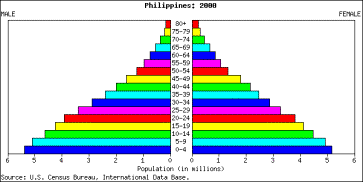
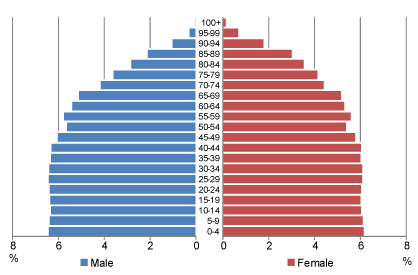
The replacement-level fertility rate is ____ for developed countries and ____ for developing countries.
1.6; 1.9
2.5; 2.0
2.0; 2.5
2.1; 2.5
1.8; 2.1
Which of the following pairs of indicators best reflects the availability of health care in a country?
Crude death rate and growth rate
Crude death rate and crude birth rate
Growth rate and life expectancy
Infant mortality rate and life expectancy
Infant mortality rate and crude death rate
Populations whose age structure diagrams are narrower at the bottom than at the top have
high death rates
the same proportion of individuals in each age group
a declining population
a high growth rate
all of the above
During what stage of the demographic transition, population growth is slow because both death and birth rates are high?
Stage 1
Stage 2
Stage 3
Stage 4
Stage 5
Which of the following statements about total fertility rate is correct
TFR is equal to the crude birth rate minus the crude death rate.
TFR is the average number of children each woman must have to replace the current population.
TFR is generally higher in developed countries than in developing countries
TFR is equal to the growth rate of a country
TFR is the average number of children each woman will give birth to during her childbearing years.

In this stage of transition, birth rate drops below the replacement level, so the population size begins to decrease.
a. Stage 1
b. Stage 2
c. Stage 3
d. Stage 4
In this stage of transition, the population size begins to stabilize as birth and death rates approach the replacement level.
a. Stage 1
b. Stage 2
c. Stage 3
d. Stage 4
In this stage, there is a high birth rate and a high death rate, resulting in a stable population.
a. Stage 1
b. Stage 2
c. Stage 3
d. Stage 4
In this stage of transition, there is a population explosion due to better hygiene and nutrition. Birth rates are still high.
a. Stage 1
b. Stage 2
c. Stage 3
d. Stage 4

A country whose demographics would be reflected in section II of the above chart would be classified in what stage of demographic transition?
a. Postindustrial
b. Industrial
c. Preindustrial
d. Transitional
A country whose demographics would be reflected in section III of the above chart would be classified in what stage of demographic transition?
a. Postindustrial
b. Industrial
c. Preindustrial
d. Transitional
A country whose demographics would be reflected in section IV of the above chart would be classified in what stage of demographic transition?
a. Postindustrial
b. Industrial
c. Preindustrial
d. Transitional
A country whose demographics would be reflected in section I of the above chart would be classified in what stage of demographic transition?
a. Postindustrial
b. Industrial
c. Preindustrial
d. Transitional
An ambassador from a particular country analyzes the following data regarding population growth and is very concerned with the results. Why should this ambassador be concerned?
a. The data reveals a country whose population is rapidly growing.
.b. The data reveals a country whose population is shrinking.
c. The data reveals a country that has a high fertility rate.
d. The data reveals a country that has a low GDP per capita.

This survivorship curve can be found in a developed country whose members survive to be old.
A. Type I
B. Type II
C. Type III
D. None of the above
This survivorship curve can be found in a developing country that has a high infant mortality rate.
A. Type I
B. Type II
C. Type III
D. None of the above
Which of the following makes it difficult to reduce population growth?
High literacy rates result in women wanting to have more children.
Population sizes will not decline until some people start having to do without food and other necessities of life.
Many people live in cities, where large families are an advantage.
Many people have low literacy and limited access to healthcare.
Which of the following is not a strategy that could slow population growth?
.
public advertising
economic incentives
legal punishments
limiting education for women
Which of the following is true of human demographic trends?
In preindustrial societies, birth rates are low, and the population grows rapidly.
When the average number of children born to each woman falls, the total population always increases.
When birth rates and death rates are both high, the population grows slowly, if at all.
Death rates rise in the third stage of the demographic transition
During Stage 2 of a population’s demographic transition, the death rate
increases.
decreases.
remains the same.
is zero.

