wayground logo

Free Printable Worksheets

Font size

S
M
L
XL
Worksheets

Earth Science Semester exam Winter 2022

Total questions: 130

Worksheet time: 3hrs 15mins

Name
Class
Date
1.
A crayon has a mass of 10g and volume of 5 mL. What is the density?
a)
30 g/mL
b)
15 g/mL
c)
1 g/mL
d)
2 g/mL
2.
How does the mass of a bowling ball on Earth compare to its mass on the moon?
a)
The mass will be greater on the moon
b)
The mass will be less on the moon
c)
The mass will stay the same
3.
A brick sinks in water while a wooden block of the same size floats.  This is because the brick has a
a)
lower volume than the wooden block
b)
lower density than the wooden block
c)
higher volume than the wooden block
d)
higher density than the wooden block
4.
Matter changes state when...
a)
energy is added or removed
b)
energy is added
c)
energy is removed
d)
there is no energy
5.
What state of matter has NO definite volume and NO definite shape?
a)
solid
b)
liquid
c)
gas
d)
plasma
6.
Liquids have...
a)
A definite shape and volume
b)
A definite shape but no definite volume
c)
No definite shape but a definite volume
d)
No definite shape or volume
7.

Which of these changes of state would involve water absorbing energy?

a)

condensation

b)

deposition

c)

evaporation

d)

freezing

8.

Physical change in matter from a gas to a liquid

a)

Condensation

b)

Freezing point

c)

Melting point

d)

Evaporation

9.

Which order correctly shows most energy to least energy for these states of matter.

a)

solid liquid gas

b)

gas liquid solid

c)

liquid gas solid

d)

gas solid liquid

10.

Which state of matter has a fixed shape, and fixed volume and vibrates?

a)

solid

b)

liquid

c)

gas

d)

all of these

11.

When air is heated, what happens to its mass?

a)

increases

b)

decreases

c)

remains the same

12.

When air is heated, its volume ____________.

a)

increases

b)

decreases

c)

remains the same

13.

Which of the following is an application of convection?

a)

The movement of heat through a metal pan to the food.

b)

The use of ice box to keep drinks cool.

c)

The sea breeze that blows from sea to land.

d)

The use of wool blanket to keep the body warm.

14.
Warm air is __________ dense than cold air and rises creating convection currents.
a)
more
b)
less
15.
The heat from a lamp allows a lizard to remain warm. This is an example of which type of heat transfer?
a)
radiation
b)
conduction
c)
convection
d)
insulation
16.

The transfer of energy from one object to another object through direct contact is

a)

convection

b)

conduction

c)

radiation

17.

What type of energy transformation is occurring in the picture?

a)

convection

b)

conduction

c)

radiation

18.

What type of energy transformation is occurring inside the teapot with the water?

a)

convection

b)

conduction

c)

radiation

19.

What energy transformation is occurring in letter (B) of this picture?

a)

radiation

b)

conduction

c)

convection

20.

Ms Hinkel holds an ice cube in her hand. As she squeezes the ice cube, it melts and drips. Why is this happening?

a)

Ms Hinkel's hand absorbs energy from the ice.

b)

The cold enters Ms Hinkel's hand

c)

Ms Hinkel's warm hand transfers energy into the ice.

d)

Energy passes freely from ice cube to hand and from hand to ice cube

21.

Thermal energy always move from_____

a)

areas of high energy to low energy

b)

areas of low energy to high energy

c)

It flows equally from high and low energy areas

d)

all of these are correct

22.

A cold air mass is _____ when compared to a warm air mass

a)

more dense

b)

less dense

c)

the same density

23.
A great conductor of energy is:
a)
wood
b)
plastic
c)
metal
d)
cloth
24.
Conductors are materials that...
a)
Allow heat to pass through
b)
Stop heat from passing through
c)
Allow cold to pass through
d)
Stop cold from passing through
25.
An object that doesn't conduct heat well is known as:
a)
a conductor
b)
an insulator
26.
The handle of a frying pan is often coated in rubber because rubber provides...
a)
Heat insulation
b)
Heat conduction
c)
A low melting point
d)
A nonstick surface
27.
How much of our planet is estimated to be covered with water?
a)
68%
b)
50%
c)
97%
d)
75%
28.
How much of our planet's water is saltwater?
a)
75%
b)
1%
c)
99%
d)
97%
29.

What is it called when plants give off water vapor as a waste product through their leaves?

a)

condensation

b)

evaporation

c)

sublimation

d)

transpiration

30.

In the morning, you observe that water droplets have formed on grass. Which process occurred when the water droplets formed on the grass?

a)

condensation

b)

deposition

c)

evaporation

d)

sublimation

31.

If a warm wind passes over snow, the snow can be heated rapidly. When this happens, the snow can change directly into water vapor without first becoming liquid water. What is the correct term for this process?

a)

deposition

b)

evaporation

c)

melting

d)

sublimation

32.

Which statement best describes the movement of liquid water from land back into a body of water?

a)

condensation

b)

evaporation

c)

precipitation

d)

runoff

33.

Nicholas pours a small beaker of water into a vase that contained different layers. What is the correct term for the movement of water from the surface of Earth to the groundwater?

a)

infiltration

b)

precipitation

c)

runoff

d)

transpiration

34.
What is the phase of the water cycle when water falls as rain, snow, sleet, or hail?  This is #3 on the picture.
a)
precipitation
b)
evaporation
c)
condensation
35.

What can you infer from the fact that there is the same amount of water on the planet now as there was one billion years ago? By the way, now there's new research suggesting that our planet got its water more than 4 billion years ago, when a celestial object about the size of Mars collided with Earth to form the moon!)

a)

The amount of water on earth changes gradually over time

b)

There will probably be the same amount of water on the planet a billion years from now unless a catastrophic event occurs

c)

There have been many fluctuations in the water cycle over the past billion years and we just met the original level of water

d)

There will be much less water on earth billions of years from now

36.
The changes to water when it cycles the earth is called
a)
the moon cycle
b)
the sun cycle
c)
the water cycle
d)
the wind cycle
37.
The ________ is the driving force of the earth's surface.
a)
sun
b)
moon 
c)
stars
38.
What causes warm air to rise?
a)
the fact that it's less dense than cold air 
b)
The fact that it weighs more than cold air 
c)
The fact that it has higher pressure than cold
d)
the fact that its more dense than cold air 
39.
Which term best describes how the earth's atmosphere is heated?
a)
Spirally
b)
Unevenly
c)
Circularly
d)
Kinetically
40.

Global winds are caused by _____

a)

uneven heating from the Sun between equator and the North and South Poles

b)

even heating from the Sun between equator and the North and South Poles

c)

local winds

d)

uneven heating from the Sun between the East Coast and the West Coast

41.

Jet streams generally flow toward the ____

a)

North

b)

East

c)

South

d)

West

42.
What is the Coriolis Effect and how does it effect global winds?
a)
Curving of winds due to rotation of earth curves wind counterclockwise in Northern Hemisphere and clockwise in the Southern Hemisphere
b)
Movement of ocean currents caused by earth rotation' counterclockwise in Northern Hemisphere and clockwise in Southern Hemisphere
c)
curve of global winds caused by global rotation clockwise in Northern Hemisphere and counterclockwise in Southern Hemisphere
43.

An air mass is _____.

a)

a large body of air that is made of the same temperature and moisture

b)

when two air masses meet

c)

a large body of air that is made of the different temperatures but the same moisture

d)

a large body of air that is made of the same temperatures but the different moisture

44.
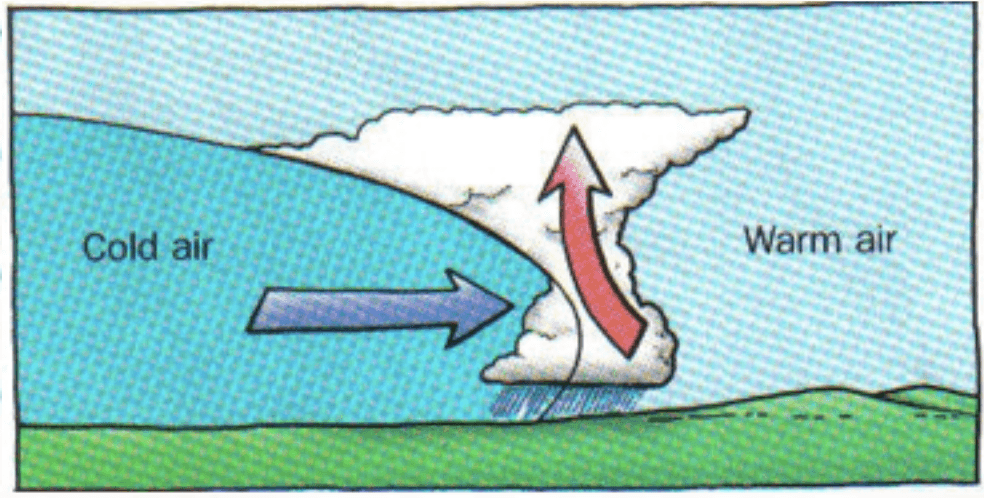
What type of storm front is this? 
a)
warm front
b)
cold front
c)
stationary front
d)
occluded front
45.
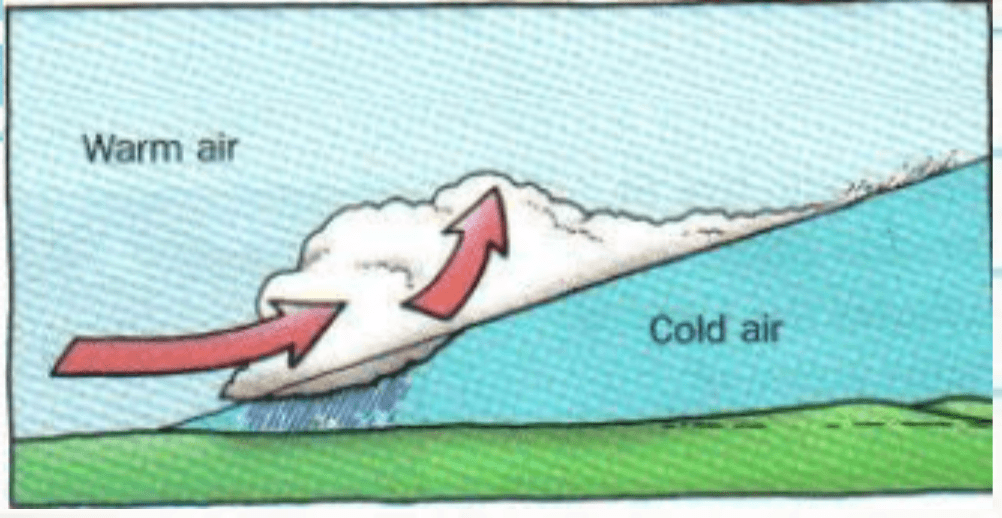
What type of storm front is this?
a)
warm front
b)
cold front
c)
stationary front
d)
occluded front
46.

Weather in the United States travels from _____.

a)

east to west

b)

north to south

c)

south to north

d)

west to east

47.

Warm air rises because it _____.

a)

has a lower density and pressure than cool air.

b)

lacks density.

c)

has a higher density than cool air.

d)

is not affected by pressure.

48.
What causes wind to blow?
a)
Differences in longitude 
b)
Shock waves from clouds 
c)
Differences in air temperature and pressure 
d)
The rotation of the earth
49.
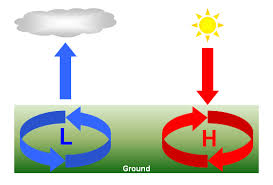
When warm air rises, ______ pressure forms at the surface of the land or sea.
a)
high
b)
some
c)
low
d)
none
50.
High pressure areas _____.
a)
High pressure areas _____.
b)
move to areas of higher pressure
c)
move to areas of higher and lower pressure
d)
move to areas of lower pressure
51.
Air pressure is greater _______.
a)
at the top of the mountain
b)
at the bottom of the mountain
c)
at the center of the mountain
52.

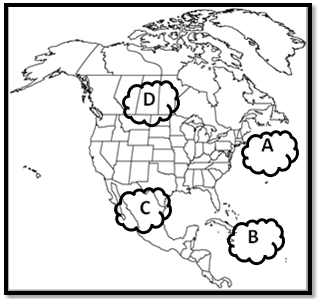
Which type of air would you find at air mass A?

a)

polar, continental

b)

topical, maritime

c)

tropical, continental

d)

polar, maritime

53.
Which type of front is near Seattle?
a)
cold front
b)
warm front
c)
occluded front
d)
stationary front
54.
Which type of weather is associated with a cold front?
a)
heavy rain, snow, thunderstorms, and snow for short periods of time 
b)
Steady, light rain or snow can occur for longer periods of time 
55.
How do jet streams influence the weather? 
a)
by creating clouds 
b)
by increasing the moisture in the atmosphere 
c)
by moving weather from one area to another very quickly 
d)
by drying out the atmosphere 
56.
What kind of breeze is this and when would it form?
a)
Land breeze - daytime
b)
Land breeze - nighttime
c)
Sea breeze - daytime
d)
Sea breeze - nighttime
57.
Where would you find a tropical maritime air mass?
a)
over the ocean, near the equator
b)
over the ocean, near the poles
c)
over a continent, near the equator
d)
over a continent, near the poles
58.

An air mass is _____.

a)

a large body of air that is made of the same temperature and moisture

b)

when two air masses meet

c)

a large body of air that is made of the different temperatures but the same moisture

d)

a large body of air that is made of the same temperatures but the different moisture

59.

Which type of air would you find at air mass A?

a)

polar, continental

b)

topical, maritime

c)

tropical, continental

d)

polar, maritime

60.

Which type of air would you find at air mass B?

a)

polar, continental

b)

topical, maritime

c)

tropical, continental

d)

polar, maritime

61.

Which type of air would you find at air mass D?

a)

polar, continental

b)

topical, maritime

c)

tropical, continental

d)

polar, maritime

62.

Which type of air would you find at air mass C?

a)

polar, continental

b)

topical, maritime

c)

tropical, continental

d)

polar, maritime

63.
What type of storm front is this?
a)
Warm Front
b)
Cold Front
c)
Occluded Front
d)
Stationary Front
64.
This shows a _____.
a)
warm
b)
cold
c)
stationary
d)
occluded
65.
Which global winds have the greatest impact on the weather in the US?
a)
trade winds
b)
prevailing westerlies
c)
doldrums
d)
polar easterlies
66.

Name that front.

a)

Cold Front

b)

Warm Front

c)

Stationary Front

d)

Occluded Front

67.

Name that front.

a)

Cold Front

b)

Warm Front

c)

Stationary Front

d)

Occluded Front

68.

Cold dense air slides underneath warm air. The warm air is forced up, cools, and condenses.

a)

Cold Front

b)

Warm Front

c)

Stationary Front

d)

Occluded Front

69.
A front is
a)
where warm air is cooling at earth's surface
b)
a line where hot and cold air are separating
c)
a line where two different air masses meet
d)
where cold air is rising and forming rain clouds
70.
Which system results in drier, fairer weather?
a)
high pressure
b)
low pressure
c)
hurricane
d)
weather system
71.

Temperature drops quickly. Strong winds, heavy precipitation.

a)

Cold Front

b)

Warm Front

c)

Stationary Front

d)

Occluded Front

72.

Neither air mass really takes over the other.

a)

Cold Front

b)

Warm Front

c)

Stationary Front

d)

Occluded Front

73.
Compared with weather patterns, climate patterns are more _____.
a)
severe
b)
long term
c)
local
d)
unusual
74.
Climates are classified by  ____
a)
plants and animals
b)
altitude and latitude
c)
bodies of water and ocean currents
d)
temperature and precipitation
75.

Which of the following best describes weather?

a)

day to day conditions of the atmosphere at a place in regards to heat, dryness, sunshine, wind, rain, etc.

b)

long-term conditions (months/years) of the atmosphere at a place in regards to heat, dryness, sunshine, wind, rain, etc.

76.

Which of the following best describes climate?

a)

day to day conditions of the atmosphere at a place in regards to heat, dryness, sunshine, wind, rain, etc.

b)

long-term conditions (months/years) of the atmosphere at a place in regards to heat, dryness, sunshine, wind, rain, etc.

77.
It is raining.
a)
weather
b)
climate
78.
The average winter temperature is 45 C.
a)
weather
b)
climate
79.

New York City had a record rainfall on Wednesday.

a)

weather

b)

climate

80.

Marco got a Christmas photo from his cousin in Hawaii. The family wore shorts, sandals, and Santa hats. Marco’s dad said that was normal clothing because the average temperature in Hawaii is 82 degrees Fahrenheit that time of the year.

a)

climate

b)

weather

81.

How would you strengthen a hurricane?

a)

move over cold water

b)

move over land

c)

move over warm water

82.

Why is water important in the formation of hurricanes?

a)

water produces the winds that move the hurricanes

b)

warm water allows for evaporation which produces the winds to fuel the hurricanes

c)

cold water produces the moisture that creates water vapor and energy to fuel the hurricane

d)

warm water produces the moisture that produces water vapor which in turn releases heat energy to fuel the hurricane

83.

Why do hurricanes form more often at the end of summer?

a)

The ocean water is cooling off and creating more moisture in the air.

b)

The ocean water is cooling off and creating less water vapor in the ocean.

c)

The ocean water is much warmer which fuels the water cycle and creates lower air pressure.

d)

The ocean water is much warmer which fuels an increase in water vapor on the ocean's surface.

84.

Why do hurricanes form approximately 8 degrees away from the equator and not closer?

a)

The depth of the oceans at the equator are too deep for heating and forming hurricanes.

b)

The rotation of the earth is too strong to create the needed formation of clouds to start the creation of hurricanes.

c)

The Coriolis Effect is too powerful to form a hurricane.

d)

The rotation force is not strong enough to create the spin of the hurricane

85.

What must be present for a hurricane to form. Check all that apply.

a)

Water temperatures over 80 degrees

b)

Great amounts of rainfall

c)

High humidity

d)

High pressure

e)

Low pressure

86.
 Where do tropical storms start? 
a)
northpole
b)
on the coast
c)
in the ocean, near the equator
d)
in the ocean, near land
87.

What is the difference between cyclones, hurricanes and typhoons?

a)

the amount of water

b)

the speed of the winds

c)

the temperature of the water

d)

the location where the storm occurs

88.

What is the difference between a tornado watch vs a tornado warning?

a)

A watch is where it tells the time and the warning means you are late

b)

A tornado watch, Has the conditions for a tornado but one hasn't spawned. While a Warning means one didn't spawn

c)

A tornado watch, Has the conditions for a tornado but one hasn't spawned. While a Warning means one has spawned

d)

yes

89.
What atmospheric conditions must be present for a twister to form?
a)
Air Mass 1: Cold/Dry and Air Mass 2: Warm/Moist
b)
Air Mass 1: Cold/Moist and Air Mass 2: Warm/Moist
c)
Air Mass 1: Cold/Dry and Air Mass 2: Warm/Dry
d)
Air Mass 1: Cold/Moist and Air Mass 2: Cold/Dry
90.
A geologist claims that a metamorphic rock was once an igneous rock. How could the igneous rock have turned into a metamorphic rock?
a)
The igneous rock could have melted and then turned solid again
b)
The igneous rock could have been uplifted and then weathered to form soil.
c)
The igneous rock could have been broken apart and its pieces transported to the ocean.
d)
The igneous rock could have been heated and squeezed for millions of years until new mineral grains and new textures formed in the rock.
91.
 Granite is an igneous rock with large crystals. What does the size of the crystals tell you about granite?
a)
It turned solid immediately.
b)
It turned solid very slowly.
c)
It started out as a sedimentary rock.
d)
It is about to transform into a metamorphic rock
92.
Fossils are found only in _____ rock.
a)
sedimentary
b)
metamorphic
c)
igneous
d)
intrusive
93.
A geologist found a rock whose minerals have been aligned or arranged into parallel bands by high pressure. The geologist probably found _____.
a)
a sedimentary rock
b)
a metamorphic rock
c)
an igneous rock
d)
a meteorite
94.
When rocks are broken down into small pieces, like sand and gravel, the pieces are known as_____.
a)
magma
b)
sediment
c)
sedimentary rocks
d)
compaction
95.
Which of the following help create both metamorphic and sedimentary rocks?
a)
cementation
b)
pressure
c)
heat
d)
evaporation
96.
Which are sources of heat that help metamorphic rock to form?
a)
being near pockets of magma rising through the crust
b)
friction of plate movement
c)
the heat from the mantle
d)
all of these
97.
The most abundant rock on the surface of the earth is _____.
a)
igneous
b)
sedimentary
c)
metamorphic
d)
foliated
98.
A collision between two continental plates could force one plate down toward the heat of the mantle (but not enough to melt it), producing _____.
a)
igneous rock
b)
sedimentary rock
c)
metamorphic rock
d)
all rock groups
99.
The process by which dissolved minerals crystallize and glue particles of sediment together is called _____.
a)
compaction
b)
cementation
c)
deposition
d)
erosion
100.

If igneous rock cuts through sedimentary rock layers, the igneous rock is _____the sedimentary rock.

a)

younger than

b)

older than

c)

the same age as

d)

all of these

101.

We date sedimentary fossils by _____.

a)

measuring the uranium 235/ lead levels noting radioactive decay

b)

looking at the color and density

c)

measuring how deep it is buried

d)

looking at index fossils and layers of igneous intrusions

e)

long walks on the beach and a fancy meal by moonlight

102.

We date igneous rock by _____.

a)

Measuring uranium 235/ lead levels=noting radioactive decay

b)

looking at the color and density

c)

measuring how deep it is buried

d)

Looking at index fossils & layers igneous intrusions flow in

103.

The Law of Superposition says _____._____.

a)

The oldest layer in an undisturbed bed of rock is on the bottom

b)

The oldest layer in an undisturbed bed of rock is on the top

c)

The oldest layer in an undisturbed bed of rock isdifficult for scientists to determine

d)

The oldest layer in an undisturbed bed of rock is the smallest
104.
Which type of rock is formed when magma from deep inside the earth comes to the surface and cools down to become a solid?
a)
intrusive
b)
extrusive
c)
foliated
d)
nonfoliated
105.

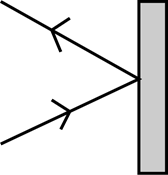
The illustration shows a light ray striking an object.

In the illustration, the light ray striking the object is-

a)

diffraction

b)

Deflection

c)

reflection

d)

all of these

106.
a)

Reflection

b)

Refraction

c)

Diffraction

107.

The wave goes around something that gets in the way.

a)

Reflection

b)

Refraction

c)

Diffraction

108.

The wave bends because the speed of the wave changes.

a)

Reflection

b)

Refraction

c)

Diffraction

109.
Which letter is a crest?
a)
F
b)
G
c)
H
d)
J
110.
Which letter shows amplitude?
a)
F
b)
G
c)
H
d)
J
111.
Which letter identifies the wavelength?
a)
F
b)
G
c)
H
d)
J
112.
In a sound wave, the area where molecules have been pressed together is a...
a)
Compression
b)
Rarefaction
c)
Wavelength
113.
In a sound wave, the area where there are fewer molecules and they are spread out is a...
a)
Compression
b)
Rarefaction
114.

In sound waves, the most dense area of dots is called ____ and the least dense areas is called _____

a)

compression, rarefaction

b)

rarefaction, compression

c)

Wavelength

d)

all of these

115.
What is the frequency of this wave?
a)
3 Hertz
b)
4 Hertz
c)
5 Hertz
d)
6 Hertz
116.

In a solid, sound waves travel _____ in a liquid.

a)

faster than

b)

slower than

c)

the same as

d)

all of these

117.

Waves that need a medium are called

a)

electromagnetic

b)

light

c)

mechanical

d)

microwaves

118.

When the car moves AWAY from you, its horn seems_____.

a)

Low frequency

b)

High frequency

c)

greater amplitude

d)

the same as when it is coming towards you

119.

When an ambulance move TOWARD you it has a ________.

a)

high frequency

b)

low frequency

c)

medium frequency

d)

the same as when it moves away

120.

In space,you cannot hear because _____

a)

there are no air molecules to carry sound.

b)

the sounds o space are too loud

c)

the sun destroys the sound waves

d)

there is no magnetic field

121.

information broken into numbered pieces to reassemble faster

a)

digital

b)

analog

122.
Which wave has a greater frequency?
a)
wave B
b)
wave C
123.
Why do some substances float on water?
a)
they are warmer than water
b)
they are cooler than water
c)
they are more dense than water
d)
they are less dense than water
124.
How does the mass of a bowling ball on Earth compare to its mass on the moon?
a)
The mass will be greater on the moon
b)
The mass will be less on the moon
c)
The mass will stay the same
125.
An object with which of the following densities will float on water?
a)
0.7 g/cm3
b)
1.2 g/cm3
c)
3.5 g/cm3
d)
11.4 g/cm3
126.

Kentucky has the weather it does because it receives _____ air masses.

a)

maritime tropical, continental tropical, maritime polar

b)

maritime polar

c)

continental tropical

d)

maritime tropical

127.
Which wave is pictured?
a)
Transverse
b)
Longitudinal
c)
Both
d)
Neither
128.
This picture (B) shows light moving as a...
a)
Transverse Wave
b)
Ocean Wave
c)
Compression Wave
d)
Slinky Wave
129.
A rock at the Earth’s surface is primarily affected by forces of _____
a)
heat and pressure
b)
pressure only
c)
weathering and erosion
d)
heat only
130.
The rock cycle indicates that each type of rock can _____.
a)
provide materials to make other rocks
b)
be changed by forces at Earth's surface
c)
form other rocks
d)
all of these