wayground logo

Free Printable Worksheets

Font size

S
M
L
XL
Worksheets

Bio Semester Review 21

Total questions: 90

Worksheet time: 2hrs 56mins

Name
Class
Date
1.

What is the DEPENDENT variable (effect) in this experiment?

"Does eating breakfast improve test score?"

a)

eating breakfast or not

b)

the grade you got on the test

c)

what time you get up in the morning

d)

how tasty the breakfast is

2.
What is the INDEPENDENT  variable (cause) is this experiment? 
"Which type of medium is best for plant growth?" 
a)
height of plant (cm)
b)
type of medium (soil vs. sand)
c)
amount of medium
d)
types of plant
3.
An experiment is performed on plants to see how different liquids affect plant growth. Each plant in the experiment is given a different liquid; water, apple juice, or milk. Each plant has the same amount of soil, sunlight, and listens to the same music. In this investigation, the independent variable is ...
a)
The type of plant
b)
The amount of sunlight
c)
The type of music
d)
The type of liquid
4.
An experiment is performed on plants to see how different liquids affect plant growth. Each plant in the experiment is given a different liquid; water, apple juice, or milk. Each plant has the same amount of soil, sunlight, and listens to the same music. In this investigation, what is the dependent variable?
a)
Type of plant
b)
Water, apple juice, milk
c)
Plant growth
5.
How can you tell this plant is a living thing?
a)
It doesn't move.
b)
It is made up of different parts.
c)
It responds to a change in its environment.
d)
It needs shelter.
6.

The following list represents characteristics of a living thing :

a)

made of cells, has lungs, can reproduce

b)

grows and develops, responds to surroundings, can move

c)

has similar chemicals, makes noises, made of cells

d)

made of cells, grows and develops, uses energy

7.
Which of the following characteristics of living things best explains why humans sweat when they get hot?
a)
maintaining a stable internal enviornment
b)
growth and development
c)
using energy
d)
ability to reproduce
8.

Which one of the following is a characteristic of life?

a)

Growth

b)

Breathing

c)

Expelling toxins

d)

Photosynthesis

9.
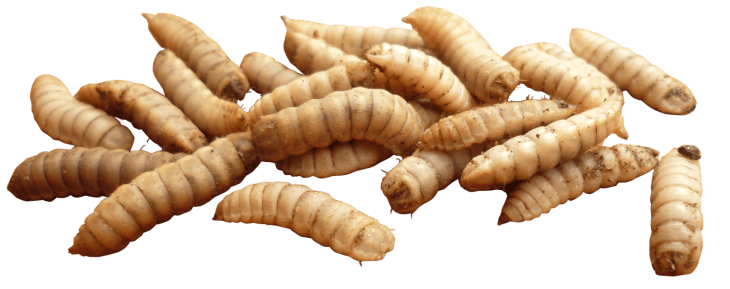
A maggot changing into a fly is an example of 
a)
reproduction.
b)
growth and development.
c)
homeostasis.
d)
evolution.
10.
The maintenance of an organism’s internal environment is called:
a)
compensating
b)
homeostasis
c)
balancing
d)
routine
11.
The "cause" for something to happen is the
a)
response
b)
effect
c)
stimulus
d)
homeostasis
12.
Rocks are not living because
a)
they never move
b)
they aren't needed for humans
c)
they are not made of cells
d)
they don't break down
13.
A cactus shows all of the following characteristics EXCEPT ____________. 
a)
need water
b)
growth 
c)
movement
d)
respond to environment 
14.
What is the main source of energy on Earth?
a)
stars
b)
moon
c)
water
d)
sun
15.

Reproduction that only involves one parent and all offspring are identical; for example, binary fission of bacteria or amoebas.

a)

Asexual

b)

Sexual

c)

Division

d)

Addition

16.

Reproduction that involves cells from two parents uniting to produce the first cell of a new organism.

a)

Asexual

b)

Sexual

c)

Budding

d)

Division

17.

The sum of all the chemical reactions in your body?

a)

organization

b)

metabolism

c)

homeostasis

d)

evolution

18.
Temperature and sunlight would be examples of ____________ factors within an environment.
a)
biotic
b)
abiotic
19.
Define BIOLOGY.
a)
The study of life and living organisms.
b)
The study of animals.
c)
They study of matter.
d)
The study of earth and its atmosphere.
20.
Which of the following is NOT true of atoms?
a)
They are composed of molecules.
b)
They can combine with other atoms.
c)
They make up elements
d)
They are extremely small
21.
An atom becomes negatively charged by
a)
gaining an electron
b)
losing an electron
c)
losing a proton
gaining a neutron
22.
What particle is found in the nucleus and has no charge?
a)
electron
b)
neutron
c)
proton
d)
atom
23.
The space surrounding the nucleus of an atom contains
a)
protons
b)
electrons
c)
neutrons
d)
ions
24.
Two or more atoms combined
a)
Molecule
b)
Compound
c)
Isotope
d)
Ion
25.

Enzymes act on

a)

products

b)

proteins

c)

amino acids

d)

substrates

26.

What are proteins made of?

a)

amino acids

b)

monosaccharides

c)

nucleic acids

d)

fatty acids

27.

Which carbon-based molecule includes sugar and starches?

a)

carbohydrates

b)

lipids

c)

proteins

d)

nucleic acids

28.

What is the primary function of DNA?

a)

to make nucleic acids

b)

long term energy storage

c)

store genetic information

d)

to function as RNA

29.

What are the products in this chemical reaction?

a)

calcium and oxygen

b)

Ca and CaO

c)

2Ca and O2

d)

2CaO

30.
The 4 macromolecules are
a)
vitamins, lipids, water, micronutrients
b)
micronutrients, macronutrients, water, vitamins
c)
Lipids, Waxes, Vitamin A, Water
d)
Carbohydrates, Lipids, Proteins, Nucleic Acids
31.
What is a substance called if it speeds up a chemical reaction?
a)
reusable
b)
catalyst
c)
specific
d)
fragile
32.
Carbohydrates are made up of three of the six major molecules found in living things. The general chemical formula for a carbohydrate is CH2O. Which elements combine to make a carbohydrate?
a)
copper and cobalt
b)
chlorine and oxygen
c)
carbon, helium, and oxygen
d)
carbon, hydrogen, and oxygen
33.
When people eat foods high in proteins, such as meat, eggs and cheese, the body breaks down the proteins into smaller molecules. What is supplied to cells when the body breaks down proteins?
a)
amino acids
b)
nucleic acids
c)
phospholipids
d)
carbohydrates
34.
What is true about this graph?
a)
The optimum pH of the enzyme is 6.6.
b)
The optimum pH of the enzyme is 5.8
c)
The enzyme’s activity increases as pH increases 5.0 to 9.0
d)
The enzyme’s activity is greater around pH of 8.0 .
35.
Glucose is a _____.
a)
carbohydrate
b)
lipid
c)
protein 
d)
nucleic acid
36.
Letter C...
a)
active site
b)
enzymes
c)
substrate
d)
products
37.

In reactions, products must be equal to..

a)

Products

b)

Reactants

c)

Starters

d)

Enders

38.

Which type of cell?

a)

Prokaryote

b)

Eukaryote

39.

Has membrane bound organelles

a)

Prokaryote

b)

Eukaryote

c)

Both

40.

Where is the DNA found in a prokaryotic cell?

a)

In the nucleus

b)

In the mitochondria

c)

Floating around in the cytoplasm

d)

In the ribosome

41.

In what organelle is the genetic material found inside?

a)

Nucleus

b)

endoplasmic reticulum

c)

Mitochondria

d)

Lysosome

42.

What is the function of this organelle?

a)

Sac that stores water, nutrients, and waste products

b)

Regulates what enters and leaves the cell

c)

Structures that transport and ship proteins like UPS

d)

Cite of cellular respiration also known as the powerhouse of the cell

43.

What can only be found in plant cells?

a)

Chloroplast

b)

Vacuole

c)

Nucleus

d)

Cell membrane

44.

The two kinds of cells are Prokaryotes and Eukaryotes. How are they different?

a)

Prokaryotes are plant cells

b)

Eukaryotes have a nucleus

c)

Prokaryotes have a nucleus

d)

There is no difference

45.
Which structure is found only in eukaryotic cells?
a)
DNA
b)
Phospholipid membrane
c)
Nuclear membrane
d)
Cytoplasm
46.
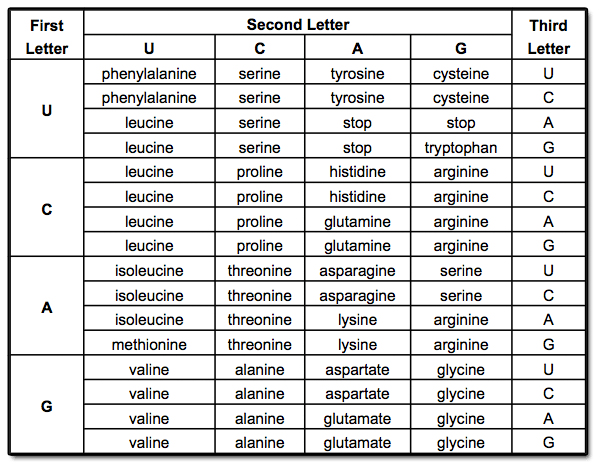
What amino acid is represented by the codon UUA?
a)
Phenylalanine
b)
Tyrosine
c)
Leucine
d)
Stop codon
47.
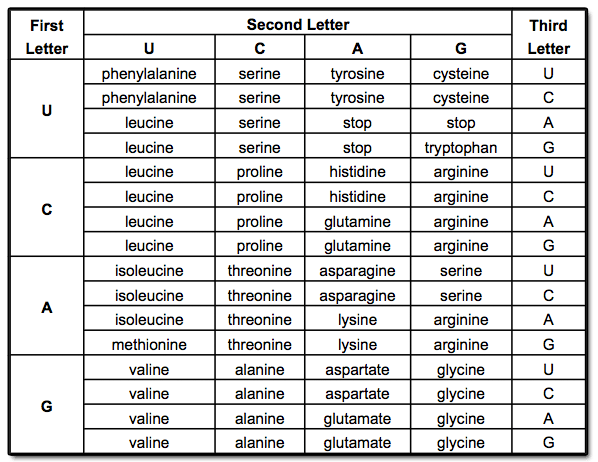
What is the correct amino acid sequence for the mRNA code AUGCCAGUAUGA
a)
Met-Pro-Ala-Val
b)
Met-Pro-Val
c)
Tyr-Gly-His
d)
Tyr-Gly-Arg-His
48.
Which is the mRNA molecule that would be transcribed from this DNA template:
TGGCAAGTACGT
a)
ACCGTTCATGCA
b)
UGGCAAGUACGU
c)
UCCGUUCUUGCU
d)
ACCGUUCAUGCA
49.

Where does TRANSCRIPTION occur?

a)

Nucleus

b)

Ribosome

c)

Cytoplasm

d)

Mitochondria

50.

Why must transcription occur where DNA can be found?

a)

because DNA can't leave

b)

because ribosomes are in the nucleus

c)

because DNA polymerase is found there

d)

because helicase unzips the DNA

51.

How many nucleotides equal 1 amino acid?

a)

1

b)

2

c)

3

d)

4

52.

Which of the following are differences in the structure between RNA and DNA

a)

DNA uses deoxyribose sugar, RNA uses sugar ribose

b)

DNA pairs Adenine with Uracil, RNA pairs Adenine with Thymine

c)

DNA is a double helix, RNA is a single helix

d)

DNA pairs Adenine with Thymine, RNA pairs Adenine with Uracil

53.
The process to go from mRNA to a protein is called ____
a)
transcription
b)
rRNA
c)
replication
d)
translation
54.
The principle shown in the image is called what?
a)
Transcription
b)
The Central Dogma
c)
Translation
d)
The Principle of Proteins
55.
Which of these nitrogenous bases is NOT in RNA?
a)
Uracil
b)
Thymine
c)
Cytosine
d)
Guanine
56.

Why do cells need to do translation?

a)

to make proteins

b)

so new cells can have a copy of the DAN

c)

to get the information out of the nucleus

57.
Transfer RNA or tRNA reads the mRNA in groups of three bases called...
a)
codons
b)
codes
c)
anticodons
d)
bases
58.
The codon CCU codes for what amino acid?
a)
Isoleucine
b)
Stop
c)
Methionine
d)
Proline
59.
Which amino acid pairs with the codon AGA
a)
Thr
b)
Arg
c)
Ala
d)
Glu
60.

What does "hydrophilic" mean?

a)

water loving, associates with water

b)

water fearing, does not associate with water

c)

a world war II submarine

d)

an example would be solutes like oil or fat

61.

What does "hydrophobic" mean?

a)

water loving, associates with water

b)

water fearing, does not associate with water

c)

a world war II submarine

d)

an example would be solutes like sugar or salt
62.
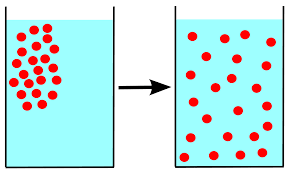
The picture below is an example of _________________.
a)
osmosis
b)
isotonic
c)
diffusion
d)
active transport
63.
Osmosis is the movement of _____ across a membrane.
a)
food
b)
energy
c)
oxygen
d)
water
64.
During osmosis
a)
water moves from high to low concentration
b)
large or oddly shaped molecules move across a cell membrane
c)
water moves when energy is used
d)
proteins are built
65.
The picture is an example of...
a)
active tranport
b)
passive transport
c)
diffusion
d)
osmosis
66.
When you get cut, your skin cells release hormones that signal platelets to come and stop the bleeding. Platelets then release more hormones that signal even more platelets to help stop bleeding. The hormone signals continue until the cut is closed.
a)
Positive Feedback Response
b)
Negative Feedback Loop 
67.

The ultimate cause of death

a)

Over Heating

b)

Diabetes

c)

Bad Hair

d)

Loss of Homeostasis

68.
Name the levels of organization in the human body in order from smallest to largest:
a)
Tissue, organ, organ system
b)
Organ system, tissue, organs, cells
c)
Cells, tissue, organs, organ system
d)
Cells , organs, tissue, organ system
69.
Which of the following is NOT the system that regulate the blood sugar level?
a)
Circulatory system
b)
Muscle system
c)
Endocrine system
d)
Digestive system
70.

When the body temperature drop below normal ranges, arterioles in the skin will

a)

dilate to allow less blood to flow to skin surface

b)

constrict to allow less blood to flow to skin surface

c)

dilate to allow more blood to flow to skin surface

d)

constrict to allow more blood to flow to skin surface

71.
Homeostasis in the human body is often maintained by a: 
a)
neutral feedback loop 
b)
solar feedback loop
c)
positive feedback loop
d)
negative feedback loop
72.

What are the jobs of the skeleton?


(Select all correct answers)

a)

supports the body and give it shape

b)

makes red blood cells

c)

protects soft parts of the body

d)

allows the organism to move

73.

What two organs does the rib cage protect?

a)

heart

b)

lungs

c)

brain

d)

eyes

74.

What organ system protects the body from injury and infection, helps maintain body temperature, retain fluid and eliminate waste, and insulates and cushions deep organs?

a)

muscular

b)

integumentary

c)

cardiovascular

d)

skeletal

75.

Transport nutrients, hormones, oxygen

a)

excretory

b)

divestive

c)

skeletal

d)

circulatory

76.

Cellular Respiration's goal is to

a)

make water

b)

make ATP

c)

make glucose

d)

make oxygen

77.

Which statement is true regarding cellular respiration?

a)

The reactants of cellular respiration are identical to the reactants of photosynthesis.

b)

The reactants of cellular respiration are obtained from the products of photosynthesis.

c)

The products of cellular respiration are the same as the products of photosynthesis

d)

Cellular respiration only occurs in autotrophs, photosynthesis occurs only in heterotrophs.
78.
What are the products of photosynthesis?
a)
water and carbon dioxide
b)
oxygen and glucose
c)
oxygen and carbon dioxide
d)
oxygen and water
79.
When humans burn fossil fuels, most of the carbon quickly enters the                       as carbon dioxide.
a)
Water
b)
Atmosphere
c)
Sun
d)
Air
80.
What does not produce carbon dioxide?
a)
Photosynthesis
b)
Burning Fossil Fuels
c)
Animal respiration
d)
Plants decaying
81.
How do living organisms return carbon to the atmosphere in the carbon cycle?
a)
respiration and photosynthesis
b)
 decomposition and respiration
82.
How does the carbon in grass become part of a lion?
a)
The lion eats the grass
b)
Carbon from grass doesn't end up in a lion. 
c)
The carbon ends up in the lion's food chain. 
d)
The lion breathes in carbon given out by the plant
83.
All of the carbon in existence is continually recycled in the carbon cycle
a)
True
b)
False
84.
Which of the following removes carbon from the atmosphere?
a)
Combustion
b)
Respiration
c)
Photosynthesis
d)
Death
85.
Organisms that do not decompose can be buried and become what?
a)
water
b)
nutrients
c)
air
d)
fossil fuels
86.
If the plant population decreased, the amount of carbon would _________.
a)
Stay the same
b)
Increase
c)
Decrease
87.

Which is a true statement?

a)

Humans depend on oxygen, plants depend on carbon dioxide

b)

Plants produce carbon dioxide

c)

Humans depend on carbon dioxide, plants depend on oxygen

d)

Humans don't depend on plants for the air they need

88.

In the carbon cycle, animals can release carbon back into the cycle through __________ or through __________.

a)

burning . . . photosynthesis

b)

fixation . . . decomposition

c)

decomposition . . . photosynthesis

d)

respiration . . . decomposition

e)

respiration . . . photosynthesis

89.

If a forest fire occurs, what will happen to the carbon in the forest?

a)

It will go into the soil

b)

It will go into the atmosphere

c)

It will runoff into nearby streams and rivers

d)

It will be destroyed

90.

Which of the following are some of the major carbon stores on Earth? You can choose multiple answers

a)

The ocean

b)

The lithosphere (upper part of Earth's crust)

c)

The atmosphere