
NEW
Font size
 Worksheets
Semester 1 Review - ESS
Total questions: 60
Worksheet time: 1hrs 8mins
Edwin Hubble measured distances to the nearest galaxies. He measured the velocities of other galaxies and found a correlation between distance and recession speed, providing observational evidence that the universe is ____________________.
expanding
shrinking
As the universe expanded and cooled, that primordial energy would have
stretched to longer-wavelength, lower-energy radiation.
compressed to shorter-wavelength, higher-energy radiation.
All the left over radiation left over from the big bang, is spread evenly throughout the universe
Cosmic Background Radiation
Universal Expansion
Radioactive Decay
Redshift/BlueShift
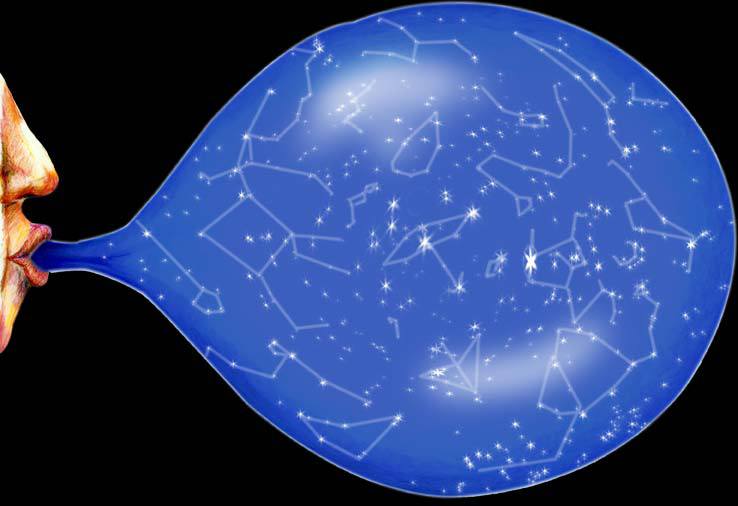
Which astronomer is responsible for discovering that dark matter causes galaxies to spin faster at the outer edges than they should?
Fritz Zwicky
Vera Rubin
Jocelyn Bell
Annie Cannon
Most of the universe is made of
visible matter
Invisible matter
dark energy
dark energy and dark matter
Most of the universe is disappearing from sight due to the expansion of space.
true
false


Which of these will MOST likely result from small meteoroids entering the atmosphere of Earth?
a decrease in air temperature
the appearance of shooting stars
a decrease in atmospheric ozone
the appearance of the Northern Lights
The eight known planets accreted during the formation of the solar system. The four inner planets are rocky and have little or no atmospheres. The four outer planets have very thick atmospheres. Which fact about the early solar system BEST helps explain how these different planet types formed?
The outer planets were too far from the Sun for solar pressure to maintain compressed gases.
The outer planets each absorbed most of the gases from their large number of moons.
The temperature near the Sun was too great for most gases to condense on the inner planets.
The gravitational forces from the outer planets pulled away the gases from the inner planets.

Who is the person credited with developing the theory of continental drift?
Harry Hess
Alfred Wegener
Which mountain range in North America shares identical fossils of plants and animals with those found in Europe?
the Appalachians
the Rockies
the Sierra Nevadas
the Pennines
What did Alfred’s The Origin of Continents and Oceans propose about how mountains formed?
by crashing into each other and folding the Earth up
by two continents moving away from each other
by one continent sinking below another continent
by one continent sliding past another continent
Geologist and Navy Admiral who mapped the seafloor in WWII discovering the Mid Atlantic Ridge and ocean trenches which led to his theory of 'seafloor spreading'
Alfred Wegener
Harry Hess
The pattern of magnetic stripes in rocks on either side of the mid-ocean ridge is the same.
True
False
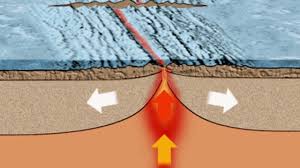
In sea-floor spreading, molten material rises from the mantle and erupts
along the edges of all the continents.
along mid-ocean ridges.
in deep-ocean trenches.
at the north and south poles.

The process by which the ocean floor sinks beneath a deep-ocean trench and back into the mantle is known as _______
convection.
continental drift.
subduction.
conduction.
Which of these tectonic plate boundaries is most likely to form a volcano.
a continental plate colliding with a continental plate
an oceanic plate sliding past a continental plate
a continental plate sliding past a continental plate
an oceanic plate colliding into a continental plate


Tsunamis are caused by
underwater disturbances such as earthquakes, landslides, and volcanoes.
wind and the gravitational pull of the moon.
Tsunamis can be
as high as 100 feet.
as high as 2 feet.
as high as 1,000 feet.
as high as 10,000 feet.
What are most tsunamis caused by?
Hurricanes
Tornadoes
Earthquakes
Landslides
What was the magnitude of the 2004 Indian Ocean Tsunami?
7.4 -7.6
8.1 - 8.3
7.7 - 8
9.1 - 9.3
What is the deadliest tsunami ever recorded?
The 1782 South China Sea tsunami
The 1868 northern Chile tsunami
The 2011 Japan Tohoku tsunami
The 2004 Indian Ocean tsunami
back and forth motion
S-wave
P-wave
elastic rebounding
L-wave
side to side motion
L-wave
S-wave
P-wave
focus
up and down motion
P-wave
S-wave
epicenter
L-wave
where quake begins below surface
elastic rebounding
focus
epicenter
fault
where quake begins on surface
epicenter
joint
fault
focus

An upward fold in the rock that makes an arch
anticline
syncline
folded mountain
fault block

What type of fault is this?
normal fault
reverse fault
strike-slip fault

What type of FOLD is shown here?
Anticline
Syncline
Monocline

What type of fold is this?
monocline
syncline
anticline

What type of fold is this?
monocline
anticline
syncline
Look at these sedimentary rock formations as the plane flies over the landscape. What principle describes the level layers?
The Law of Horizontality, deposition of sediment due to gravity
Plate Tectonics, the movement of these layers across the landscape
Density, the heavier materials settle to the bottom

