wayground logo

Free Printable Worksheets

NEW

Font size

S
M
L
XL
Worksheets

Environmental Systems Fall 22 SE Review

Total questions: 68

Worksheet time: 2hrs 6mins
Name
Class
Date
1.
The scientific name for an organism is made from the:
a)
class and family name
b)
genus and species name
c)
domain and kingdom name
d)
kingdom and phylum name
2.
Tool used by a taxonomist to identify an unknown organism is a:
a)
dichotomous key
b)
binomial nmenclature
c)
scientific name
d)
binomial key
3.
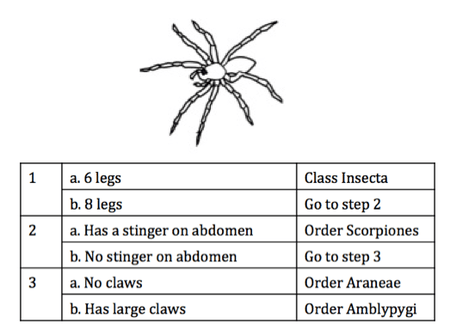
An illustration and a dichotomous key are given. What is the correct classification for this organism?
a)
Class Insecta
b)
Order Amblygygi
c)
Order Araneae
d)
Order Scorpiones
4.
A table of arachnid and insect characteristics is shown. Which characteristic could be used to distinguish between
arachnids and insects?
a)
Jointed legs
b)
Body segments
c)
Presence of eyes
d)
Presence of antennae
5.
A dichotomous key for trees is provided. Hikers found a tree that has large brown cones and single sharp needles. What species of tree have the hikers found?
a)
Juniper
b)
Pine
c)
Spruce
d)
Fir
6.

Biome with plants and grasses, but no trees.

a)

grassland

b)

desert

c)

forest

d)

arctic tundra

7.

Biome with many different species of cacti and reptiles and very little rainfall.

a)

Desert

b)

Temperate Rainforest

c)

Tropical Rainforest

d)

Arctic Tundra

8.

Forest biome with many different trees, mosses and ferns; most trees lose and regrow their leaves each year.

a)

temperate rainforest

b)

biome

c)

desert

d)

grassland

9.
Type of forest biome near the equator; receives a lot of rain; temperatures are warm all year.
a)
desert
b)
tropical rain forest
c)
arctic
d)
temperate rain forest
10.

Which land biome is the ground frozen all year round?

a)

Grassland

b)

Taiga

c)

Tundra

d)

Deciduous Forest

11.
The relationship between ALL the organisms in a community showing who eats whom is called a ___________________________.
a)
Food Web
b)
Food Chain
c)
Abiotic Factors
d)
Biotic Factors
12.
One path that energy could take through an ecosystem is called a ________________________.
a)
Food Web
b)
Food Chain
c)
Abiotic Factors
d)
Biotic Factors
13.
Where does the energy that travels through an ecosystem originally come from?
a)
Earth's Core
b)
Water
c)
Plants
d)
The Sun
14.
An organism that lives by breaking down dead organic matter into simpler parts is a _______________________.
a)
scavenger
b)
consumer
c)
decomposer
d)
carnivore
15.
A second-level (secondary) consumer CANNOT be which type of consumer?
a)
Carnivore.
b)
Decomposer.
c)
Omnivore
d)
Herbivore.
16.
An animal that only eats other animals is a _______________.
a)
carnivore
b)
omnivore
c)
herbivore
d)
decomposer
17.
A living thing that makes its own food is called a __________________________.
a)
consumer
b)
producer
c)
carnivore
d)
herbivore
18.
A population of mice lives in a barn community. A cat population has just joined the community. What will happen?
a)
Mouse and cat populations both go up?
b)
Mouse and cat populations both go down
c)
Mouse population goes down as cat population goes up
d)
Mouse population goes up as cat population goes down
19.
In the food web shown, the snail would be considered...
a)
primary consumer
b)
secondary consumer
c)
tertiary consumer
d)
producer
20.
What are organisms that use other organisms for food in order to gain energy?
a)
decomposers
b)
producers
c)
herbivores
d)
consumers
21.

What converts nitrogen gas into a usable form for plants and animals?

a)

bacteria

b)

rain

c)

fungi

d)

car exhaust

22.

Organisms that need nitrogen to survive.

a)

only plants

b)

only animals

c)

only bacteria

d)

all living things

23.

How do animals get the nitrogen they need?

a)

From the air they breathe

b)

From the water they drink

c)

From the food they eat

d)

From the sun

24.

What is the process of combining nitrogen gas with other elements to make nitrogen into usable compounds?

a)

nitrogen composition

b)

nitrogen fixation

c)

ammonia

d)

denitrification

25.
A rock formed from fragments of other rocks is a(n)
a)
Metamorphic Rock
b)
Sedimentary Rock
c)
Extrusive Rock
d)
Igneous Rock
26.
If heat and pressure inside the Earth cause a rock to melt, the material that formed would be
a)
Metamorphic
b)
Magma
c)
Sedimentary
d)
Igneous
27.
You find a rock in which the grains are arranged in parallel bands of white and black crystals.  The rock is probably a(n)
a)
Igneous rock
b)
Sedimentary rock
c)
Metamorphic rock
d)
Extrusive rock
28.
Fossils are only found in
a)
Sedimentary rocks
b)
Foliated Metamorphic rocks
c)
Igneous Rocks
d)
Nonfoliated Metamorphic rocks
29.
oxygen is a gas produced by _ and used by  _ 
a)
plants and animals 
b)
photosynthesis and carbon dioxide 
c)
animals and plants 
d)
carbon dioxide and photosynthesis
30.
Which process converts carbon in the form of sugar into carbon dioxide gas?
a)
Bioremediation
b)
Photosynthesis
c)
Respiration
d)
Transpiration
31.

If the plant population decreased, the amount of carbon in the atmosphere would _________.

a)

Stay the same

b)

Increase

c)

Decrease

32.

Which is an example of a carbon sink?

a)
b)
c)
d)
33.
What process occurs when coal (fossil fuel) is used for energy?
a)
Decomposition
b)
Combustion
c)
Pressurization 
d)
Respiration 
34.
The average temperature of the surface of Earth has increased approximately 1°C in the past century. Which reason best explains this increase in temperature?
a)
lower levels of ozone in the atmosphere
b)
lower levels of nitrogen in the atmosphere
c)
higher levels of carbon dioxide and other greenhouse gases in the atmosphere
d)
higher levels of oxygen in the atmosphere
35.

Breaking News! A new island has formed off of Hawaii! What must occur for it to become an ecosystem?

a)

Secondary Succession

b)

Aquatic succession

c)

Primary Succession

d)

Ferns must grow

36.

How do pioneer species compare in primary and secondary succession?

a)

primary starts with grass and weeds, secondary starts with mosses

b)

primary starts with forest fire, secondary starts with volcano

c)

primary starts with a volcano, secondary starts with a forest fire

d)

Lichens and moss in primary, and grasses/ ferns in secondary

37.

Primary succession occurs in areas with:

a)

very little soil

b)

lots of soil

c)

no soil

d)

soil that has been disturbed

38.
succession that occurs in an area where soil is already present
a)
ecological succession 
b)
primary succession 
c)
secondary succession
d)
pioneer speciles
39.

Which experiences the least change over time?

a)

Pioneer Species

b)

Primary Succession

c)

Aquatic Succession

d)

Climax Community

40.
Land used for recreation and scenic enjoyment, and for preserving native animal and plant communities and ecosystems.
a)
parks and preserves
b)
urban land
c)
ecosystem services
d)
forest land
41.
Relatively few people and large areas of open space.
a)
rangeland
b)
urban land
c)
rural land
d)
parks and preserves
42.
 Land used to grow plants for food and fiber
a)
cropland
b)
urban land
c)
rural land
d)
forestland
43.
What are some consequences of deforestation?
a)
increased population in cities
b)
building of more infrastructure
c)
soil erosion, loss of biodiversity, loss of ability to remove CO2
d)
more mercury and cyanide released into rivers
44.
This sphere includes the continents, the ocean floor, all the rocks on the surface, and all of the sand in the deserts. 
a)
Hydrosphere 
b)
Biosphere 
c)
Atmosphere 
d)
Geosphere 
45.

What causes an Earthquake?

a)

Tectonic plates in the Earth moving and sliding.

b)

Giants racing across the Earth.

c)

Masses of people jumping up and down all at once.

46.

Landslides are caused by...

a)

The trees deciding that they want a new home.

b)

Landslides are not real.

c)

Gravity pulling soil down a cliff or mountain that has been loosened by rain or weathering.

47.

Volcanoes are...

a)

just like ant hills

b)

created by magma formed beneath the Earths crust that gets pushed up through cracks in the Earth's surface.

c)

a figment of our imagination.

48.

Tsunamis are caused by...

a)

underwater Earthquakes that create large ripples in the water that eventually push out into land.

b)

someone leaving the faucet running for too long.

c)

someone doing a huge cannon ball in the middle of the ocean.

49.

Which Natural Disaster could have caused this?

a)

A landslide.

b)

An avalanche.

c)

A volcanic eruption.

d)

A flood.

50.

Both El Nino and La Nina have this in common

a)

Influence birds that migrate over the ocean

b)

Influence rainy / dry weather world wide

c)

The weather at the polar regions

d)

The directions that ships travel in the oceans

51.

How often do El Nino events occur?

a)

2-5 years

b)

2-7 years

c)

7-10 years

52.

La Niña is characterized by ______________ of the Western Pacific Ocean.

a)

a warming

b)

a cooling

c)

average temperatures

53.

When La Nina and hurricanes pull cold water to the surface and bring nutrient rich sediments from the seafloor, this is called ___________________.

a)

upwelling

b)

downwelling

c)

El zapato

d)

La Gloria

54.

In El Nino, rain moves east with the warm pool causing rainy/stormy weather in California and less hurricanes in the Atlantic Ocean.

a)

True

b)

False

55.

During a(n) ____ event, trade winds are much stronger than usual.

a)

El Nino

b)

La Nina

c)

Normal

d)

Partly sunny

56.
What is the transfer of heat by movement of liquids or gases?
a)
Radiation
b)
Convection
c)
Conduction
d)
Heat
57.
What is a transfer of heat energy by electromagnetic waves?
a)
Radiation
b)
Convection
c)
Conduction
d)
Heat
58.
What is a substance that DOES conduct heat well?
a)
Conductor
b)
Insulator
c)
Convector
d)
Radiator
59.

Boiling Water

a)

Conduction

b)

Convection

c)

Radiation

60.

A group of organisms that have common characteristics and can reproduce to breed offsprings is called.......

a)

ecosystem

b)

community

c)

species

d)

population

61.

A group of organisms of the same species that live in the same habitat is called .....

a)

species

b)

population

c)

community

d)

ecosystem

62.
Trophic levels are represented by 
a)
squares
b)
circles
c)
pyramids
d)
lines
63.
An organism that gets energy from breaking down dead organisms, non-living material or waste is a(an) ___________.
a)
producer
b)
consumer
c)
decomposer
d)
autotroph
64.
Eat primary consumers (can be carnivores and omnivores)
a)
Tertiary Consumers
b)
Secondary Consumers
c)
Quaternary Consumers 
d)
Top Predators 
65.
An organism that obtains energy from eating meats
a)
Omnivores
b)
Carnivores
c)
Herbivores
d)
Animals 
66.

What organisms can take energy from the sun to create its own energy in the form of glucose?

a)

Primary consumers

b)

Primary producers

c)

Secondary consumers

d)

Tertiary consumers

67.

The primary consumer in this image is the....

a)

Hawk

b)

Grass

c)

Grasshopper

68.

The omnivores in this diagram are the .....

a)

Grass

b)

Rabbits

c)

Snakes

d)

Hawk