wayground logo

Free Printable Worksheets

Font size

S
M
L
XL
Worksheets

REVIEW TEST QUARTER 2

Total questions: 100

Worksheet time: 1hrs 17mins

Name
Class
Date
1.
Wood burning is an example of _______
a)
physical intensive property
b)
physical extensive property
c)
chemical change
d)
Physical change
2.
Physical properties of a substance include _________
a)
color and odor
b)
melting and boiling points
c)
density 
d)
all of the choices are correct
3.

Which is a chemical property?

a)

The texture of a compound

b)

The reactivity of a compound with air

c)

The mass of an element

d)

The volume a solution takes up

4.

Which is the best description of a liquid?

a)

definite shape and definite volume

b)

indefinite shape and definite volume

c)

definite shape and indefinite volume

d)

indefinite shape and indefinite volume

5.

Which is the most compressible state of matter?

a)

Solid

b)

Liquid

c)

Gas

6.

Which of the following is true of a compound compared to an element?

a)

Elements are considered pure and a compound is not

b)

Compounds can have different properties from the elements that make them up

c)

Elements can be broken down into simpler parts and compounds can not (even by chemical means)

d)

The separate parts that make up an element can be seen visually but the same is not true for compounds

7.

Which of the following is a chemical change?

a)

Color Change

b)

Melting

c)

Boiling (vaporization)

d)

Dissolving in water

8.
A combination of two or more different substances in which the substances keep their identities. 
a)
reaction
b)
mixture
c)
solution
d)
atom
9.
A combination that can be separated by physical processes is a .....
a)
Atom
b)
Compound
c)
Element
d)
Mixture
10.

a characteristic that can be observed without changing the substance

a)

physical change

b)

physical property

c)

chemical change

d)

chemical property

11.

What happens to the atoms of a substance in a physical change?

a)

Atoms get bigger

b)

Atoms change their arrangement and motion

c)

Atoms get smaller

d)

Atoms bond together differently

12.

What happens to the atoms of a substance in a chemical change?

a)

Atoms get bigger

b)

Atoms change their arrangement and motion

c)

Atoms get smaller

d)

Atoms bond together differently

13.
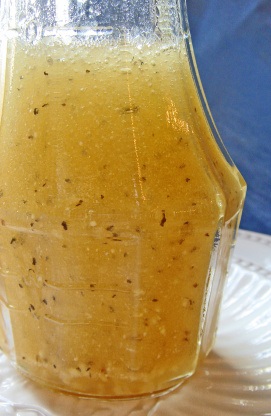
Italian Salad Dressing is a . . .
a)
heterogeneous mixture
b)
homogeneous mixture
c)
Pure Substance
d)
Compound
14.
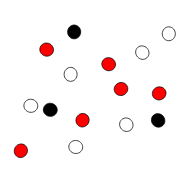
This picture represents: 
a)
Element
b)
Compound
c)
Mixture of Elements
d)
Mixture of Compounds
15.
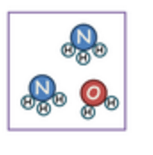
This picture represents: 
a)
Element
b)
Compound
c)
Mixture of Elements
d)
Mixture of Compounds
16.
This picture represents: 
a)
Element
b)
Compound
c)
Mixture of Elements
d)
Mixture of Compounds
17.
Which of the following would you use to separate sand from iron?
a)
a bar magnet
b)
paper
c)
hot plate
18.
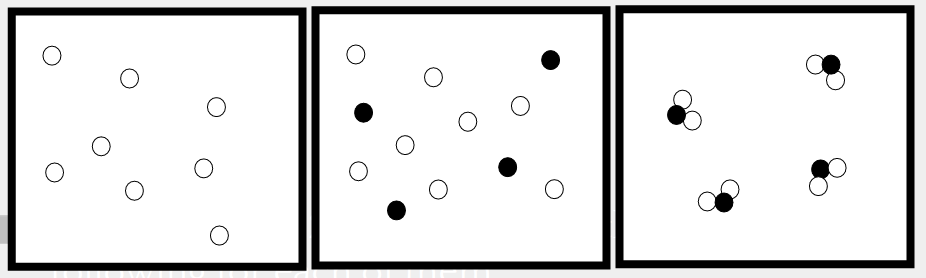
Which one of these pictures represents a pure substance? 
a)
1 and 2
b)
1 and 3
c)
2 and 3
d)
1, 2 and 3
19.
Which one of these pictures represents a mixture? 
a)
1
b)
2
c)
3
d)
1, 2 and 3
20.
Mixture, such as mixed nuts or dry soup mix, in which different materials are unevenly distributed and are easily identified.
a)
suspension
b)
homogeneous mixture
c)
heterogeneous mixture
d)
colloid
21.

What type of mixture is black ink?

a)

heterogeneous mixture

b)

homogeneous mixture

22.
Which is NOT a chemical change?
a)
Leaves changing colors in the fall
b)
Iron rusting
c)
Digesting Lunch
d)
Ice Melting
23.
Which of the following is not a clue that a chemical change is taking place?
a)
rapid release of energy (heat, light, or sound)
b)
phase change
c)
formation of bubbles
d)
formation of a precipitate from solution
24.
Which of the following are not examples of physical properties?
a)
density
b)
malleability
c)
magnetism
d)
tarnish
25.
Which of the following is not a homogeneous mixture?
a)
orange juice
b)
vinegar
c)
soft drinks
d)
pool water
26.
What is viscosity?
a)
ability to be drawn into a wire
b)
ability of a substance to change states
c)
the ability of the substance to flow
d)
ability of a substance to regenerate
27.
Which word means to be pounded into sheets?
a)
ductile
b)
malleable
c)
dissolvable
d)
ferment
28.

The alloy stainless steel is made from mixing iron and chromium. This makes stainless steel a ___

a)

mixture

b)

compound

c)

element

d)

pure substance

29.

The gasoline burned. This is a __

a)

chemical change

b)

physical change

c)

phase change

d)

none of the choices are correct

30.
What is digestion?
a)
Physical property
b)
Chemical change
c)
Physical change
d)
Chemical property
31.

Which separation technique is used to obtain salt from seawater?

a)

Sieving

b)

Filtration

c)

Chromatography

d)

Evaporation

32.

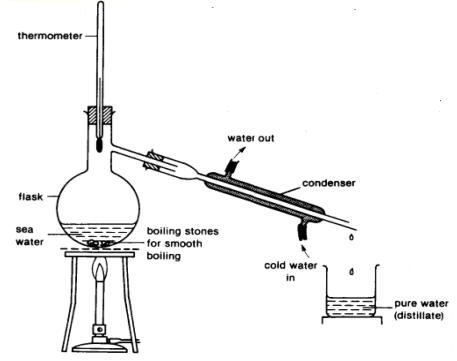
What is the name of this separation technique?

a)

Simple distillation

b)

Fractional distillation

c)

Boiling

d)

Evaporation

33.

For paper chromatography to work,

a)

the dyes must have different boiling points.

b)

the dyes must have different solubilities in the solvent.

c)

the dyes must have only one component.

d)

The starting line must be below the level of the solvent.

e)

the solvent used must be a mixture of different compounds.

34.

No matter what you do, sand will not dissolve in water, because sand is _________.

a)

dissolved

b)

soluble

c)

insoluble

d)

aqueous

35.

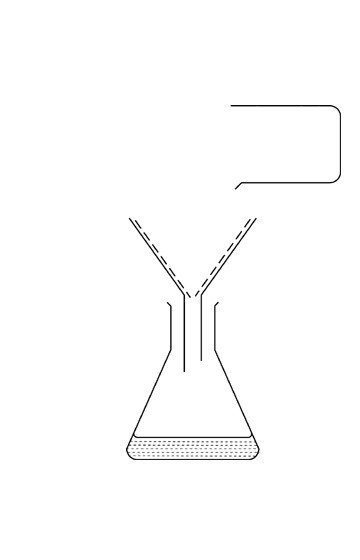
What is the name of this separation technique?

a)

distillation

b)

filtration

c)

evaporation

d)

chromatography

36.

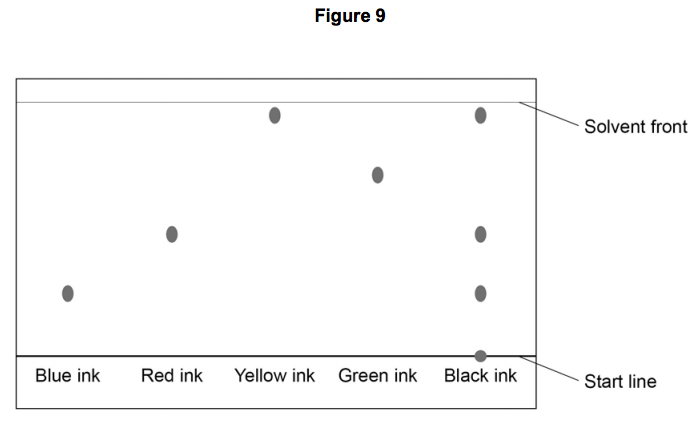
Referring to the chromatogram, black ink contains

a)

Blue, red and yellow ink only

b)

Blue, red, yellow and green ink

c)

Blue and yellow ink

d)

Black ink only

37.

What does the term "filtrate" mean?

a)

solid particles that decompose upon heating

b)

the liquid that evaporates from a solution

c)

solid particles that are left behind after filtration on the filter paper

d)

the liquid that passes through the filter paper

38.
Gas particles have the ________ kinetic energy because they move the fastest.
a)
least
b)
most
39.
When a liquid changes its phase and turns into a solid it is known as
a)
condensation.
b)
melting.
c)
vaporization.
d)
freezing or solidification.
40.
When a gas changes its phase and turns into a liquid it is known as
a)
condensation.
b)
sublimation.
c)
vaporization.
d)
freezing or solidification.
41.
When a gas changes its phase and turns into a solid it is known as
a)
deposition.
b)
sublimation.
c)
condensation.
d)
freezing or solidification.
42.
When a solid changes its phase and turns into a gas it is known as
a)
deposition.
b)
melting.
c)
condensation.
d)
sublimation.
43.
All phase changes are
a)
chemical changes
b)
chemical reactions
c)
physical changes
d)
irreversable
44.
What kind of energy is added to or removed from matter to cause a phase change?
a)
Radiation
b)
Heat
c)
Solar
d)
Wind
45.
Liquids and gases are similar because __________________________.
a)
they both take the shape of their container
b)
they both have their own shape
c)
liquids pour and gases don't
d)
liquids take the shape of the container but gases have their own shape
46.
The drops of water that appear on the outside of a glass of cold juice on a warm day are an example of?
a)
Sublimation: A solid turning into a gas.
b)
Condensation: A gas changing to a liquid.
c)
Evaporation: A liquid changing to a gas.
d)
Deposition: A gas changing to a solid.
47.
What Is Volume?
a)
How heavy something is.
b)
The amount of space taken up by and object.
c)
How a liquid flows.
d)
The international unit of measurement.
48.

What are the three particles that make up the atom?

a)

protons, neutrons and isotopes

b)

protons, negatives and electrons

c)

neutrons, isotopes and electrons

d)

protons, neutrons and electrons

49.

The central region of an atom where its neutrons and protons are is its

a)

nucleus

b)

core

c)

electron cloud

d)

centre

50.

A particle that moves around the nucleus is called an

a)

proton

b)

electron

c)

neutron

51.

What does the nucleus of an atom contain?

a)

Electrons and neutrons

b)

Protons and neutrons

c)

Electrons and protons

d)

Neutrons and electrons

52.

Isotopes of an element contain an equal number of protons but a different number of ____________________.

a)

neutrons

b)

electrons

c)

atomic numbers

53.

The mass number of an isotope is made up of which subatomic particles?

a)

protons and electrons

b)

protons and neutrons

c)

electrons and neutrons

d)

protons, neutrons and electrons

54.

The atomic number of an element is the total number of which subatomic particle found in the nucleus?

a)

Electron

b)

Neutron

c)

Proton

d)

Neutrons + Protons

55.

Element X has 13 neutrons with a mass number of 28. Element Y has 13 protons. These elements are:

a)

Different elements

b)

Isotopes

56.

Element Q has 56 protons and 18 neutrons.

Element R has 56 protons and 17 neutrons. These elements are:

a)

different elements

b)

isotopes

57.

What is the mass number of an element with 11 protons and 12 neutrons?

a)

1

b)

11

c)

12

d)

23

58.

How many electrons are in a neutral atom of magnesium?

a)

10

b)

12

c)

24

d)

24.3

59.
What is the atomic number of the atom pictured? 
a)
11
b)
12
c)
22
d)
23
60.
What is the atomic mass of the atom pictured? 
a)
11
b)
12
c)
22
d)
23
61.
 What is the mass number of this element?
a)
5
b)
27
c)
32
d)
59
62.

What are valence electrons?

a)

electrons on the first orbital always

b)

nucleus

c)

the outermost shell

d)

the number of electrons present in the outermost orbital

63.
Elements which are shiny, conduct electricity and heat are called
a)
metal
b)
nonmetal
c)
metalloid
d)
nonexistent
64.
The atomic number of this pictured element is
a)
28
b)
58.6934
c)
Ni
d)
Nickel
65.
Group Name and Number for Neon
a)
Alkaline Earth Metals 2 or 2A
b)
Noble Gases 18 or 8A
c)
Halogens 17 or 7A
d)
Alkali Metals 1 or 1A
66.
Group Name and Number for Flourine
a)
Transition Metals 3-12
b)
Noble Gases 18 or 8A
c)
Halogens 17 or 7A
d)
Alkali Metals 1 or 1A
67.
Who first developed the Periodic Table?
a)
Mendeleev
b)
Mosely
c)
Mendella
d)
Murphy
68.
What is the formula to solve for the neutron?
a)
Mass + Atomic Number= Neutrons
b)
Mass x Atomic Number = Neutrons
c)
Mass - Atomic Number = Neutrons
d)
Mass + Number of Protons = Neutron
69.
The Modern Periodic Table of Elements is arranged by
a)
atomic mass
b)
atomic number
c)
valence electrons
d)
number of isotopes
70.
These are found on the Periodic Table.
a)
Compounds
b)
Elements
c)
Mixtures
71.

a row on the Periodic Table of Elements

a)

family

b)

period

c)

row

d)

isotope

72.
Most of the mass of an atom is found it its _____.
a)
electron cloud
b)
nucleus
c)
atomic number
d)
empty space
73.

The periodic table is mostly comprised of what type of element?

a)

Metals

b)

Nonmetals

c)

Metalloids

74.

Which elements are colored red?

a)

nonmetals

b)

metals

c)

metalloids

75.
Silicon is a semiconductor and has properties of both metals and nonmetals. What type of element is Silicon? 
a)
Metal
b)
Nonmetal
c)
Metalloid
d)
Pretty
76.

where are the metaloids found

a)

far left, vertical

b)

stair step/diagonal

c)

far right horizontal

d)

at the bottom

77.
How many Neutrons does Bromine have?
a)
35
b)
80
c)
45
d)
79.905
78.
How many Protons does Bromine have?
a)
45
b)
79.904
c)
80
d)
35
79.
How many electrons are in the following chlorine atom?
a)
7
b)
8
c)
17
d)
13
80.
The atomic mass of Boron is 10.81, which means Boron has..
a)
5 electrons and 6 protons, each weigh 1 amu
b)
5 neutrons and 6 electrons, each weigh 1 amu
c)
6 neutrons and 5 protons, each weigh 1 amu
d)
10.81 protons each weighing around 1 amu
81.
The first person to propose a theory about an atom was
a)
Democritus
b)
Rutherford
c)
Dalton
d)
Aristotle
82.
Rutherford's gold foil experiment provided evidence that...
a)
Negative and positive charges are spread evenly throughout the atom.
b)
Alpha particles have a positive charge.
c)
Gold is not a dense as previously thought.
d)
There is a dense positively charged nucleus at the center of an atom.
83.
J.J. Thomson provided evidence that an atom...
a)
is the smallest particle of matter
b)
contains negatively and positively charged particles
c)
has an overall negative charge
d)
has an overall positive charge
84.
What contribution did John Dalton make to atomic theory? 
a)
He discovered that every atom was positively charged. 
b)
He discovered that every element consisted of one type of atom.  
c)
He discovered that atoms had nuclei. 
d)
He discovered that atoms could be divided into smaller parts. 
85.
What scientist is best known for his "Plum Pudding" model of the atom?
a)
J.J. Thomson
b)
Ernest Rutherford
c)
John Dalton
d)
Democritus
86.
How did Rutherford discover the proton?
a)
Cathode tube ray experiment
b)
Gold Foil Experiment
c)
Planetary Model
d)
Plum Pudding Model
87.
Who stated that all atoms of the same element are exactly alike?
a)
Democritus
b)
Dalton
c)
Thomson
d)
Borh
88.
Niels Bohr suggested that electrons.......
a)
are found in specific orbits
b)
electrons are scattered throughout the atom
c)
electrons move according to their energy level
d)
electrons are positive
89.
Which is the correct sequence of the scientists who made major changes in the model of the atom?
1-JJ Thomson
2-Erwin Schrodinger
3-John Dalton
4-Niels Bohr
5-Ernest Rutherford
a)
2, 1, 4, 3, 5
b)
3, 1, 5, 4, 2
c)
5, 3, 2, 1, 4
d)
4, 3, 2, 1, 5
90.
The word atom comes from a Greek word "atomos" that means
a)
Invisible
b)
Indivisible
c)
Undivided
d)
Indestructable 
91.
His atomic model was depicted similar to a planetary/solar system
a)
Bohr
b)
Thomson
c)
Rutherford
d)
Dalton
92.
James Chadwick discovered the ________.
a)
proton
b)
neutron
c)
electron
d)
nucleus
93.
What did Thomson discover?
a)
electron
b)
proton
c)
neutron
d)
electron cloud
94.
A tiny but very dense, positively charged portion of the atom that holds most of the atomic mass
a)
Electron Shells
b)
Orbitals
c)
Electron Cloud
d)
Nucleus
95.
Where electrons are likely to be found as they travel around the nucleus
a)
Nucleus
b)
Electron Cloud
c)
Within a Proton
d)
Within a Neutron
96.

The number of protons is equal to the number of electrons for an atom. This means an atom is-

a)

electrically neutral

b)

electrically positive

c)

electrically negative

97.

When an atom loses or gains electrons to become more stable it becomes an:

a)

ion

b)

isotope

c)

atom

d)

average

98.

After Rutherford discovered the nucleus, which model is believed to be true?

a)

protons, neutrons, and electrons are evenly distributed

b)

the nucleus is made of protons, neutrons, and electrons

c)

the nucleus is made of protons and electrons

d)

the model is mostly empty space with a central nucleus

99.
John Dalton stated:
a)
elements are made of atoms
b)
atoms of a given element are identical
c)
atoms cannot be subdivided, created, nor destroyed
d)
all of the above
100.
True or False: The majority of an atom is made up of empty space
a)
True
b)
False