wayground logo

Free Printable Worksheets

Font size

S
M
L
XL
Worksheets

Evolution and Classification

Total questions: 163

Worksheet time: 6hrs 56mins

Name
Class
Date
1.

Which of the following terms is no longer used to describe a group of organisms in the modern classification system?

a)

Archea

b)

Monera

c)

Eubacteria

d)

Protists

2.

Which of the following is the result of artificial selection?

a)

The rain forest plants and animals

b)

The fish that live in the ocean

c)

A particular breed of dogs with a certain coat.

d)

The weeds in a garden.

3.

The scientific name for an organism comes from its _____.

a)

class and phylum

b)

family and species

c)

kingdom and phylum

d)

genus and species

4.

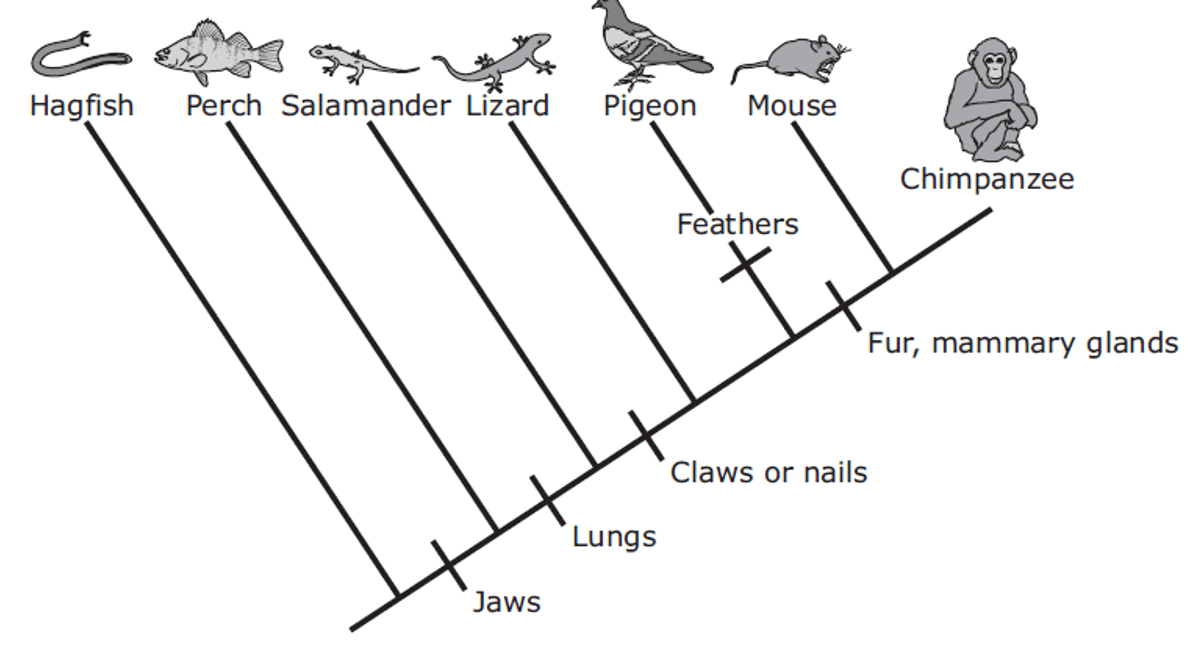
On this Cladogram, which animals have fur?

a)

Mouse, Chimp

b)

Pigeon, Mouse, Chimp

c)

Lizard, Pigeon, Mouse, Chimp

d)

Chimp

5.

What Level of Classification is missing from the RED section?

a)

Kingdom

b)

Order

c)

Genus

d)

Species

6.
The species of finches that Darwin observed differed in the shape of their beaks.  According to Darwin, all of these species probably differed due to...
a)
natural selection
b)
had migrated from Africa
c)
had descended from similar birds in Africa
d)
ate the same diet
7.
Refer to the illustration.  The similarity of these structures is one from of evidence that the organisms...
a)
share a common ancestor
b)
all grow at different rates
c)
evolved instantaneously
d)
live for a long time
8.

Taxonomy is...

a)

The study of life

b)

the science of naming and classifying animals

c)

the evolutionary history of species

d)

the sequence in which different groups evolved

9.

One difference between plants and animals is that plants are

a)

prokaryotic and animals are eukaryotic.

b)

eukaryotic and animals are prokaryotic.

c)

autotrophs and animals are heterotrophs.

d)

heterotrophs and animals are autotrophs.

10.

Four of the kingdoms include eukaryotes and the other two include

a)

plants

b)

fungi

c)

animals

d)

prokaryotes

11.

Layers of rock give evidence of

a)

Lamarckian inheritance.

b)

population growth.

c)

the great age of Earth.

d)

artificial selection.

12.

Arctic foxes and snowshoe rabbits have specific adaptations that evolved over time to help them survive. Both turn white in the winter and have fur on the pads of their feet. These are adaptations to:

a)

food source

b)

environment

c)

competition

d)

mating

13.

The structural similarity shown in the organisms pictured here suggests that –

a)

similar bones are the same size in all animals.

b)

the organisms have common ancestors.

c)

some bones in the skeleton have immovable joints.

d)

only quadrupeds need the humerus bone.

14.

According to Darwin's theory on natural selection, the traits that survive and continue in future generations are –

a)

caused by response to stress

b)

made by environmental change

c)

already present in the population

d)

introduced by immigrating species

15.

The largest division that a group of organisms can belong to is a

a)

Domain

b)

Species

c)

Phylum

d)

Kingdom

16.
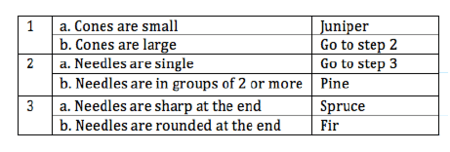
What is the purpose of a dichotomous key?
a)
to find a common ancestor
b)
to show the evolution of organisms
c)
to show relationships between organisms
d)
to identify organisms
17.
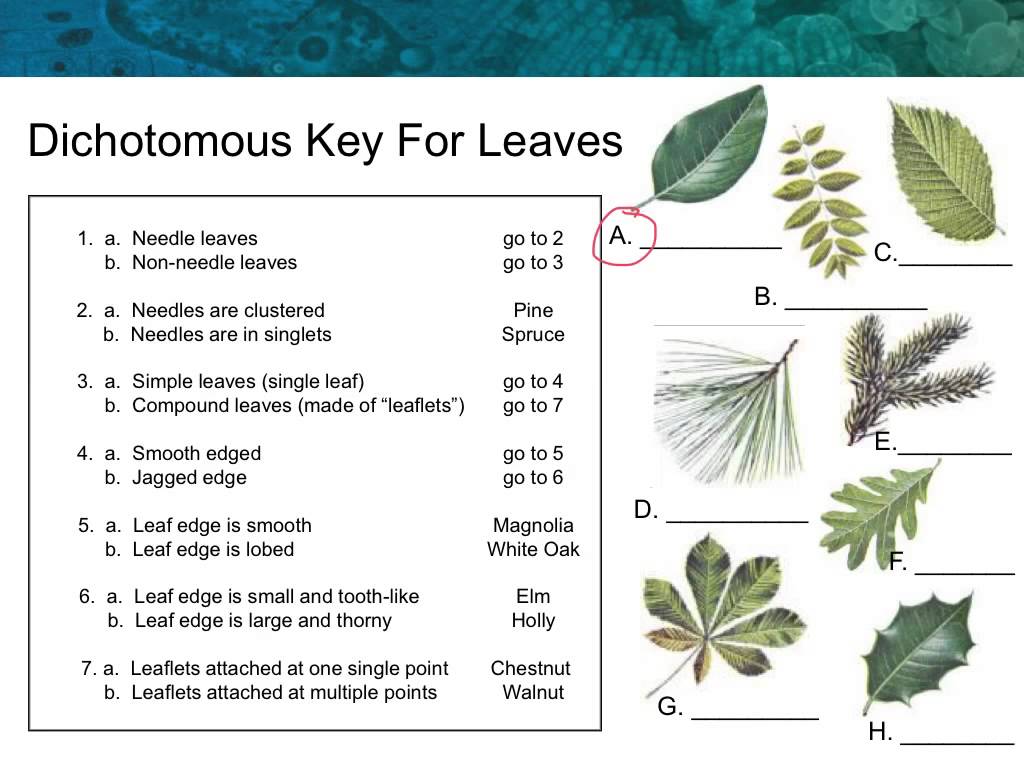
A dichotomous key for trees is provided. Hikers found a tree that has large brown cones and single sharp needles. What species of tree have the hikers found?
a)
Juniper
b)
Pine
c)
Spruce
d)
Fir
18.
What step do we always start with when using dichotomous keys?
a)
1
b)
2
c)
3
d)
4
19.
When using a dichotomous key to identify organisms, what do we look at?
a)
physical features
b)
weather patterns
c)
environment
d)
diet
20.

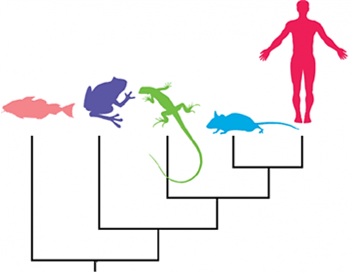
According to this phylogenetic tree, which creature is the least related out of all pictured?

a)

Fish

b)

Frog

c)

Salamander

d)

Human

21.

Which of these animals does not have/produce an amniotic egg?

a)

Turtle

b)

Leopard

c)

Lamprey

d)

All three of these animals produce the amniotic egg

22.

According to this tree, which of these animal phyla are most closely related?

a)

Arthropoda & Mollusca

b)

Arthropoda & Chordata

c)

Chordata & Mollusca

23.
What process does a multi-cellular organism use to replace its damaged body cells?
a)
mitosis
b)
meiosis
c)
replication
d)
transcription
24.
Which of these lists presents the stages of the cell cycle in the correct order?
a)
interphase, mitosis, cytokinesis
b)
cytokinesis, mitosis, interphase
c)
mitosis, interphase, cytokinesis
d)
interphase, cytokinesis, mitosis
25.
Identify the stage of mitosis.
a)
interphase
b)
prophase
c)
metaphase
d)
anaphase
26.
Which process and type of resulting cells are represented?
a)
mitosis, gametes
b)
mitosis, body cells
c)
meiosis, gametes
d)
meiosis, body cells
27.
The chromosomes that pair up during meiosis, are called __________ chromosomes.  
a)
homozygous 
b)
asexual
c)
homologous
d)
genes
28.

In a phylogenetic tree, the branching points represent common ancestors.

a)

Yes

b)

NO

29.

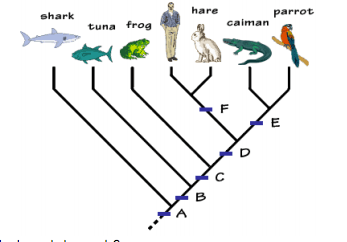
On the cladogram, which organism is the closest relative of the parrot?

a)

Frog

b)

Hare

c)

Caiman

d)

Parrot

30.

All the animals to the right of the salamander would have the common characteristic of...

a)

Fur

b)

Claws or nails

c)

Lungs

d)

Jaws

31.

A common ancestor for both A and E could be at position __.

a)

1

b)

2

c)

3

d)

4

32.

What is the common ancestor of Letters A, B, C, D, E?

a)

1

b)

2

c)

3

d)

4

33.

An inherited characteristic that increases an organisms ability to survive and reproduce in its specific environment is called a(n)

a)

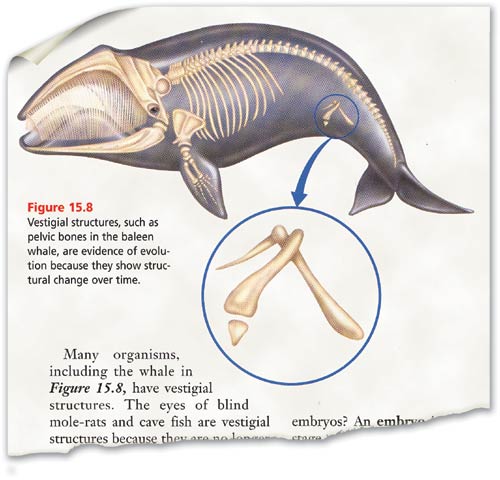
vestigial structure

b)

analogous structure

c)

adaptation

34.
What behavior allows newborns to recognize and follow the first moving object they see?
a)
imprinting
b)
conditioning
c)
trial and error
d)
reflex
35.
A trainer using fish to reward a dolphin that jumps through a hoop is an example of
a)
imprinting
b)
conditioning
c)
trial and error
d)
insight
36.
A chick following a lawnmower because it was the first moving object it ever saw is an example of
a)
imprinting
b)
conditioning
c)
trial and error
d)
insight
37.
Why is a spider spinning a web an innate behavior?
a)
It learns how to spin the web from its mother.
b)
It learns how to spin a web through insight learning.  
c)
It is born knowing how to spin a web.
d)
It learns how to spin a web through observational learning.
38.
Michael went to the circus and saw a seal balance a beach ball on its nose.  This is an example of a...
a)
instinct
b)
mimicry
c)
camouflage
d)
learned behavior
39.
The behavior of some animals to attract other animals (think dating)
a)
courtship
b)
dating
c)
showing off
d)
hibernation
40.
The behavior that is set in an animal at birth
a)
Learned
b)
Imprinting
c)
Instinct
d)
Conditioning
41.
The conditioning stimuli Pavlov introduced to dogs to gain the response of salivation.
a)
Clapped hands
b)
Ringing a bell
c)
Food
d)
Blew a whistle
42.

Behaviors that organisms are BORN WITH are _______ behaviors.

a)

cyclic

b)

innate

c)

social

d)

trial and error

43.

Automatic response such as coughing or sneezing

a)

reflex

b)

stimulus

c)

instinct

d)

insight

44.

When a response to a stimulus becomes associated with another stimulus (dog produces saliva when hears bell ring)

a)

imprinting

b)

reflexing

c)

conditioning

d)

hibernating

45.
Migration is an innate behavior.
a)
true
b)
false
46.

Examine the picture below. Which behavioral response is most likely shown in the picture?

a)

Courtship

b)

Ejection

c)

Migration

d)

Hibernation

47.

Which of the following statements distinguishes an inherited behavior from a learned behavior

a)

A learned behavior passes from the parent to offspring and is with the animal from birth while an inherited behavior is the result of direction observations or experiences.

b)

An inherited behavior passes from the parent to offspring and is with the animal from birth while a learned behavior is the result of direct observation or experience.

c)

Both learned and inherited behaviors pass from the parent to the offspring.

d)

Both learned and inherited behaviors are the result of direct observation or experience.

48.
Which feature of a rose helps it grow without being eaten by large animals?
a)
flowers with bright colors
b)
sharp thorns
c)
small seeds
d)
deep roots
49.
What is a characteristic, or feature of a plant or animal called?
a)
trait
b)
survive
c)
adaptation
d)
reproduce
50.
A trait that helps a living thing survive is called an _______.
a)
trait
b)
adaptation
c)
survive
d)
reproduce
51.
Why might some plants have thorns?
a)
to stay safe from animals that want to eat the plant
b)
to attract insects that spread pollen to other plants
c)
to take in nutrients from the air
d)
to provide shade for the plant
52.
What is one reason why some plants have scents?
a)
to shed extra water off the plant
b)
to take in nutrients from the soil
c)
to attract animals to spread its pollen
d)
to conserve water during dry periods
53.
Why might some plants that grow on the shady rain forest floor have large leaves?
a)
to stay safe from predators
b)
to attract different animals
c)
to survive harsh winters with heavy snowfall
d)
to take in as much sunlight as possible
54.
Some trees shed their leaves in time for winter. Why is this adaptation useful?
a)
The trees save energy during the darker, colder months.
b)
The trees take in more sunlight through their branches.
c)
The trees attract animals to spread their seeds.
d)
The trees blend into their environment and hide.
55.
Some grasses grow in hot dry areas. Why might they grow deep roots?
a)
to protect the plant from sun damage
b)
to take in as much light as possible
c)
to spread seeds to new places
d)
to reach water down below
56.
The rose of Jericho grows in dry areas. It curls up and laws DORMANT until there is enough water. What does DORMANT mean?
a)
flowering
b)
not active
c)
dead
d)
dried
57.
The rose of Jericho grows in dry areas. It curls up and laws DORMANT until there is enough water. What does DORMANT mean?
a)
flowering
b)
not active
c)
dead
d)
dried
58.
Cactus have a thick waxy coating on their stem that keeps them from drying out- is this a behavioral adaptation or physical adaptation?
a)
Behavioral adaptation
b)
Physical adaptation 
59.
Many plants that live in the tropical rainforest must be able to tolerate -
a)
High levels of nutrients in the soil
b)
Hot temperatures in summer and low temperatures in winter
c)
Shade and indirect sunlight
d)
All of these choices
60.

Desert plants have adaptations for survival, such as -

a)

Stems and roots store water

b)

Leaves with waxy coating or hairy covering

c)

Fewer and smaller stomata

d)

All of these choices

61.

Why do tundra plants typically grow close to the ground?

a)

This allows their roots to grow very deep

b)

To prevent herbivores from eating them

c)

To avoid the wind and conserve heat

d)

All of these choices

62.
Color or pattern that helps an animal blend in with its habitat
Adaptation: polar bears in the Artic
a)
Hibernation
b)
Locomotion
c)
Camouflage
d)
Migration
63.
A resting state through the winter. 
Adaptation: Bear sleeping in a cave during the winter months
a)
Locomotion
b)
Hibernation
c)
Migration
d)
Defense
64.
Which of these choices is an example of something that is needed for survival?
a)
Adaptation
b)
Food 
c)
Water
d)
All of the above
65.
According to this evolutionary tree, which organism is most distantly related to the human?
a)
crayfish
b)
grasshopper
c)
perch
d)
frog
66.
On this evolutionary tree, which organism is the closest relative of the human?
a)
Frog
b)
Hare
c)
Caiman
d)
Parrot
67.
Where is the T.rex and frog's common ancestor?
a)
Point A
b)
Point B
c)
Point C
d)
Point D
68.
Where is the alligator and T. rex's common ancestor?
a)
Point A
b)
Point B
c)
Point C
d)
Point D
69.
Where is the frog and alligator's common ancestor?
a)
Point A
b)
Point B
c)
Point C
d)
Point D
70.
Which two animals are most closely related?
a)
Swordfish and Frog
b)
Swordfish and Alligator
c)
Frog and Alligator
d)
T. rex and Alligator
71.
Where is the sponge and mouse's most common ancestor?
a)
Point E
b)
Point B
c)
Point C
d)
Point D
72.
Who shares a more distant common ancestor?
a)
Sponge and Mouse
b)
Mouse and Mushroom
c)
Tomato and Fern
73.
An inheritable characteristic that gives a survival advantage to the organism
a)
speciation
b)
adaption
c)
rapid speciation
d)
derived character
74.
According to this evolutionary tree, birds are LEAST related to: 
a)
Amphibians
b)
Sharks
c)
Ray Finned Fish
d)
Crocodiles
75.
 Which is a source of genetic variation?
a)
mutations
b)
artificial selection
c)
exponential growth
d)
genetic bottlenecking
76.
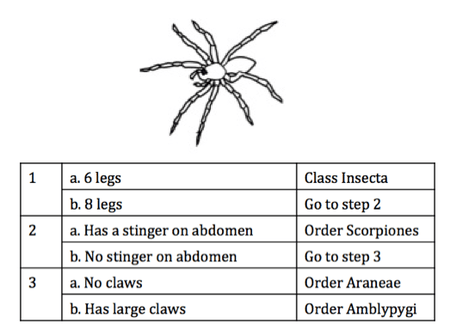
An illustration and a dichotomous key are given. What is the correct classification for this organism?
a)
Class Insecta
b)
Order Amblygygi
c)
Order Araneae
d)
Order Scorpiones
77.
An illustration and a dichotomous key are given. What is the correct classification for this organism?
a)
Class Insecta
b)
Order Amblygygi
c)
Order Araneae
d)
Order Scorpiones
78.
When using a dichotomous key to identify organisms, what do we look at?
a)
physical features
b)
weather patterns
c)
environment
d)
diet
79.
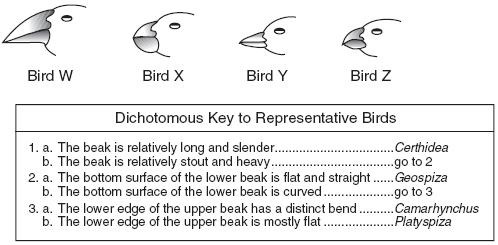
What is the name of bird Z?
a)
Certhidea
b)
Geospiza
c)
Camarhynchus
d)
Platyspiza
80.
What is a dichotomous key used for in science?
a)
To organize biomes
b)
Classify organisms
c)
Identify bacteria only
d)
None of these
81.
Cladograms are constructed by grouping organisms together based on their____________ characteristics.
a)
shared
b)
different
c)
varied
d)
opposite
82.
Structures are similar in appearance but not in structure
a)
Vestigial 
b)
Homologous 
c)
Analogous Structures 
d)
Embryonic 
83.
Which layer is the youngest
a)
1
b)
2
c)
3
d)
4
84.
Which layer is the oldest
a)
B
b)
A
c)
E
d)
C
85.

Which of the following is the collection of life's remains found in sedimentary rock?

a)

natural selection

b)

homologous structures

c)

Charles Darwin

d)

the fossil record

86.

Similar structures with different purposes found in different species are known as _____

a)

vestigial structures

b)

DNA

c)

homologous structures

d)

the fossil record

87.
The changes of species over time
a)
Embryonic 
b)
Natural selection 
c)
Mimicry 
d)
Evolution 
88.

The picture shows a/an ___________

a)

homologous structure

b)

vestigial structure

89.
The opossum and kangaroo both incubate their young in a pouch. This provides evidence that they---
a)
are descended from a common ancestor
b)
Have very similar skeletal structures
c)
belong to the same species
d)
must range great distances to eat
90.

What is this an example of?

a)

Homologous structure

b)

Analogous structure

c)

Vestigial organs

d)

Functional adaption

91.
Which of the following is an example of a vestigial structure?
a)
the wings of a red-tailed hawk
b)
the hind limbs of a house cat
c)
the fins of sharks
d)
the tailbone of a human
92.
Which is not evidence for evolution?
a)
many animals have homologous structures due to common ancestry
b)
Many animals have vestigial structures from an ancestor
c)
We can observe changes in life forms by observing the fossil record
d)
All of these are evidence for evolution
93.
How do fossils provide evidence that evolution has happened on Earth?
a)
Fossils show how the sizes of certain animals has changed drastically over millions of years
b)
Fossils show that some species have gone extinct
c)
Fossils show how life forms present today are different than those from the past
d)
Different sedimentary rock layers provide evidence for how the environment has changed over time
94.
A change in the inherited characteristics of an organism over time is ________
a)
evolution.
b)
development.
c)
growth.
d)
ancestry.
95.
If two organisms have similar traits of DNA they are probably
a)
share a common ancestor
b)
share a common environment
c)
share a common population
d)
speciation
96.

The appendix, which is not needed to survive, is conisdered to be a

a)

Homologous Structure

b)

Analagous Structure

c)

Vestigial Structure

d)

Homology

97.

Similarities in bone arrangements, like those in the picture, support the hypothesis that...

a)

these organisms are not well adapted

b)

these organisms share a common ancestor

c)

these organisms all share the same DNA sequences

d)

these organisms are members of the same species

98.

Similarities in bone arrangements, like those in the picture, support the hypothesis that...

a)

these organisms are not well adapted

b)

these organisms share a common ancestor

c)

these organisms all share the same DNA sequences

d)

these organisms are members of the same species

99.
This is the study of embryos and their development.
a)
Embryology
b)
Evolution
c)
Embryos
d)
adaptation
100.
This kind of structure is when the bones have similar form but are used for different functions.
a)
analogous structure
b)
homologous structure
c)
vestigial structure
101.
This kind of structure is when the structures have the same function but have a different structure/form. 
a)
analogous structure
b)
homologous structure
c)
vestigial structure
102.
This kind of structure are body parts that have no function now and are just the remains from an ancestor.
a)
analogous structure
b)
homologous structure
c)
vestigial structure
103.
This is any alteration in a structure of a function that allows an organism to be better suited for its environment.
a)
vestigial structures
b)
adaptation
c)
embryo
d)
species
104.
When you compare DNA or proteins to support evolution, you are using what kind of evidence?
a)
anatomical evidence
b)
molecular evidence
c)
fossil evidence
105.
What kind of evidence for evolution is shown in this image?
a)
fossil evidence
b)
anatomical evidence
c)
molecular evidence
106.
The scientific name for an organism includes which taxa?
a)
class and family 
b)
genus and species 
c)
domain and kingdom 
d)
kingdom and phylum 
107.
A tool used by a taxonomist to identify an unknown organism is known as a __________.
a)
dichotomous key
b)
binomial nomenclature
c)
scientific name
d)
binomial key
108.
The science of classifying and naming organisms is ______________.
a)
evolution
b)
taxonomy
c)
grouping
d)
scientific names
109.
The 8 levels of classification, from most broad to most specific are ...
a)
Domain, Genus, Family, Order, Class, Phylum, Kingdom, Species
b)
Domain, Species, Kingdom, Genus, Phylum, Family, Class, Order
c)
Domain, Kingdom, Phylum, Class, Order, Family, Genus, Species
d)
Order, Kingdom, Species, Domain, Phylum, Family, Class, Genus
110.
Which of the following is a term for a group of similar organisms that can reproduce fertile offspring?
a)
individual
b)
population
c)
species
d)
fossil
111.
Mutations are important because they bring about
a)
death of the organism in which they develop
b)
genetic variation needed for a population to evolve
c)
benefits for the individual, not for the population
d)
Hardey-Weinberg equilibrium within a population
112.
Extinction can occur because of which of the following?
a)
All can be causes of extinction.
b)
Increased competition with other species
c)
New predators within the environment
d)
Loss of habitat and/or catastrophes
113.
This scientist came up with the idea of natural selection.
a)
Jean Baptiste Lamarck
b)
Gregor Mendel
c)
Charles Darwin
d)
Thomas Malthus
114.
A remnant or trace of an organism from the past is called a _______.
a)
Ancestor
b)
Skeleton
c)
Fossil
d)
Imprints
115.

Which structures allow sacrodines, such as amoebas, to move?

a)

Cilia

b)

Psuedopods

c)

Flagella

116.

Like animals, animal-like protists are

a)

autotrophs

b)

unicellular

c)

heterotrophs

117.

What structure collects water and expels it in protists?

a)

Contractile Vacuoles

b)

Cytoplasm

c)

Food Vacuoles

118.

What is the purpose of the eyespot on an euglena?

a)

To detect a light source.

b)

To see where the nearest light source is.

c)

To help see where it is going.

119.
Which type of protist is shown in the picture?
a)
euglena
b)
paramecium
c)
amoeba
d)
eukaryotic
120.
Which type of protist is shown in the picture?
a)
euglena
b)
paramecium
c)
amoeba
d)
prokaryotic
121.
Which type of protist is shown in the picture?
a)
euglena
b)
paramecium
c)
amoeba
d)
autotroph
122.
What is the name of the structure shown in the model?
a)
cilia
b)
flagella
c)
amoeba
d)
pseudopod 
123.
Which of the following is the best model for cilia?
a)
A
b)
B
c)
C
d)
D
124.
This experiment was conducted by the scientists:
a)
Stanley Miller and Harold Urey
b)
Harold Urey and Albert Einstein
c)
Louis Pasteur and Francesco Redi
d)
James Watson and Francis Crick
125.
Which question were the scientists trying to answer with this experiment?
a)
Where do cells come from?
b)
How did prokaryotes form cell membranes?
c)
How are biomolecules formed?
d)
What gave rise to the Eukaryotic cell?
126.
The apparatus in the experiment was used to mimic what?
a)
Proteins
b)
Present Earth conditions
c)
Early Earth conditions
d)
Nucleic acids (DNA/RNA)
127.
The electrical sparks mimicked?
a)
The Sun's energy
b)
Lightning
c)
Volcanic eruptions
d)
Cosmic radiation
128.
Miller/Urey and other scientists have shown that:
a)
 Life on early Earth required material from space
b)
Cells survived in the primitive atmosphere
c)
Amino acids could be produced from inorganic molecules 
d)
Simple cells can be produced in a laboratory
129.
Which type of cell came first?
a)
Eukaryotic
b)
Prokaryotic
c)
Plant
d)
Both Eukaryotic and Prokaryotic cells evolved around the same time
130.
The diagram shows fossils in different rock layers. Which of these statements about the age of these fossils is most likely correct?
a)
Fossil A and C are the same age
b)
Fossil B is older than fossil C
c)
Fossils A is older than fossil B
d)
Fossil D is older than fossil C
131.
Based upon the conditions of the early Earth, which forms of live most likely appeared first?
a)
Prokaryotic and aerobic
b)
Prokaryotic and anaerobic 
c)
Eukaryotic and aerobic
d)
Eukaryotic and anaerobic
132.
The idea that Earth's early oceans had organic molecules that became the first life is called the...
a)
Primordial soup hypothesis
b)
Bubble hypothesis
c)
Miller-Urey Experiment
d)
Radioactive dating theory
133.
The theory of Endosymbiosis explains...
a)
The origin of eukaryotes
b)
How species develop
c)
How bacteria evolved
d)
Why cells rely on one another
134.
RNA World Theory states that ...
a)
Life came from RNA
b)
Life came from life
c)
Life came from non living things
d)
Life came from outer space
135.
The Miller-Urey experiment of 1953 was designed to test the hypothesis that lightning supplied the energy needed to turn atmospheric gases into organic molecules such as amino acids. Which of the following describes why the Miller-Urey theory is widely accepted today? 
a)
Amino acids spontaneously form from molecules in the atmosphere today
b)
 Organic molecules are present today in extremely high concentrations
c)
The process of synthesizing organic molecules from a mixture of gases has been successfully modeled in the laboratory
d)
No other alternative hypotheses have been introduced
136.
The two extant species that are closely related to each other are __.
a)
A and B
b)
B and C
c)
C and D
d)
D and E
137.

Endosymbiotic Theory is the idea that ______ cells could have evolved from_____cells

a)

prokaryotic, eukaryotic

b)

eukaryotic, animal

c)

prokaryotic, plant

d)

eukaryotic, prokaryotic

138.

Prokaryotic cells do not have

a)

cell wall

b)

nucleus

c)

cytoplasm

d)

ribosomes

139.

Both prokaryote and eukaryotes have a cell membrane

a)

True

b)

False

c)

Only eukaryotes have a membrane

d)

Only prokaryotes have a membrane

140.

How did one type of prokaryote get inside of another type of prokaryote

a)

Acts as a ligand

b)

One engulfed the other

c)

Fused in as a vesicle

d)

snuck in as a retrovirus

141.

Symbiosis means

a)

Feeding off of something

b)

Using something for its ATP

c)

Living in harmony

d)

Producing sugars

142.

Early bacteria that could make its own energy evolved into

a)

Mitochondria

b)

Chloroplast

c)

ATP

d)

ADP

143.

Early bacteria that could perform photosynthesis evolved into

a)

Mitochondria

b)

Chloroplast

c)

ATP

d)

ADP

144.

Eukaryotic cells can have

a)

Only chloroplast

b)

Only mitochondria

c)

both mitochondria and chloroplast

d)

neither chloroplast nor mitochondria

145.

Evidence for endosymbiosis includes

a)

Mitochondria and Chloroplast are the same color

b)

Mitochondria and Chloroplast are the same size

c)

Mitochondria and Chloroplast are the same structure

d)

Mitochondria and Chloroplast have the same pH

146.

Evidence for endosymbiosis includes

a)

Mitochondria and chloroplast have their own Lysosomes

b)

Mitochondria and chloroplast have their own vesicles

c)

Mitochondria and chloroplast have their own RNA

d)

Mitochondria and chloroplast have their own DNA

147.

Mitochondria and Chloroplast are similar to prokaryotic cells like bacteria in what way?

a)

They have the same lifespan

b)

They divide the same way

c)

They are the same color

d)

They have the same shape

148.

Mitochondria and Chloroplast are similar to prokaryotic cells like bacteria in what way?

a)

Their DNAs are copies of each other

b)

Their DNAs both have uracil

c)

Their DNAs are circular

d)

Their DNAs both have short lifespans

149.
A flash flood carried a raft of Amazon ants away from their original population. There is enough distance between the two groups, that they will never meet in nature again. What type of reproductive barrier is this?
a)
behavioral isolation
b)
temporal isolation 
c)
gametic isolation
d)
geographic isolation 
150.
The genitalia of the male damselfly varies in shape. Certain males can only hold onto & mate with females whose genitalia fit.  What type of reproductive barrier is this?
a)
behavioral isolation
b)
temporal isolation 
c)
gametic isolation
d)
mechanical isolation 
151.
Some female peacocks prefer males with large, colorful tales while other female peacocks prefer males with no tail at all. Females are beginning to only mate with the type of males with the tail they prefer. What type of reproductive barrier is this?
a)
behavioral isolation
b)
hybrid sterility 
c)
temporal isolation
d)
mechanical isolation 
152.
The flowers of pink tulips open in the morning, while the flowers of lavender tulips open in the early afternoon. The bees that pollinate these tulips cannot carry pollen back & forth between the two types of tulips because of their flowers being closed at different times of day. What type of reproductive barrier is this?
a)
behavioral isolation
b)
hybrid sterility 
c)
temporal isolation
d)
mechanical isolation 
153.
The term for the formation of new and distinct species over the course of evolution is...
a)
speciation
b)
biological species concept
c)
reproductive barrier
d)
natural selection
154.
What is a species? 
a)
A group of organisms that can mate with each other and produce fertile offspring. 
b)
A group of organisms that can mate and produce offspring even if those offspring are infertile.
c)
A group of organisms that genetically are very different from each other. 
d)
Indivual organisms that live in the same environment. 
155.

A new river forms and splits two populations, causing ______________ speciation

a)

Sympatric

b)

Allopatric

c)

Extreme

d)

Convergent

156.

Orcas occur in the same habitat but some are avoiding each other and do not interbreed. They have different diets, vocal behavior, and social structures. What type of speciation is this?

a)

Allopatric

b)

Sympatric

c)

Complex

d)

Covergent

157.

when the organism develops different courtship rituals which do not attract main population this is a part of ____________ speciation.

a)

Allopatric

b)

Sympatric

c)

Simple

d)

Temporal

158.

The emergence of a mountain range is an event that would lead to _______________ speciation

a)

Allopatric

b)

Sympatric

c)

Temporal

d)

Behavioral

159.

The emergence of new rivers or streams is a type of ____________ isolation.

a)

Temporal

b)

Mechanical

c)

Behavioral

d)

Geographic

160.

When the Grand Canyon in Arizona formed, two populations of one squirrel species were separated by the giant canyon. This is an example of _____________ speciation.

a)

Allopatric

b)

Sympatric

c)

Simple

d)

Divergent

161.

Different finch populations lived on separate islands with different environments. They evolved to best adapt to those particular environments and can no longer mate. What type of speciation is this?

a)

Allopatric

b)

Sympatric

c)

Temporal

d)

Mechanical

162.

The presence of islands represents what type of reproductive isolation

a)

allopatric speciation

b)

sympatric speciation

163.

The Western Skunk mates in the fall and the Eastern Skunk mates in the spring. This is a type of

a)

prezygotic barrier

b)

postzygotic barrier

c)

allopatric barrier

d)

polyploidy