wayground logo

Free Printable Worksheets

Font size

S
M
L
XL
Worksheets

Final Exam Review Game

Total questions: 146

Worksheet time: 3hrs 31mins

Name
Class
Date
1.
Interest rate that the Federal Reserve System charges on loans to the nation's financial institutions.
a)
discount rate
b)
prime rate
c)
monetary rate
d)
explicit rate
2.

The central bank in the USA that regulates the monetary system is known as

a)

The FED

b)

FDIC

c)

The IRS

d)

Social Security

3.
Monetary Policy is used to regulate spending by increasing/decreasing
a)
supply
b)
aggregate supply
c)
demand
d)
aggregate demand
4.
Selling bonds
a)
increases money supply
b)
decreases money supply
5.
Buying bonds
a)
increases money supply
b)
decreases money supply
6.
High reserve requirements 
a)
lower the money supply
b)
increase the money supply
7.
Low reserve requirements 
a)
lower the money supply
b)
increase the money supply
8.
Interest Rate is the fee that 
a)
the member bank must pay the district bank for a loan
b)
you and I must pay our bank for a loan
c)
the district bank pays the national bank for a loan
d)
the FED pays FOMC for services
9.

Two types of Monetary Policy

a)

Macro and Micro

b)

Up or Down

c)

Expansionary or Contractionary

d)

Positive or Negative

10.

An increase in the money supply will

a)

Reduce interest rates and increase aggregate demand.

b)

Reduce interest rates and decrease aggregate demand.

c)

Raise interest rates and increase aggregate demand.

d)

Raise interest rates and decrease aggregate demand.

11.

A decrease in the money supply will

a)

Reduce interest rates and increase aggregate demand.

b)

Reduce interest rates and decrease aggregate demand.

c)

Raise interest rates and increase aggregate demand.

d)

Raise interest rates and decrease aggregate demand.

12.

To correct for an inflationary gap, the Fed will use

a)

Expansionary Policies

b)

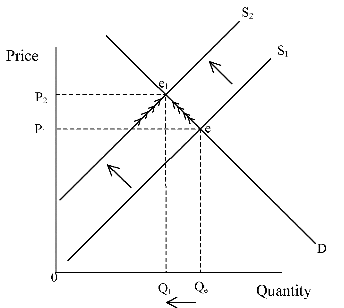
Contractionary Policies

13.

To correct for a recessionary gap, the Fed will use

a)

Expansionary Policies

b)

Contractionary Policies

14.

This Monetary Policy tool raises and lowers the amount of money banks must keep and not loan out

a)

Open Market Operations

b)

Discount Rate

c)

Reserve Requirement

15.

This Monetary Policy tool raises and lowers the interest rate banks must pay to borrow from the Fed

a)

Open Market Operations

b)

Discount Rate

c)

Reserve Requirement

16.

This Monetary Policy tool is when the Fed buys or sells Treasury bonds

a)

Open Market Operations

b)

Discount Rate

c)

Reserve Requirement

17.

Raising interest rates

a)

Increases the money supply

b)

Decreases the money supply

18.

Lowering interest rates

a)

Increases the money supply

b)

Decreases the money supply

19.

Lowering the reserve requirement

a)

Increases the money supply

b)

Decreases the money supply

20.

Increasing the reserve requirement

a)

Increases the money supply

b)

Decreases the money supply

21.

Selling Treasury bonds

a)

Increases the money supply

b)

Decreases the money supply

22.

Buying Treasury bonds

a)

Increases the money supply

b)

Decreases the money supply

23.

Inflation or expansion is a period of rising GDP, lower unemployment, and higher prices

a)

True

b)

False

24.

Stagflation is a period of falling GDP, higher unemployment, and higher prices

a)

True

b)

False

25.

This image shows a...

a)

Inflationary Gap

b)

Recessionary Gap

c)

Aggregate Equilibrium

26.

This image shows a...

a)

Inflationary Gap

b)

Recessionary Gap

c)

Aggregate Equilibrium

27.

This image shows a...

a)

Inflationary Gap

b)

Recessionary Gap

c)

Aggregate Equilibrium

28.
What type of GDP is calculated with the current year's prices?
a)
Nominal GDP
b)
Real GDP
c)
GDP per capita
29.
Cars, TVs, computers belong in which part of the GDP formula?
GDP = C+I+G+(X-M)
a)
Consumption Expenditures
b)
Investment Expenditures
c)
Government Expenditures
d)
Net Imports
30.
An airline buying a plane belong in which part of the GDP formula?
GDP = C+I+G+(X-M)
a)
Consumption Expenditures
b)
Investment Expenditures
c)
Government Expenditures
d)
Net Imports
31.
Tanks and roads belong in which part of the GDP formula?
GDP = C+I+G+(X-M)
a)
Consumption Expenditures
b)
Investment Expenditures
c)
Government Expenditures
d)
Net Imports
32.
What does X represent in calculating net imports?
X-M
a)
Imports
b)
Exports
c)
Expenditures
d)
None of the Above
33.
What does M represent in calculating net imports?
X-M
a)
Imports
b)
Exports
c)
Taxes
d)
None of the Above
34.

GDP per capita is found by dividing a country's GDP by it's

a)

population.

b)

average birth rates.

c)

number of households.

35.

A higher GDP generally correlates to a(n) ___________ standard of living.

a)

higher

b)

lower

c)

unrelated

36.

All of the following are excluded from GDP except

a)

non-market goods and services

b)

used goods

c)

environmental quality

d)

final goods and services

37.

To be certain that a country is producing more from year to year, economists look to see that ________________ has _________________.

a)

GDP; decreased

b)

GDP; increased

c)

Real GDP; decreased

d)

Real GDP; increased

38.
What is the 1st economic goal of each country?
a)
Limit Inflation
b)
Limit Unemployment
c)
Promote Economic Growth
d)
Measure expenditures
39.

Which is the best way to measure the PRODUCTIVITY of a nation's workers

a)

GDP

b)

Real GDP

c)

GDP per capita

d)

Nominal GDP

40.

When individuals lose jobs due to fall in aggregate demand, often during an economic recession.

a)

Structural Unemployment

b)

Cyclical Unemployment

c)

Frictional Unemployment

d)

Seasonal Unemployment

41.

Individuals are unemployed due to a lack in skills that modern industries need, change in technology.

a)

Cyclical Unemployment

b)

Frictional Unemployment

c)

Structural Unemployment

d)

Seasonal Unemployment

42.

When an individual is unemployed because they are looking for a new job.

a)

Frictional Unemployment

b)

Cyclical Unemployment

c)

Structural Unemployment

d)

Seasonal Unemployment

43.

When individuals are unemployed due to a change in season, e.g. Santa Claus after christmas.

a)

Seasonal Unemployment

b)

Frictional Unemployment

c)

Structural Unemployment

d)

Cyclical Unemployment

44.

Sum of the employed and the unemployed

a)

Employed

b)

Unemployment

c)

Labor Force

45.

Unemployment Rate formula

a)

(Unemployed/ Labor force) * 100

b)

(Employed/ Unemployed) * 100

c)

(Labor force/ Employed) * 100

46.

Discouraged workers in

the economy implies that the measurement of unemployment...

a)

understates the true unemployment rate

b)

overstates the true unemployment rate

c)

correctly measures the true unemployment rate

d)

doubles the unemployment rate

47.

If actual GDP is less than potential GDP...

a)

Actual unemployment exceeds the natural unemployment rate

b)

Actual unemployment rate is less than the natural rate

c)

No cyclical unemployment is present

d)

Hyperinflation is present Hyperinflation is present

48.

Underemployed workers are

a)

Workers with only one job

b)

Workers who are overqualified for their current position

c)

Workers who are under-qualified for their current position

d)

None of the above

49.

Which measurement accounts for (takes out) inflation?

a)

Real GDP

b)

Nominal GDP

c)

GDP per capita

d)

Base GDP

50.

How do you find Real GDP?

a)

Divide by the population

b)

Divide by current year prices

c)

By using a base year price

d)

None of the above

51.

What are physical objects that are capable of being touched

a)

Goods

b)

services

c)

scarcity

52.

What are intangible things that cannot be touched, such as motorcycle repairs, haircuts or insurance.

a)

Services

b)

Goods

c)

Scarcity

53.

What questions should we ask about the basic economic problem?

a)

What should be produced and with what quantities?

b)

How should things be produced?

c)

Who should things be produced for

d)

All of them

54.

What is an entrepreneur?

a)

someone who organizes a business venture and assumes the risk for it

b)

someone who goes bankrupt

c)

someone who is a bank tellr

d)

4th option

55.

What is the definition of economics?

a)

The study of getting rich

b)

The study of people and choices regarding scarcity

c)

Forecasts of how a certain market will do

d)

Study of the stock market

56.
What is an example of opportunity cost?
a)
Eating a hamburger instead of a hotdog
b)
Giving up going to see a movie to study for a test in order to get a good grade.
c)
Wearing dress shoes instead of tennis shoes in your house
d)
Writing with blue pen instead of a black pen
57.
What is macroeconomics?
a)
The part of economics concerned with large-scale or general economic factors, such as interest rates and national productivity
b)
The record of how the prices of baked goods rise and fall
c)
A camera lens that allows it to take pictures close to the subject 
d)
The part of economics concerned with single factors and the effects of individual decisions.
58.
What is microeconomics?
a)
The study of small things
b)
The part of economics concerned with large-scale or general economic factors, such as interest rates and national productivity
c)
The part of economics concerned with single factors and the effects of individual decisions.
d)
The unit prefix that denotes the factor of one millionth in the metric system
59.
If my government is selling me bread for $5 a loaf, and I have no choice but to buy that type of bread, I live in a _____ economy. 
a)
Traditional 
b)
Market 
c)
Command 
d)
Mixed
60.
In this type of economy, the individual decides who to sell their products to.  
a)
Traditional 
b)
Mixed 
c)
Market
d)
Command
61.
The government has little to no role in the production of goods in this type of economy. 
a)
Traditional 
b)
Mixed
c)
Command 
d)
Market
62.
_______ is another word for Market Economy. 
a)
Capitalism 
b)
Communism
63.
I am a farmer in Africa, and have always traded for my goods.  I have a _____ economy. 
a)
Traditional 
b)
Command 
c)
Market
d)
Mixed
64.
In this type of economy, the government places control on businesses, but the individual decides what to make. 
a)
Mixed
b)
Market
c)
Command 
d)
Traditional
65.
In a command economy, who holds power over the economy?
a)
The people
b)
The government 
c)
Beyonce
d)
The traditions of your ancesetors 
66.
What are the 3 economic questions?
a)
What to produce? How To Produce? For whom to produce?
b)
Who to produce? Why you produce? Like to produce?
c)
Why to produce? Tell who to produce? Things to produce?
67.
The four types of economic systems are: 
a)
Traditional, Command, Mixed, & Market
b)
Traditional, Command, Combined, & Market
c)
Communism, Capitalism, Free Market, and Macroeconomics
d)
Microeconomics, Macroeconomics, Individual, and Traditional.
68.
________ is the most basic economic problem.
a)
Scarcity
b)
Labor
c)
Greed
d)
Capital
69.
Which of the following is NOT one of the three basic questions of economics when looking at economic systems? 
a)
What goods and services will be produced?
b)
What is the price of the goods? 
c)
Who is responsible for producing goods and services?
d)
How will goods and services be distributed to customers?
70.
A person who comes up with a product or service, and finds the money and time to produce this new product.
a)
Entrepreneur
b)
Incentive
c)
Specialization
d)
Barter
71.
The sacrifice that is made when a person chooses between two goods or services.
a)
Profit
b)
Economics
c)
Productivity
d)
Opportunity Costs
72.

What are the four factors of production?

a)

Capital, land, labour, money

b)

Land, labor, capital, entrepreneurship

c)

Land, raw materials, enterprise, capital

d)

Enterprise, Oil, Labor, Capital

73.

The factors of production are defined as

a)

The materials businesses use to produce goods and services

b)

The resources needed for an economy to grow

c)

Scarce resources with limited supply in an economy

d)

Resources used to produce goods and services in the economy

74.

What does the PPC represent?

a)

An economics diagram

b)

Economic growth

c)

All maximum output possibilities of 2 goods with fixed input

d)

All things an economy can produce over a period of time

75.

The physical effort of people to produce goods or services describes which factor of production?

a)

Land

b)

Capital

c)

Labor

d)

Entrepreneurship

76.

Land is defined as

a)

Soil used in farming.

b)

Natural resources used in production.

c)

Farms used in agriculture or production

d)

The most important factor of production.

77.
Which factor of production would you consider a lawn mower?
a)
Land
b)
Labor
c)
Capital
d)
Entrepreneur
78.
This economic system is based on competition, profits, and self-interest.
a)
Socialism
b)
Communism
c)
Capitalism
79.

How does socialism differ from capitalism?

a)

In socialism, the government controls the means of production; whereas, in capitalism it is individuals

b)

In socialism, individuals cannot own private property; whereas, in capitalism the government ensure all people's basic needs are met.

c)

In socialism, the government does not provide any form of financial help; whereas, in capitalism the government funds small business with tax relief.

d)

In socialism, the government controls what the consumer can purchase; whereas, in capitalism the government controls what the business can sell.

80.

______________get to make the economic decisions under capitalism.

a)

Individuals

b)

Government

c)

no one

d)

The President

81.

Karl Marx’s idea of an equal society without social classes- everyone would share the factors of production

a)

Capitalism

b)

Socialism

c)

Communism

82.

Who came up with the idea of capitalism in their book, The Wealth of Nations?

a)

Vasco da Gama

b)

Charles Marx

c)

Adam Smith

d)

Donald Trump

83.

The long-run refers to looking at the economy over a short period of time

a)

True

b)

False

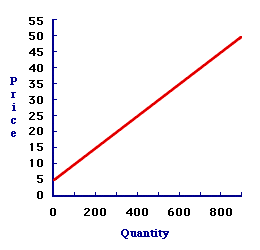
84.
What does this curve represent?
a)
demand
b)
supply
c)
equilibrium
d)
shortage
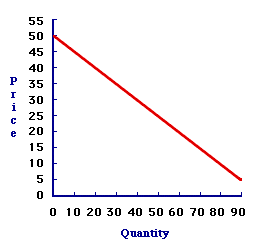
85.
What does this curve represent?
a)
supply
b)
equilibrium
c)
demand
d)
surplus
86.
If the price of printers goes down, what happens in the market for ink cartridges?
a)
Supply increases.
b)
Supply decreases.
c)
Demand increases.
d)
Demand decreases
87.
Assume the image is showing the market for apples.  Which of the headlines could indicate the pictured shift is occurring in the market?
a)
Pesticides on apples linked to mouth cancer.
b)
Storms destroy apple orchards.
c)
An apple a day really does keep the doctor away.
d)
New genetic strain leads to apple trees that produce twice as many apples.
88.
The following is a factor that will not cause the demand curve to shift:
a)
Advertising
b)
Population
c)
Price
d)
Consumer expectations
89.
For the law of demand, as price rises, what happens to quantity demanded?
a)
it goes up
b)
it goes down
c)
it stays the same
d)
it is not effected
90.
In a market economy, who decides on the prices of goods and services?
a)
government
b)
buyers and sellers
c)
firms
d)
local leaders
91.
Generally speaking, the lower the price, the greater the quantity demand.
a)
True
b)
False
92.
For the law of supply, as price rises, what happens to quantity supplied?
a)
it goes up
b)
it goes down
c)
it stays the same
d)
it is not effected
93.
If farmers stopped growing potatoes because it was too hard, this would cause the ___________ curve for Grippo's to shift ____________.
a)
demand.........right
b)
demand.........left
c)
supply.......right
d)
supply....... left
94.
If Michael Jordan did advertisements for Steak and Shake, this would cause the ___________ curve for Steak and Shake to shift ____________.
a)
demand.........right
b)
demand.........left
c)
supply.......right
d)
supply....... left
95.
If sandals suddenly became very popular, what would happen to the market for basketball shoes? This would cause the ___________ curve for basketball shoes to shift ____________.
a)
demand.........right
b)
demand.........left
c)
supply.......right
d)
supply....... left
96.
When CDs became popular, people stopped listening to tape cassettes. This caused the ___________ curve for tape cassettes to shift ____________.
a)
demand.........right
b)
demand.........left
c)
supply.......right
d)
supply....... left
97.
A person who buys goods and services
a)
consumer
b)
entrepreneur
c)
resource
d)
currency
98.
The place where goods and services are exchanged
a)
barter
b)
currency
c)
market
d)
resource
99.

What is a surplus?

a)

Supply is greater than demand

b)

Supply is less than demand

100.

condition where quantity supplied equals quantity demanded

a)

price floor

b)

price ceiling

c)

market equilibrium

d)

market share

101.

lowest legal price that can be paid for a good or service

a)

price floor

b)

price ceiling

c)

market equilibrium

d)

price

102.

Equilibrium price would go _______________ if demand suddenly increased

a)

up

b)

down

c)

stay the same

d)

left

103.

Which of the following is an example of a price ceiling?

a)

minimum wage

b)

free lunch program

c)

rent control

d)

government subsidies

104.
Which of the following would not shift the demand curve for beef? 
a)
an effective advertising campaign by pork producers
b)
a widely publicized study that indicates beef increases one's cholesterol
c)
a change in the incomes of beef consumers
d)
a reduction in the price of cattle feed
105.
A leftward shift of a product supply curve might be caused by: 
a)
an improvement in the relevant technique of production.
b)
 an increase in consumer incomes.
c)
some firms leaving an industry.
d)
a decline in the prices of needed inputs.
106.

When quantity supplied is smaller than quantity demanded, you have a ____________.

a)

shortage

b)

surplus

c)

deficit

d)

equilibrium

107.
Equilibrium price is the price at which the quantity of a product demanded by consumers and the quantity supplied by producers
a)
are different.
b)
are equal.
c)
is higher for the product demanded.
d)
is higher for the product supplied.
108.

Which of the following is an example of a price ceiling?

a)

minimum wage

b)

free lunch program

c)

rent control

d)

government subsidies

109.

Which of the following is an example of a price ceiling?

a)

minimum wage

b)

free lunch program

c)

rent control

d)

government subsidies

110.

Equilibrium price would go _______________ if demand suddenly increased

a)

up

b)

down

c)

stay the same

d)

left

111.
Price ceilings are...
a)
Above the equilibrium
b)
Below the equilibrium
c)
Irrelevant to economics
d)
All over the graph 
112.
A surplus is when 
a)
Supply is greater than demand
b)
Demand is greater than supply
c)
Demand a supply are at a equilibrium
d)
Below the equilbrium
113.

This graph shows

a)

A decrease in supply

b)

A decrease in demand

c)

A decrease in quantity demanded

d)

A decrease in quantity supplied

114.

This graph shows

a)

Decrease in quantity supplied

b)

Decrease in supply

c)

Decrease in Demand

d)

Increase in supply

115.

This graph shows

a)

Increase in Supply

b)

Decrease in Quantity Demanded

c)

Increase in Demand

d)

Decrease in Demand

116.

A movement from A to B on this graph would represent

a)

Increase in supply

b)

Increase in quantity supplied

c)

Increase in demand

d)

Increase in quantity demanded

117.

A movement from b to a in this graph would represent

a)

A decrease in supply

b)

A decrease in quantity supplied

c)

A decrease in demand

d)

A decrease in quantity demanded

118.

A movement from x to y on this graph would represent

a)

Increase in demand

b)

Decrease in supply

c)

Increase in quantity demanded

d)

Increase in quantity supplied

119.

A movement from y to x on this graph would represent

a)

An increase in quantity demanded

b)

A decrease in quantity demanded

c)

A decrease in demand

d)

A decrease in quantity supplied

120.

What does it mean to be ELASTIC for a product?

a)

With every change in price, consumers react in a comparably BIG way

b)

With every change in price, consumers react in a comparably SMALL way

121.

What does it mean to be INELASTIC for a product?

a)

With every change in price, consumers react in a comparably BIG way

b)

With every change in price, consumers react in a comparably SMALL way

122.
Who is in charge of fiscal policy?
a)
Government
b)
Federal Reserve
123.
Which of the following are responsible for making fiscal policy decision? 
a)
The President and Congress
b)
The Federal Reserve System
c)
The National Council of Economic Advisors
d)
The commerce Department
124.
Taxing & spending to help the economy grow is referred to as
a)
expansionary policy
b)
monetary policy
c)
contractionary policy
d)
budget deficit
125.
Taxing & spending to slow the economy is referred to as 
a)
budget surplus 
b)
monetary policy
c)
contractionary policy
d)
budget deficit
126.
An example of expansionary fiscal policy would be
a)
cutting taxes.
b)
cutting government spending.
c)
cutting production of consumer goods.
d)
cutting prices of consumer goods.
127.
If and economy experiences a dramatic rise in prices, which fiscal policy action could be taken?
a)
Selling securities on the open market
b)
Raising interest rates
c)
Reducing government spending
d)
Raising reserve requirements
128.
When the government raises taxes, what does it take out of circulation?
a)
Money
b)
Credit
c)
People
d)
Jobs
129.

More revenue than expenditures.

a)

Budget Surplus

b)

Budget Deficit

130.

More expenditures than revenue.

a)

Budget Surplus

b)

Budget Deficit

131.
The purpose of fiscal policy is to...
a)
increase the money supply.
b)
increase economic efficiency.
c)
stabilize the economy.
d)
increase economic growth only.
132.
If the federal government is attempting to encourage spending by consumers and businesses, a fiscal policy BEST serving this purpose would be
a)
decreasing taxes.
b)
decreasing government spending.
c)
reducing the investment tax credit.
d)
balancing the budget.
133.

A tax on imports is called?

a)

tariff

b)

excise tax

c)

import tax

d)

quota

134.
_____________ occurs when a government deficit drives up the interest rate and leads to reduced investment spending.
a)
Crowding Out
b)
Rate of Return
c)
Loanable Funds Market
d)
Fisher Effect
135.
When determining comparative advantage one must determine 
a)
Opportunity cost
b)
Specialization
c)
Absolute Advantage
d)
Embargos 
136.
If I am better at all types of production, I have the ______ in all forms of production.
a)
Comparative advantage
b)
Specialization
c)
Absolute advantage
d)
developed nation
137.
This is a tax on imports that is used to increase price of foreign products and raise government revenue. 
a)
tariff
b)
quota
c)
subsidy
d)
embargo
138.
The expanding number of markets that countries must trade with to maintain their standard of living
a)
domestic jobs
b)
tariffs
c)
trade advantage
d)
globalization
139.

Capital Account

a)

Exports and Imports

b)

Investments

140.

Capital Account

a)

Exports and Imports

b)

Investments

141.

Current Account

a)

Exports and Imports

b)

Investments

142.

Higher Income = Higher Taxes

a)

Regressive

b)

Progressive

c)

Proportional

143.

Higher Income = Lower Taxes

a)

Regressive

b)

Progressive

c)

Proportional

144.

"Flat" Tax

a)

Regressive

b)

Progressive

c)

Proportional

145.

Lower Income = Lower Taxes

a)

Regressive

b)

Progressive

c)

Proportional

146.

The ability to produce something while giving up very little to do it is...

a)

Absolute Advantage

b)

Comparative Advantage