
 Worksheets
AP Chem Titrations and Buffers Practice
Total questions: 127
Worksheet time: 5hrs 58mins

Which of the following is the key characteristic of a buffer solution?
ability to resist pH change when small amount of acid or base added

An acidic buffer consists of a

A basic buffer consists of a
Two beakers have liquids in them. When you add 3 drops of 0.1M NaOH to beaker 1, the pH did not change. When you add 3 drops of 0.1M NaOH to beaker 2, the pH rises drastically. Choose the best explanation.
Beaker 1 contained pure water and Beaker 2 contained a buffer solution.
Beaker 1 contained a buffer solution and Beaker 2 contained pure water.
Beaker 2 contained an acid solution.
The beaker that changed pH contained a buffer.
Mixtures that would be considered buffers include which of the following?
0.10 M HCl + 0.10 M NaCl
0.10 M HF + 0.10 M NaF
0.10 M HNO3 + 0.10 M NaNO3
0.10 M HF and 0.10M NaNO2

If equal volumes of equimolar samples of these solutions are mixed together, which would form a buffer?
The addition of hydrofluoric acid and __________ to water produces a buffer solution.
HCl
NaNO3
NaF
NaCl
Which of the following reactions shows what happens when potassium hydroxide is added to an ammonium ion/ammonia buffer?
OH- + NH3 ⇌ NH3OH
K+ + NH3⇌ KNH3
K+ + NH4+ ⇌ NH4K
OH- + NH4+ ⇌ NH3 + H2O
Which of the following reactions shows what happens when nitric acid is added to an ammonia /ammonium ion buffer?
H+ + NH3 ⇌ NH4+
H+ + NH4+ ⇌ NH52+
NO3- + NH3 ⇌ NH3NO3
NO3- + NH4 ⇌ NH4NO3
Which of the following combinations will form a buffer solution? Select all that apply
HCOOH and LiCOOH
NH3 and NH4Br
KOH and KF
HCl and RbOH
What is the pH of a buffer mixture of 0.70 M KCH3COO and 0.50 M CH3COOH (Ka = 1.8x10⁻⁵)?
0.45
4.89
4.60
4.74
Which is the net ionic equation when NaOH(aq) is added to HF(aq) ?
H+ + OH- --> H2O
HF+ NaOH --> H2O + NaF
HF + OH---> H2O + F-
F- + NaOH --> OH- + NaF
50 mL of 0.10 M HCl is titrated by 0.20 M NaOH. What is the volume of NaOH at the equivalence point?
25 mL
50 mL
100 mL
75 mL
When HCOOH(aq) is titrated by RbOH(aq), what is the pH at the equivalence point and why does this occur?
pH > 7 because there is excess NaOH.
pH < 7 because an acidic salt forms.
pH = 7 because a neutral salt forms.
pH > 7 because a basic salt forms.
What is the primary hydrolysis reaction at the equivalence point when HF(aq) is titrated by NaOH(aq)?
HF + NaOH ⇌ NaF + H2O
F- + H2O ⇌ HF + OH-
HF + H2O ⇌ F- + H3O+
Na+ + H2O ⇌ NaOH + H+
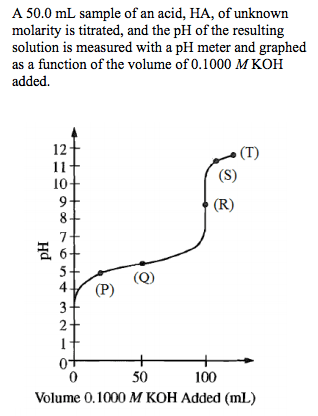
Which point on the titration curve corresponds to the point at which the moles of the added strong base are equal to the moles of the weak acid initially present?
Q
R
S
T
At which point on the titration curve will pH = pKa?
Q
R
S
P

Which reactants could produce this titration curve?
HCI titrated with KOH
HCI titrated with NH3
CH3COOH titrated with KOH
CH3COOH titrated with NH3
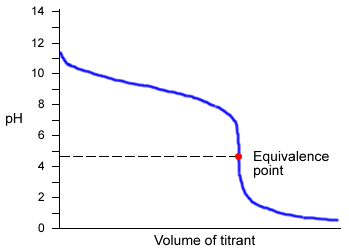

Which curve is produced by the addition of a strong acid to a strong base?
A
B
C
D
Which pair is the most effective buffer at a pH of 10.5?
Ka of HIO is 1.7 x 10⁻¹¹ Ka of HF is 3.5 x 10⁻⁴
0.9 M HIO and 0.1 M HF
[Formic acid] > [Potassium formate]
[Formic acid] < [Potassium formate]
[Formic acid] = [Potassium formate]
What is the pH of a buffer that is 0.08 M NaA and 0.1 HA? The Ka of HA = 1.0 x 10⁻⁴.
H+ + BrO- ⟶ HBrO
OH- + H+ ⟶ H2O
OH- + HBrO ⟶ H2O + BrO-
OH- + BrO- ⟶ O-2 + HBrO
The buffer solution is able to maintain pH by some events, except . . .
The addition of a little acid
The addition of a little base
Dilution
Addition of water
The addition of excess acid
Which of the following mixtures are buffers?
NaH2PO4 and Na2HPO4
NH3 and (NH4)2SO4
HCO2H and KCO2H
HNO3 and NaNO2
HCl and NaCl
The following mixture of solutions that form a buffer solution is . . .
50 mL CH3COOH 0.2 M and 50 mL NaOH 0.1 M
50 mL CH3COOH 0.2 M and 100 mL NaOH 0.1 M
50 mL HCl 0.2 M and 100 mL NH4OH 0.1 M
50 mL HCl 0.2 M and 50 mL NH4OH 0.1 M
50 mL HCl 0.2 M and 100 mL NaOH 0.1 M
What is the pH of a solution that consists of 0.10M HC2H3O2 and 0.1M NaC2H3O2 ?
Ka = 1 x 10⁻⁵
4
5
6
8
9
Which of the following statements ARE TRUE about buffer solution?
(you may choose more than one answer)
The pH of buffer solution will never change despite addition of small amount of base or acid
A buffer can be made by mixing weak acid and salt of its conjugate base or by mixing weak base with salt of its conjugate acid
a buffer has acid and base components that can work specifically to resist pH change
The closer the ratio of concentration weak acid/base to the concentration of salt of its conjugate base/acid, the less effective the buffer is at resisting pH change
A buffer solution is made of mixture of aqueous methanoic acid, HCOOH, with aqueous sodium methanoate, NaHCOO.
The equilibrium reaction takes place in buffer solution is :
HCOOH ⇌ HCOO- + H+
Which of the following reactions explains why the pH of the solution barely changes when a drop of 0.1M NaOH is added to the buffer?
HCOOH + H+ → HCOOH2
HCOO- + H+ → HCOOH
HCOOH + OH- → HCOO- + H2O
HCOO- + OH- → COO2- + H2O
A buffer solution is made of mixture of aqueous ethanoic acid, CH3COOH, with aqueous potassium ethanoate, KCH3COO.
The equilibrium reaction takes place in buffer solution is :
CH3COOH ⇌ CH3COO- + H+
Which of the following reactions explains why the pH barely changes when a small amount of HCl is then added to that buffer solution?
CH3COO- + H+ → CH3COOH
CH3COO- + OH- → CH2COO2- + H2O
CH3COOH + H+ → CH3COOH2
CH3COOH + OH- → CH3COO- + H2O

A buffer solution is prepared by mixing equal volumes of 0.50 M weak acid with 1.0 M of its conjugate base. Based on the data given in the table above, which of the following pairs of chemical solutions should be used to prepare the buffer solution so that the pH will be between 4 and 7?
CH3COOH and NH3
CH3COOH and CH3COONa
H2CO3 and NH3
H2CO3 and Na2CO3
What is the pH of a solution containing 0.02 M HA and 0.01 M A-? pKa of HA = 5.0.
4.70
5.30
9.30
8.70
Calculate [H3O+] in a solution that is 0.10 M in HF and 0.20 M in NaF.
Ka for HF = 6.8x10⁻⁴
3.47
3.17
3.39x10⁻⁴
6.76x10⁻⁴
Calculate the pH of a solution consisting of 15g of HF and 21g of NaF in 750 mL solution. Ka for HF = 6.8x10⁻⁴
3.31
3.03
3.41
2.97
When making a buffer of pH = 5, acids with the following Ka values are available. Which would be the best acid to use?
1.8 x 10⁻⁵
1.8 x 10⁻⁸
4.9 x 10⁻¹⁰
3.0 x 10⁻⁸
A buffer has a pH of 4.85 and contains formic acid and potassium formate. What can you conclude about the concentrations of the components of the buffer? The Ka of formic acid is 1.8 x 10⁻⁴.
[Formic acid] > [Potassium formate]
[Formic acid] < [Potassium formate]
[Formic acid] = [Potassium formate]
More information is needed to determine the relative concentrations

Which of the following is the correct equilibrium expression for the hydrolysis of CO32– ?
CO32- + H2O ⇌ HCO3- + OH-
a
b
c
d
What does a buffer do?
Keeps the pH of a solution relatively constant
Keeps the salt concentration of a solution relatively constant
Keeps the cation concentration constant
Keeps the anion concentration constant
What substances are present in a buffer?
A weak base or acid and its salt
A hydrolyzing salt only
A weak base or acid only
A salt only
Calculate the pH of a solution prepared by dissolving 0.37 mol of formic acid (HCOOH) and 0.23 mol of sodium formate (NaCOOH) in water sufficient to yield 1.00 L of solution. The Ka of formic acid is 1.8 x10⁻⁴.
2.1
3.54
10.46
2.31
Calculate the pH of a solution prepared by dissolving 0.750 mol of NH3 and 0.250 mol of NH4Cl in water sufficient to yield 1.00 L of solution. The Kb of ammonia is 1.8 x10⁻⁵.
5.22
4.27
9.73
8.78
Which of the following reactions shows what happens when nitric acid is added to an ammonia /ammonium ion buffer?
H+ + NH3 ⇌ NH4+
H+ + NH4+ ⇌ NH52+
NO3- + NH3 ⇌ NH3NO3
NO3- + NH4 ⇌ NH4NO3
A 1.0-liter solution contains 0.25 M HF and 0.60 M NaF (Ka for HF is 7.2 x 10⁻⁴)
What is the pH of this solution?
1.40
3.52
4.63
2.81

Which one of the following combinations does the titration curve represent?
Addition of a strong base to a weak acid
Addition of a weak base to a strong acid
Addition of a strong acid to a weak base
Addition of a strong acid to a strong base

What is the value of the pKa that can be obtained from this titration curve?
11.3
9.3
5.3
1.8

What is the pH of the solution at the equivalence point?
11.3
9.3
5.3
1.8

Which one of the following indicators would be most suitable for this titration?
phenolphthalein (pKa = 9.6)
cresol red (pKa = 8.3)
methyl red (pKa = 5.1)
methyl yellow (pKa = 3.1)
The pH at the equivalence point of a titration of a weak acid with a strong base will be:
less than 7.00
equal to 7.00
greater than 7.00
0.00
The pH at the equivalence point of the titration of a strong acid with a strong base is:
3.9
4.5
7.0
8.2
The pH of a solution prepared by mixing 50.0 mL of 0.125 M KOH and 50.0 mL of 0.125 M HCl is ______.
6.29
7.00
8.11
0.00
What volume (mL) of 0.5 M HNO3 is necessary to titrate 25 mL of 0.05 M KOH solution to the stoichiometric endpoint?
2.5
5.0
10
25
If 25 mL of 0.750 M HCl are added to 100. mL of 0.250 M NaOH, what is the final pH?
12.70
0.823
1.30
7.00
Consider the titration of 300.0 mL of 0.500 M NH3 (Kb = 1.8 x 10⁻⁵) with 0.500 M HNO3. After 150.0 mL of 0.500 M HNO3 have been added, the pH of the solution is:
4.74
11.48
2.52
9.25
Consider the titration of 300.0 mL of 0.500 M NH3 (Kb = 1.8 x 10⁻⁵) with 0.500 M HNO3. How many milliliters of 0.500 M HNO3 are required to reach the stoichiometric point (endpoint) of the reaction?
100. mL
150. mL
200. mL
300. mL
Consider the titration of 300.0 mL of 0.500 M NH3 (Kb = 1.8 x 10⁻⁵) with 0.500 M HNO3. At the stoichiometric (equivalence) point of this titration, the pH is:
2.67
11.33
4.93
9.07

The equivalence point in the titration occurs at which letter in the titration curve?
V
W
X
Y

The half equivalence point occurs at which labeled point on the titration curve?
V
W
X
Y

Which of the indicators listed in the table above is the best choice for this titration?
methyl orange; pH range 3.2-4.4
methyl red; pH range 4.8-6.0
bromothymol blue; pH range 6.1-7.6
phenolphthalein; pH range 8.2-10.0

A 60.mL sample of NaOH (aq) was titrated with 0.10 M HCl (aq). Based on the resulting titration curve shown above, what was the approximate concentration of NaOH in the sample?
0.033 M
0.050 M
0.10 M
0.20 M

A 0.20M solution of the weak acid potassium hydrogen phthalate (KHP) is titrated with 0.10M NaOH(aq). Based on the titration curve shown in the graph below, the pKa of KHP is closest to which of the following?
3.6
5.4
8.8
11.8
Which of the following correctly describes the equivalence point of an acid-base titration?
The point when the solution in the flask has a neutral pH
The point in the titration where the moles of acid and base are exactly equal
The point in the titration where the buret is emptied of titrant
The point in the titration where the indicator changes color

HCNO is a weak acid with a pKa value of 3.5. The graph below shows the results of a titration of an aqueous solution of HCNO with 0.100 M NaOH. Based on the results, the concentration of CNO− is greater than the concentration of HCNO at which of the following pH values?
2.0
3.0
3.5
4.0

What is the level (in mL) of the liquid in this buret?
10.39
9.52
9.62
11.00
Which of the following would be the SAME for equal volumes of 1.0-M HCl and 1.0-M HF?
pH
percent ionization
conductivity
moles NaOH needed to neutralize
Which of the following could produce the titration curve shown below?
HCI titrated with KOH
HCI titrated with NH3
CH3COOH titrated with KOH
CH3COOH titrated with NH3


Which of the following net ionic equations best explains why the pH is 8.77 after 25.0 mL of titrant has been added?
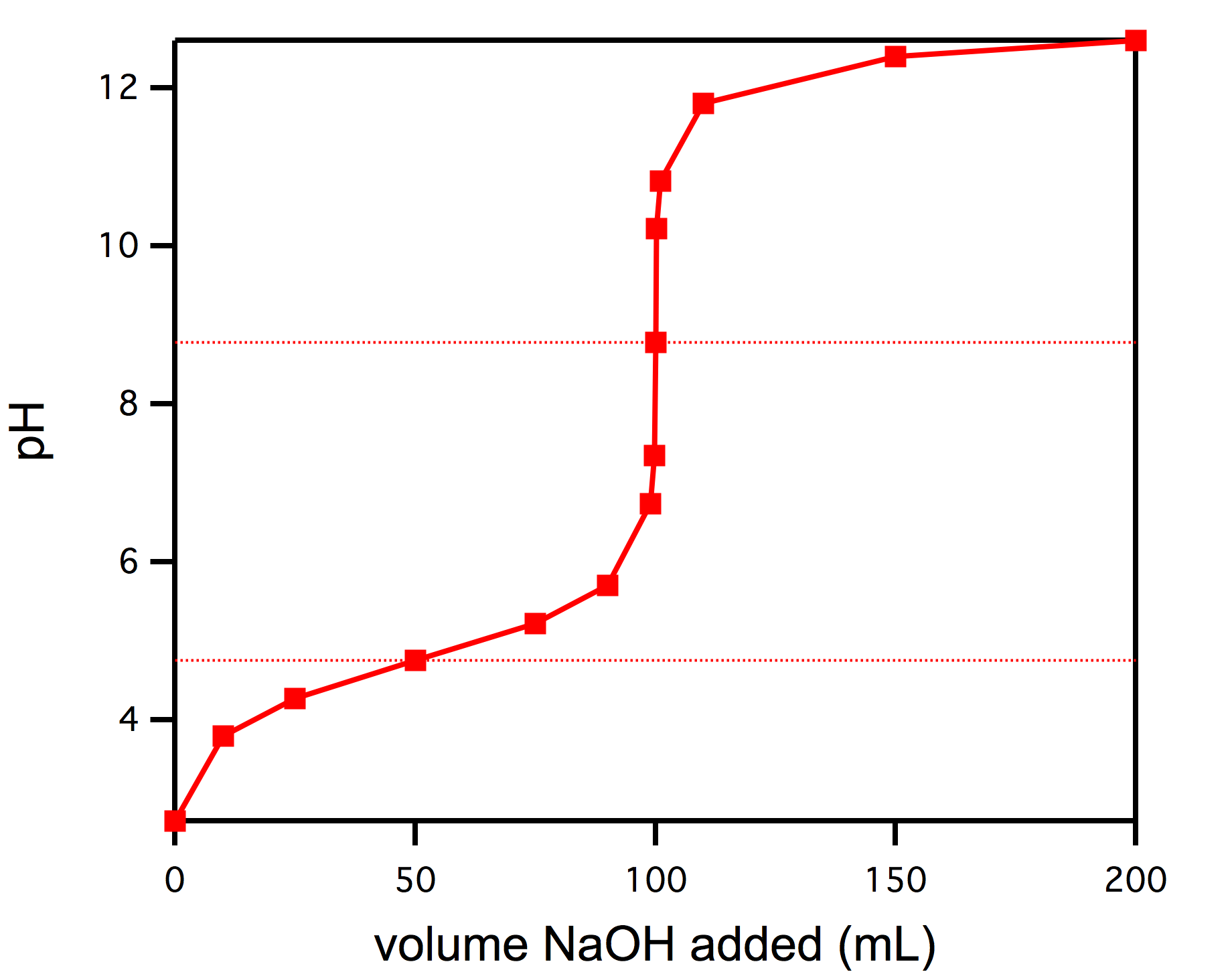

A sample of sulfuric acid is titrated with 0.24 M sodium hydroxide. The titration curve appears below. What volume of NaOH is needed to reach the equivalence point?
Which solution A and B of equal volume and concentration mixed together to form a buffer?
Nitric acid and potassium hydroxide
Nitric acid and potassium nitrate
Propanoic acid and potassium hydroxide
Propanoic acid and potassium propanoate
Suppose you have a solution of 0.3 M HBrO and 0.3 M BrO. You add a small amount of HCl to this buffer solution. What is the reaction that takes place?
H+ + BrO- ⟶ HBrO
OH- + H+ ⟶ H2O
OH- + HBrO ⟶ H2O + BrO-
OH- + BrO- ⟶ O-2 + HBrO

An acid-base indicator has pKa value of 4.0. At what pH will this indicator change colour?

The titration of a dilute solution of a weak acid, HA, with 0.1M NaOH was conducted and the pH curve is shown here. Which of the following statements is true at point B in the titration?
[HA] < [A-]
[HA] = [A-]
[HA] > [A-]
[HA] = 1 x 10⁻⁴ M
Which point on the titration curve corresponds to the point at which the moles of the added strong base are equal to the moles of the weak acid initially present?
Q
R
S
T
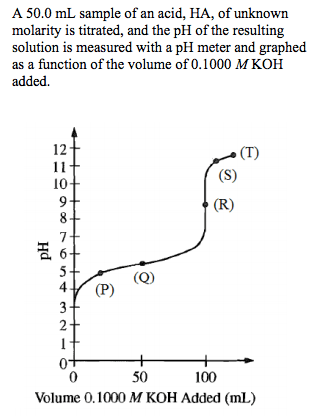
At point P in the titration, which of the following species has the highest concentration?
HA
A–
H3O+
OH–
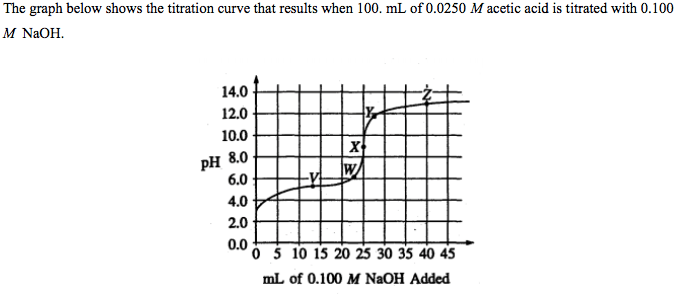
What part of the curve corresponds to the optimum buffer action for the acetic acid/acetate ion pair?
Point V
Point Z
Along all of section WY
Along all of section YZ
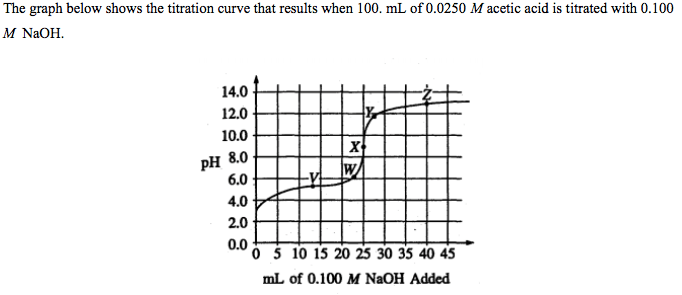
Which of the following indicators is the best choice for this titration?
Methyl orange (pH range of color change is 3.2 - 4.4)
Methyl red (pH range of color change is 4.8 - 6.0)
Bromothymol blue (pH range of color change is 6.1 - 7.6)
Phenolphthalein (pH range of color change is 8.2 - 10.0)

A 50.0 mL sample of an acid, HA, of unknown molarity is titrated, and the pH of the resulting solution is measured with a pH meter and graphed as a function of the volume of 0.100 M NaOH added.
At point R in the titration, which of the following species has the highest concentration?
HA
A-
H3O+
OH-

A solution of a weak monoprotic acid is titrated with a solution of a strong base, KOH. Consider the points labeled (A) through (E) on the titration curve
that results, as shown below.
The point at which the concentrations of the weak acid and its conjugate base are approximately equal is
A
B
C
D
E

An unknown acid is dissolved in 25 mL of water and titrated with 0.100 M NaOH. The results are shown in the titration curve above. Which of the following could be the unknown acid?
Fluoroacetic acid, pKa = 2.6
Glycolic acid, pKa = 3.8
Propanoic acid, pKa = 4.9
Hypochlorous acid, pKa = 7.5
Boric acid, pKa = 9.3

The graph above shows the titration curve that resulted when a sample of 0.1 M monoprotic acid was titrated with a solution of NaOH. Based on the graph, the pKa of the acid is closest to
3.0
4.0
6.0
8.0
12.0

A solution of lithium hydroxide is added to a clean, dry buret and used to titrate an aqueous solution of a monoprotic acid. The pH curve for this titration is shown in the diagram below.
On the basis of the pH curve, the pKa value of the acid is closest to
4
5
8
12

B(aq) + HCl(aq) ↔ HB+(aq) + Cl-(aq)
The graph above shows the titration curve for an aqueous solution of a weak base, B, with HCl as the titrant. Based on the graph, which of the following best estimates the pKa of HB+?
12.0
10.8
6.0
1.8
What is the pH at the equivalence point?
The pH is approximately 5
The pH is approximately 6
The pH is approximately 8
The pH is approximately 9
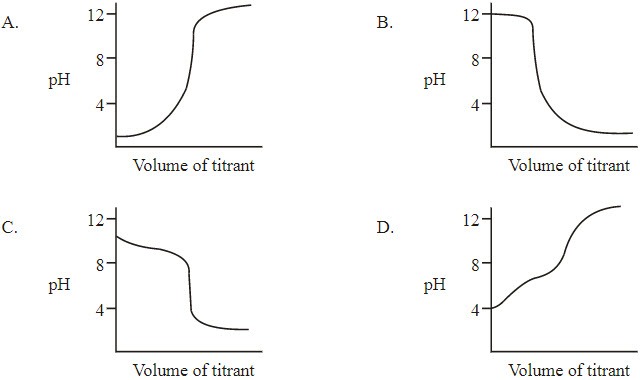
When titrating a strong acid with a strong base, the equivalence point
will be below a pH of 7.0
will be at a pH of 7.0
will be a pH above 7.0
will be either above or below a pH of 7.0
What is the molarity of an HCl solution if 50.0 mL is neutralized in a titration by 40.0 mL of 0.400 M NaOH?
.0.200 M
0.320 M
0.280 M
0.500 M
What is the molarity of an NaOH solution if 4.37 mL is titrated by 11.1 mL of 0.0904 M HNO3?
0.230 M
0.460 M
.0.355 M
0.620 M
What is the molarity of an H2SO4 solution if 49.0 mL is completely titrated by 68.4 mL of an NaOH solution whose concentration is 0.333 M?
.0.116 M
0.465 M
.0.232 M
0.880 M
During an acid-base titration, a rapid change in pH
occurs when the first addition of the standard solution is made
occurs at several points during the titration
occurs when the amounts of H3O+ ions and OH- ions are nearly equal
should not occur
A 0.95 M solution of 10.0 mL Al(OH)3 is neutralized using a 2 M solution of H2SO4. What volume of H2SO4 was used?
3H2SO4 + 2Al(OH)3 ⟶ 6H2O + Al2(SO4)3
0.040 M NaOH is load into a buret. The initial buret reading is 4.5 mL
60. mL of unknown monoprotic acid, HA, is placed under the buret and and 2 drops of phenolphthalein are added to the acid.
The base is slowly added to the acid until the color is pale pink. The final reading from the buret is 34.6 mL.
Calculate the molarity of the acid solution.
0.040 M
0.0012 M
0.020 M
30. M
Which of the following combinations will form a buffer solution? Select all that apply
HCOOH and LiCOOH
NH3 and NH4Br
KOH and KF
HCl and RbOH
What is the pH of a buffer mixture of 0.70 M KCH3COO and 0.50 M CH3COOH (Ka = 1.8x10⁻⁵)?
0.45
4.89
4.60
4.74
Which is the net ionic equation when NaOH(aq) is added to HF(aq) ?
H+ + OH- ⟶ H2O
HF+ NaOH ⟶ H2O + NaF
HF + OH- ⟶ H2O + F-
F- + NaOH ⟶ OH- + NaF
50 mL of 0.10 M HCl is titrated by 0.20 M NaOH. What is the volume of NaOH at the equivalence point?
25 mL
50 mL
100 mL
75 mL
When HCOOH(aq) is titrated by RbOH(aq), what is the pH at the equivalence point and why does this occur?
pH > 7 because there is excess NaOH.
pH < 7 because an acidic salt forms.
pH = 7 because a neutral salt forms.
pH > 7 because a basic salt forms.
What is the primary hydrolysis reaction at the equivalence point when HF(aq) is titrated by NaOH(aq)?
HF + NaOH ⇌ NaF + H2O
F- + H2O ⇌ HF + OH-
HF + H2O ⇌ F- + H3O+
Na+ + H2O ⇌ NaOH + H+
Which point on the titration curve corresponds to the point at which the moles of the added strong base are equal to the moles of the weak acid initially present?
Q
R
S
T
At which point on the titration curve will pH = pKa?
Q
R
S
P
Which curve is produced by the addition of a strong acid to a strong base?
A
B
C
D
Which of the following statements is/are true about acidic buffer (HX/X-) solutions?
(Select all that apply)
The buffer is more effective when the ratio [𝑋−][𝐻𝑋] > 10
The buffer is most effective at a pH ±1 from the pKa of HX
The pH of the buffer would remain the same if few drops of sodium hydroxide solution, NaOH, are added
The buffer has a higher buffer capacity when it is more concentrated.
The buffer is more effective when the ratio [𝑋−][𝐻𝑋] < 0.1
A solution with a pH < 7 which is not a buffer
An example of a buffer solution is:
0.100M in HNO2 and 0.100M NaCl
0.100M in HNO2 and 0.100M HCl
0.100M in HNO2 and 0.100M NaNO2
0.100M in HNO2 and 0.100M HF
What is the pH of a buffer solution where [HA]=[A-]?
pH = 7.0
pH = 1.0
pH = Ka
pH = pKa
pH = pOH
What is the pH of a solution containing 0.718M acetic acid (Ka= 1.76 x 10⁻⁵) and 0.192M sodium acetate?
5.33
8.45
4.18
9.25
What volume of 0.135M NaOH is required to neutralize 13.7mL of 0.129 M HCl?
13.1 mL
0.24 mL
14.3 mL
0.076 mL
6.55 mL
What volume of 0.0748 M phosphoric acid, H3PO4, can be neutralized with 115 mL of 0.244M sodium hydroxide?
125 mL
375 mL
750. mL
188 mL
75.0 mL
What is the molarity of a NaOH solution if 28.2 mL of a 0.355 M H2SO4 solution is required to neutralize a 25.0 mL sample of the NaOH solution?
0.801 M
0.315 M
0.629 M
125 M
0.400 M
What volume of 0.132 M HClO4 solution is needed to neutralize 50.00 mL of 0.0789 M NaOH?
0.521 mL
0.0120 mL
83.7 mL
0.0335 mL
29.9 mL
The titration of a dilute solution of a weak acid, HA, with 0.1M NaOH was conducted and the pH curve is shown here. Which of the following statements is true at point C in the titration?
[HA] < [A-]
[HA] = [A-]
[HA] > [A-]
pH = pKa
pH < pKa
The titration of a dilute solution of a weak acid, HA, with 0.1M NaOH was conducted and the pH curve is shown here. Which of the following statements is true at point D in the titration?
[HA] < [A-]
[HA] = [A-]
[HA] > [A-]
pH = pKa
pH > pKa

The titration of a 27.2 mL sample of a weak acid, HA, with 0.12 M NaOH was conducted and the pH curve is shown here. What was the original HA concentration?
0.029 M
0.50 M
0.00100 M
0.00068 M

