wayground logo

Free Printable Worksheets

Font size

S
M
L
XL
Worksheets

AH2 Final Review

Total questions: 115

Worksheet time: 1hrs 16mins

Name
Class
Date
1.

Issuing the Truman Doctrine, defending South Korea, and sending military advisors to Vietnam were actions taken by the United States to

a)

gain additional overseas colonies.

b)

encourage membership in the United Nations.

c)

promote American business in Asia.

d)

limit the spread of communism.

2.

Which best describes the Cold War?

a)

This period of time following World War II is where the United States and the Soviet Union emerged as superpowers and faced off in an arms race that lasted nearly 50 years.

b)

Any struggle between the opposing forces of good and evil.

c)

A lessening of tensions between U.S. and Soviet Union begun to insure a lasting peace between superpowers.

d)

A legal state created by a declaration of war and ended by official declaration during which the international rules of war apply.

3.

The position taken by Truman which became known as the Truman Doctrine was a

a)

proposal for peaceful use of atomic energy.

b)

policy for extending economic and military aid to those countries threatened by communism.

c)

policy of aiding peace-loving peoples of underdeveloped nations.

d)

policy to provide technical assistance to countries ravaged by WWII.

4.

What ultimately happened to the “Hollywood Ten” who refused to answer questions put to them by the House Un-American Activities Committee?

a)

they spent time in jail and were blacklisted

b)

they were fined by the courts

c)

they were forced into exile.

d)

they became double agents against the communists

5.

When the Soviet Union denied the United States, Britain and France access to West Berlin in 1948, President Truman responded by

a)

asked the United Nations to intervene.

b)

denying the Soviets access to West Germany.

c)

calling up reserves in anticipation of war.

d)

organizing an airlift of supplies to West Berlin.

6.

What was the purpose of the Marshall Plan?

a)

to start a Cold War

b)

to punish Germany for building the Berlin Wall

c)

to fund the rebuilding of Europe

d)

to increase support for South Korea

7.

What country put the first human-made space satellite into orbit around Earth?

a)

the United States

b)

Great Britain

c)

the Soviet Union

d)

France

8.

Which individual/group contributed to the Red Scare by accusing American citizens of being communist spies?

a)

McCarthy/HUAC

b)

NAACP/Farm Workers Union

c)

Nativists/Muckrakers

d)

Philanthropists/Entrepreneurs

9.

What happened as a result of the launch of Sputnik in 1957?

a)

It started the space race between the USSR and U.S.

b)

The U.S. government started NASA.

c)

U.S. began to spend more money on math and science to maintain national security.

d)

All of the above

10.

During the Cuban Missile Crisis, what did President J.F. Kennedy do when he heard that the Soviet Union was constructing nuclear missile sites in Cuba.

a)

He launched a nuclear missile at the Kremlin in Moscow.

b)

He gave into the demands of the Soviet & Cuban government.

c)

He ordered a naval blockade around Cuba to prevent Soviet ships from bringing the necessary materials.

d)

He declared war on the Soviet Union & Cuba.

11.

What legislation helped American soldiers get an education and buy homes in the suburbs during the Cold War?

a)

Interstate Commerce Act

b)

Federal Housing Authority Act

c)

Social Security Act

d)

GI BIll

12.

What was the name of the rapid increase of population following the end of WWII called?

a)

Baby Boom

b)

Columbian Exchange

c)

Great Migration

d)

Demographic Shift

13.

What theory caused the U.S. to enter the Vietnam War in order to stop the expansion of communism across Southeast Asia?

a)

Marshall Plan

b)

Domino Theory

c)

Open Door Policy

d)

Dollar Diplomacy

14.

What words should you immediately associate with the Cold War?

a)

Hitler & the Nazis

b)

Economic recession

c)

Containment of Communism

d)

Corruption & Industrialization

15.
He was the communist leader of North Vietnam
a)
Diem
b)
Johnson
c)
Ho Chi Minh
d)
Castro
16.
What were the problems of fighting in Vietnam?
a)
Identifying the enemy 
b)
Jungle/Location provided cover and a place to transport enemy supplies
c)
Weather and climate
d)
all of these
17.
What rule was Vietnam unified under 
a)
Democratic
b)
Communist
c)
Socialist 
d)
Monarchy
18.

Shifting the burden of actual combat from American troops to South Vietnamese forces.

a)

Vietminization

b)

Vietcong

c)

Internationalism

d)

Linkage

19.
What event sparked significant protests in the United States during the 1960's?
a)
WWII
b)
Vietnam War
c)
Cuban Missile Crisis
d)
WWI
20.

What event caused a negative shift in U.S. public opinion during the Vietnam War?

a)

The Geneva Accords

b)

Operation Rolling Thunder

c)

The Tet Offensive

d)

Gulf of Tonkin

21.
What defined the border between North Vietnam and South Vietnam?
a)
38th Parallel
b)
17th Parallel
c)
Mekong River
d)
It was a straight line exactly halfway between the northern tip and the southern tip of the country
22.

What year did the US go to war with North Vietnam?

a)

1945

b)

1955

c)

1965

d)

1975

23.
Court case that created "Separate-but-equal" doctrine.
a)
Sweatt v. Painter
b)
Brown v. Board of Education
c)
Plessy v. Ferguson
d)
Mendez v. Kirby ISD
24.
Who was arrested for refusing to give up their seat on a bus?
a)
Charlayne Hunter
b)
Harriet Tubman
c)
Rosa Parks
d)
Rebecca L. Felton
25.
An organization formed in 1960 to coordinate sit-ins and other protests and to give young blacks a larger role in the civil rights movement.
a)
affirmative action
b)
de facto segregation
c)
Student Nonviolent Coordinating Committee 
d)
National Organization for Women 
26.
Act that eliminated the so-called literacy tests that had disqualified many voters.
a)
Voting Rights Act of 1965
b)
Civil Rights Act of 1964
c)
Brown vs. the Board of Education
d)
Roe Vs. Wade
27.
What state laws created separate public facilities for African Americans in the South?
a)
Jim Crow Laws
b)
affirmative action
c)
Civil Rights Acts
d)
Force Acts
28.
In the 1954 trial of Brown v Board of Education, the US Supreme Court ruled that
a)
private schools should be controlled by the federal government
b)
issues of racial segregation should be decided by the states.
c)
racially segregated public schools are unconstitutional
d)
the "separate but equal" doctrine should be contnued
29.
Who did the Southern Christian Leadership Conference elect as its first leader?
a)
Rosa Parks
b)
Jackie Robinson
c)
Martin Luther King Jr.
d)
Thurgood Marshall
30.
The Selma March is also known as ____. 
a)
Bloody Sunday
b)
Black Sunday
c)
Bloody Tuesday
d)
Black Tuesday
31.
What amendment was used by the NAACP and civil rights leaders to challenge segregation?
a)
13th
b)
14th
c)
15th
d)
16th
32.
What event was organized after Rosa Parks was arrested?
a)
Birmingham bus boycott
b)
Atlanta bus boycott
c)
Memphis bus boycott
d)
Montgomery bus boycott
33.
City that saw violence at the protests and resulted in MLK being arrested?
a)
Montgomery
b)
Birmingham
c)
Selma
d)
Memphis
34.
Where did MLK deliver his iconic "I have a dream" speech?
a)
Washington
b)
Memphis
c)
Dallas
d)
Selma
35.
What march was organized by MLK and advocated for equal voting rights?
a)
Selma
b)
Montgomery
c)
Memphis
d)
Birmingham
36.
What strategy did MLK NOT use when fighting for equal rights?
a)
Sit-ins
b)
Marches
c)
Protests
d)
Violent Riots
37.
The spark that ignited World War 1 
a)
The assassination of Archduke Franz Ferdinand
b)
Germany attacking Belgium
c)
Russian support of Serbia
d)
The sinking of the Lusitania
38.

Who was the President during World War 1?

a)

Abraham Lincoln

b)

Woodrow Wilson

c)

Teddy Roosevelt

d)

Franklin Roosevelt

39.

Who said, "The world must be made safe for democracy"?

a)

Woodrow Wilson

b)

Ulysses S. Grant

c)

Theodore Roosevelt

d)

Barack Obama

40.
Militarism means....
a)
Building up armed forces and getting ready for war
b)
Having pride in your nation
c)
Trying to build an empire
d)
Agreements to help others
41.
According to Woodrow Wilson, the purpose of the League of Nations was
a)
to remove threat of future wars.
b)
to prevent nuclear proliferation.
c)
to help the US gain more territories.
d)
to help promote prohibition in other countries.
42.
On May 7, 1915, a German submarine torpedoed and sank
a)
the Maine
b)
The Titanic
c)
The Lusitania
d)
The Queen Mary
43.

Which area was called the "powder keg" of Europe and was the place where World War I began?

a)

Balkans

b)

Gallipoli

c)

Western Front

d)

Ottoman Empire

44.
Which answer summarize the Schlieffen Plan that Germany created to prepare for a two-front war?
a)
Attack France first, then Russia.
b)
Attack Russia first, then France.
c)
Send half of the army to France and half to Russia.
d)
Ally with Russia to fight France.
45.

What was the Zimmermann Note?

a)

The German policy of attacking all ships entering or leaving Britain

b)

Wilson's speech concerning why the U.S should enter WWI

c)

A proposal by Germany that Mexico attack the US in return for territory

d)

a note left behind by a Serbian Nationalist in Austria-Hungary

46.
Payments for war damages were known as
a)
nationalism
b)
separatism.
c)
reparations.
d)
retaliations.
47.
Why did many Americans not want to sign the Treaty of Versailles?
a)
It forced us to join the League of Nations
b)
It forced us to ally with Germany
c)
It forced us to sell supplies to Russia
d)
It forced us to fight against John Cena in the Wrestlemania
48.

Which of the following is the best example of imperialism?

a)

France building a powerful navy

b)

England's alliance with France

c)

German schools teaching English

d)

England and Germany competing for colonies

49.

What was the name of the new style of warfare during World War I?

a)

tank warfare

b)

plane warfare

c)

train warfare

d)

trench warfare

50.

Which treaty ended World War I?

a)

The Treaty of Paris

b)

The Treaty of Versailles

c)

The Armistice of Versailles

d)

The Treaty of World Powers

51.
World War 1 took place between what years?
a)
1939 - 1945
b)
1915 - 1920
c)
1914 - 1918
d)
1899 - 1914
52.
Which event caused the US to enter the war?
a)
Pearl Harbor
b)
Invasion of Poland
c)
Stalingrad
d)
Assassination of Archduke Franz Ferdinand
53.
What event took the Japanese out of the war?
a)
Island hopping
b)
Pearl Harbor
c)
Battle of Britain
d)
Atomic Bombs
54.
Who was the commander of the allied forces in DDay
a)
Elmer Early Lunsford
b)
George S. Patton
c)
Harry S. Truman
d)
Dwight D. Eisenhower
55.

France & Britain's response to Germany's expansion

a)

appeasement

b)

isolationist

c)

interventionist

d)

declaration of war

56.

allowed economic assistance to the Allies

a)

Lend Lease Act

b)

Selective Service Act

c)

Four Freedoms

d)

Executive Order 9066

57.

the spread of ideas for the purpose of helping or damaging a cause

a)

propaganda

b)

totalitarianism

c)

fascism

d)

appeasement

58.

a government that controls all aspects of society

a)

totalitarianism

b)

democracy

c)

laissez faire

d)

capitalism

59.
The president of the United States during most of WWII.
a)
Teddy Roosevelt
b)
Franklin D. Roosevelt
c)
Harry Truman
60.
United States, Great Britain, Soviet Union
a)
Central Powers
b)
Allied Powers
c)
Axis Powers
61.
The United States president who made the decision to drop atomic bombs on Japan
a)
Franklin D. Roosevelt
b)
Harry Truman
62.
What was the codename for the invasion of Normandy?
a)
D-Day
b)
Operation Torch
c)
Operation Seal Lion
d)
Operation Overlord
63.
Where did the D-Day battle take place?
a)
England
b)
France
c)
Germany
d)
Hawaii
64.
Which was NOT a LONG-TERM cause of the Great Depression?
a)
Buying stock on margin
b)
Stock market crash (Black Tuesday)
c)
too much production and consumer spending
d)
Laisezz-faire economic policies
65.
The Great Depression began in
a)
1925
b)
1929
c)
1932
d)
1940
66.
What effect did the Dust Bowl storms have on the Great Depression?
a)
Many farmers were forced to leave the Great Plains.
b)
Unemployment decreased gradually.
c)
Many homes long the Mississippi River were flooded.
d)
Hoover was re-elected as president.
67.
Who was president at the time of the Stock Market Crash of 1929?
a)
Abraham Lincoln
b)
Franklin D. Roosevelt
c)
Theodore Roosevelt
d)
Herbert Hoover
68.
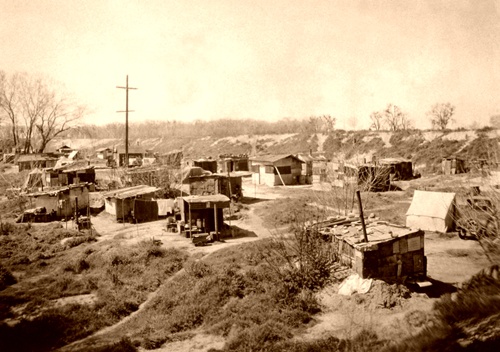
What were the villages full of shacks located in cities filled with unemployed Americans called?
a)
Hoovervilles
b)
Okies
c)
Bonus Army Bases
d)
Rooseveltowns
69.
What is another name for the Stock Market Crash?
a)
Black Friday
b)
Taco Tuesday
c)
Black Tuesday
d)
Throwback Thursday
70.

What was President Herbert Hoover's response to the Great Depression?

a)

He believed "rugged individualism" would solve the economy

b)

He created mass welfare

c)

He increased infrastructure to create jobs

d)

He violated his policy of laissez-faire

71.
Many people lost their jobs during the Great Depression.  The national government responded with President Franklin Roosevelt's "New Deal," which
a)
provided programs to help people make money to provide for their needs. 
b)
helped reduce the national debt, providing more capital for businesses
c)
forced people to join the military forces to make money for their needs. 
d)
forced people to use charities to help them provide for their needs. 
72.
The _______________________ was FDR's plan to help get the economy going again and help the unemployed find jobs.
a)
Hoovervilles
b)
German race
c)
The New Deal
d)
Pearl Harbor
73.
FDR addressed the American public in weekly broadcasts known as:
a)
FDR Hour
b)
Hangin' With Franklin
c)
Fireside Chats
d)
Around the Fire
74.

What event brought the country out of the Great Depression?

a)

the Bonus Army

b)

the building of the Hoover Dam

c)

going off of the gold standard

d)

World War II

75.
What were the major goals of the New Deal?
a)
no gold standard and free coinage of silver
b)
abolition and suffrage
c)
relief, recovery, and reform
d)
expanding the size and economic influence of the United States
76.
The social impact of the Red Scare was characterized by
a)
Yellow Journalism
b)
Spread of Communism
c)
Stock Market Crash
d)
Anti-Immigrant Sentiment
77.
Which music genre was created in the 20s?
a)
Bluegrass
b)
Jazz
c)
Hip Hop
d)
R&B
78.
What was the symbol of feminine change in the 1920s?
a)
Flapper
b)
Bootlegger
c)
Immigrant
d)
Musician
79.
What was the major change for women in the 1920s?
a)
Right to Vote
b)
Right to Work
c)
Right to Dance
d)
Right to Drink
80.
Which political scandal marked Warren Harding's presidency and caused increased distrust of the government?
a)
Teapot Dome
b)
Fall
c)
Yosemite Land
d)
Haymarket Square
81.
The Harlem Renaissance was
a)
Celebration of African American Culture
b)
Spark of increased industrial jobs
c)
Creation of controversial policies
d)
Creation of the Department of Interior
82.

What amendment gave women the right to vote?

a)

16

b)

18

c)

19

d)

21

83.

What amendment banned alcohol (Prohibition)?

a)

16

b)

18

c)

19

d)

21

84.

Why was the 1920s known as the "Roaring 20s?"

a)

huge increase in immigration which led to fighting

b)

economic depression

c)

people were free to drink and party at their leisure

d)

it was a time of cultural and social changes

85.

Amendment that ended prohibition

a)

16

b)

18

c)

19

d)

21

86.

Territories gained as a result of the Spanish-American war include Puerto Rico, Guam and-

a)

Cuba

b)

Spain

c)

Philippines

87.
What US President was most influential in starting the Panama Canal?
a)
FDR
b)
JFK
c)
Teddy Roosevelt
d)
Taft
88.
What 2 oceans does the Panama Canal connect?
a)
Atlantic Ocean and Indian Ocean
b)
Pacific Ocean and Indian Ocean
c)
Atlantic Ocean and Pacific Ocean
d)
Lake Michigan and Mississippi River
89.
______________ is a name for false or exaggerated reporting.
a)
Red-top
b)
Government
c)
Newspaper lying
d)
Yellow Journalism
90.
Which territory did the United States NOT take as a territory and gave them independence? 
a)
Puerto Rico
b)
Guam
c)
Philippines
d)
Cuba
91.
What term describes building an empire by conquering other nations?
a)
Isolationism
b)
Repubicanism
c)
Militarism
d)
Imperialism
92.
He was part of the Rough Riders during the Spanish American war. He was also the assistant Secretary of the Navy and a president during the progressive era. 
a)
Alfred T Mahan 
b)
Rough Riders 
c)
Theodore Roosevelt 
d)
Henry Cabot Lodge 
93.
1898- It lasted only 4 months. This was the end of Spain's colonial empire and the emergence of the US as a world power,
a)
Sinking of the USS Maine 
b)
Boxer Rebellion 
c)
Dollar Diplomacy 
d)
Spanish American War 
94.

Journalists called muckrakers and urban photographers exposed people

a)

to the plight of the unfortunate in hopes of sparking reform.

b)

the difficulties entrepreneurs faced in hopes of sparking reform.

c)

to the plight of the unfortunate in hopes of sparking a social purge of the weak.

d)

the difficulties millionaires faced in hopes of sparking reform.

95.

~Upton Sinclair exposed the unhealthy practices of Chicago's meat-packing plants


~Ida Tarbell revealed the dishonest business tactics of Rockefeller's Standard Oil

Company


~Jacob Riis wrote How the Other Half Lives, showing the conditions of the residents of

New York City tenements


What was the impact of these muckraking activities during the early 1900s?

a)

Society changed in response to their promotion of Social Darwinism

b)

Voters agreed to let big business owner create more profitable monopolies

c)

Reports of their works in publications abroad caused a decline in immigration

d)

Public reaction to their books led to new laws addressing the abuses of industrialization

96.

"The Senate of the United States shall be composed of two Senators from each State, elected by the people thereof..."


The text is an excerpt from which amendment?

a)

16th

b)

17th

c)

18th

d)

19th

97.

Which of these was a major goal of Jane Addam's Settlement House movement in

Chicago?

a)

founding of women's colleges

b)

introduction of prison reform

c)

assimilation of immigrants

d)

establishment of public libraries

98.
1906- Wrote The Jungle which exposed the conditions in the U.S. meat packing industry. (Helped pass the Pure Food and Drug Act) 
a)
Upton Sinclair 
b)
Lincoln Steffens 
c)
Jacob Riis 
d)
Frank Norris 
99.

Nativists are against...

a)

Corruption

b)

African Americans

c)

Railroads

d)

Immigrants

100.
Henry Ford’s main contribution to the US industry was the idea of the assembly line and __________.
a)
automobile
b)
mass production
c)
sports car
d)
transportation
101.
Which amendment abolished slavery?
a)
13th
b)
14th
c)
15th
d)
19th
102.
The 15th amendment gave the right to vote to
a)
All African Americans
b)
African American men
c)
Native Americans
d)
White Women
103.
How did the 14th amendment overrule the Dred Scott decision?
a)
It abolished slavery
b)
It said slaves could vote
c)
It protected African Americans as equal citizens
d)
It said that African Americans could move north
104.

The Homestead Act:

a)

Encouraged westward settlement

b)

Granted 160 acres to every head of household

c)

Created Native Tension

d)

was an act which granted land to Natives

105.

William Jennings Bryan's famous Cross of Gold speech is about...

a)

The acquisition of colonies to increase employment opportunities.

b)

The creation of a national park system

c)

A policy of bimetalism to help farmers with raising crop prices.

d)

Higher tariffs to protect American goods from foreign cometition.

106.
The political party that advocated for farmers was known as the ______party.
a)
Republican
b)
Democrat
c)
Populist
107.
Populist sought to have a typical work day last____hours.
a)
5
b)
6
c)
7
d)
8
108.

An economic practice where the government does NOT try to control the economy.

a)

Gospel of Wealth

b)

laissez faire

c)

Social Darwinism

d)

horizontal integration

109.

When a company controls everything from raw materials to the distribution of the product

a)

horizontal integration

b)

vertical integration

c)

trust

d)

monopoly

110.

In which industry did Andrew Carnegie earn his fortune?

a)

steel

b)

railroad

c)

gold

d)

oil

111.

Which industry did Rockefeller dominate?

a)

oil

b)

steel

c)

communication

d)

railroad

112.
A movement concerned with helping the poor -- according to biblical principles
a)
Social Gospel
b)
Gospel of Wealth
c)
Social Darwinism
113.
"Survival of the fittest" applied to business competition
a)
Social Gospel
b)
Gospel of Wealth
c)
Social Darwinism
114.
The __________ process was a less expensive way to make steel.
a)
Edison
b)
Foundry
c)
Bessemer
d)
Factory
115.

Select the term that best describes the Gilded Age

a)

The time when everything was covered in gold

b)

Businesses were struggling financially

c)

businesses grew at a rapid rate and many problems lied below perceived prosperity

d)

Businesses achieved unprecedented success with an increase in pay for all workers