wayground logo

Free Printable Worksheets

Font size

S
M
L
XL
Worksheets

Semester 1 Review Guide Chemistry

Total questions: 91

Worksheet time: 1hrs 16mins

Name
Class
Date
1.

Subatomic particles with a negative charge

a)

Electrons

b)

Neutrons

c)

Protons

d)

Quarks

2.
Subatomic particles with a positive charge
a)
neutrons
b)
atomic mass
c)
protons
d)
isotopes
3.
Measure mainly of the nuclear particles: protons + neutrons
a)
Subatomic Particles
b)
Atomic Number
c)
Atomic Mass
d)
Gluons
4.
Value representing the number of protons in an element
a)
Atomic Mass
b)
Mass Number
c)
Valence Electrons
d)
Atomic Number
5.
Subatomic particles that are neutral in charge
a)
Neutrons
b)
Protons
c)
Nucleus 
d)
Electrons
6.

What is one way Neutrons are different from electrons?

a)

they both are negative

b)

neutrons have no charge, while electrons have a negative charge

c)

Both are in the nucleus( center of atom)

d)

Electrons are inside nucleus and neutrons are outside the nucleus.

7.

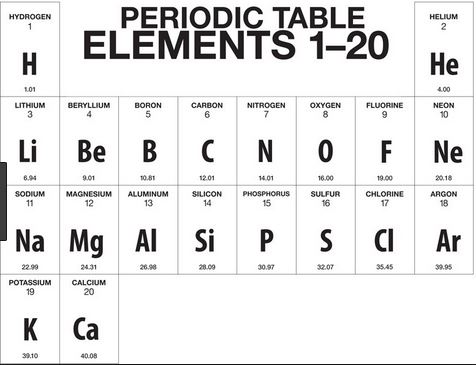
What is the atomic number?

a)

35

b)

18

c)

17

d)

52

8.

How many protons and electrons does this element have?

a)

35

b)

18

c)

17

d)

52

9.

How many neutrons does Chlorine have?

a)

18

b)

17

c)

35

d)

52

10.

What is the atomic mass of Neon?

a)

10

b)

20

c)

30

11.

How many neutrons does calcium have?

a)

20

b)

40

c)

60

d)

0

12.

What is the atomic mass of Arsenic?

a)

33

b)

107

c)

75

13.
What is the name of this element?
a)
Helium
b)
Hydrogen
c)
Argon
d)
Silver
14.

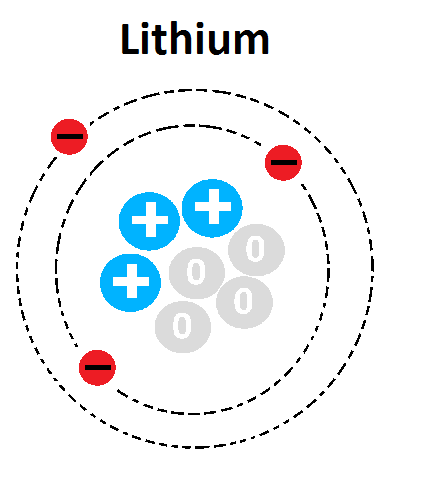
What element is represented in this Bohr Model?

a)

Carbon

b)

Hydrogen

c)

Aluminum

d)

Lithium

15.
How many valence electrons?
a)
2
b)
3
c)
5
d)
10
16.
What group does this element belong to?
a)
Group 1: Alkali metals
b)
Group 18: Noble Gases
c)
Group 2: Alkaline-Earth Metals
d)
Group 17: Halogens
17.
What is the mass number of this atom?
a)
1
b)
3
c)
4
d)
7
18.
What is the atomic number of this atom?
a)
2
b)
4
c)
6
d)
none of the above
19.

___________ simplify the Bohr Model by showing only the outer valence electrons used for bonding.

a)

Lewis Dot Diagrams

b)

Bohr Models

c)

Electron Clouds

d)

Periodic Tables

20.

Which Bohr model represents Beryllium?

a)
b)
c)
d)
21.
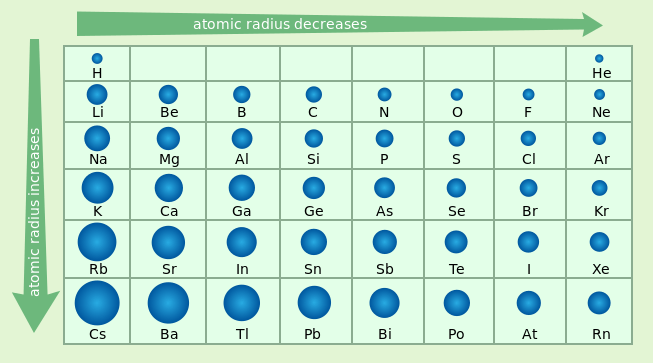
As you move down the periodic table atoms get bigger.  This is because ____________.
a)
The atoms have more mass.
b)
The atoms have more protons.
c)
The atoms have more energy levels
d)
The atoms have more nuetrons
22.
Atomic Radius is...
a)
the relative size of the atom's nucleus
b)
the relative size of the atom's electron cloud
c)
the energy required to shield the outer electrons from the nucleus
d)
a measure of the ability of an atom to attract electrons
23.
As you move across the periodic table atoms tend to get smaller because, ______________.
a)
the atoms have more mass.
b)
the atoms have less mass
c)
the atoms have more protons.
d)
the atoms have less electrons.
24.
Which atom has the largest atomic radius?
a)
potassium
b)
rubidium 
c)
francium
d)
cesium
25.
The atom with the largest atomic radius in Group 18 is - 
a)
Ar
b)
He
c)
Kr
d)
Rn
26.
Which periodic group has the smallest atomic radius?
a)
Alkali metals
b)
Halogens
c)
Noble Gases
d)
Transition metals
27.
Ionization energy is...
a)
the energy required to add an electron to a specific atom
b)
how much energy it takes to remove an electron from an atom
c)
the energy required to shield the outer electrons from the nucleus
d)
a measure of the ability of an atom to attract electrons
28.
Which of the following will have a lower ionization energy than Scandium (Sc)?
a)
Helium (He)
b)
Titanium (Ti)
c)
Calcium (Ca)
d)
Magnesium (Mg)
29.
Which of the following will have a higher ionization energy than arsenic (As)?
a)
Gallium (Ga)
b)
Neon (Ne)
c)
Antimony (Sb)
d)
Germanium (Ge)
30.
Electronegativity is...
a)
how good an atom is at attracting electrons
b)
the ability of an atom to lose electrons
c)
the energy required to remove an electron from a specific atom
d)
how easy it is to make friends. 
31.
Atoms that have a high electronegativity, _______________.
a)
give up their electrons more easily.
b)
hold on to their electrons more tightly.
c)
have more electron shells.
32.
Which of the following will have a higher electronegativity than arsenic (As)?
a)
Carbon (C)
b)
Neon (Ne)
c)
Antimony (Sb)
d)
Germanium (Ge)
33.

In group 16, when going from top to bottom, the electronegativity...

a)

decreases

b)

increases

c)

remains the same

d)

none of the above

34.

How many valence electrons does Hydrogen Have?

a)

1 Valence electron

b)

2 Valence electron

c)

3 Valence electron

d)

4 Valence electron

e)

5 Valence electron

35.

How many valence electrons does Helium Have?

a)

1 Valence electron

b)

2 Valence electron

c)

3 Valence electron

d)

4 Valence electron

e)

5 Valence electron

36.

How many valence electrons does Aluminum Have?

a)

1 Valence electron

b)

2 Valence electron

c)

3 Valence electron

d)

4 Valence electron

e)

5 Valence electron

37.
How many electrons should Lithium have around its Lewis dot model?
a)
1
b)
2
c)
3
d)
4
38.
How many electrons should Silicon have around its Lewis dot model?
a)
1
b)
2
c)
3
d)
4
39.
How many electrons should Argon have around its Lewis dot model?
a)
5
b)
6
c)
7
d)
8
40.
This could be the dot diagram of
a)
Mg
b)
Cl
c)
C
d)
O
41.
This is a correct dot diagram for neon (Ne)
a)
true
b)
false
42.
This is a correct dot diagram for carbon (C)
a)
true
b)
false
43.
This is a correct dot diagram for oxygen (O)
a)
true
b)
false
44.
What does the principle of conservation of mass mean?
a)
The total mass of the reactants is more than the products
b)
Matter is not created or destroyed
c)
The total mass of the reactants is less than the products
45.
Can matter be created or destroyed?
a)
Yes, it can be created.
b)
Yes, it can be destroyed.
c)
No, matter is always conserved
d)
None of these
46.
The mass after a physical change, such as ice melting into water, stays the same
a)
True
b)
False
47.
All matter is made of what?
a)
energy 
b)
atoms 
c)
electrons 
d)
compounds 
48.

State of matter with a definite shape and definite volume.

a)

solid

b)

liquid

c)

gas

49.

State of matter with a definite volume, but no definite shape.

a)

solid

b)

liquid

c)

gas

50.

State of matter with no definite shape and no definite volume.

a)

solid

b)

liquid

c)

gas

51.
Water boiling is a _______ change. 
a)
Physical Change 
b)
Chemical Change 
52.
Fireworks Exploding are a ________ change.
a)
Physical Change
b)
Chemical Change
53.
Sugar is dissolved into Kool Aid. What type of change is this? 
a)
Chemical 
b)
Physical 
c)
Multi
d)
Asystematic 
54.
What is the evidence of the chemical change seen here?
a)
Color change
b)
Light produced
c)
state change
d)
mixture
55.
Is burning wood a chemical or physical change?
a)
chemical
b)
physical
56.
Adding baking soda and vinegar together and it fizzes and creates carbon dioxide.
a)
Chemical
b)
Physical
57.
What type of bond forms when 2 or more electrons are SHARED?
a)
Covalent bond
b)
Incomplete bond
c)
Ionic bond
d)
Metallic bond
58.
What type of bond forms between two or more atoms that are charged (+/-)?
a)
Covalent bond
b)
Incomplete bond
c)
Ionic bond
d)
Metallic bond
59.
Which of the following is an example of an IONIC COMPOUND?
a)
NaCl
b)
H2O
c)
CO2
d)
NO
60.
Which of the following is an example of a COVALENT COMPOUND?
a)
H2S
b)
KI
c)
CaCl2
d)
MgO
61.
Ionic bonds are between _______ and ________. 
a)
nonmetals and nonmetals 
b)
metals and metals 
c)
metals and nonmetals
d)
none
62.
How does a positively charged ion form?
a)
An atom loses an electron
b)
An atom gains an electron
c)
An atom gains a proton
d)
An ionic compound dissolves
63.
Covalent bonds tend to happen between two
a)
metals
b)
nonmetals
c)
metal and nonmetal
64.
Outer shell electrons are called
a)
outer electrons
b)
valence electrons
c)
negatives
65.
Atoms want
a)
A full outer shell of electrons
b)
One electron short of a full shell
c)
kit kats
66.
The compound formed between lithium and chlorine is _________.
a)
ionic
b)
covalent
67.
An ionic bond forms when atoms ___________ electrons.
a)
gain
b)
share
c)
increase
d)
transfer
68.
If an atom loses two electrons what charge will it have?
a)
+ 2
b)
 - 2
c)
+1
d)
-1
69.
If an atom gains one electron what charge will it have?
a)
-2
b)
-1
c)
+1
70.
What is the number of valence electrons for Oxygen?
a)
8
b)
6
c)
2
d)
1
71.

CaCl2 is an example of what type of bond?

a)

Covalent

b)

Metallic

c)

Ionic

72.
What group on the Periodic Table contains the elements of the alkaline earth family?
a)
1
b)
2
c)
17
d)
18
73.

The elements in this family are soft, silvery, and very reactive with water.

a)

Alkaline Earth Metals

b)

Alkali Metals

c)

Transition Metals

d)

Lanthanides

74.

What group is the family found? These halides are very reactive and almost have full outer energy level/shell.

a)

1

b)

2

c)

16

d)

17

75.
Gold (Au)
a)
Transition Metal
b)
Alkali Metal
c)
Alkaline Earth Metal
d)
Heavy Metal
76.
Which group of elements have the most stable, nonreactive elements (will not bond with others)?
a)
metalloids
b)
halogens
c)
alkali metals
d)
noble gases
77.

Which family(group) of metals have two electrons in the outer most energy level?

a)

Lanthanides

b)

Halogens

c)

Oxygen family

d)

Alkaline earth metals

78.

Boron is an example of

a)

Metalloid

b)

Metal

c)

Non metal

d)

Inert gas

79.

Is this a metal, metalloid, or nonmetal?

a)

Metal

b)

Metalloid

c)

Nonmetal

80.

Is this a metal, metalloid, or nonmetal?

a)

Metal

b)

Metalloid

c)

Nonmetal

81.

Is this a metal, metalloid, or nonmetal?

a)

Metal

b)

Metalloid

c)

Nonmetal

82.
What represents the x axis?
a)
ABC Company
b)
Hours Worked
c)
Amount Earned in Dollars
d)
Hours in Car
83.
Which of the following lines represents the line of best fit for the scatter plot?
a)
A
b)
B
c)
C
d)
D
84.

Which graph shows a scatter plot?

a)

A

b)

B

c)

C

d)

D

85.

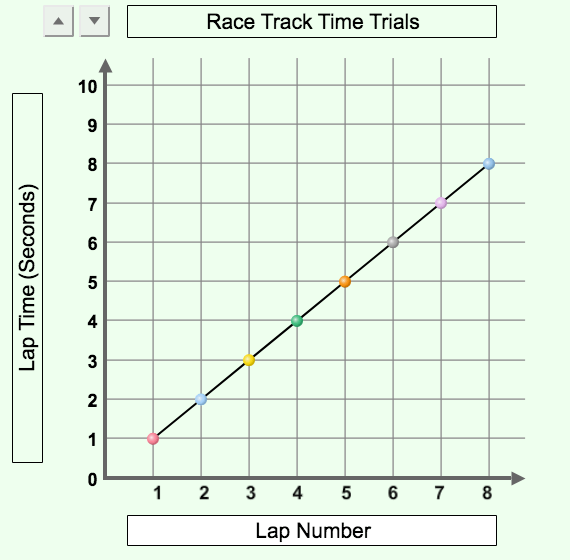
A car is timed around a race track for 8 laps. The laps are numbered in order. Look at the relationship between Lap Number and Lap Time (seconds).


What type of relationship is this?

a)

Direct

b)

Inverse

c)

Diagonal

d)

Horizontal

86.

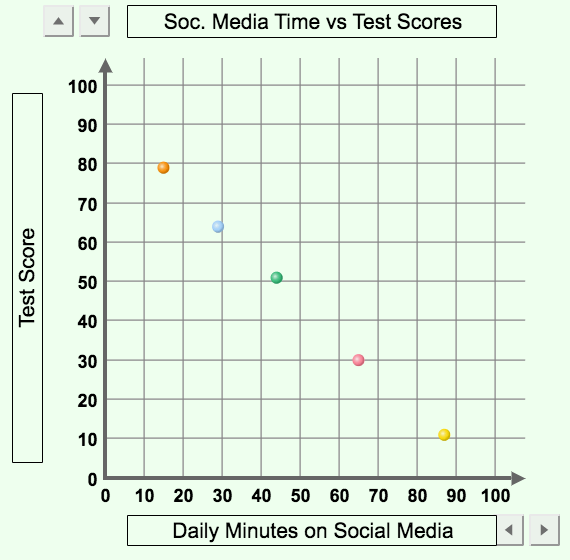
Look at the relationship between time spent on social media, and school test performance.


What type of relationship is being displayed?

a)

Direct

b)

Inverse

c)

Diagonal

d)

Quadrant

87.
Independent variable is located on which axis?
a)
x-axis
b)
y-axis
88.

The variable that the experimenter (or you) control is the ___ variable.

a)

Independent

b)

Dependent

c)

Constant

d)

Control

89.

Which variable always goes on the y-axis (vertical)?

a)

Independent

b)

Dependent

c)

Constant

d)

Control

90.

When one variable on a graph INCREASES and the other variable also INCREASES, it's called a(n) ____ relationship.

a)

Direct

b)

Indirect

c)

Inverse

d)

Linear

91.

When one variable on a graph INCREASES and the other variable DECREASES, it's called a(n) ____ relationship.

a)

Indirect

b)

Direct

c)

Linear

d)

Negative