wayground logo

Free Printable Worksheets

Font size

S
M
L
XL
Worksheets

Unit 3: History of the Earth (Geology)

Total questions: 60

Worksheet time: 2hrs 30mins

Name
Class
Date
1.

What Era are we currently in?

a)

Paleozoic

b)

Mesozoic

c)

Cenozoic

d)

Triassic

2.

What is the longest unit of time?

a)

Eon

b)

Era

c)

Period

d)

Epoch

3.

Which Era was dominated by dinosaurs?

a)

Paleozoic

b)

Mesozoic

c)

Cenozoic

d)

Cambrian

4.

Which segment of time is the smallest?

a)

Eon

b)

Era

c)

Period

d)

Epoch

5.

Which era is the first era represented with fossils?

a)

Paleozoic

b)

Mesozoic

c)

Cenozoic

6.
What era was the age of fish?
a)
Precambrian
b)
Palezoic
c)
Mesozoic
d)
Cenozoic
7.
What type of rock do fossils form in?
a)
Igneous
b)
Sedimentary
c)
Metamorphic
d)
Classic
8.
An event in time when large amounts of animals and plants die off
a)
geologic time
b)
precambrian
c)
period
d)
mass extinction
9.
What is the Cenozoic Era also known as ?
a)
Age of Mammals
b)
Age of Plants
c)
Age of Cenozoic 
d)
Age of Birds 
10.
How old do Paleontologists believe the Earth is?
a)
2015 years old
b)
3.6 billion years old
c)
4.6 billion years old
d)
4.6 million years old
11.
The Geologic Time Scale is a record of what?
a)
old geologists
b)
sweet geology music
c)
the known history of rocks and fossils
d)
a list of every living thing ever
12.
A scientist who studies fossils is called a what?
a)
Fossilologist
b)
Rock Hound
c)
Archeologist
d)
Paleontologist
13.

Which rock layer is the youngest?

a)

A

b)

B

c)

C

14.

Which rock layer is the oldest?

a)

A

b)

C

c)

D

d)

F

15.

What do scientists think may have caused dinosaurs to become extinct?

a)

competition between animals

b)

climate change due to the asteroid hitting earth

c)

disappearance of prey

d)

competition from mammals

16.

What type of event usually marks the end of an Era

a)

A Mass Extinction

b)

A Quinceanera

c)

An earthquake

d)

A Volcanic Eruption

17.

Fossil lived the longest?

a)

plant

b)

Trilobite

c)

Ammonite

d)

bird

18.

Which era ended in the largest mass extinction on the time scale?

a)

Paleozoic

b)

Mesozoic

c)

Cenozoic

19.

The ________ strata is the oldest.

a)

top

b)

middle

c)

bottom

20.

Small particles of soil are called _______.

a)

layers

b)

fossils

c)

strata

d)

sediment

21.

It is made in layers. It is _____ rock.

a)

sedimentary

b)

volcanic

c)

metamorphic

22.

It has strata. It is _____ rock.

a)

sedimentary

b)

volcanic

c)

metamorphic

23.

What is this?

a)

bone

b)

metamorphic rock

c)

fossil

d)

volcanic rock

24.
Subdivision of an Era
a)
Era 
b)
Eon 
c)
Period 
d)
Epock
25.
Subdivision of an eon (Paleozoic, Mesozoic, Cenozoic)
a)
Era 
b)
Period
c)
Epoch 
d)
Eon 
26.
Method of determining the age based on measuring radioactive elements (radiometric) 
a)
Radioactive Dating 
b)
Relative Age 
c)
Index Fossil 
d)
Law of Superposition 
27.
Determination of the age of a rock based on the surrounding evidence 
a)
Radioactive Dating 
b)
Relative Age 
c)
Trace Fossil 
d)
Carbonized Fossil 
28.
A common fossil found in many areas from a specific time; used to help identify the age of other formations. 
a)
Trace Fossil 
b)
Mold Fossil 
c)
Cast Fossil 
d)
Index Fossil 
29.
States that younger rock is found above older rock when comparing undisturbed sedimentary rock layers. 
a)
Law of Thermodynamics 
b)
Law of Gravity 
c)
Law of Superposition 
d)
Murphy's Law
30.
A fossilized piece of evidence of an organism's activity ( such as a footprint)
a)
Mold Fossil 
b)
Trace Fossil
c)
Cast Fossil 
d)
Preserved Fossil
31.

Which era is known as the "age of reptiles (dinosaurs)"

a)

Paleozoic Era

b)

Cenozoic Era

c)

Mesozoic Era

d)

Precambrian Era

32.

during Precambrian time, the only living things were?

a)

Dinosaur.

b)

Humans

c)

Single-celled organisms.

33.
About how much of Earth's history is made up of the Precambrian time?
a)
 88% 
b)
12%
c)
2%
d)
50%
34.
Cyanobacteria created this gas during the Precambrian Era.
a)
Carbon Dioxide
b)
Hydrogen
c)
Nitrogen
d)
Oxygen
35.
Where did life originally form?
a)
land
b)
oceans
c)
atmosphere
d)
center of Earth
36.
Where did the water on Earth come from?
a)
volcanoes and comets
b)
cellular respiration
c)
photosynthesis
37.
What event formed the original ancient atmosphere?
a)
photosynthesis
b)
outgassing by volcanoes 
c)
cellular respiration 
d)
meteorite collisions
38.
The earth and moon were formed during which of the following eons?
a)
Proterozoic
b)
Hadean
c)
Archean
d)
Phanerozoic
39.

What was the earth like during PreCambrian time?

a)

tropical climate with warm shallow seas

b)

vegetation and tectonic movement

c)

cooler temperatures because of nuclear winter

d)

intense volcanic activity, very warm temperatures

40.
The moon probably formed when...
a)
A piece of the Earth broke off due to it's fast rotation
b)
A Mars-sized object rammed into the Earth
c)
Earth captured the moon gravitationally as it attempted to pass by.
d)
the molten bubble of the Earth budded.
41.
How does the law of crosscutting explain the age of a fault?
a)
The fault is younger than the rocks above it.
b)
The fault is younger than the rocks it cuts through.
c)
The fault is older than the rocks above it.
d)
The fault is older than the rocks it cuts through.
42.
Which of the following is the oldest?
a)
Layer L
b)
Intrusion D
c)
Intrusion H
d)
Layer E
43.
The rock formation labeled "P" is a(n)...
a)
fault
b)
intrusion
c)
inclusion
d)
unconformity
44.

What rock in the Oldest?

a)

Conglomerate

b)

Shale

c)

Breccia

d)

Sandstone

45.

What is the last event to happen?

a)

Deposition of Breccia

b)

Igneous Intrusion

c)

Faulting

d)

Deposition of Limestone

46.
Which rock layer in the diagram seems to be the oldest?
a)
F
b)
E
c)
B
d)
A
47.
Which of the following correctly lists the layers in order from oldest to youngest?
a)
A, B, C, D, E
b)
E, B, C, D, A
c)
E, D, C, B, A
d)
C, B, A, D, E
48.

Which layer is OLDER? Layer M or Intrusion P?

a)

Layer M

b)

Intrusion P

49.

Which layer is OLDER? Fault E or Intrusion D?

a)

Fault E

b)

Intrusion D

50.

Which layer is OLDER? Intrusion M or Layer D?

a)

Intrusion M

b)

Layer D

51.
The length of time required for half of the radioactive atoms in a sample to decay is its...
a)
era
b)
age
c)
half-life
d)
eon
52.
What element is usually used to date fossils?
a)
uranium-235
b)
carbon-14
c)
mercury-203
d)
thorium-234
53.
The original element that undergoes radioactive decay is known as the...
a)
daughter element
b)
half-life
c)
parent element
d)
carbon-14
54.
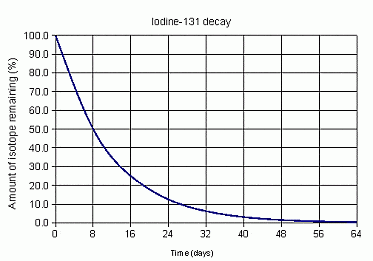
If 10 mg of iodine 131 is given to a patient, how much is left after 24 days? The half-life of iodine-131 is 8 days.
a)
1.25mg
b)
1.25g
c)
10g
d)
10mg
55.
The half-life of strontium-90 is 25 years. How much strontium-90 will remain after 100 years if the initial amount is 4.0 g?
a)
3.0g
b)
0.25mg
c)
0.3g
d)
0.25g
56.
What is the half-life of iodine-131?
a)
32 days
b)
8 days
c)
16 days
d)
24 days
57.

The % of the parent isotope remaining after 2 Half Lives.

a)

50%

b)

25%

c)

12.5%

d)

6.25%

58.

What type of absolute dating is based on the amount of sediment put down?

a)

Rate of Deposition

b)

Rate of Erosion

c)

Varve Count

d)

Radiometric Dating

59.

The following make up the 3 periods of the mesozoic era:

a)

Triassic

b)

Jurassic

c)

Cretaceous

d)

Permian

60.

Which of the following shows the periods of the Paleozoic era, in order from oldest to youngest?

a)

Cambrian, Ordovician, Silurian, Devonian, Carboniferous, Permian

b)

Carboniferous, Cambrian, Silurian, Ordovidian

c)

Silurian, Devonian, Permian, Ordovidian, Cambrian

d)

Permian, Carboniferous, Devonian, Silurian, Ordovician, Cambrian