
 Worksheets
Wave and Optics Exam Part 1
Total questions: 100
Worksheet time: 50mins
What is the SI unit for Frequency?
1/sec
meters
Joules
Hertz
What does the frequency of a wave determine?
The pitch of a sound
how loud the sound is
how fast the sound travels
the magnitude of the compression
When waves come together to for a larger wave for a brief period of time
additive waves
constructive waves
subtractive waves
destructive waves
When a wave bounces off the surface of something it can not pass through
diffraction
reflection
refraction
interference

When an object looks bent when it goes from one medium to another, it is called ..
refraction
diffraction
reflection
interference
Sound travels fast in ..
warmer temperatures
colder temperatures
solids and liquids
gasses
What is the sound range that humans can hear?
audible
supersonic
ultrasonic
echolocation

What color has the longest wavelength?
orange
green
purple
blue

What letter represents a crest?
A
B
C
D

What letter represents a wave amplitude?
A
B
C
D
Which wave represents a longitudinal wave?


What type of image does a flat mirror show?
same size, virtual image
smaller, real image
smaller, virtual image
larger, real image
Do we measure the angle of incidence from the normal, or from the mirror?
The mirror
the normal
What does a convex lens produce?
both real and virtual, both upright and inverted images
virtual, upright images
real and inverted images
real and upright imaes
What does a convex mirror produce?
virtual upright images
real, upright images
virtual, inverted images
real, inverted images
What is the law of reflection state?
An angle bounces off at the same angle it hits at
an angle bounces off 30 degrees different from where it hits
An angle does not bounce off of anything


The height of a wave from the undisturbed state is called
frequency
amplitude
period
crest
Which type of light has the shortest wavelength?
Radio
Gamma
Infrared
Visible
The index of refraction is wavelength dependent.
True
False

Which type of lens is this?
concave
convex
opaque
plano

Which type of lens is this?
concave
convex
opaque
plano
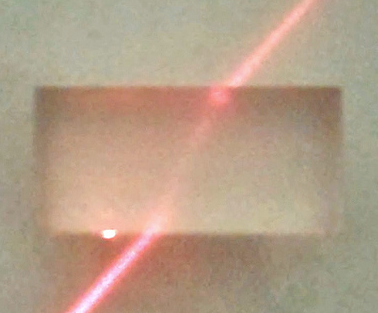
this is an example of
refraction
diffraction
infraction
reflection
What does a convex lens do to a light ray?
diverges
converges
implodes
merges

What type of image does this lens form?
Virtual image
Real Image
No Image
real and virtual

In what type of wave do the particles in the medium move PERPENDICULAR to the wave itself?
Longitudinal Wave
Transverse Wave
Sound Waves
Gravitational Waves
Which of the following is an example of a physical (aka mechanical) wave?
Sound Waves
X-Rays
radio waves
gravitational waves

In the diagram, what does the arrow labeled D indicate?
crest
trough
wavelength
amplitude
In the diagram, what does the arrow labeled E indicate?
crest
trough
wavelength
amplitude
In a longitudinal wave, the region in which the particles of the medium are more spread out is called a...
crest
trough
compression
rarefaction
Which of following properties of a wave can NOT be changed by the source because it depends on the medium of the wave?
amplitude
wave speed
frequency
wavelength
If it takes a waves 2.0 s to travel a distance of 10 meters, what is the wave speed?
0.2 m/s
5 m/s
12 m/s
20 m/s
If a wave is traveling at 15 m/s and has a frequency of 5.0 Hz, what is its wavelength?
0.33 m
3 m
20 m
75 m

In the diagram shown, light is traveling toward a mirror and reflecting off of it. The angle labeled as A is known as the...
angle of incidence
angle of reflection
angle of refraction
normal angle
LIGHT IS A FORM OF
SOUND
ENERGY
ILLUSIONS
MOVEMENT
LIGHT WAVES TRAVEL IN...
ZIG ZAG LINES
LOOP-DE-LOOPS
WAVY LINES
STRAIGHT LIGHTS
THE DISTANCE BETWEEN 2 CRESTS OR 2 TROUGHS IS CALLED...
GAP
WAVE SET
BIG OLE GAPS
WAVELENGTHS
LIGHT WAVE LENGTHS AND FREQUENCIES ARE SHOWN ON THE...
ELECTROMAGNETIC SPECTRUM
EVAPORATED WAVE SPECTRUM
ELEVATED FREQUENCY SPECTRUM
ECCENTRIC LENGTH SPECTRUM
WHICH BEHAVIOUR OF LIGHT IS THE REASON WE CAN SEE ANYTHING?
REFLECTION
REFRACTION
ABSORPTION
TRANSMISSION
DOES LIGHT REFLECT MORE OFF OF LIGHT COLOURED OR DARK COLOURED SURFACES
LIGHT COLOURED
DARK COLOURED
TRUE OR FALSE: LIGHT BEHAVES RANDOMLY AND UNPREDICTABLY
TRUE
FALSE


What type of wave does NOT need matter to travel through?
Mechanical
Transverse
Sound
Electromagnetic


A lens that is thinner in the middle than on the outside is called ___.
diverging
concave
convex
achromatic
EM waves can travel through a vacuum at ______
decreasing speed
increasing speed
different speed
same speed
The only visible EM wave to human eyes
infrared
light waves
radio waves
uv rays
Portion of EM spectrum with the shortest wavelength has
low energy
low frequency
high frequency
It is basic to almost all life on Earth.
(a)
It represents energy transfer from the source to the observer.
(a)
The fundamental phenomena in ray (geometric) optics.
(a)
It is is the basis for fiber optics.
(a)
He is the chief architect of the particle theory of light.
(a)
He argued that light might be some sort of a wave motion.
(a)
He provided the first clear demonstration of the wave nature of light.
(a)
He showed that light rays interfere with each other.
(a)
He is known for his contributions to the field of optics and dynamics
(a)
He provided evidence that light rays interfere with one another according to the principle of superposition.
(a)
He asserted that light was a form of high-frequency electromagnetic wave.
(a)
He proposed an explanation of the photoelectric effect that used the idea of quantization.
(a)
It exhibits the characteristics of a wave in some situations and the characteristics of a particle in other situations.
(a)
He tried to measure the speed of light by using two observers separated by about 10 km.
(a)
He used astronomical observations to estimate the speed of light.
(a)
The first successful method for measuring the speed of light by means of a purely terrestrial technique.
(a)
It involves the study of the propagation of light.
(a)
It assumes that a wave moving through a medium travels in a straight line in the direction of its rays.
(a)
It is good for the study of mirrors, lenses, prisms, etc.
(a)
It uses the assumption that light travels in a straight-line path in a uniform medium and changes its direction when it meets the surface of a different medium or if the optical properties of the medium are nonuniform.
(a)

