wayground logo

Free Printable Worksheets

Font size

S
M
L
XL
Worksheets

EES Final Exam Complete Review

Total questions: 115

Worksheet time: 2hrs 55mins

Name
Class
Date
1.
Studies the solid portions of the earth, including volcanoes, earthquakes, and fossils.
a)
Geology
b)
Geography
c)
Cartography
d)
Oceanography
2.
Weather, climate, and the atmosphere are studied in this branch of Earth Science.
a)
Astronomy
b)
Meteorology
c)
Cartography
d)
Geology
3.
This branch studies how humans interact with and impact ecosystems (pollution, population growth, and resource use).
a)
Geology
b)
Ecology
c)
Environmental Science
d)
Oceanography
4.

What is the term given to the study of Earth's oceans and the movement of water?

a)

Environmental Science

b)

Astronomy

c)

Geology

d)

Oceanography

5.

What branch of Earth Science does this picture represent?

a)

Environmental Science

b)

Astronomy

c)

Meteorology

d)

Geology

6.

Which topic would an astronomer study?

a)

pollution

b)

galaxies

c)

mountains

d)

rain

7.

Which topic might an environmental scientist study?

a)

energy resources

b)

mountains

c)

hurricanes

d)

comets

8.

Which topic(s) might an oceanographer study?

a)

tides

b)

clouds

c)

stars

d)

minerals

9.

What is Astronomy?

a)

The study of astrological signs.

b)

The study of Earth.

c)

The study of asteroids.

d)

The study of all physical things beyond Earth.

10.
What branch of Earth Science does this picture represent?
a)
Environomental Science
b)
Meterology
c)
Oceanography
d)
Geology
11.
What branch of Earth Science does this picture represent?
a)
Oceanography
b)
Meteorology 
c)
Geology
d)
Astronomy
12.
What branch of Earth Science does this picture represent?
a)
Oceanography
b)
Meteorology 
c)
Geology
d)
Astronomy
13.
What branch of science does this picture represent?
a)
Oceanography
b)
Meteorology 
c)
Geology
d)
Astronomy
14.
What branch of Earth Science does this picture represent?
a)
Astronomy
b)
Geology
c)
Meteorology
d)
Environmental Science
15.

What is Meteorology?

a)

The study of meteors.

b)

The study of the atmosphere.

c)

The study of rocks.

d)

The study of organisms.

16.

What is Geology?

a)

The study of geography.

b)

The study of rocks.

c)

The study of weather.

d)

The study of the solid Earth.

17.
A _____ is a transfer of energy from one water molecule to the next.
a)
current
b)
wave
c)
breaker
18.
Describe surface currents.
a)
Currents that occur on the surface of the water.
b)
Currents caused by prevailing winds.
c)
Currents caused by water molecules moving in a circular pattern.
d)
Both A & B
19.
What causes waves?
a)
ice and wind
b)
winds and currents
c)
currents and tides
d)
wind and tide changes
20.
What is the lowest point of a wave called?
a)
crest
b)
trough
c)
breaker
d)
peak
21.
At low tide there is _____.
a)
less beach
b)
more water
c)
higher water
d)
more beach
22.
What is a tsunami?
a)
a wave direction
b)
a type of current
c)
a sand particle
d)
a giant sea wave
23.
How are waves, tides, and currents alike?
a)
Always moving, affect the shape of the shoreline
b)
Affect the shape of the shoreline & are caused by wind
c)
Affect the shape of the shoreline & are caused by tsunamis
d)
Always moving & affected by gravity
24.
Surface currents...
a)
occur below the surface of the water.
b)
occur above the surface of the water.
c)
occur on the surface of the water.
d)
All of the above.
25.
What is the highest point of a wave called?
a)
the top
b)
peak
c)
crest
d)
trough
26.
What is the same about density currents and surface currents?
a)
circular flow
b)
caused by temperature
c)
generated by wind
d)
direction is altered by landforms in their path
27.
How are sand particles affected by currents and waves?
a)
They move in a straight line.
b)
They swash and backwash in a zig zag line.
c)
They move in a circular pattern.
d)
They stay in place and aren't affected.
28.
What is the distance from the crest of one wave to the crest of another?
a)
current
b)
peak
c)
wave height
d)
wave length
29.
What is the distance from the trough of the wave to the crest?
a)
peak
b)
wave length
c)
wave height
d)
trough
30.
Density currents are caused by...
a)
density differences caused by temperature & salinity. 
b)
changes in wind directions.
c)
prevailing winds.
31.
Longshore currents flow...
a)
in a zig zag pattern.
b)
parallel to the shoreline.
c)
vertically to the shoreline.
32.

Gravity is a force that pulls objects away from the Earth's surface.

a)

True

b)

False

33.

Earth's gravitational force on objects is directed down.

a)

True

b)

False

34.

The closer to the Earth's surface an object is, the stronger gravity pulls on it.

a)

True

b)

False

35.

Gravity is a force that causes objects to pull towards each other.

a)

True

b)

False

36.

The strength of gravity's pull on an object depends on how fast the object is moving.

a)

True

b)

False

37.

Why does the sun appear brighter and larger than any other star?

a)

It is the smallest star.

b)

It has more gravity than other stars.

c)

It is the largest and brightest star that exists.

d)

It is the closest star to Earth.

38.

The apparent brightness of a star depends on:

a)

Mass

b)

Distance from Earth

c)

Gravitational pull

d)

What color it is

39.

How long does it take Earth to rotate on its axis?

a)

One year

b)

One month

c)

One season

d)

One day

40.

What causes shadows to change throughout the day?

a)

Earth's tilt

b)

Earth's rotation

c)

Earth's revolution

d)

The shadow monster

41.

What is the best definition of apparent motion of objects in one day?

a)

The movement seems to happen because of the Earth's rotation

b)

The movement seems to happen because of Earth's revolution

c)

The objects move because of gravity.

d)

Constellations make objects move.

42.

Which of the following happens because of apparent motion?

a)

A new moon

b)

The moon revolves around the Earth

c)

The Earth revolves around the sun

d)

The sun, moon or stars seem to move across the sky.

43.

What causes seasons?

a)

The Earth's tilt on its axis

b)

The Earth's revolution around the sun

c)

The Earths rotation

d)

A full moon

44.

When it is summer in the Northern Hemisphere, what season is it in the Southern Hemisphere?

a)

Summer

b)

Winter

c)

Spring

d)

Fall

45.

How long does it take for the moon to revolve around the Earth?

a)

One day

b)

One year

c)

One season

d)

One month

46.

In which two ways does the moon move?

a)

It rotates on its axis

b)

It revolves around the Earth

c)

It revolves around the Sun

d)

The moon only has apparent motion.

47.

How many moon phases are there?

a)

10

b)

4

c)

657,823

d)

8

48.

The apparent shape of the moon is how the moon seems to change shape in a pattern that repeats every month.

a)

True

b)

False

49.

What causes us to see different constellations in the night sky at different times of the year?

a)

Earth's revolution

b)

Moon's revolution

c)

Earth's rotation

50.

How do shadows change throughout the day?

a)

They do not change

b)

They change in length

c)

They change in position.

d)

They look different during every season.
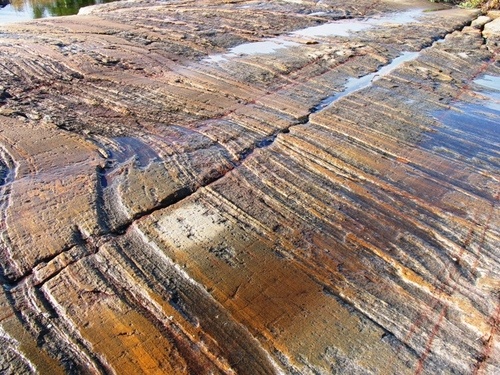
51.
What is this a picture of?
a)
plate tectonics
b)
continental drift
c)
pangea
d)
glacier scaring
52.
This is a picture of glacier scars found in Africa.  What are these evidence for?
a)
Africa has always been near the equator
b)
Africa was once in an area of the Earth that had a very cold climate
c)
The continents have not moved
d)
sea floor spreading
53.
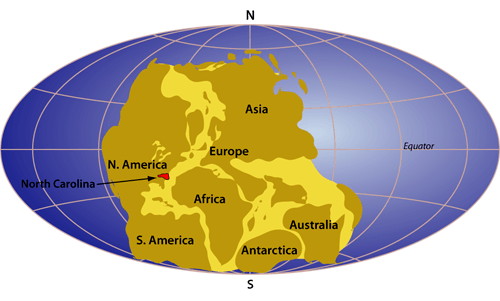
What does the theory of continental drift state?
a)
The continents were once joined in a super-continent and have moved over time
b)
Continents are stationary and do not move
c)
The Earth is broken into lithospheric plates that move due to convection currents
d)
none of the above
54.
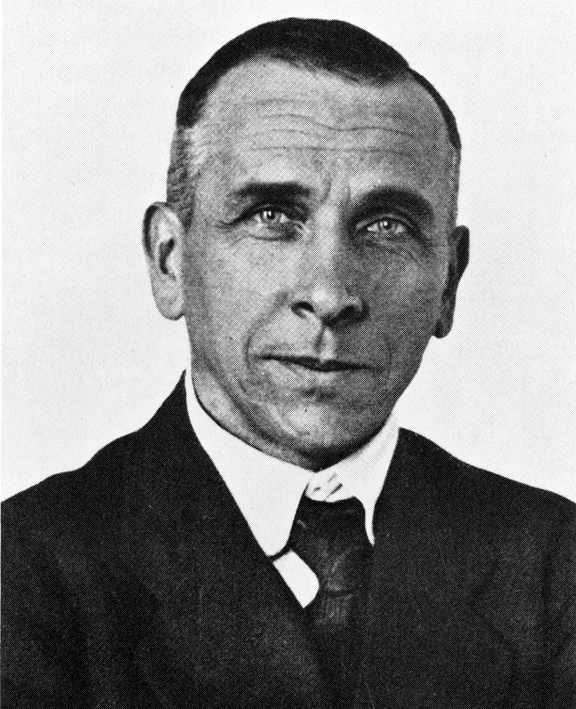
Who is the person credited with developing the theory of continental drift?
a)
Harry Hess
b)
Galileo
c)
Alfred Wegener
d)
Newton
55.

According to Wegener's hypothesis of continental drift,

a)

Earth's surface is made up of seven major landmasses

b)

the continents DO NOT move

c)

Earth is slowly cooling and shrinking

d)

the continents were once joined together in a single landmass, and these plates will continue to move.

56.

According to the continental drift hypothesis, the presence of similar fossils in South America and Africa supports which scientific idea?

a)

Animals easily and frequently travel from Africa to South America.

b)

Species of animals probably traveled between continents on natural rafts (such as trees destroyed in tsunamis).

c)

Land bridges once existed that connected the continents.

d)

South America and Africa were once connected together.

57.

Which of the following best describes Wegener's continental drift ideas?

a)

Hypothesis: There was data to support the idea but more information was needed to build it into a scientific theory.

b)

Theory: It was an early idea of Wegener's but it didn't yet have any evidence to support it.

c)

Theory: It was a well supported idea that explained many things. No additional information was needed (it just needed time for people to accept it).

d)

Hypothesis: It was an educated guess that Wegener made based on maps, but he hadn't yet collected experimental data.

58.

Why did no one believe Wegener's ideas about continental drift? (Choose 2)

a)

He could not successfully explain HOW the continents moved

b)

He didn't have evidence that supported his ideas that the continents had once been connected

c)

They were biased against his ideas because he was German and a meteorologist

d)

He didn't use the right technology to gather data

59.

The Appalachian Mountains in the U.S. match up with a similar mountain ranges in northern Europe. How does this support Wegener's theory of Continental Drift?

a)

The mountains were formed after tectonic plates had moved away from each other

b)

The similarities provide evidence North America & Europe were connected when the mountains formed.

c)

Similar rock samples were found on the ocean floor and at the two mountain ranges indicating that they both formed around the same time.

d)

This evidence does not support the theory of continental drift.

60.

What type of evidence was used by Alfred Wegener to support his continental drift hypothesis? (Select 3)

a)

evidence from landforms / geology

b)

evidence from fossils

c)

evidence from human remains

d)

evidence from climate

61.

What items were found in Antarctica that lead us to believe the climate was once much warmer? (Select 3)

a)

Plant fossils of tropical ferns

b)

Animal fossils of reptiles that live in warm conditions

c)

Coal deposits that formed in tropical swamps

d)

Mammoth fossils preserved in ice

62.

Alfred Wegener used all of the following for evidence of his idea EXCEPT...

a)

The shapes of the continents fitting together like a puzzle

b)

Similar fossils on different continents

c)

Comparable modern weather patterns on different continents

d)

Similar rock formations on different continents

63.
Which of the following correctly lists the steps of the scientific method?
a)
Observe, Experiment, Hypothesize, Analyze, Conclude
b)
Observe, Hypothesize, Analyze, Experiment Conclude
c)
Observe, Hypothesize, Experiment, Analyze, Conclude
d)
Observe, Analyze, Hypothesize, Experiment, Conclude
64.
In which step of the scientific method do you predict an outcome or possible explanation for an observation?
a)
Hypothesize
b)
Experiment
c)
Analyze
d)
Conclude
65.
Which of the following terms refers to factors that remain the same in all groups?
a)
Constants
b)
Dependent variables
c)
Exemplars
d)
Independent variables
66.
Which of the following terms refers to the variable that is measured or recorded as the results of the experiment?
a)
Experimental Controls
b)
Test Controls
c)
Dependent Variable
d)
Independent Variable
67.
Which of the following terms refers to the group that receives no treatment with the independent variable?
a)
Constant group
b)
Control group
c)
Dependent group
d)
Experimental group
68.
Which of the following terms refers to the variable that is manipulated (changed) by the experimenter?
a)
Experimental Controls
b)
Test Controls
c)
Dependent Variable
d)
Independent Variable
69.
This VARIABLE is the 1 FACTOR YOU CHANGE in an experiment. It is what you are testing. It CAUSES something to happen. 
a)
Independent 
b)
Dependent
c)
Control 
d)
Qualitative
70.
What is the INDEPENDENT VARIABLE in this hypothesis?
If a dog is given a bath using DAWN dish soap,  THEN the # of fleas will decrease. 
a)
the dog
QUANTITATIVE
b)
bath in DAWN dish soap
c)
#  of fleas
71.
What is the DEPENDENT VARIABLE in this hypothesis?
If a dog is given a bath using DAWN dish soap,  THEN the # of fleas will decrease. 
a)
the dog
QUANTITATIVE
b)
bath in DAWN dish soap
c)
#  of fleas
72.
What is the DEPENDENT VARIABLE in this hypothesis?
If students get quiet when the bell rings, then the # of detentions will decrease.
a)
the students
   
b)
the bell ringing
c)
# of detentions
73.
What is the relationship between the independent variable and the dependent variable?
a)
As time increase, distance decreases
b)
As time increases, distance increases
c)
As time decreases, distance decreases
d)
As time decreases, distance increases
74.
What would be the best scale for this data?
Days
      Cm
  1            1.0
  2            3.5
  3            5.0
  4            8.5
a)
count by fives to 10
b)
count by tens to 100
c)
count by ones to 5
d)
count by ones to 10
75.
What is the control for the experiment? 
a)
the thing being tested
b)
the normal situation
c)
what we measure in the end
d)
what we change 
76.
What is a constant? 
a)
the normal situation
b)
the thing we measure in the end
c)
the thing we are testing
d)
the thing we keep the same for every part of the experiment
77.
The Independent/Manipulated Variable goes on the ___ axis
a)
x
b)
y
78.
The Dependent/Responding Variable goes on the ___ axis
a)
x
b)
y
79.
Which would go on the y-axis?
a)
Time
b)
# of Bacteria 
80.
Should experiments be repeated over and over to see if the results are the same each time?
a)
yes
b)
no
81.
Mandates the restoration and maintenance of the chemical, physical, and biological integrity of the nation's waters
a)
Safe Drinking Water Act
b)
Clean Water Act
c)
Clean Air Act
d)
Resource Conservation Recovery Act
82.
An undesired change in air, water or soil that adversely affects the health, survival, or activities of humans or other organisms.
a)
Pollution
b)
Loss of Biodiversity
c)
Natural Resource Depletion
83.
A natural resource that is naturally formed much more slowly than we use it is called __________
a)
renewable
b)
nonrenewable
c)
ecological
d)
stustainable
84.
Which of the following is an example of a nonrenewable natural resource?
a)
wind energy
b)
sunlight
c)
natural gas
d)
geothermal energy
85.
A resource that forms at a much slower rate than the rate at which it is consumed
a)
Nonrenewable Resource
b)
Renewable Resource
c)
Biodegradable
d)
Nonbiodegradable
86.
Why do water sources need to be conserved?
a)
We have a limited amount of fresh water.
b)
Pollution reduces the amount of usable water.
c)
Because we need to save it for the whales
d)
Both a and b.
87.
The Clean Air Act is federal law that regulates levels of air pollution produced from
a)
Transportation and factories
b)
Private homes only
c)
Power plants only
d)
Transportation, factories, power plants, and private homes
88.
Air pollution is _________________________
a)
the addition of any substance that has harmful or toxic effects to air
b)
the addition of any good substance that benefits air
c)
a chemical reaction
89.
The Law of Unintended Consequences states that
a)
actions of people and governments have effects that are unanticipated.
b)
everything can always be predicted ahead of time.
c)
things which look good on paper work out well in reality.
d)
disasters can usually be avoided with enough money and time planning.
90.

Solar energy is a ________________ resource.

a)

Nonrenewable

b)

Renewable

91.
What is the correct definition of Environmental Science? 
a)
The study on how humans affect the natural environment. 
b)
The study of how organisms interact with one another. 
c)
The study of the Earth. 
d)
The study of living organisms
92.

Why should we remove an invasive species?

a)

They won't be able to survive in a new environment.

b)

They will eat native species and cause other species to decrease.

c)

We should not remove them and let nature be.

93.

As species go extinct what will happen to the biodiversity in that ecosystem?

a)

Decrease

b)

Increase

c)

Stay the same

94.

Which of these would not be included as part of the environment?

a)

What the soil is made of.

b)

The average temperature, wind, percipitation, and other factors.

c)

Animals and plants in the region and surrounding area.

d)

All of the above.

95.

An example of an inexhaustible resource would be:

a)

Iron Ore

b)

Coal

c)

Sunlight

96.

Which of these events during the modern environmentalism era was the result of a town constructed on a chemical waste dumpsite, and raised awareness of the problem of hazardous waste disposal?

a)

Love Canal

b)

Nuclear Testing in the Marshall Islands

c)

Donora, Pennsylvania smog

97.

Which of the following type of environmental ethics places an emphasis on human interests?

a)

biocentric

b)

anthropocentric

c)

ecocentric

98.

What decision was eventually made regarding Hetch Hetchy?

a)

No dam was constructed.

b)

A dam was constructed somewhere else, but not a National Park.

c)

The Hetch Hetchy dam was built.

d)

The Hetch Hetchy dam was built and later moved.

99.

What is a renewable resource?

a)

A substance of little or none economic value that can be replaced or replenished in less time than it takes to draw the supply down.

b)

A substance of economic value that can NOT be replaced in less time than it takes to draw the supply down.

c)

Natural Gas

d)

A substance of economic value that can be replaced or replenished in less time than it takes to draw the supply down.

100.

Which example best illustrates the point behind the Tragedy of the Commons essay?

a)

Various nations overfishing in international waters, leading to a collapse of fish stocks.

b)

One country declaring war on another.

c)

One farmer that over plants his crops one spring, and has a poor harvest in the fall.

101.
This is the symbol for a... 
a)
Cold Front
b)
Warm Front
c)
Stationary Front
d)
Occluded Front 
102.
This is the symbol for a... 
a)
Occluded Front
b)
Stationary Front
c)
Warm Front
d)
Cold Front 
103.
Identify the type of front that is shown in the image.
a)
Occluded Front
b)
Cold Front
c)
Stationary Front
d)
Warm Front
104.
Identify the type of front that is shown in the image.
a)
Occluded Front
b)
Cold Front
c)
Stationary Front
d)
Warm Front
105.
Identify the type of front that is shown in the image.
a)
Occluded Front 
b)
Cold Front
c)
Stationary Front
d)
Warm Front
106.
Located at the leading edge of a temperature drop off. Bring heavy thunderstorms, rain, and hail. Cool, fair weather is likely to follow.  
a)
Warm Front
b)
Cold Front
c)
Occluded Front
d)
Stationary Front 
107.
Located at the leading edge of a warm air mass. Brings gentle rain or light snow, followed by warmer, milder weather.  
a)
Warm Front
b)
Cold Front 
c)
Occluded Front 
d)
Stationary Front 
108.
Find the IV:  You experiment to find out if you can blow bigger bubbles when it is hot outside or when it is cold outside.
a)
bubble blowing technique
b)
Type of bubble juice
c)
Size of bubbles
d)
Temperature
109.
Find the DV:  You experiment to find out if you can blow bigger bubbles when it is hot outside or when it is cold outside.
a)
bubble blowing technique
b)
Type of bubble juice
c)
Size of bubbles
d)
Temperature
110.
What causes winds to form on Earth?
a)
solar energy
b)
ocean currents
c)
elevation differences
d)
uneven heating of the Earth by the sun
111.
Which statement about Hawaii refers to its climate?
a)
A blizzard occurs on one of Hawaii’s tallest mountain peaks.
b)
A high temperature of 37.8°C was recorded earlier today in Hawaii.
c)
The mountains were shaded by cumulus clouds on a Tuesday afternoon.
d)
The coolest months are February and March.
112.
Which observation describes a change in climate rather than a change in weather?
a)
The thunderstorm dropped about three centimeters of rain today.
b)
The average summer temperatures have increased over the last ten years.
c)
 The snowfall in this area was more this week than it was last week.
d)
The average wind speed in April was less than it was in March.
113.
Two major factors used to identify climate are?
a)
longitude and latitude
b)
temperature and precipitation
c)
lattitude and temperature
d)
layers in the atmosphere
114.
Weather refers to the conditions of Earth’s atmosphere at a particular ____________. 
a)
 Location
b)
Time
c)
Place
d)
 Time and Place
115.
A student states the weather is the same as the climate. Which response BEST tells the student the difference between weather and climate?
a)
Weather is about the wind and the rain, but climate is about the clouds.
b)
Weather is the conditions in one day, but climate is the conditions over a long time.
c)
Weather is measured with tools like thermometers, but climate is measured with tools like forecasts.
d)
Weather is recorded on charts, but climate is recorded on world maps.