wayground logo

Free Printable Worksheets

Font size

S
M
L
XL
Worksheets

IB - Water

Total questions: 77

Worksheet time: 6hrs 25mins

Name
Class
Date
1.
Capillary action is the result of adhesion. Which aspect of water is responsible for this?
a)
Nonpolar covalent bonds that enable water to dissolve other substances
b)
Polar covalent bonds that join molecules of water to other substances
c)
Hydrogen bonds between water and another substance
d)
Ionic bonds that enable electrons to flow through water and into another substance
2.

Which of the following properties of water enables it to move from the roots to the leaves of plants?

a)

Water expands as it freezes.

b)

Water is an excellent solvent.

c)

Water exhibits cohesive and adhesive behavior.

d)

Water moderates temperature.

3.
What property of water allows it to be such a versatile solvent that it is often called the "universal solvent?"
a)
Purity
b)
Polarity and cohesion
c)
High heat capacity
d)
Expansion upon freezing
4.
Large bodies of water do not quickly fluctuate in temperature. Why?
a)
Water is a solvent.
b)
Water has a high heat capacity.
c)
Water acts as a buffer.
d)
Water is non-polar.
5.

Which two elements make up water?

a)

Helium and oxygen

b)

Hydrogen and oxygen

c)

helium and carbon

d)

oxygen and carbon

6.

Attractions between different water molecules is called ....

a)

Covalent bonds

b)

Ionic bonds

c)

Polar bonds

d)

Hydrogen bonds

7.
Water is polar because.....
a)
The unequal sharing of electrons gives the water molecule a slight negative charge near its oxygen atom and a slight positive charge near its hydrogen atoms.
b)
The molecule has two poles, at which the it is colder than other regions of the molecule.
c)
The unequal sharing of electrons gives the water molecule a slight negative charge near its hydrogen atoms and a slight positive charge near its oxygen atom.
d)
The water molecule is neutral.
8.
The fact that ice floats on liquid water is due to the fact that ........
a)
as water freezes, it expands and its density decreases.
b)
as water freezes, it takes up more hydrogen from the atmosphere, causing it to have a greater buoyancy.
c)
as water freezes, air becomes trapped between the hydrogen bonds of water molecules.
d)
as water freezes, it takes up more oxygen from the atmosphere, causing it to have a greater buoyancy.
9.

What is the name given to molecules who's opposite ends have opposite electric charges?

a)

cohesion

b)

polar molecules

c)

hydrogen bond

d)

solution

10.

Molecules will dissolve in water if they are.....

a)

polar and hydrophobic

b)

polar and hydrophilic

c)

non-polar and hydrophobic

d)

non-polar and hydrophilic

11.
A water molecule is a ________ molecule, which has one oxygen that has a __________ charge and two hydrogens that have a ___________ charge.
a)
nonpolar, positive, negative
b)
polar, positive, negative
c)
polar, negative, positive
d)
nonpolar, negative, positive
12.

Sweat cools our bodies down because....

a)

water has a high heat of vaporization which means it absorbs a lot of body heat before it evaporates off the skin.

b)

water has a high heat of vaporization which means it absorbs a lot of body heat before it evaporates off the skin.

c)

sweat contains minerals and salts that absorb heat.

d)

adding water to our skin makes our bodies feel cooler.

13.

Water takes a long time increase in temperature because....

a)

it has a high specific heat capacity due to hydrogen bonding

b)

it has a low latent heat of vaporization due to capillary action

c)

it adheres to the side of the container (pot, beaker, kettle) conducting heat back to the surrounding air

d)

water is a viscous and the energy cannot be dispersed very easily

14.

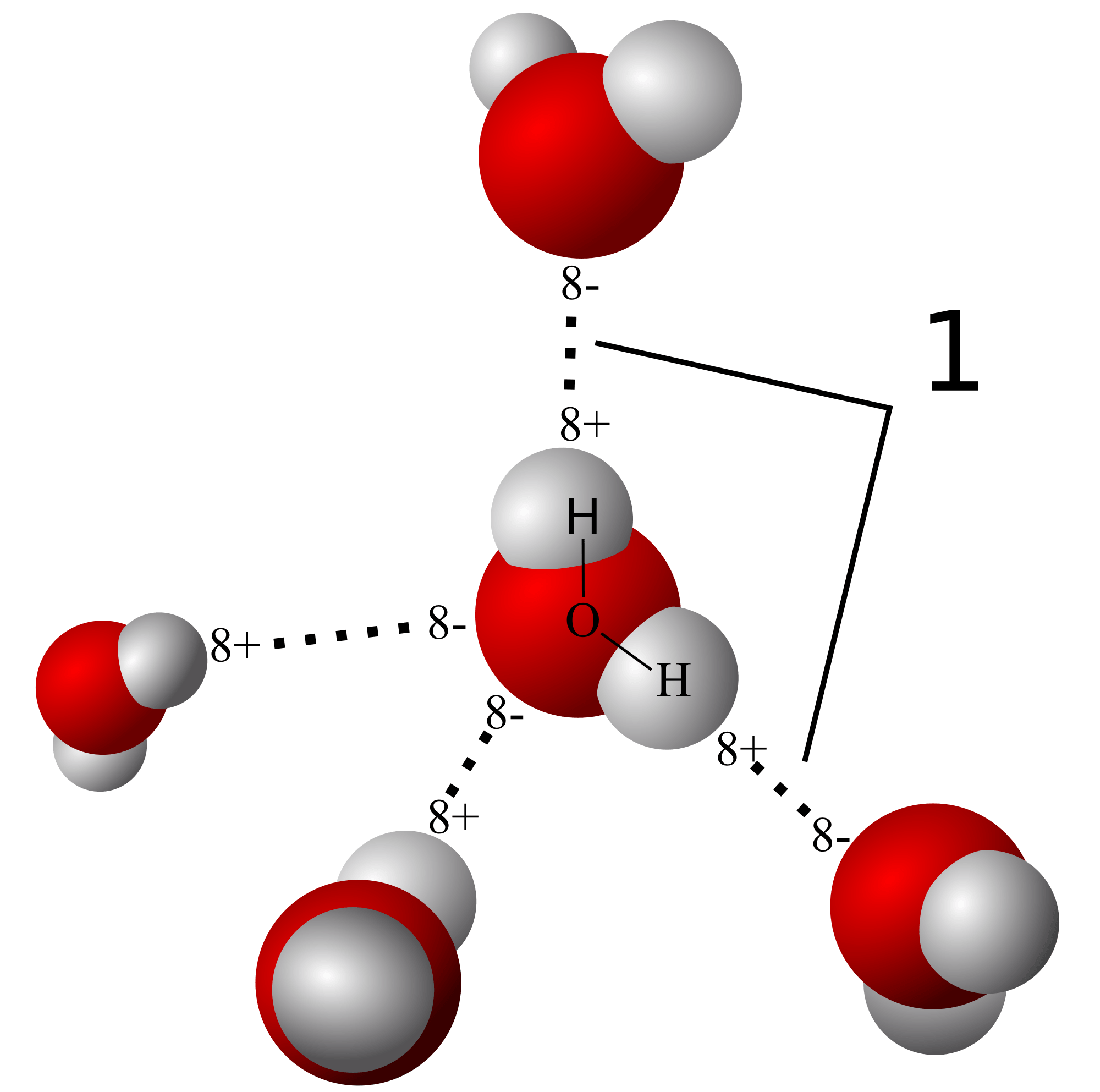
In the water molecule shown, which atoms should be labeled with a partial positive charge?

a)

hydrogens

b)

oxygen

c)

both

d)

neither

15.

Which property of water is shown here?

a)

cohesion

b)

adhesion

c)

thermal

d)

solvent

16.

Which option shows the correct dipoles?

a)

O = δ+ / H = δ-

b)

O = δ- / H = δ+

c)

O = δ+ / H = δ+

d)

O = δ- / H = δ-

17.
Water is a universal solvent because it...
a)
It can be found anywhere
b)
It freezes when it gets cold
c)
floats when frozen
d)
Dissolves most substances
18.
True or false, water is a polar molecule? 
a)
True 
b)
False 
19.
Which is NOT a property of water that helps or bodies function properly?
a)
Water is a natural antibiotic substance
b)
Water dissolves many substances
c)
Water cools when it evaporates
d)
Water can hold heat (maintain temperature)
20.
Water dissolves ionic compounds, like NaCl, because water molecules...
a)
are non polar
b)
have a pH value of 14
c)
Have partially charged ends that interact with ions
d)
do not contain atoms
21.
What property of water is being shown?
a)
polarity
b)
hydrogen bonds
c)
surface tension
d)
capillary action
22.
What property of water is being shown?
a)
cohesion
b)
hydrogen bonds
c)
adhesion
d)
polarity
23.
Pure water has a
a)
Neutral pH 
b)
Negative pH
c)
Positive pH
d)
Both Negative and Positive pH
24.
Which of the following is LEAST likely to dissolve in water?
a)
nonpolar fats and oils
b)
polar sugar molecules
c)
salt made of a positive sodium ion and a negative chloride ion
d)
all of the substances will dissolve easily in water
25.
Which types of compounds dissolve easily in water?
a)
Polar and Nonpolar
b)
Polar and Ionic
c)
Nonpolar and Ionic
d)
Covalent and Nonpolar
26.

You body sweats to help prevent you from overheating. How does water regulate temperature?

a)

it lets heat pass through it

b)

it absorbs a lot of heat, then decreases in temperature

c)

it absorbs a lot of heat, but only increases a little in temperature

d)

heat is afraid of water and avoids it

27.

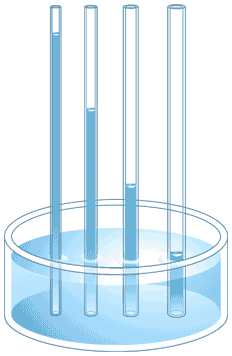
What is the term for water's ability to defy gravity and climb up a tube?

a)

Capillary Action

b)

Specific Heat

c)

Universal Solvent

d)

Magic

28.

A water strider can skate along the top of a pond because:

a)

covalent bonds result in water cohesion (surface tension)

b)

hydrogen bonds result in water cohesion (surface tension)

c)

water striders have adapted to take advantage of water cohesion

d)

water striders are afraid of water and avoid it

29.
Water has a much higher specific heat than most other covalent compounds. What do you predict might happen if water had a low specific heat instead?
a)
Flooding would occur and animals would be forced to migrate
b)
 Harmful organisms living in water would reproduce at a rapid rate
c)
Organisms that are sensitive to changes in temperature would die
d)
Plants would not have enough water to effectively carry out photosynthesis
30.

Hydrophobic molecules will dissolve in water.

a)

True

b)

False

31.
The tightness across the surface of water that enables paper clips to float is ____________.
a)
adhesion
b)
capillary action
c)
surface tension
d)
polarity
32.
The fact that ice floats on liquid water is due to the fact that water's solid is ___________ than it's liquid form
a)
less polar
b)
more polar
c)
less dense
d)
more dense
33.
 Small insects can walk across the surface of calm water. Their feet push the surface of the water down slightly, somewhat like a person walking across a trampoline, but they do not break the surface. What is the best explanation for why this happens?
a)
The insects are light enough so that they do not break the hydrogen bonds holding the water molecules together
b)
The insects actually use their wings to hover slightly above the water's surface and they only skim it with their feet
c)
The insects' feet are non-polar, so they are repelled by the polar water molecules and are pushed away from the water's surface
d)
The insects are small enough to see the individual water molecules, so they are able to step carefully from one molecule to the next
34.
When water molecules stick easily to other water molecules, this is called what?
a)
cohesion
b)
adhesion
c)
solution
d)
polar molecule
35.

What property of water causes these Alka-Seltzer tablets to dissolve?

a)

Universal Solvent

b)

Expansion Upon Freezing

c)

Cohesive Behavior

d)

High Specific Heat

36.

Sweating is an example of what property of water?

a)

Ability to Moderate Temperature

b)

Expansion Upon Freezing

c)

Cohesive Behavior

d)

Universal Solvent

37.

Why does water move from the roots to the leaves of plants?

a)

Water is pushed by solutes

b)

Water is pulled by gravity

c)

Capillary action pulls the water molecules like a chain

d)

Water's cohesion causes it to "pull" towards the leaves

38.

Why does ice stay at the top of oceans instead of sinking to the bottom? 

a)

Ice is colder than liquid water

b)

Ice is less dense than liquid water

c)

Ice is more dense than liquid water

d)

Ice is warmer than liquid water

39.

Water has an unusually high specific heat. What does this mean?

a)

At its boiling point, water changes from liquid to vapor.

b)

A large amount of heat is required to raise the temperature of water.

c)

Ice floats in liquid water.

d)

Salt water freezes at a lower temperature than pure water.

e)

Floating ice can insulate bodies of water.

40.

What property of water allows for water to act as a temperature regulator for the world?

a)

Cohesive Behavior

b)

Expansion Upon Freezing

c)

High Specific Heat

d)

Universal Solvent

41.
Why does water move from the roots to the leaves of plants?
a)
Water is pushed by solutes
b)
Capillary action pulls the water molecules like a chain
c)
Water is pulled by gravity
d)
Water’s cohesion causes it to “pull” towards the leaves
42.

Capillary action is....

a)

adhesion

b)

cohesion

c)

change in matter (heat of fusion)

d)

both adhesion and cohesion

43.
What property of water allows it to be such a versatile solvent that it is often called the "universal solvent?"
a)
Purity
b)

Polarity

c)
High heat capacity
d)
Expansion upon freezing
44.
Water is polar because...
a)
The unequal sharing of electrons gives the water molecule a slight negative charge near its oxygen atom and a slight positive charge near its hydrogen atoms.
b)
The molecule has two poles, at which the it is colder than other regions of the molecule.
c)
The unequal sharing of electrons gives the water molecule a slight negative charge near its hydrogen atoms and a slight positive charge near its oxygen atom.
d)
The water molecule is neutral.
45.
Which of the following is LEAST likely to dissolve in water?
a)
nonpolar fats and oils
b)
polar sugar molecules
c)
salt made of a positive sodium ion and a negative chloride ion
d)
all of the substances will dissolve easily in water
46.

Water has __ specific heat. It can absorb a lot of energy without increasing its own temperature. This is why water takes so long to boil.

a)

high

b)

low

c)

medium

d)

no

47.

We do not want our body temperature to fluctuate very much because it would alter chemical reactions (metabolism). When metabolism is thrown off, homeostasis (balance) is also thrown off. This can lead to death.

Is this statement true or false?

a)

True

b)

False

48.

What charge does oxygen have in water?

a)

neutral

b)

positive

c)

negative

d)

both positive and negative

49.

What charge does hydrogen have in water?

a)

negative

b)

neutral

c)

positive

d)

no charge

50.

Water is.. Select all that apply

a)

Universal Solvent

b)

Has High Specific Heat to regulate temperature

c)

Comes in three states

d)

Is polar

51.

In a water molecule, hydrogen and oxygen are bonded together by ___________.

a)

covalent bond

b)

ionic bond

c)

hydrogen bond

d)

static

52.

Which property of water accounts for the others?

a)

cohesion

b)

adhesion

c)

polarity

d)

high specific heat

53.

Trees must pull water up their trunks from the roots. What property of water allows trees to pull against gravity?

a)

cohesion

b)

adhesion

c)

universal solvent

d)

high specific heat

54.

Oceans do not freeze in winter due to which property of water?

a)

cohesion

b)

adhesion

c)

universal solvent

d)

high specific heat

55.

When adding sugar to water,

a)

Water is the solute, sugar is the solvent, together they are a mixture

b)

Water is the solution, sugar is the solute, together they are a solution

c)

Water is the solvent, sugar is the solute, together they are a solution

d)

Water is the mixture, sugar is the solution, together they are a solvent

56.
Attractions between the negative Oxygen atom of one water molecule and the positive Hydrogen atom of another water molecule are called
a)
Covalent bonds
b)
Ionic bonds
c)
Polar bonds
d)
Hydrogen bonds
57.
The tightness across the surface of water that enables paper clips to float is ____________.
a)
adhesion
b)
capillary action
c)
surface tension
d)
polarity
58.
Water beads up on the surface of a penny because of what property?
a)
Adhesion
b)
High Surface Tension
c)
Universal Solvent
d)
Changes in Density
59.

Atoms in molecules share pairs of electrons when they form

a)

covalent bonds.

b)

ionic bonds.

c)

hydrogen bonds.

d)

polymers.

60.
What is the main reason why water is not desalinated?
a)
don't know how
b)
too expensive
c)
difficult to transport
d)
inaccessible
61.
Why is water the most important substance on the planet?
a)
It Dilutes
b)
Drives Climate
c)
Sustains Life
d)
It's Pretty
62.

What type of bond forms between the negative pole of one water molecule and the positive pole of another?

(a)  

63.

Identify the property of water that means that many substances can dissolve in it

a)

High specific heat capacity

b)

High latent heat of vapourization

c)

Solvent

d)

Adhesion

64.

The oxygen pole of a water molecule has which of the following charges?

a)

Positive

b)

Neutral

c)

Negative

65.

Which type of molecules are attracted to water?

a)

Non polar

b)

Hydrophobic

c)

Amphipathic

d)

Polar

66.

Which vessels in plants transport long unbroken columns of water upwards under tension?

a)

Xylem

b)

Phloem

c)

Cambium

d)

Veins

67.

What is a polar covalent bond.

a)

An ionic bond in which electrons are not shared equally.

b)

A covalent bond in which electrons are not shared equally within a molecule

c)

A covalent bond where protons are not shared equally within a molecule

d)

An ionic bond where protons are not shared equally within a water molecule.

68.

Capillary Action

a)

Tendency of a liquid in a tube to decrease

b)

Tendency of a solid to dissolve

c)

Tendency of a gas to condense

d)

the tendency of a liquid in a tube to rise

69.

hydrophobic

a)

water absorption

b)

Water evaporating

c)

Water fearing

d)

Water saturation

70.

hydrophilic

a)

Repelled by water

b)

Attracted to water

c)

on top of water

d)

anti water

71.

Hydrogen bond

a)

weak attraction between two molecules (ex: water to water) that is formed due to positive and negative charges attracting

b)

Strong attraction between two molecules.

c)

Weak attraction between two molecules that is formed due to charges repelling.

d)

Strong attraction due to repelling of charges.

72.
Pure water has a
a)
Neutral pH 
b)
Negative pH
c)
Positive pH
d)
Both Negative and Positive pH
73.
TRUE or FALSE. Many people on Earth do not have accces to clean water.
a)
TRUE
b)
FALSE
74.

What are the main sources of water pollution?

a)

Plastic, Paper, and Metal

b)

Snails in water

c)

Help, there is a boot with a snake inside of it that somehow in the nearby lake.

d)

Agriculture, Industry, and Community

75.

Some communities have banned detergents containing high levels of phosphates because

a)

phosphates cause chemical reactions that raise temperature of rivers, waters, and lakes.

b)

phosphates are not efficient cleaners

c)

excessive phosphates in lakes may begin a process that cause fish to suffocate and die

76.

sources of ocean pollution include

a)

oil spills

b)

direct dumping of wastewater

c)

activities on land

d)

all the above

77.

One reason polluted ground water pollution is difficult to clean that

a)

location of underground storage tanks is not always known

b)

pollutants cling to the materials that make up aquifers

c)

runoff contaminates the water supply

d)

all the above