
 Worksheets
PS U2.2 Forces #1
Total questions: 124
Worksheet time: 2hrs 56mins
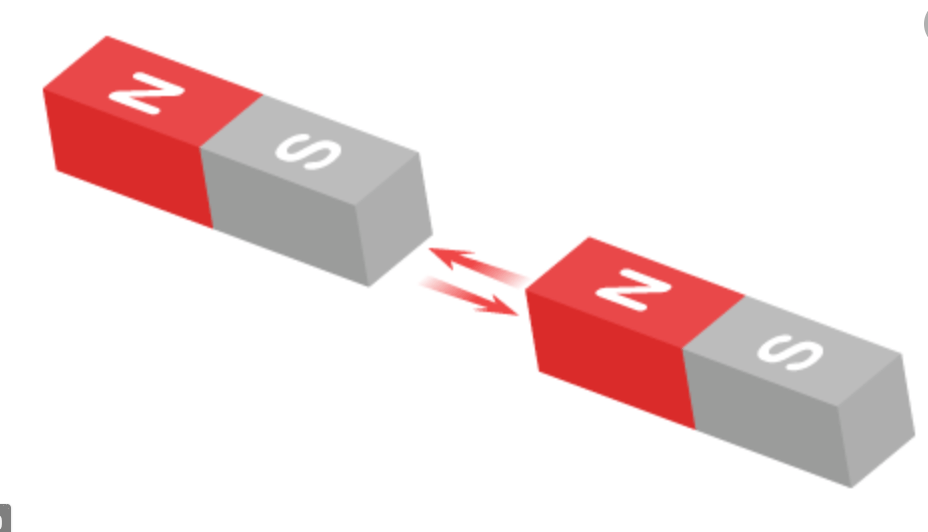
What is happening in the picture?
gravity
repulsion
pushing
attraction

A ball falling back to the ground is an example of which force?
magnetism
gravity
electricity
attraction

What type of force is this man using to push his grocery cart?
Normal Force
Gravity
Air Resistance
Applied Force
What is the unit to MEASURE force?
Kilogram
Meter
Pounds
Newton

A ____________ is a push or a pull on an object.
friction
force
magnet
gravity

What is the force that causes objects to fall to Earth?
Friction
Gravity
Magnetism
Pressure
What is air resistance?
A type of force
A type of friction
A type of magnet
A type of truck
Gravity and friction are two types of
inertia
masses
speed
forces
Match the description to the graph:
"The car is stopped."


Match the description to the graph:
"The car is coming back."

Segment A-B The bus is _________________.
at rest
returning (to original position)
moving forward

Which runner won the race?
Albert
Bob
Charlie
Which runner stopped for a rest?
Albert
Bob
Charlie
How long did Charlie stop for a rest?
2.5 seconds
2 seconds
3 seconds
5 seconds

What does the slope of a position-time graph represent?
Distance
Displacement
Velocity
Acceleration

What is the starting point of the object?
2 m
4 m
10 m
20 m
What is the unit for velocity?
m
s
m/s
m/s/s
What is the unit for position?
m
s
m/s
m/s/s
What is the unit for time?
m
s
m/s
m/s/s
A unit of mass in the metric system is the:
centimeter
gram
liter
ounce
The SI unit for volume is the __________.
meter
kilogram
liter
second
Newton
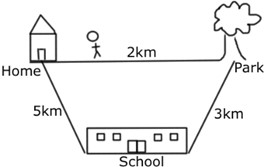
Jerry walked from home to school, then from the school to the park. What is his total distance?
2 km
5 km
8 km
10 km

From the figure, what is the displacement?
20 meters
25 meters
15 meters
25 meters NE

What is the Overall Net Force and which side has a greater Net Force?
12, Right
0, Both are balanced
12, Both are balanced
0, Left
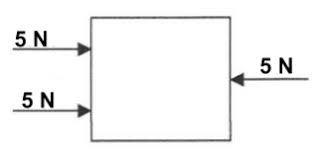
Is the Net Force balanced or Unbalanced?
Balanced
Unbalanced

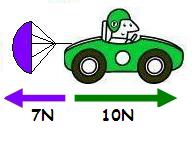
What is the net force?
3 N
3 N, right
17 N, right
3 N, left


The net force (Fnet) acting on the object is (a) N.
Velocity has both _____ and _____.
mass and direction
speed and acceleration
speed and direction

The net force acting on the block is (a) N.

What is the resultant/ net force?
30 N left
25 N right
5 N left
55 N right

What is the resultant/ net force?
400 N Up
400 N Down
- 400 N Down
800 N Down

Student A is pushing at 63 newtons, and student B is pushing at 56 newtons. What is the net force (calculation).
119 N Right
7
7 N Right
119

What is the net force (calculation).
5 N Right
19 N Left
13 N Right
13 N Left

Mrs. Jones is pulling a rope at 73 newtons, and a student is pulling a rope at 47 newtons. What is the net force (calculation).
26
120 N Left
26 N Left
120


What is the horizontal net force acting on this object?
35 N
50 N
-5 N
5 N


Which one of Newton's laws are displayed
2nd law
1st law
3rd law

Which of Newton's laws is shown
1st law
3rd law
2nd law

This is Newton's 3rd law
True
False
What is another name for Newton’s 1st law?
Law of Inertia
Law of Acceleration
Law of Action/Reaction
Your car has a mass of 2500 kg and a force of 5000 N. How fast will it accelerate?
1 m/s2
2 m/s2
3 m/s2
4 m/s2
What is the force of a baseball that has a mass of 142 kg and has an acceleration of 30 m/s2?
1 N
2 N
4260 N
3 N
Objects with greater _________ also have greater inertia.
speed
mass
force
friction
Which one has the LEAST inertia?


Which of these has the MOST inertia?


Which character would have the LEAST inertia?


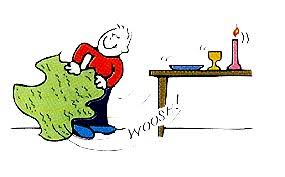
Which explains why the tablecloth trick works?
The dishes are stuck in place due to air resistance.
The tablecloth is an ilusion.
The dishes have inertia, and therefore stay on the table.
magic
Objects with MORE mass have...
MORE inertia
LESS inertia
the SAME amount of intertia
A 20 kg bike accelerates at 10 m/s2. What was the force?
25 Newtons
20 Newtons
200 Newtons
10 Newtons

What is the net force?
40 N left
400 N right
0 N Balanced
40 N right
Jenny applies a 60 N force to a 20 Kg cart, what is the acceleration of the cart if friction can be neglected?
1200 m/s/s
0.33 m/s/s
20 m/s/s
3 m/s/s
The mass of a wagon is 40 kg. The wagon accelerates at 8 m/s2 . What is the force?
38.25 Kg
320N
5N
3.825Kg
If an object was accelerating at 10 m/s2, and a force of 10 newtons was required to accelerate it, what was the object's mass?
1kg
10kg
5kg
2kg
You push on a tree with 20 N of force. If the tree doesn't move, the tree is pushing back on you with _____of force.
20N
10N
40N
70N
(Use Fnet=ma), A 10 kg bowling ball would require what force to accelerate down an alleyway at a rate of 3 m/s2?
30 N
13 N
3.3 N
0.3 N
(Use Fnet=ma). What is the mass of a falling rock if it produces a force of 147 N? (Acceleration due to gravity = 9.8 m/s2)
15 kg
1,440.6 kg
156.8 kg
137.2 kg

(Use Fnet=ma). Use the diagram to determine the net force, assume the object is accelerating at a rate of 3 m/s2, and determine the object's mass?
3 kg
5 kg
60 kg
75 kg

(Use Fnet=ma). Use the diagram to determine the net force, assume the object is accelerating at a rate of 2 m/s2. What amount of mass does the object have?
2 kg
4 kg
6 kg
8 kg

If the mass of the car/man/parachute is 150 kg, what is their acceleration?
0.02 m/s2
50 m/s2
0.11 m/s2
8.82 m/s2

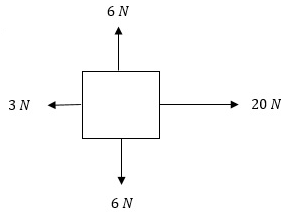
What is the NET FORCE of this diagram?
17 N, right
17 N, left
23 N, right
12 N, up
A crayon has a mass of 10.0 g and volume of 5.0 mL. What is the density?
30 g/mL
15 g/mL
1.0 g/mL
2.o g/mL
A block of aluminum occupies a volume of 15 mL and has a mass of 40.5 g. What is its density?
.37 g/mL
605.5 g/mL
2.7 g/mL
25.5 g/mL

Jack has a rock. The rock has a mass of 14g and a volume of 2cm3. What is the density of the rock?
7 mL
7 g/cm3
28 g/cm3
1/7 g/cm3
A. gasoline 0.7 g/ cm3
B. lead 11.3 g/ cm3
C. mercury 13.6 g/ cm3
D. Paraffin(wax) 0.87 g/ cm3
E. platinum 21.4 g/ cm3
Which will not sink in water?
A & B
C & E
B & C
A & D

Find the momentum of a 3.0 kg mass when it is stopped.
0 kg*m/s
need to know the velocity
3.0 kg*m/s
9.8 kg * m/s
What is the measuring unit of weight
Newton
Gram
Kilogram
Ton
All of the answers
What is the measuring device of weight?
Spring scale
Digital scale
Medical thermometer
An attraction or pull between two objects is called
weight
gravity
mass
meniscus
A measurement of how strongly gravity pulls on an object is called
weight
mass

What is the net force?
40 N left
400 N right
0 N Balanced
40 N right
What does Newton's First Law state?
F=Ma
Every action has an equal and opposite reaction.
An object will stay at rest until an external force acts upon it.
Every action has no reaction.
Who created Newton's Law?
Albert Einstein
Olivia Newton John
Thomas Edison
Sir Issac Newton
The A in F=Ma stands for?
Mass
Area
Acceleration
Force
F=Ma. Mass = 26kg. Acceleration = 2.0 m/s2. What is the objects force?
13 newtons
56 newtons
52 newtons
12 newtons
How many laws of Motion does Newton have?
20
3
4
2
F=Ma. An object has a force of 21 Newtons. The object has a mass of 3 kgs. How fast is the object accelerating?
63 m/s2
24 m/s2
18 m/s2
7 m/s2
A 20 kg bike accelerates at 10 m/s2. What is the force?
25 Newtons
20 Newtons
200 Newtons
10 Newtons
An object of mass 10 kg is accelerated upward at 2 m/s2. What force is required?
20 N
2 N
5 N
0 N

Which wagon will require more force to move?
Top wagon, because it has more weight.
Top wagon, because it has more mass.
Bottom wagon, because it has more weight.
Bottom wagon, because it has more mass.
A force of 20 N acts upon a 5 kg block. Calculate the acceleration of the object.
100 m/s2
70 m/s2
15 m/s2
4 m/s2
An object of mass 30 kg experiences a force of 60 newtons. Calculate the acceleration.
180 m/s2
90 m/s2
20 m/s2
2 m/s2
What is the unit for mass?
kg
newton
m/s
m/s2
What is the unit for acceleration?
kg
newton
m/s
m per s2
If the object accelerates at a rate of 3 m/s/s, what is the object's mass?
3 kg
5 kg
60 kg
75 kg

