wayground logo

Free Printable Worksheets

Font size

S
M
L
XL
Worksheets

DNA:RNA Test Review

Total questions: 82

Worksheet time: 4hrs 6mins

Name
Class
Date
1.

What are chromosomes made of?

a)

Ribosomes

b)

DNA

c)

Mitochondria

d)

Chloroplasts

2.

What is the function of the nucleus?

a)

Makes proteins for the cell

b)

Produces energy for the cell

c)

Control center of the cell

d)

Regulates what enters and exits the cell

3.

What is the code for a specific trait?

a)

A chromosome

b)

An allele

c)

A gene

d)

DNA

4.
What is the monomer of nucleic acids?
a)
Glycerol
b)
Monosaccharides
c)
Amino Acids
d)
Nucleotides
5.

What are the components of a nucleotide?

a)

nitrogenous base, phosphate group, and deoxyribose sugar

b)

deoxyribose sugar, purine, and pyrimidine

c)

nitrogenous base and a phosphate group

d)

DNA, phosphate group, monosaccharide

6.
Which sequence of DNA bases would pair with this partial strand
ATG TGA CAG
a)
ATG TGA CAG
b)
TAC ACT GTC
c)
GTA AGT GAC
d)
CAT TCA CTG
7.
Which of the following units are repeatedly joined together to form a strand of DNA?
a)
amino acids
b)
nucleotides
c)
fatty acids
d)
polysaccharides
8.
In a molecule of double-stranded DNA, the amount of Adenine present is always equal to the amount of
a)
cytosine
b)
guanine
c)
thymine
d)
uracil
9.
Guanine bonds with ______________.
a)
Adenine
b)
Guanine
c)
Cytosine
d)
Thymine
10.
Why is DNA important?
a)
it is very small and very complicated
b)
it's in everything
c)
it serves as the blueprint for traits of all living things
d)
because we eat it every day for energy
11.
What determines the code, or information, of a DNA molecule?
a)
the shape (structure) of the nitrogen bases
b)
the order (sequence) of the nitrogen bases
c)
the color of the nitrogen bases
d)
the frequency (number) of nitrogen bases
12.
Watson and Crick were the first to suggest that DNA is _____
a)
a short molecule
b)
the shape of a double helix
c)
a protein molecule
d)
the genetic material
13.
Which organelle is DNA usually found in?
a)
cell membrane
b)
vacuole
c)
chloroplast
d)
nucleus
14.
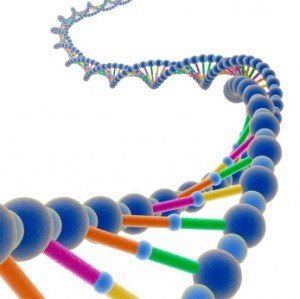
Name this structure
a)
double helix
b)
nucelotide
c)
twisted ladder
d)
hydrogen bond
15.
Nitrogenous bases are joined by which type of bond?
a)
polar bonds
b)
ionic bonds
c)
covalent bonds
d)
hydrogen bonds
16.
Nucleotides are made up of a sugar, phosphate, and..?
a)
nitrogenous base
b)
nucleic acid
c)
cholesterol
d)
fatty acid
17.
Which shows the correct complementary base pairing for DNA?
a)
C-A, T-G
b)
A-G, C-T
c)
C-G, U-A
d)
T-A, G-C
18.
What does DNA stand for?
a)
Deoxyribonucleic acid
b)
Denitrogenous acid
c)
Deribonucleic acid
d)
Diribonucleic acid
19.
In a certain gene, 15% of the DNA is thymine, how much of it is adenine? 
a)
15
b)
35
c)
30
d)
70
20.
DNA Replication occurs in which phase of interphase? 
a)
G1
b)
S
c)
G2
d)
Mitosis
21.
Who is responsible for producing this image?
a)
Francis Crick
b)
James Watson
c)
Rosalind Franklin
d)
Watson and Crick
22.
The work of scientists including Griffin, Avery, Hershey & Chase and Franklin helped us to determine the __ are responsible for carrying genetic material.
a)
Amino Acids
b)
Proteins
c)
Nucleic Acids
d)
Carbohydrates
23.
From his work with mice and pneumonia-causing bacteria, Frederick Griffin discovered ________.
a)
Replication
b)
Transcription
c)
Transformation
d)
Translation
24.
The work of Erwin Chargaff allowed Watson and Crick to determine the rules of...
a)
protein synthesis
b)
transcription
c)
hydrogen bonding
d)
nitrogen base pairing
25.
Which of the following pairs identifies the PURINE nitrogen bases?
a)
Cytosine and Thymine
b)
Adenine and Thymine
c)
Adenine and Guanine
d)
Cytosine and Guanine
26.
Nitrogen bases attach to the deoxyribose sugar of a DNA molecule backbone.
a)
True
b)
False
27.
The enzyme that constructs the new strand of DNA during replication is known as...
a)
DNA Helicase
b)
DNA Polymerase
c)
DNA Ligase
d)
RNA Polymerase
28.
Replication use___ to make more ___.
a)
DNA, RNA
b)
RNA, RNA
c)
DNA, DNA
d)
DNA, Protein
29.
According to the semi-conservative model of DNA replication, two DNA molecules result, ___.
a)
Each strand with one new strand and one original strand
b)
Each with two new strands
c)
One with two new strands and one with both original strands
d)
Each with two original strands
30.
What is the relationship between a protein, the cell, and DNA?
a)
DNA is produced by protein which is produced in the cell
b)
Protein is composed of DNA which is produced in the cell
c)
DNA controls the production of protein in the cell
d)
A cell is composed of DNA and protein
31.
In RNA, Uracil pairs with ______. 
a)
cytosine
b)
adenine
c)
guanine
d)
thymine
32.
The process to go from DNA to mRNA is _______
a)
translation
b)
transcription
c)
replication
33.
The process to go from mRNA to a protein is called ____
a)
transcription
b)
rRNA
c)
replication
d)
translation
34.
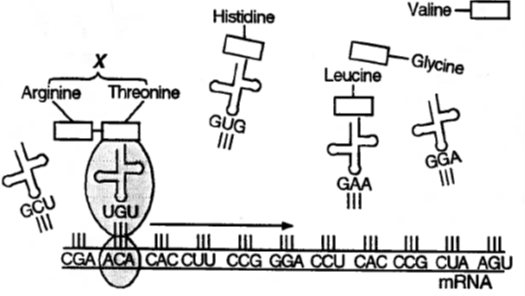
What process is going on in this photo? 
a)
Transcription 
b)
Translation 
c)
Replication 
d)
All the above 
35.
What is the location in the cell for translation?
a)
nucleus
b)
mitochondria
c)
ribosome
d)
chloroplast
36.
How many amino acids are coded for by this sequence of nucleotides:
ATG GGA ACT CCA
a)
4
b)
2
c)
6
d)
12
37.
What is the three base sequence of mRNA that codes for a single amino acid?
a)
Anticodon
b)
Codon
c)
Protein
38.
The mRNA leaves the ________ to find the ribosome to make proteins.
a)
cell
b)
nucleotide
c)
nucleus
39.

A small organelle in the cell on which proteins are assembled, It is a type of protein.

a)

Mitochondria

b)

Ribosome

c)

Nucleus

d)

Lysosome

40.
Which statement is describing the process of protein synthesis?
a)
DNA is copied into mRNA which is translated into protein
b)
DNA is copied into DNA
c)
DNA is copied into lysosome
41.
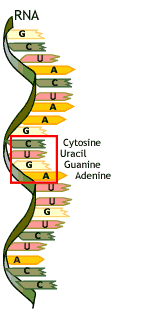
Contains the bases adenine, uracil, cytosine and guanine
a)
DNA
b)
RNA
c)
Both
42.

Transcribe the following DNA strand: CTG AAT

a)

GAC TTA

b)

CTG AAT

c)

GAC UUA

d)

CUG AAU

43.

Which one of the following is not a pyrimidine structure?

a)

Cytosine

b)

Thymine

c)

Uracil

d)

Adenine

44.

Which one of the following is not true of purines?

a)

Purines are single ring-shaped molecules that belong to the macromolecule group of nucleic acids

b)

Purines consist of adenine and guanine

c)

Purines are the nitrogenous base of both DNA and RNA

d)

Purines pair with Pyrmidines in the sequences of DNA and RNA

45.

Which of the following element(s) are found in nucleic acids?

a)

carbon/hydrogen

b)

oxygen

c)

phosphorus

d)

nitrogen

e)

sulfur

46.

Which of the following is NOT one of the three groups comprising the nucleotide?

a)

R group

b)

phosphate

c)

nitrogenous base

d)

pentose sugar

47.

Which of the following describes the difference between a purine and a pyrimidine?

a)

Purines are single ring structures while pyrimidines are double ring structures.

b)

Pyrimidines are single ring structures while purines are double ring structures.

c)

Purines are composed of single bonds while pyrimidines are composed of double bonds.

d)

Pyrimidines are composed of single bonds while purines are composed of double bonds.

48.

Which of the following are pyrimidines?

a)

adenine

b)

cytosine

c)

guanine

d)

thymine

e)

uracil

49.

Which of the following are purines?

a)

adenine

b)

cytosine

c)

guanine

d)

thymine

e)

uracil

50.
In a strand of DNA, if it contains 20% of Thymine, then how much Guanine would be present?
a)
30%
b)
20%
c)
80%
d)
10%
51.
Which of the following best describes a DNA molecule?
a)
double helix
b)
contains ribose
c)
made of amino acids
d)
contains Uracil
52.
What is the process of turning DNA into mRNA?
a)
Central Dogma
b)
Transcription
c)
Translation
d)
Trapezoid
53.
Every three letters (example: ATC) in DNA codes for what??
a)
Amino Acid
b)
Nucleotide
c)
Lipid
d)
Carbohydrate
54.
DNA is turned to RNA and then to Protein is called what?
a)
Central Dogma
b)
DNA
c)
RNA
d)
Theory of Everything
55.

chargaff said that..

a)

A to T , G to C

b)

G to C , A to C

c)

G to A , A to C

d)

biology is hard

56.

where is the site of translation ?

a)

ribosomes

b)

telomerase

c)

helicase

d)

primase

57.

What is the order for Protein Synthesis?

a)

Transcription -> Translation -> Protein

b)

Translation - > Transcription -> Protein

c)

Protein -> Transcription -> Translation

d)

Translation -> Protein -> Transcription
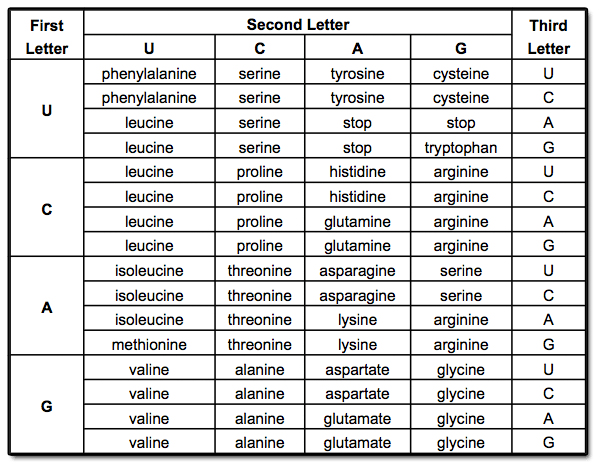
58.
What amino acid is represented by the codon UUA?
a)
Phenylalanine
b)
Tyrosine
c)
Leucine
d)
Stop codon
59.
What are 3 types of RNA?
a)
mRNA, tRNA, rRNA
b)
aRNA, fRNA, mRNA
c)
TRNA, MRNA, RRNA
d)
MRNA, ARNA, FRNA, MRNA
60.

The polymer called Nucleic Acids are made of the monomers....

a)

Nucleotides

b)

Amino Acids

c)

Glucose/Monosaccharides

d)

Glycerol

e)

Fatty Acids

61.

The polymer called Proteins are made of the monomers....

a)

Nucleic Acids

b)

Amino Acids

c)

Glucose/Monosaccharides

d)

Glycerol

e)

Fatty Acids

62.

The monomer Amino acids make up the polymer....

a)

Proteins

b)

Lipids

c)

Nucleic Acids

d)

Carbohydrates

63.
What are the monomers of DNA?
a)
glycerols
b)
amino acids
c)
fatty acids
d)
nucleotides
64.
What is the monomer of a protein?
a)
amino acid
b)
monosaccharide
c)
fatty acid
d)
nucleic acid
65.

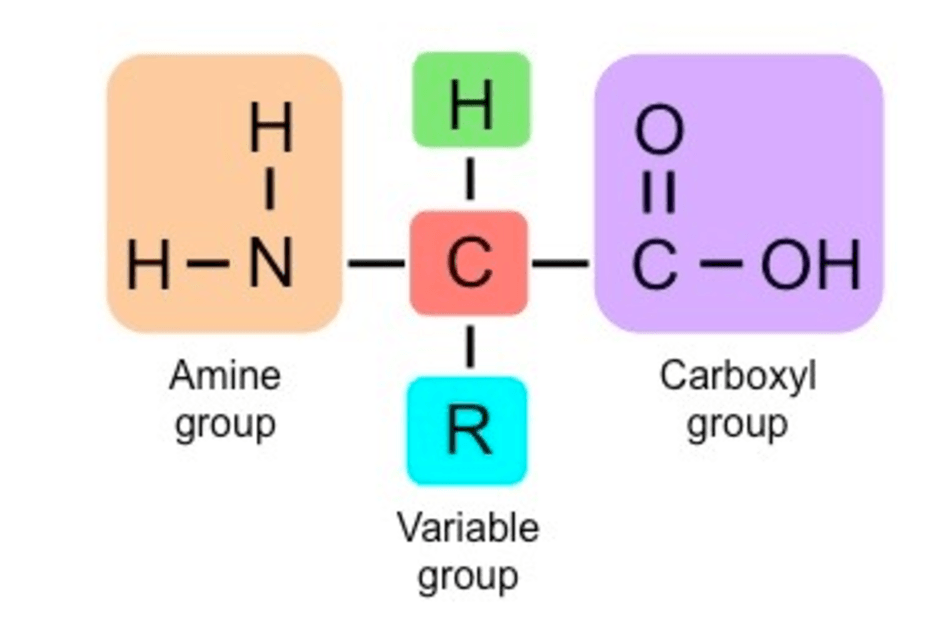
Which of the following describes the secondary structure of proteins?

a)

The sequence of amino acids

b)

The α-helix and β-pleated sheet folding

c)

The folding of the polypeptide chain due to the 'R' groups

d)

The joining of different protein molecules to make one big molecule
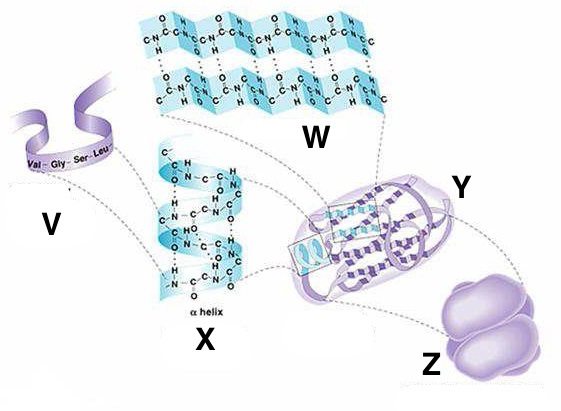
66.

What is a of the functionsof a protein?

a)

cell energy

b)

structure

c)

long term energy storage

d)

contain genetic information

67.
The name of the initial chain of monomers in a protein is called.....
a)
polypeptide
b)
polysaccharide
c)
polyester
d)
polynucleotide
68.

Why is folding so important in proteins?

a)

It gives them a unique, 3-D functional shape

b)

It makes them look tidier

c)

It makes every protein molecule different from the next even if they are the same type

d)

The folding is random so is not that important at all

69.

The main bonding in the secondary structure of a protein is due to.....

a)

covalent bonding

b)

ionic bonding

c)

hydrogen bonding

d)

polar bonding

70.

The tertiary structure folding in proteins is primary due to the interactions of....

a)

the 'R' groups

b)

the 'P' groups

c)

the 'A' groups

d)

the 'S'

71.

What is it called when the unique 3-D shape of a protein has been disrupted or 'unravelled'?

a)

Denaturation

b)

Deproteination

c)

Decoupling

d)

Depeptidasing

72.

Shape is essential for a protein to be functional?

a)
b)
73.

Which of the following give a protein its unique 3-D shape? (3)

a)

the unique sequence of amino acids in the primary structure

b)

hydrogen bonding to form alpha-helixes and beta-pleated sheets in the secondary structure.

c)

unique interactions between the 'R' groups in the tertiary structure

d)

random folding due to temperature and extreme pH throughout the folding process

e)

unique sequence of monosaccharides in the quaternary structure

74.

The amino acid sequence of each polypeptide that determines what three-dimensional shape in turn determines a protein's

a)

Function

b)

Structure

c)

Fate

d)

Limitations

e)

Location

75.

Proteins that are roughly spherical

a)

globular proteins

b)

fibrous proteins

c)

enzymatic proteins

d)

storage proteins

e)

motor proteins

76.

What is a virus that infects bacteria called?

a)

bacteriophage

b)

infectious virus

c)

transformation

d)

gene change

77.

Which of the following best describes the arrangement of the sides of the DNA molecule

a)

Bonding

b)

Alternating

c)

Anitparallel

d)

Parallel

78.

DNA polymerase moves in the _________ to ____________ direction

a)

3' to 5'

b)

easiest

c)

5" to 3"

d)

9 to 5

79.

Enzyme that breaks hydrogen bonds (unzips)

a)

Ligase

b)

Polymerase

c)

Primase

d)

Helicase

80.

When using your codon chart, what sequence can you use to find the correct amino acid?

a)

DNA

b)

mRNA

c)

tRNA

d)

Any of these will do

81.

How many nucleotides make up a codon?

a)

1

b)

3

c)

5

d)

15

82.

On which molecule can an anticodon be found?

a)

mRNA

b)

DNA

c)

tRNA

d)

rRNA