Wayground logo

Free Printable Worksheets

Font size

S
M
L
XL
Worksheets

Nervous system

Total questions: 74

Worksheet time: 52mins

Name
Class
Date
1.
The long, fiber like part of a neuron which the cell sends information to receiving neurons
a)
axon 
b)
dendrite
c)
axon terminal
d)
gene
2.
This releases neurotransmitters which are sent into the synaptic cleft for receptors on the dendrite to taste
a)
axon
b)
axon terminal
c)
gene
d)
neuron
3.
A network of branches coming from individual cells.  They carry information and electrical signals in the brain and nervous system
a)
axon
b)
axon terminal
c)
dendrite
d)
neuron
4.
A nerve cell that is the basic working unit of the brain and nervous system which processes and transmits information
a)
axon
b)
neuron
c)
dendrite
d)
neurotransmitter
5.
This insulating material forms a layer, around the axon of a neuron.  It enables electrical signals to travel down the axon at higher speeds.
a)
neuron
b)
myelin sheath
c)
dendrite
d)
neurotransmitter
6.
How many nerve cells does the brain contain?
a)
100 million
b)
86 billion
c)
86 million 
d)
100 billion
7.
What is the brain made of?
a)
Nerve tissue
b)
Brain tissue
c)
Cortex tissue 
d)
Stem tissue
8.

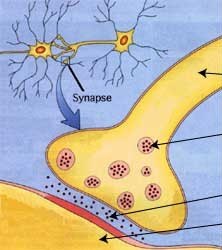
Neurotransmitters are released from the

a)

Dendrites

b)

Post-synaptic neuron

c)

Presynaptic neuron

d)

Schwann Cells

9.

The location of neurotransmitters

a)

axon terminals

b)

dendrites

c)

Schwann cells

d)

cell body

10.

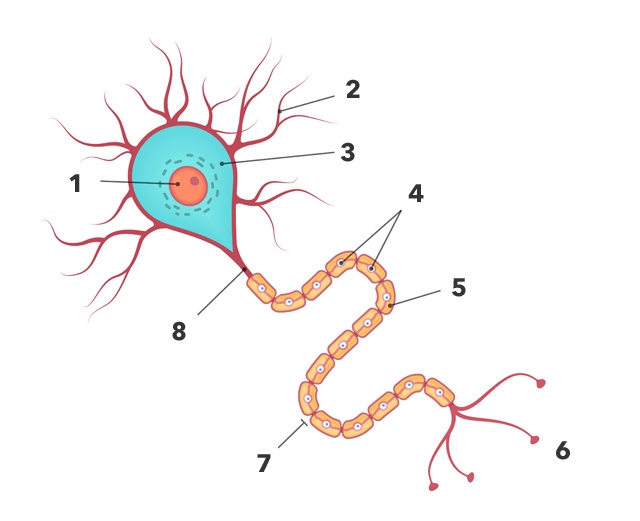
Identify #2

a)

axon

b)

cell body

c)

dendrite

d)

myelin sheath

11.
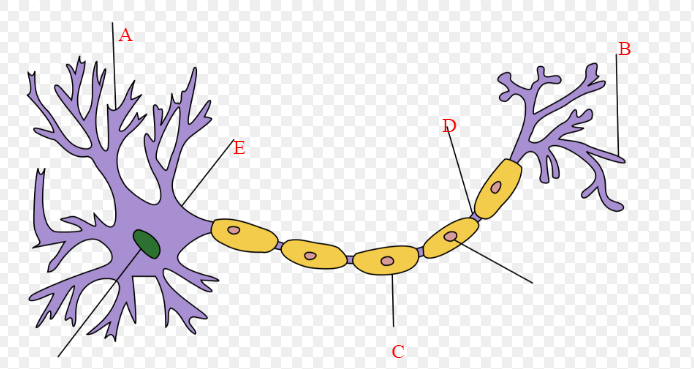
A
a)
Dendrite
b)
Axon
c)
Axon Terminal
d)
Cell Body
12.
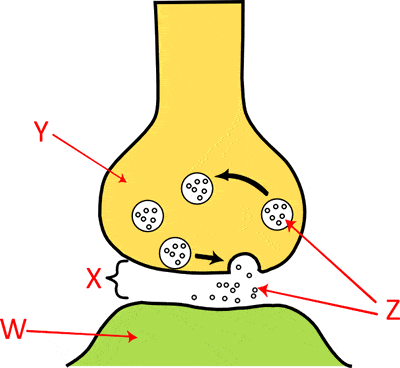
W
a)
Axon Terminal Button
b)
Neurotransmitters
c)
Dendrite
d)
Synapse
13.

X

a)

Axon Terminal Button

b)

Neurotransmitters

c)

Dendrite

d)

Synapse

14.

Label number 3 is the (a)  

15.

Label number 5 is the

a)

Axon terminal

b)

Axon

c)

Myelin Sheath

d)

Dendrites

16.

Label number 2 is the

a)

Axon terminals

b)

Axon buttons

c)

Dendrites

d)

Synaptic cleft

17.

This part of the neuron receives chemical messages from the neurotransmitters of other neurons

a)

Axon terminal

b)

Myelin sheath

c)

Cell body

d)

Dendrites

18.

This is the electrical charge that travels down an axon when a neuron is firing

a)

Resting potential

b)

Action potential

c)

Threshold

d)

Refractory period

19.

If you picked up a hot coal, the signal from the sensory neurons in your fingertips would travel to ________ in your spinal cord

a)

Sensory Neurons

b)

Motor Neurons

c)

Interneurons

20.
Afferent nerves are called
a)
efferent
b)
sensory
c)
motor
d)
peripheral
21.
Motor nerves are called
a)
afferent
b)
peripheral
c)
sensory
d)
efferent
22.
The "fight or flight" response during threatening situations in the role of the:
a)
sympathetic nervous system
b)
parasympathetic system
c)
somatic nervous system
d)
cerebellum
23.
The part of the nervous system that consists of nerves that branch out from the CNS (central nervous system) and connect to other body parts
a)
Sympathetic
b)
Parasympathetic
c)
Autonomic
d)
Peripheral
24.
_____ neurons carry messages to the central nervous system
a)
Motor
b)
Inter
c)
Sensory
d)
Fun
25.
The _____part of the autonomic nervous system is active during resting.
a)
sympathetic
b)
parasympathetic
c)
somatic
d)
peripheral
26.
_____ neurons carry  messages away from the central nervous system.
a)
Motor
b)
Inter
c)
Sensory
d)
Flower
27.

The job of the somatic nervous system is to control breathing and the respiratory system.

a)

True

b)

False

28.

What is NOT part of the peripheral nervous system (PNS)?

a)

axons

b)

sensory receptors

c)

spinal cord

d)

motor neurons

29.

What are the 2 main divisions of the Nervous System?

a)

Central and Axillary

b)

Central and Peripheral

c)

Axillary and Peripheral

d)

Peripheral and Responsive

30.

The fight or flight response is a function of the _ nervous system.

a)

Central

b)

Parasympathetic

c)

Sympathetic

d)

Sensory

31.

The function of the nervous system that deals with collecting information

a)

Sensory

b)

Integrative

c)

Motor

32.

The function of the nervous system that deals with making decisions

a)

Sensory

b)

Integrative

c)

Motor

33.

The function of the nervous system that deals with responding is _ (Muscles and glands)

a)

Sensory

b)

Integrative

c)

Motor

34.

What are axons

a)

Nerve part that carries messages to the cell body

b)

Nerve part carries messages away from the cell body.

c)

Nerve part that carries messages across the axon

d)

Nerve part that contains the organelles

35.

What is a neurotransmitter?

a)

Electrical Impulse

b)

Sensory impulse

c)

Visual impulse

d)

Chemical that carries messages across the synapse

36.

Neurons that carry messages TOWARD the brain

a)

Glial

b)

Sensory

c)

Motor

37.

Neurons that carry messages AWAY from the brain

a)

Glial

b)

Motor

c)

Sensory

38.

What are the jobs of the nervous system

a)

Communication and control

b)

Transport

c)

Support

d)

Protection

39.

Which is a function of the AUTONOMIC nervous system

a)

Contracting the bicep

b)

Seeing a car stop in front of you

c)

Sensing pain

d)

Controlling breathing

40.
What is protected by the vertebral column?
a)
Ligaments
b)
Spinal cord
c)
Muscles
d)
The brain stem
41.

Which of the following nourishes the spinal cord:

a)

Meninges

b)

Cerebrospinal fluid

c)

Cartilage

d)

Vertebrae

42.

Damage to the cervical vertebrae would most likely cause

a)

Paraplegia

b)

Quadriplegia

43.
Paralysis of the lower extremities is __________.
a)
paraplegia
b)
hemiplegia
c)
diplegia
d)
quadriplegia
44.
Quadriplegia means the patient is paralyzed from 
a)
the neck down
b)
the waist down
c)
only the legs
d)
isn't paralyzed at all
45.
What is the fluid in the space between the meninges that acts as a shock absorber to the brain and spinal cord called? 
a)
Blood-Brain Barrier
b)
Meninges
c)
Cerebrospinal Fluid
d)
Cerebral Cortex
46.

Place in order from top to bottom vertebrae:

A. coccyx (tailbone)

B. thoracic

C. lumbar

a)

B C A

b)

A B C

c)

B A C

d)

A C B

47.
The membranes covering the brain and spinal cord are the _________.
a)
thalamus
b)
ventricles
c)
meninges
d)
choroid plexuses
48.
In this picture, the red line represents a(n)
a)
motor neuron
b)
sensory neuron
c)
receptor
d)
interneuron
49.
Given these components of a reflex: 
1. association neuron
2. skeletal muscle
3. afferent neuron
4. efferent neuron
5. sensory receptor

Choose the sequence below that best represents the order followed in a reflex, from stimulus to response.
a)
5, 4, 3, 2, 1 
b)
5, 3, 2, 4, 1
c)
5, 4, 3, 1, 2
d)
5, 3, 1, 4, 2
50.

The long, fiber like part of a neuron which the cell sends information to receiving neurons

a)

axon

b)

dendrite

c)

myelin

d)

Node of Ranvier

51.
The tiny gap between neurons where nerve impulses are sent from one neuron to another.  It is where communication occurs between an axon and dendrite
a)
synapse
b)
axon terminal
c)
impulse
d)
myelin
52.
This insulating material forms a layer, around the axon of a neuron.  It enables electrical signals to travel down the axon at higher speeds.
a)
neuron
b)
myelin sheath
c)
dendrite
d)
neurotransmitter
53.
A chemical produced by neurons that carries messages to other neurons
a)
myelin sheath
b)
neurotransmitter
c)
axon
d)
axon terminal
54.

Identify #1

a)

axon

b)

cell body

c)

myelin sheath

d)

nucleus

55.

Identify #2

a)

axon

b)

cell body

c)

dendrite

d)

myelin sheath

56.

Identify #3

a)

axon

b)

cell body

c)

dendrite

d)

myelin sheath

57.

Identify #6

a)

axon terminals

b)

dendrites

c)

dendrite

d)

schwann cells

58.

Myelin, an insulating material, is found in

a)

cell bodies

b)

dendrites

c)

axon terminals

d)

Schwann cells

59.

Gaps between Schwann cells that increase the speed of the transmission of the signal down the neuron are called

a)

axon terminals

b)

dendrites

c)

myelin

d)

nodes of Ranvier

60.

This releases neurotransmitters which are sent into the synaptic cleft for receptors on the post-synaptic neuron to receive

a)

dendrite

b)

axon terminal

c)

Scwann cells

d)

myelin

61.

The part of the neuron that receives messages from adjacent neurons

a)

axon

b)

axon terminal

c)

dendrite

d)

neuron

62.

The long, fiber like part of a neuron which the cell sends information to receiving neurons

a)

axon

b)

dendrite

c)

myelin

d)

Node of Ranvier

63.
A
a)
Dendrite
b)
Axon
c)
Axon Terminal
d)
Cell Body
64.
B
a)
Dendrite
b)
Axon
c)
Axon Terminal
d)
Cell Body
65.
E
a)
Synapse
b)
Cell Body
c)
Axon 
d)
Dendrite
66.
The part of the neuron that insulates the axon and increases the speed of the neural message within the neuron.
a)
Synapse
b)
Dendrite
c)
Myelin Sheath
d)
Axon Terminal Button
67.
This part of the neuron stores then releases neurotransmitters into the synapse.
a)
Axon 
b)
Dendrite
c)
Myelin Sheath
d)
Axon Terminal
68.
The part of the neuron where action potentials take place.
a)
Axon Terminal Button
b)
Myelin Sheath
c)
Dendrite
d)
Axon
69.
The correct direction of the neural impulse within one neuron.
a)
Axon Terminal to Dendrite
b)
Dendrite to Axon Terminal
c)
Cell Body to Axon
d)
Axon Terminal to Cell Body
70.
This part of the neuron receives chemical messages from the neurotransmitters of other neurons.
a)
Axon Terminal
b)
Dendrites
c)
Myelin Sheath
d)
Cell Body
71.
C
a)
Synapse
b)
Soma
c)
Axon Terminal
d)
Myelin Sheath
72.
D
a)
Synapse
b)
Axon
c)
Axon Terminal
d)
Dendrite
73.

Neurotransmitters are released from the

a)

Dendrites

b)

Post-synaptic neuron

c)

Presynaptic neuron

d)

Schwann Cells

74.

The blue nerve in the image represents a

a)

sensory neurone

b)

motor neurone

c)

relay neurone