wayground logo

Free Printable Worksheets

Font size

S
M
L
XL
Worksheets

Evolution Review

Total questions: 101

Worksheet time: 6hrs 3mins

Name
Class
Date
1.
How can the change in the fossil record be explained?
a)
The Molluscks were well adapted, but a change favored the larger size.
b)
The Molluscks were well adapted, but they hybridized with a smaller species of mollusck, resulting in the larger shell.
c)
The Molluscks were not well adapted and the shell size changed gradually over time.
d)
The mulluscks were well adaptaed, but humans introduced a new species of molluscks.
2.
Which claim is best supported from the genus Gallotia from the map?
a)
The common ancestor of the lizards first colonized the island El Hierro
b)
The ancestors of each species came from different continents at different times
c)
The common ancestor of the lizards probably came from Africa
d)
The ancestors of each species evolved in Spain and were brought to the islands at the same time.
3.
How has the seed dispersal method developed by these plants given them a reproductive advantage?
a)
The method ensures that offspring will be dispersed and reduces competition for resources
b)
The method reduces the chance that herbivores will consume the seeds.
c)
The method lengthens the life cycle of each of these plants.
d)
The method reduces the plants' need for water and other nutrients.
4.
Whi is it best for scientists to use the name from the standardized taxonomic system?
a)
The standardized name differentiates mountain lions and pumas
b)
The standardized name is less descriptive of the animal that has been observed.
c)
Communications with other scientists about mountain lions will be reduced
d)
All scientists will be using one name for mountain lions
5.
Which statement is best supported by the information in this dendrogram?
a)
Lesser pandas are more genetically similar to giant pandas than they are to raccoons.
b)
Brown bears are more genetically similar to giant pandas than they are to sun bears.
c)
Lesser pandas are more geneticall similar to raccoons than they are to giant pandas
d)
The bear species are all more genetically similar to dogs than they are to giant panda
6.
Which of these is a characteristic that the student should list in the shaded part of the diagram?
a)
Heterotrophic
b)
Mobile
c)
Prokaryotic
d)
Multicellular
7.
Frogs and toads belong to the Order Anura. The smallest in this order is 7 millimeters long, and the largest is 30 centimeters. Which list describes this order best?
a)
A
b)
B
c)
C
d)
D
8.
This nudibranch is brightly colored, lack shells, and secrete poison. 
a)
They find food wherever they go.
b)
They blend in with their environment.
c)
They are not attacked by most predators.
d)
They have bright colors and attract a mate.
9.
Why does the ability to lay 1,000-5,000 eggs increase the fitness of the species?
a)
Increases opportunities for offspring to compete for limited resources
b)
It increases the probability that some offspring will survive long enough to reproduce.
c)
It increases the probability that moving water will promote gene flow from one population to another.
d)
It increases the chance of the recombination of alleles, leading to genetic drift in the population.
10.
Which two trees are most closely related?
a)
Taiwan beech and Taiwan catkin yew
b)
Taiwan catkin yew and lodgepole pine
c)
Lodgepole pine and Japanese maple
d)
Japanese maple and Taiwan beech
11.
Which statement provides the best evidence that Ambulo. natans is an ancestor of Basilo. isis?
a)
Homologous structures appear in both fossils
b)
Similar nitrogenous bases are found in the DNA of each fossil
c)
The fossils were found in different locations
d)
The youngest fossil is larger than the older fossils.
12.
Which statement about the beetles in this environment is best supported by the data?
a)
Green beetles are more fit for the environment than brown beetles are.
b)
Brown beetles undergo a greater number of unfavorable mutations than green beetles do.
c)
Green beetles
13.
Taxonomic classification is important to marine biologists because it provides a way to - 
a)
prove that marine evolution occurs
b)
discover and name every marine organism on Earth
c)
designate Latin as the universal language of marine biology
d)
identify marine organisms and find evolutionary relationships between them.
14.
What theory is represented in the diagram?
a)
The theory that all living organisms are made of cells
b)
The theory that all living organsisms share the same basic genetic components
c)
The theory that organisms function best when their internal conditions are maintained within narrow limits
d)
The theory that complex cells evolved after primitive cells engulfed baterial cells that continued functioning
15.
Which conclusion about relatedness of the lizards do these data support?
a)
G. atlantic and G. stehlini are the least closely related
b)
G. atlantic and G. stehlini are the most closely related
c)
G. galloti eisentrauti and G. galloti palmae are the most closely related
d)
G. galloti eisentrauti and G. galloti galloti are the least closely related
16.
Which statement is best supported by these data?
a)
Competition for food and shelter among reptile species was very low during the Triassic period
b)
A great extinction occurred during the Jurassic period.
c)
Environmental conditions for speciation were most favorable for reptiles during the Permian period.
d)
Reptiles adapted to a terrestrial environment during the Cretaceous period.
17.
If an organism has a vestigial structure, that structure likely once had a function in a(n)
a)
close relative
b)
early ancestor
c)
unrelated organism
d)
embryological stage
18.
Mutations are important because they bring about
a)
death of the organism in which they develop
b)
genetic variation needed for a population to evolve
c)
benefits for the individual, not for the population
d)
Hardey-Weinberg equilibrium within a population
19.
Why are advantageous traits more likely to be passed onto offspring?
a)
Because they are more likely to survive and reproduce.
b)
Because they come from dominant alleles.
c)
Because they come from recessive alleles.
d)
Because the trait is an acquired phenotype.
20.
The ability of an organism to survive and reproduce in its specific environment 
a)
diversity.
b)
evolution
c)
adaptation
d)
 fitness
21.
Magda is a tall, 11 year old drummer. She has a scar on her right cheek. She is good at swimming. Which of her traits did Magda most likely inherit?
a)
height
b)
the scar
c)
ability to swim
d)
ability to play drums
22.
Extinction can occur because of which of the following?
a)
All can be causes of extinction.
b)
Increased competition with other species
c)
New predators within the environment
d)
Loss of habitat and/or catastrophes
23.
Inherited trait that helps an organism survive is a(n) __________.
a)
Fossil
b)
Adaptation
c)
Ancestor
d)
Natural selection
24.
Survival of the fittest or when favorable adaptations reproduce faster is called what?
a)
Evolution
b)
Adaptation
c)
Natural selection
d)
Fossilization
25.
This occurs when no more of a species is living.
a)
Fossilization
b)
Adaptation
c)
Extinction
d)
Natural selection
26.
The diagram shows fossils in different rock layers. Which of these statements about the age of these fossils is most likely correct?
a)
Fossil A and C are the same age
b)
Fossil B is older than fossil C
c)
Fossils A is older than fossil B
d)
Fossil D is older than fossil C
27.
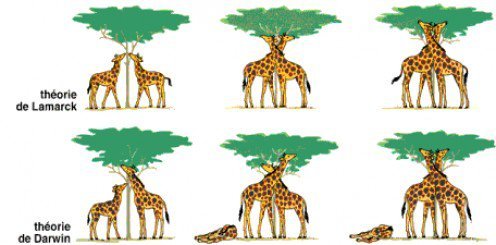
What would happen if the Giraffes never evolve?
a)
they would survive
b)
They would thrive
c)
They would become extinct
d)
They will find another source of food
28.
Finches on the Galapagos Islands had different beaks in order to help them do what?
a)
Build nests
b)
Fight off predators
c)
Collect food sources
d)
Compete with rivals
29.
This scientist came up with the idea of natural selection.
a)
Jean Baptiste Lamarck
b)
Gregor Mendel
c)
Charles Darwin
d)
Thomas Malthus
30.
A remnant or trace of an organism from the past is called a _______.
a)
Ancestor
b)
Skeleton
c)
Fossil
d)
Imprints
31.
According to the diagram, which organism is older?
a)
ammonite
b)
coral
c)
gastropod
d)
trilobite
32.
Structures with the same parts have different functions; suggests that organisms share a common ancestry
a)
vestigial structures
b)
homologous structures
c)
adaptive radiation
d)
fossil
33.
Which of the following is an example of a vestigial structure?
a)
the wings of a red-tailed hawk
b)
the hind limbs of a house cat
c)
the fins of sharks
d)
the tailbone of a human
34.
If species A and B have very similar genes and proteins, what is probably TRUE?
a)
species A and B share a relatively recent common ancestor
b)
species A evolved independently of species B for a long period
c)
species A is younger than species B
d)
species A is older than species B
35.
Farmers breed cows to produce high amounts of milk. This is an example of...
a)
Natural Selection 
b)
Variations in a species 
c)
Selective Breeding 
d)
inbreeding
36.
Which of the following is a term for a group of similar organisms that can reproduce fertile offspring?
a)
individual
b)
population
c)
species
d)
fossil
37.
Natural selection could not occur without...
a)
genetic variation in species
b)
stable environments
c)
competition for unlimited resources
d)
gradual warming of the Earth
38.
Use the cladogram to determine which of the following organisms is most closely related to the dog?
a)
cat
b)
frog
c)
fish
d)
fly
39.
The species of finches that Darwin observed differed in the shape of their beaks.  According to Darwin, all of these species probably differed due to...
a)
natural selection
b)
had migrated from Africa
c)
had descended from similar birds in Africa
d)
ate the same diet
40.
An inherited characteristic that increases an organism's ability to survive and reproduce in its specific environment is called a(n)...
a)
homologous structure
b)
vestigial organ
c)
adaptation
d)
speciation
41.
When farmers select the largest hogs, the fastest horses, or the cows that produce the most milk for breeding it is called...
a)
natural selection
b)
artificial selection
c)
survival of the fittest
d)
homologous variation
42.
The study of the evolutionary relationships among organisms is called...
a)
taxonomy 
b)
domainology
c)
phylogeny
d)
binomial nomenclature
43.
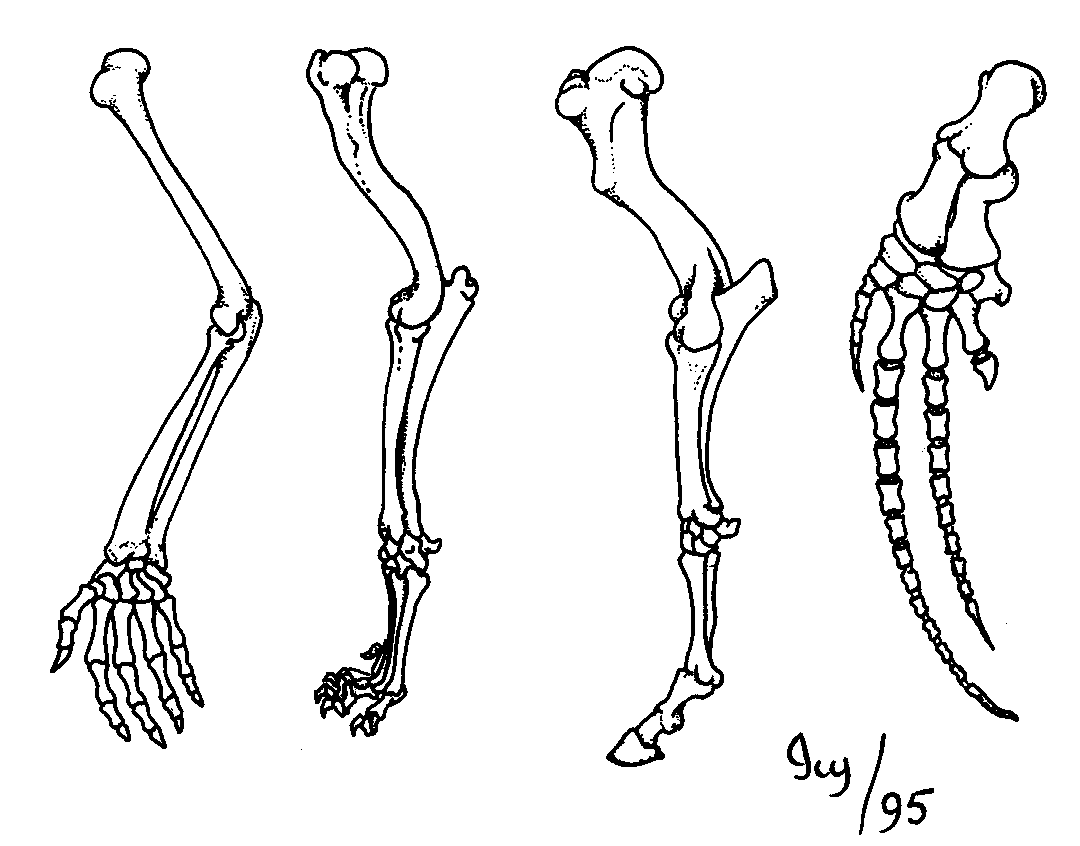
Refer to the illustration.  The similarity of these structures is one from of evidence that the organisms...
a)
share a common ancestor
b)
all grow at different rates
c)
evolved instantaneously
d)
live for a long time
44.
Which of the following would lead to genetic variation?
a)
crossing over
b)
independent assortment
c)
mutations
d)
all answers are correct
45.
Natural selection is the process by which...
a)
the age of selected fossils is calculated
b)
organisms with traits well suited to their environment survive and reproduce more successfully than organisms less suited to the same environment
c)
acquired traits are passed on from one generation to the next
d)
all answers are correct
46.
Evidence that evolution occurs includes all of the following except...
a)
no change has occurred in any species
b)
similarities in proteins and DNA sequences between organisms
c)
the fossil record
d)
homologous structures among different organisms
47.
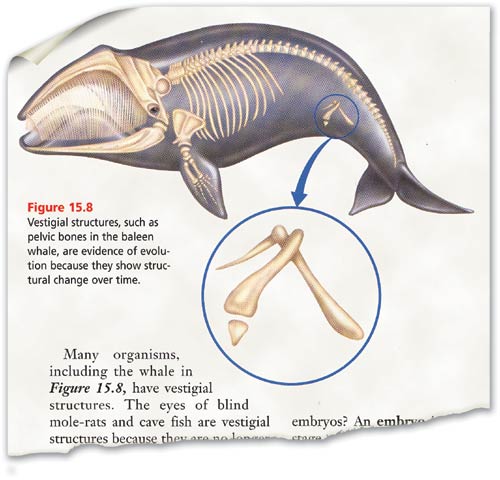
A human appendix, whale hipbones, and skink's legs are examples of...
a)
homologous structures
b)
embryonic mates
c)
vestigial organs
d)
analogous structures
48.
When Darwin published his first book about evolution, he included all of the following ideas except...
a)
the idea that species change slowly over time
b)
the idea that some organisms reproduce at a greater rate than others
c)
the idea that species are permanent and unchanging
d)
the idea that some species become better suited to their environment than others
49.
How do fossils demonstrate evidence of evolution?
a)
They show that ancient species share similarities with species now on Earth
b)
They show evidence of species that are not extinct
c)
They are the primary source of evidence of natural selection
d)
Fossils reveal that many species have remained unchanged for millions of years
50.
Scientists see anatomical and molecular similarities among organisms that suggest that life on Earth began about 4 billion years ago as what type of organism?
a)
multicellular organisms
b)
eukaryotic organisms
c)
simple, one-celled organisms
d)
heterotrophic organisms
51.
Darwin believed in the idea that evolution happened slowly over a long period of time called
a)
punctuated equillibrium
b)
gradualism
c)
symbiosis
d)
mass extinction
52.
 In a population of clover flowers, there are both white and purple varieties.  The cows that graze the field where the clover grows prefer the purple variety.  Over time, the white clover flowers become much more numerous and the purple ones more scarce.  This is an example of which process that can cause evolutionary change?
a)
genetic equilibrium
b)
genetic mutation
c)
natural selection
d)
overproduction
53.
According to Darwin, evolution occurs...
a)
only through artificial selection
b)
during half-life periods of 5,715 years
c)
because of natural selection
d)
so rapidly that it can be observed easily
54.
The ability of an individual to survive and reproduce in a specific environment is called
a)
fitness
b)
common descent
c)
survival of the fittest
d)
struggle for existence
55.
Which of the following is a correct statement about the relationship between natural selection and evolution?
a)
Natural selection results from evolution.
b)
Natural selection includes evolution as a part of it.
c)
 Natural selection is one mechanism of evolution.
d)
Natural selection and evolution are the same thing.
56.

Scientists can determine relatedness among organisms by comparing partial amino acid sequences. The table shows four partial amino acid sequences from four organisms.


Which organism is the LEAST related to the other three organisms?

a)

Organism 1

b)

Organism 2

c)

Organism 3

d)

Organism 4

57.

The image shows part of the humerus bone in different genera of primates.

Which statement is best supported by the observable structures of the different humerus bones?

a)

The primates lived in similar environments.

b)

The primates shared a common ancestor.

c)

The primates interbreed with similar organisms in a population.

d)

The primates had diets that consisted of similar types of foods.

58.

Researchers studying populations of lizards from the genus Gallotia on the Canary Islands compared the protein cytochrome b in different populations. The table shows the number of differences in the cytochrome b protein between different populations.


Which conclusion about the relatedness of the lizards do these data support?

a)

G. atlantica and G. stehlini are the least closely related. .

b)

G. simonyi and G. bravoana are the most closely related.

c)

G. galloti eisentrauti and G. galloti palmae are the most closely related.

d)

G. galloti eisentrauti and G. galloti galloti are the least closely related

59.

The graph shows the number of taxa of reptiles whose fossilized tracks have been found.

Which statement is best supported by these data?

a)

Competition for food and shelter among reptile species was very low during the Triassic period.

b)

A great extinction occurred during the Jurassic period.

c)

Environmental conditions for speciation were most favorable for reptiles during the Permian period.

d)

Reptiles adapted to a terrestrial environment during the Cretaceous period.

60.

The diagram shows light- and dark-colored beetles that live on a tree.

Which result is most likely to occur to the beetle population due to predation over time?

a)

The number of light-colored beetles in the population will increase.

b)

There will be more dark-colored beetles than light-colored beetles.

c)

The number of light-colored beetles will decrease.

d)

The dark-colored beetles will move to a different type of tree.

61.

The white cattail is a hybrid species of plant that is a result of the cross between the broad-leaved cattail and the narrow-leaved cattail. Over time, the white cattail has established itself in the wetlands of Midwestern states. Which of these explains the success of the white cattail?

a)

Favorable genes from parental generations provide advantageous characteristics to the hybrid species.

b)

Hybridization produces offspring traits that allow different species to survive in extreme environments.

c)

Inherited traits passed on from parental generations make hybrid species more susceptible to disease.

d)

Hybrid species display more adaptations due to their reduced genetic diversity.

62.

Adaptations that result from natural selection are expected to increase the fitness of an organism. In terms of natural selection, which of the following best describes fitness?

a)

Being able to escape from predators

b)

Being among the strongest organisms in a population

c)

Being able to survive, find a mate, and produce offspring

d)

Being able to survive long enough to reach the adult stage

63.

Common baboons live on the savanna in breeding groups called troops. While females tend to stay with the troop, younger or less dominant males may leave to join a neighboring troop. Which of these is a likely outcome of movement by young males?

a)

Gene flow occurs between populations.

b)

Allele frequencies suddenly change.

c)

Relative genotypic frequencies reach a constant state.

d)

Intermediate phenotypes increase in the species.

64.

The gray squirrel, Eastern fox squirrel, and red squirrel are all different species of squirrels. Why is having a scientific name for each species of an organism important?

a)

To prevent existing named organisms from having their names changed as they become extinct

b)

To keep the classification system from being altered as new organisms are discovered

c)

To allow organisms to be placed in many classification levels at the same time

d)

To standardize the naming and organization of organisms to avoid confusion

65.

Scientists around the world use a standardized taxonomic system. Why would scientists want to use a taxonomic system that is standardized?

a)

In order to avoid confusion with the identification of organisms

b)

Because Linnaeus established the system

c)

So that Latin names can be applied for a practical purpose

d)

In order to place organisms in different groups

66.

Scientists around the world use a standardized taxonomic system. Why would scientists want to use a taxonomic system that is standardized?

a)

In order to avoid confusion with the identification of organisms

b)

Because Linnaeus established the system

c)

So that Latin names can be applied for a practical purpose

d)

In order to place organisms in different groups

67.
a)

A

b)

B

c)

C

d)

D

68.
a)

F

b)

G

c)

H

d)

I

69.
a)

A

b)

B

c)

C

d)

D

70.
a)

A

b)

B

c)

C

d)

D

71.

Hereditary changes in groups of living organisms over time

a)

natural selection

b)

adaptation

c)

evolution

d)

variation

72.

Theory of evolution developed by Darwin, based on four ideas.

a)

evolution

b)

natural selection

c)

fitness

d)

adaptation

73.

Darwin's term for the selective breeding of organisms selected for certain traits in order to produce offspring having those traits.

a)

embryology

b)

natural selection

c)

variation

d)

artificial selection

74.

Inherited characteristic of a species that develops over time in response to an environmental factor, enabling that species to survive.

a)

fitness

b)

natural selection

c)

adaptation

d)

evolution

75.

Measure of a traits relative contribution to the following generation.

a)

fitness

b)

adaptation

c)

homologous sturctures

d)

variation

76.

Group of organisms that can be interbreed and produce fertile offspring.

a)

evolution

b)

species

c)

enbryology

d)

DNA fingerprint

77.

Preserved evidence of an organism that provides evidence of past life.

a)

species

b)

analogous structures

c)

homologous structures

d)

fossil

78.

The study of the formation, development, structure and functional activities of embryos.

a)

DNA fingerprint

b)

Evolution

c)

Embryology

d)

Adaptation

79.

Anatomically similar structure inherited from a common ancestor.

a)

vestigial structures

b)

homologous structures

c)

analogous structures

d)

embryology

80.

Reduced form of a functional structure that indicates shared ancestry

a)

vestigial structures

b)

homologous structures

c)

fitness

d)

analogous structures

81.

Structure that has the same function by different construction and was not inherited from a common ancestor.

a)

DNA fingerprint

b)

homologous structures

c)

vestigial structures

d)

analogous structures

82.

An individual's unique sequence of DNA fragments that can be used by forensic scientists to identify suspects and determine paternity.

a)

Evolution

b)

Embryology

c)

DNA fingerprint

d)

Homologous structures

83.

Purposed the idea of evolution through natural selection and wrote the book, The Origin of Species.

a)

Darwin

b)

Crick

c)

Watson

d)

Mendel

84.

Differences that are seen between individual organisms, groups, and species

a)

fitness

b)

variation

c)

artificial selection

d)

adaptation

85.

Hereditary changes in groups of living organisms over time

a)

natural selection

b)

adaptation

c)

evolution

d)

variation

86.

Homologous structures are defined as anatomical structures originating from the same structure in ancestral form. For instance, a bird's wing and the front flippers of a seal are examples of homologous structures. Which of the following does the presence of homologous structures in vertebrates suggest?

a)

All vertebrates developed at the same rate.

b)

All vertebrates developed internally.

c)

All vertebrates evolved from different animals.

d)

All vertebrates have a common ancestor.

87.

The position and shape of the bones in the forelimbs of four present-day vertebrates were studied. Two of the organisms seemed to be more closely related to each other than to the other vertebrates. This relationship was most likely based on evidence using the field of —

a)

comparative anatomy

b)

DNA sequences

c)

biochemistry

d)

fossil record

88.

According to Darwin's theory on natural selection, the traits that survive and continue in future generations are –

a)

caused by response to stress

b)

made by environmental change

c)

already present in the population

d)

introduced by immigrating species

89.

Survival of the fittest can best be described as –

a)

the process by which only the strongest of a species will be able to survive and reproduce

b)

the process in which organisms that are better adapted to their environment will have a better chance of surviving and reproducing

c)

the reason the strongest of the species will not be able to reproduce as often as others

d)

the reason weaker organisms in a species will always be killed by predators

90.

Scientists compared the fossil remains of a species that lived 5,000 years ago to members of the same species living today. Scientists concluded that the species changed very little over this period of time. Which statement best accounts for this lack of change?

a)

The environment did not change significantly, and those offspring expressing new characteristics survived their natural enemies.

b)

The environment changed significantly, but the species had no natural enemies for a long period of time.

c)

The environment did not change significantly, and those offspring expressing new characteristics did not survive.

d)

The environment changed significantly, and those offspring without favorable characteristics did not survive.

91.

Which process results in greater genetic diversity in offspring?

a)

genetic linkage

b)

recombination of DNA during meiosis

c)

crossing-over during mitosis

d)

rearrangement of chromosomes in germ cells

92.

The knowledge of the species name of an organism most importantly indicates for scientists –

a)

precisely where the organism lives in the world

b)

the life span of the organism

c)

which organisms have reproductive potential with one another

d)

the color of external features

93.

Scientists can determine relatedness among organisms by comparing partial amino acid sequences. The table shows four partial amino acid sequences from four organisms. Which organism is the LEAST related to the other three organisms?

a)

Organism 1

b)

Organism 2

c)

Organism 3

d)

Organism 4

94.

A student used a microscope to study four members of the phylum Ciliophora. Members of this phylum move when propelled by hundreds of tiny cilia. Although these organisms belong to the same phylum, they are classified as different —

a)

families

b)

species

c)

kingdoms

d)

orders

95.

The white cattail is a hybrid species of plant that is a result of the cross between the broad-leaved cattail and the narrow-leaved cattail. Over time, the white cattail has established itself in the wetlands of Midwestern states. Which of these explains the success of the white cattail?

a)

Favorable genes from parental generations provide advantageous characteristics to the hybrid species.

b)

Hybridization produces offspring traits that allow different species to survive in extreme environments.

c)

Inherited traits passed on from parental generations make hybrid species more susceptible to disease.

d)

Hybrid species display more adaptations due to their reduced genetic diversity.

96.

The gray squirrel, Eastern fox squirrel, and red squirrel are all different species of squirrels. Why is having a scientific name for each species of an organism important?

a)

To prevent existing named organisms from having their names changed as they become extinct

b)

To keep the classification system from being altered as new organisms are discovered

c)

To allow organisms to be placed in many classification levels at the same time

d)

To standardize the naming and organization of organisms to avoid confusion

97.

The diagram shows light- and dark-colored beetles that live on a tree. Which result is most likely to occur to the beetle population due to predation over time?

a)

The number of light-colored beetles in the population will increase.

b)

There will be more dark-colored beetles than light-colored beetles.

c)

The number of light-colored beetles will decrease.

d)

The dark-colored beetles will move to a different type of tree.

98.

Adaptations that result from natural selection are expected to increase the fitness of an organism. In terms of natural selection, which of the following best describes fitness?

a)

Being able to escape from predators

b)

Being among the strongest organisms in a population

c)

Being able to survive, find a mate, and produce offspring

d)

Being able to survive long enough to reach the adult

99.

Niles Eldredge and Stephen Jay Gould researched the lenses of the eyes of fossil trilobites of different species. In 1972 they published a paper in which they described the tendency of a species to remain the same until a sudden change in the environment causes a new related species to appear.

Which hypothesis was most challenged by the work of Eldredge and Gould?

a)

Redi’s hypothesis that spontaneous generation does not occur

b)

Haeckel’s hypothesis that embryological development mimics the evolution of species

c)

Wallace’s hypothesis that geography affects the distribution of species

d)

Darwin’s hypothesis that the development of species is a slow, gradual process

100.

The relationships among different orders of millipedes are shown in the cladogram. Based on this cladogram, which statement best describes relationships among millipede orders?

a)

Stemmiulida is more closely related to Merocheta than Penicillata is to Merocheta.

b)

Spirostreptida is more closely related to Glomerida than Sphaerotheriida is to Glomerida.

c)

Polyzoniida is more closely related to Glomeridesmida than Sphaerotheriida is to Glomeridesmida.

d)

Merocheta is more closely related to Glomeridesmida than Glomerida is to Glomeridesmida.

101.

The image shows part of the humerus bone in different genera of primates. Which statement is best supported by the observable structures of the different humerus

bones?

a)

The primates lived in similar environments

b)

The primates shared a common ancestor.

c)

The primates interbreed with similar organisms in a population.

d)

The primates had diets that consisted of similar types of foods.