wayground logo

Free Printable Worksheets

NEW

Font size

S
M
L
XL
Worksheets

Earth Review

Total questions: 75

Worksheet time: 57mins

Name
Class
Date
1.
_____________ is a plate boundary where two plates move away from each other.
a)
Convergent boundary
b)
Transform boundary
c)
Divergent boundary
d)
Insurgent boundary
2.
_____________ is when two plates move toward each other.
a)
Convergent boundary
b)
Allegiant boundary
c)
Transform boundary
d)
Sliding boundary
3.
A _____________ is when two plates move past each other in opposite directions.
a)
emergent boundary
b)
divergent boundary
c)
transform boundary
d)
convergent boundary
4.
Which explains that the continents were once joined together and over time they broke up and then drifted apart?
a)
Plate Tectonic Theory
b)
Continental Drift 
5.
Name the boundary
a)
convergent boundary
b)
divergent boundary
c)
transform boundary
d)
sergent boundary
6.
Name the boundary
a)
convergent boundary
b)
divergent boundary
c)
transform boundary
d)
sergent boundary
7.
Name the boundary
a)
convergent boundary
b)
divergent boundary
c)
transform boundary
d)
sergent boundary
8.

What is represented by the picture could be?

a)

Sea-floor spreading

b)

Pangea

c)

How the continents are arranged today

d)

Volcanoes

9.

Which of the following is the thinnest layer of Earth?

a)

Mantle

b)

All of the above

c)

Lithosphere

d)

Inner Core

10.

What type of event will occur at this boundary?

a)

Earthquake

b)

Volcano Eruption

c)

Tornado

d)

Mountain Building

11.

What geologic process formed the Himalayas?

a)

two continental plates converging

b)

an earthquake in a subduction zone

c)

a tectonic plate moving over a hot spot

d)

movement at a transform fault boundary

12.

Which of the following is the thinnest layer of Earth?

a)

Mantle

b)

Crust

c)

Lithosphere

d)

Inner Core

13.

This image here shows what type of boundary?

a)

Divergent

b)

Convergent: Subduction

c)

Convergent: Collision

d)

Transform

14.

Outer most layer of the earth.

a)

Inner Core

b)

Mantle

c)

None of the above

d)

Outer Core

15.
The inner most layer is ...
a)
hot, metallic liquid
b)
hot, metallic solid
c)
cold, brittle
d)
cold, molten
16.
What is the core made of?
a)
steel
b)
iron 
c)
aluminum
d)
iron and nickel
17.

What is the correct order (starting from the inner most layer) of Earth's layers?

a)

crust, outer core, inner core, mantle

b)

mantle, outer core, inner core, crust

c)

crust, mantle, outer core, inner core

d)

innner core, outer core, mantle Crust

18.
What describes the outer core?
a)
solid
b)
liquid
c)
viscous
d)
gas
19.
This layer of Earth is solid Iron and Nickel
a)
Outer Core
b)
Mantle
c)
Inner Core
d)
Crust
20.
What happens to temperature as we move from the crust down into the inner core?
a)
Decreases
b)
Increases
21.

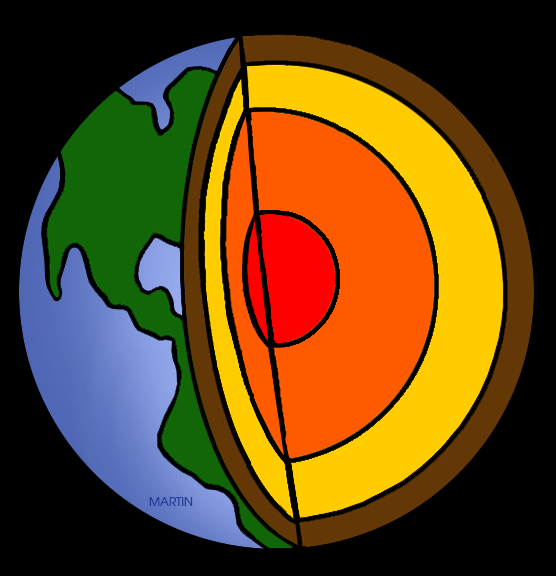
Which layer is shown in red?

a)

crust

b)

mantle

c)

outer core

d)

inner core

22.

Which layer is made of "flowing" solid rock (think clay or pudding)?

a)

crust

b)

mantle

c)

outer core

d)

inner core

23.

Which layer is shown in orange?

a)

crust

b)

mantle

c)

outer core

d)

inner core

24.

Which layer is shown in yellow?

a)

crust

b)

mantle

c)

outer core

d)

inner core

25.

Which layer is shown in brown?

a)

crust

b)

mantle

c)

outer core

d)

inner core

26.

Which shows the order of the layers from COOLEST to HOTTEST?

a)

crust, mantle, outer core, inner core

b)

inner core, outer core, mantle, crust

c)

crust, outer core, inner core, mantle

d)

Trick question! All of the layers are the same temperature!

27.

Which layer is the coolest?

a)

crust

b)

mantle

c)

outer core

d)

inner core

28.

How many layers does Earth have?

a)

1

b)

2

c)

3

d)

4

29.
The huge pieces of the earth's crust are called ____________________________. 
a)
crust
b)
plates
c)
directions
d)
seismos
30.

Many earthquakes happen along the borders of...

a)

Countries

b)

Tectonic Plates

c)

Climate Zones

d)

None of the above.

31.
Which of the following correctly lists the layers in order from oldest to youngest?
a)
A, B, C, D, E
b)
E, B, C, D, A
c)
E, D, C, B, A
d)
C, B, A, D, E
32.
Lakes that form near volcanoes considered to be....
a)
Craters
b)
Conduits
c)
Vents
d)
Calderas
33.

What is part 4 of the volcano?

a)

pipe

b)

magma chamber

c)

crater

d)

lava flow

34.
Once magma reaches the earth's surface it is called.....
a)
Silica
b)
Rock
c)
lava
35.
Beneath a volcano, magma collects in a:
a)
magma chamber
b)
magma pocket
c)
vent
d)
hole
36.
What type of volcano is this? It has been created with layers of both lava and pyroclastic materials. 
a)
Shield
b)
Cinder cone
c)
Composite
37.
What type of volcano is this? It has been created with only pyroclastic materials. 
a)
Cinder cone
b)
Shield
c)
Composite
38.
What type of volcano is this? It has been created with layers of cooled lava. 
a)
Shield
b)
Cinder cone
c)
Composite
39.
What is letter B in the picture?
a)
Magma Chamber
b)
Crater
c)
Vent
d)
Conduit
40.

What is letter A in the picture?

a)

Vent

b)

Crater

c)

Caldera

d)

Tephra

41.
What is letter D in the picture?
a)
Crater
b)
Vent
c)
Conduit
d)
Tephra
42.
What is molten rock that has formed deep within the Earth?
a)
Hot Spot
b)
Magma
c)
Lava
d)
Volcano
43.
What major events cause islands to form in the Pacific Ocean? 
a)
tsunamis 
b)
severe storms
c)
volcanic eruptions 
d)
erosion 
44.

Who is credited with proposing the hypothesis of Continental Drift?

a)

Harry Hess

b)

Galileo Galilei

c)

Alfred Wegener

d)

Isaac Newton

e)

Albert Einstein

45.

Where is Yellowstone?

a)

Minnesota

b)

California

c)

Wyoming

d)

Alaska

46.

How many time has Yellowstone erupted in the past million years?

a)

1

b)

2

c)

3

d)

4

47.

A Volcano that has not erupted for some time is called?

a)

Sleeping

b)

Active

c)

Extinct

d)

Dormant

48.
Where are most volcanoes found?
a)
Southern Hemisphere
b)
Ring of Fire
c)
Mid-Atlantic Ridge
d)
Hot Spots
49.
Volcanoes that have recently erupted are known as:
a)
Extinct Volcano
b)
Dormant Volcano
c)
Active Volcano
d)
What's a volcano?
50.
volcano that has erupted in the last 2000 years but not recently is known as....
a)
Dormant
b)
Active
c)
Extinct
d)
Angry
51.
Volcanoes that have not erupted for at least 10,000 years are described as...
a)
Sleeping
b)
Dormant
c)
Active
d)
Extinct
52.
What percent of the Earth's volcanoes reside in the Ring of Fire?
a)
75%
b)
100%
c)
90%
d)
0%
53.
Dormant volcanoes might erupt in the future.
a)
True
b)
False
54.

Which of the following is a characteristic of all minerals?

a)

Crystalline structure

b)

Fills the shape of its container

c)

Usually organic

d)

Random chemical composition

55.
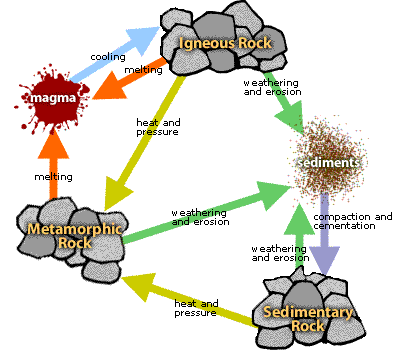
Which type of rock results from melting and cooling of magma?
a)
Igneous
b)
Metamorphic
c)
Sedimentary
d)
Extrusive
56.
Which type of rock forms from extreme heat and pressure?
a)
Igneous
b)
Sedimentary
c)
Organic
d)
Metamorphic
57.
A metamorphic rock changes into an igneous rock by what two processes?
a)
Melting and cooling
b)
Extreme heat and pressure
c)
Compaction and cementation
d)
Weathering and erosion
58.
What are the 3 major types of rocks?
a)
Igneous, Metamorphic, Sedimentary
b)
Metamorphic, Igneous, Cementation
c)
Brown, Red, Gray
d)
Streak, Hardness, Breakage
59.
Diamond has a hardness of ___ on Mohs Hardness Scale.
a)
1
b)
5
c)
8
d)
10
60.
By definition, a mineral has which of the following characteristic(s)?
a)
definite chemical composition
b)
crystal structure
c)
naturally occuring
d)
all of the above
61.
Which minerals would all scratch apatite?
a)
diamond, topaz, quartz
b)
quartz, calcite, gypsum
c)
fluorite, talc, calcite
d)
diamond, fluorite, corundum
62.
Which mineral would scratch calcite but not scratch apatite?
a)
fluorite
b)
gypsum
c)
talc
d)
topaz
63.
Which mineral is number 6 on the hardness scale?
a)
Conrundum
b)
Topaz
c)
Quartz
d)
Orthoclase
64.

Talc is the softest mineral on Mohs Hardness Scale.

a)

True

b)

False

65.

If a mineral is scratched by talc, what must its hardness rating be?

a)

1

b)

3

c)

6

d)

10

66.

What is # 4 on the MOH's scale?

a)

Fluorite

b)

Feldspar

c)

Quartz

d)

Calcite

67.

Which mineral is HARDER than quartz?

a)

Topaz, Corundum, and Diamond

b)

Feldspar. Apatite, and Talc

c)

Talc, Gypsum, Topaz

d)

Diamond, Calcite, Fluorite

68.
Can a penny scratch fluorite?
a)
Yes 
b)
No 
69.
What can scratch Talc?
a)
Gypsum
b)
Diamond
c)
Quartz
d)
All of them
70.
The difference between rocks and minerals is
a)
Minerals make rocks, but rocks don't make minerals.
b)
Rocks are harder then minerals.
c)
Rocks are the same as minerals.
d)
Minerals have a greater luster than rocks.
71.

Noah was asked to describe the texture of a rock that he found to help identify it. Which statement best describes Noah's response?

a)

My rock has one shiny side.

b)

My rock is able to scratch talc.

c)

My rock is smooth.

72.

Jacob is studying minerals. Which will NOT help him name the mineral?

a)

Size

b)

Hardness

c)

Color

d)

Luster

73.
Formed by compacting & cementing of sediments
a)
Sedimentary
b)
Metamorphic
c)
Extrusive Igneous
d)
Intrusive Igneous
74.

Limestone is an example of...

a)

Sedimentary

b)

Igneous

c)

Metamorphic

75.

Sandstone is an example of...

a)

Metamorphic

b)

Sedimentary

c)

Igneous