wayground logo

Free Printable Worksheets

Font size

S
M
L
XL
Worksheets

Earth and Stuff

Total questions: 64

Worksheet time: 55mins

Name
Class
Date
1.
If contour lines are close together, then the slope is
a)
gentle
b)
steep
c)
flat
d)
going up and down
2.
When you move from one contour line to another, the elevation
a)
stays the same
b)
goes up or down
c)
disappears
d)
is below sea level
3.
On a topographic map of a mountain, you walk a longer distance to get to the top when the contour lines are
a)
spread out
b)
close together
c)
going down
d)
going up
4.
Which events describe slow changes to earth's surface?
a)
volcanoes
b)
earthquakes
c)
landslides
d)
chemical weathering
5.
Which events are rapid, or fast, changes to earth's surface?
a)
tree roots
b)
freezing water
c)
flash floods
d)
chemical weathering
6.
What are the curved lines on a topographic map called?
a)
contour lines
b)
contour intervals
c)
slope
d)
elevation
7.
The height above sea level is called
a)
topographic
b)
contour
c)
elevation
d)
depth
8.
What is melted rock called that is below the Earth's surface?
a)
lava
b)
magma
c)
fossils
d)
crust
9.
What is melted rock called that is erupting from Earth's surface?
a)
lava
b)
magma
c)
fossils
d)
sedimentary rock
10.
Volcanic eruptions create new land by adding
a)
gases to the air
b)
heat to the soil
c)
new rock to Earth's surface
d)
water vapor to the air
11.
Volcanic eruptions create new land by adding
a)
gases to the air
b)
heat to the soil
c)
new rock to Earth's surface
d)
water vapor to the air
12.
The outer layer of Earth's surface made of solid rock is called the
a)
mantle
b)
magma
c)
crust
d)
core
13.
An example of physical weathering is
a)
freezing water
b)
acid rain
c)
rust
d)
volcanic ash
14.
An example of erosion is
a)
rock is broken into little bits
b)
pieces of rock carried by water settle in a new location
c)
a delta
d)
pieces of rock are blown away by the wind
15.
A feature of the land, such as a mountain, canyon, or beach, is called a(n)
a)
elevation
b)
topographic map
c)
landform
d)
volcano
16.
In which direction is Mill River flowing?
a)
Southeast
b)
Southwest
c)
Northeast
d)
Northwest
17.
What is the elevation of Y?
a)
Between 120-140 meters
b)
Between 100-120 meters
c)
Between 140-160 meters
d)
Between 80-100 meters
18.
What is the elevation of the peak of the small island on the left side?
a)
About 20 meters
b)
About 40 meters
c)
About 60 meters
d)
About 200 meters
19.
Which side of Holland Hill is the steepest?
a)
North
b)
South
c)
East 
d)
West
20.
If we were in a plane, Path B --> C is about the same distance as path E --> N. But, which path is the easier walk? 
a)
B --> C is the easier walk
b)
E --> N is the easier walk
c)
B --> C and E --> N are the same walking distance
21.
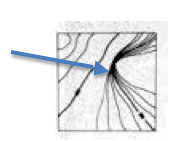
What feature is at the arrow?
a)
volcano
b)
mountain
c)
cliff
d)
river
22.
If contour lines are close together, then the slope is
a)
gentle
b)
steep
c)
flat
d)
going up and down
23.
On a topographic map of a mountain, you walk a longer distance to get to the top when the contour lines are
a)
spread out
b)
close together
c)
going down
d)
going up
24.

What are the two types of crust?

a)

Convergent and Divergent

b)

Lithosphere and Asthenosphere

c)

Continental and Oceanic

d)

Trench and Island Arc

25.

What happens at the boundary where a continental plate and an oceanic plate collide?

a)

The two plates are moving

b)

Mountains develop on edge of the oceanic plate

c)

The continental plate slips under the oceanic plate

d)

The oceanic plate is forced down under the continental plate

26.

How is subduction zone formed?

a)

When two plates slide each past each other

b)

When two plates move away from each other

c)

When two plates move toward each other

d)

When one tectonic plate sinks below another

27.

Why does the oceanic crust sink beneath the continental crust at a subduction boundary?

a)

The oceanic crust is hotter

b)

The oceanic crust has a greater density

c)

The oceanic crust has a lighter density

d)

The oceanic crust has more magnetic composition

28.

What is/are formed when two oceanic plates collide? (Multiple answer)

a)

Trench

b)

Tsunami

c)

Volcanic Island Arc

d)

Mountain Ranges

29.

What geological feature would an continental-continental convergent boundary create?

a)

volcanic mountains

b)

mountains

c)

volcanic islands

30.
Name the boundary
a)
convergent boundary
b)
divergent boundary
c)
transform boundary
d)
sergent boundary
31.
What is represented by the picture? 
a)
Sea-floor spreading
b)
Pangea
c)
How the continents are arranged today
d)
Volcanoes
32.
Name the boundary
a)
convergent boundary
b)
divergent boundary
c)
transform boundary
d)
sergent boundary
33.
Name the boundary
a)
convergent boundary
b)
divergent boundary
c)
transform boundary
d)
sergent boundary
34.
Which type of crust is more dense and thinner?
a)
Continental
b)
Asthenosphere
c)
Oceanic
d)
Byers
35.
What was Wegener's hypothesis called?
a)
The Pangea 
b)
Moving Continents 
c)
The Continental Drift
d)
Techtonic Plates
36.

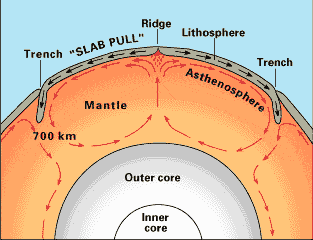
What is the source of energy that drives plate movement?

a)

the subducton of the sea floor

b)

the different densities of the oceanic and crustal plates

c)

convection currents in the asthenosphere

d)

the friction force between the plates that move past each other

37.
Scientists hypothesize that a super continent existed 200 million years ago.  This continent is called
a)
America
b)
Super Earth
c)
Pangea
d)
Eurasia
38.
You an feel the sun's rays on your face as you lay by the beach on a warm summer day.  Which type of heat transfer is this an example of?
a)
Conduction
b)
Convection
c)
Radiation
d)
Radioactive
39.
_______________ Currents within the mantle cause the earth's plates to move and shift s molten material rises and falls due to density and gravity
a)
Convection
b)
Radiation
c)
Conduction
d)
Wind
40.
What type of boundary is the SAN ANDREAS FAULT on?
a)
Covergent
b)
Transformers
c)
Divergent
d)
Transform
41.

Rocks from two different continents that are the same age, show chemical and geological similarities, and both formed by magma are evidence of

a)

coastal erosion

b)

plate tectonics

c)

ocean currents

d)

glacial melting

42.
Gravity attracts all objects towards one another.
a)
False
b)
True
c)
It depends
43.
Which of the following never changes no matter where in the universe?
a)
weight
b)
force
c)
mass
d)
pounds
44.
__________holds all of the planets in orbit around the sun.
a)
Force
b)
Motion
c)
Weight
d)
Gravity
45.
A person would weigh more on Jupiter than on the Earth because---
a)
Jupiter has less mass, and therefore less gravity
b)
Jupiter has more mass, and therefore less gravity.
c)
Jupiter has less mass, and therefore more gravity.
d)
Jupiter has more mass, and therefore more gravity
46.

Which of the following is required for planets to stay in orbit around the Sun? (choose all that apply)

a)

Gravity

b)

Weight

c)

Friction

d)

Inertia (Forward Motion)

47.

What prevents planets from drifting off into space and keeps it in the planets in our Solar System?

a)

Gravity

b)

Weight

c)

Friction

d)

Forward Motion

48.
What are most likely the date of the full moons? (Hint 14 days later)
a)
February 5, March 7, April 5, May 4
b)
February 15, March 17, April 15, May 14
c)
February 25, March 27, April 25, May 24
d)
February 29, March 31, April 29, May 28
49.
Which phases happen immediately before and after the phase shown
a)
Full moon and New moon
b)
Waxing Crescent and Waxing Gibbous
c)
Waxing Crescent and Full Moon
d)
Waxing Gibbous and Full Moon
50.
If the new moon must always be between the sun and Earth where should a student put the "sun"
a)
Position 1
b)
Position 2
c)
Position 3
d)
Position 4
51.
How many days does it take to go from New Moon to New Moon?
a)
28 days
b)
29.5 days
c)
27 days
d)
365 days
52.
What kind of moon is this..
Two weeks have passed since
the new moon. We see the entire face of the moon shining. 
a)
Full Moon
b)
Half moon
53.
What moon phase comes next?
a)
New Moon
b)
Waxing Crescent
c)
First Quarter
d)
Waxing Gibbous
54.
What moon phase comes next?
a)
New Moon
b)
First Quarter
c)
Full Moon
d)
Third Quarter
55.
Differences in the moon's and sun's pull on different sides of the Earth cause _________.
a)
gravity
b)
lunar phases
c)
tides
d)
dabbing
56.
The bulge of water on the side of the Earth closest to the moon produces ___________.
a)
high tide
b)
low tide
c)
neap tide
d)
spring tide
57.
What is a difference between spring and neap tides?
a)
Spring tides occur when the earth and sun are IN LINE with the new or full moon. 
b)
Spring tides occur when moon in 3rd or 1st quarter phases
c)
Spring tides are LOWER than neap tides
d)
Spring tides occur in Spring and neap tides can occur in any season
58.
Which body has the greater effect on Earth's tides?
a)
Sun
b)
Saturn
c)
Moon 
d)
Venus
59.
What type of tide would this arrangement of earth-moon-sun create?
a)
full moon tide
b)
new moon tide
c)
neap tide
d)
spring tide
60.
What causes tides?
a)
gravity
b)
wind
c)
spring
d)
neap
61.
If tides alternate from high to low and there are two of each type of tide a day, about how many hours will generally be between each different tide?
a)
2 hours
b)
6 hours
c)
12 hours
d)
24 hours
62.
The diagram below shows the alignment of the sun, the moon, and Earth. In which locations are neap tides taking place?
a)
1 and 2
b)
1 and 3
c)
2 and 4
d)
3 and 4
63.
How many high tides are there in Myrtle Beach every day?
a)
One
b)
Two
c)
Three
d)
Four
64.
What type of tides would this arrangement of earth-moon-sun create?
a)
neap tide
b)
spring tide
c)
new moon tide
d)
full moon tide