wayground logo

Free Printable Worksheets

Font size

S
M
L
XL
Worksheets

Physical Science Unit 5

Total questions: 125

Worksheet time: 2hrs 5mins

Name
Class
Date
1.

Which graph indicates that one of runners started 10 meters ahead of the other?

a)

A

b)

B

c)

C

d)

D

2.

In which graph are both runners moving at the same velocity?

a)

A

b)

B

c)

C

d)

D

3.

Which velocity-time graph matches the position-time graph?

a)
b)
c)
d)
4.

Which sentence best describes the runner whose velocity-time graph is shown?

a)

The runner ran forward for 2 seconds, and then ran backward for 2 more seconds

b)

The runner ran forward for 4 seconds — slowly for the first 2 seconds, then more quickly for the last 2 seconds

c)

The runner ran forward for 4 seconds — quickly for the first 2 seconds, then more slowly for the last 2 seconds

d)

The runner stood still for 2 seconds, moved suddenly, and then stood still again for 2 more seconds

5.

What is acceleration?

a)

the rate at which speed increases

b)

the time an object’s velocity increases

c)

the rate at which displacement changes

d)

the rate at which velocity changes

6.

Which of the following is an example of negative acceleration?

a)

Mike starts riding his bike and uses the pedals to go from 0 km/h to 20 km/h

b)

Mike pedals up a hill and gradually slows from 20 km/h to 5 km/h

c)

Mike sits on his bike at the top of the hill and rests

d)

Mike coasts downhill without pedaling, going from 0 km/h to 15 km/h

7.

The acceleration at a specific point on a distance-time graph is

a)

instantaneous acceleration

b)

momentary acceleration

c)

positive acceleration

d)

numerical acceleration

8.

If an object experiences a steady velocity change in a straight line, it is undergoing constant acceleration

a)

true

b)

false

9.

A woman jogs 10 kilometers in one hour, stops at a restaurant for one hour, and then walks 10 kilometers in two hours. What is her average speed for the outing?

a)

0.2 km/h

b)

4 km/h

c)

5 km/h

d)

10 km/h

10.

Lisa plotted time on the x-axis of a line graph and distance on the y-axis. What does the slope of her graph represent?

a)

total distance traveled

b)

velocity

c)

speed

d)

displacement

11.

Lisa plotted time in seconds on the x-axis of a line graph and distance in centimeters on the y-axis. Her plot showed a straight line from (0,0) to (10, 20). What is the speed?

a)

0.5 cm/s

b)

2 cm/s

c)

10 cm/s

d)

20 cm/s

12.

Two velocities of an object are combined by using

a)

division of the larger velocity by the smaller velocity

b)

addition of the 2 speeds

c)

vector addition

d)

numeric addition

13.

A kayak is moving across a stream that is flowing downstream at a velocity of 4 km/h. The kayak’s velocity is 3 km/h. What is the magnitude of the kayak’s velocity relative to the river bank?

a)

1.3 km/h

b)

5 km/h

c)

7 km/h

d)

12 km/h

14.

The SI unit for speed of an airplane is miles per hour

a)

true

b)

false

15.

Which graph represents the fastest runner?

a)

A

b)

B

c)

C

d)

D

16.

Which graph indicates that one of the runners started 10 meters ahead of the other?

a)

A

b)

B

c)

C

d)

D

17.

Which sentence best describes the runner whose distance-time graph is shown?

a)

The runner ran forward for 2 seconds, and then backward for 2 seconds

b)

The runner ran forward for 2 seconds, and then stood still for 2 seconds

c)

The runner ran forward for 2 seconds, and then ran forward more slowly for 2 seconds

d)

The runner ran forward for 2 seconds, and then turned right and continued forward at the same speed for 2 seconds

18.

A car is driving down the highway. From which frame of reference does it appear to not be moving?

a)

standing at the side of the road

b)

a car driving at the same speed but going the opposite direction

c)

sitting inside the car

d)

an airplane flying overhead

19.

The SI unit of distance that would be most appropriate for measuring the distance between two cities is the

a)

meter

b)

centimeter

c)

kilometer

d)

mile

20.

If you walk across town, taking many turns, your displacement is the

a)

total distance that you traveled

b)

distance and direction of a straight line from your starting point to your ending point

c)

distance in a straight line from your starting point to your ending point

d)

direction from your starting point to your ending point

21.

You travel 30 miles west of your home and then turn around and start going back home. After traveling 10 miles east, what is your displacement from your home?

a)

20 km

b)

20 km west

c)

40 km

d)

40 km west

22.
Scott drives a Jeep 12 km east, then 4 km north, then finally 3 km west. He traveled a total distance of:
a)
5 km
b)
10 km
c)
13 km
d)
19 km
23.
Distance and direction of an object's change in position from a starting point
a)
displacement
b)
distance
c)
motion
d)
reference point
24.
Liza is swimming laps from one end of a 50 meter pool to the other. Going from one end to the other is considered one lap. If she swims four complete laps, which statement is TRUE?
a)
Her distance and displacement are both zero.
b)
Her distance is zero, but her displacement is 200 meters.
c)
Her distance is 200 meters, but her displacement is zero.
d)
Her distance and displacement are both 200 meters.
25.
Ivan walks 10 meters west to the water fountain, then runs 2 meters east to his class to avoid a lockout. His displacement would be:
a)
8 meters
b)
8 meters, east
c)
8 meters, west
d)
12 meters
26.
During a game of dodgeball, Marina runs 2.45 meters forward to grab a dodgeball, then runs 1.25 meters backward to avoid a opponent's dodgeball. Her displacement would be:
a)
3.7 meters backwards
b)
1.2 meters backwards
c)
3.7 meters forwards
d)
1.2 meters forwards
27.
Ronaldo runs across a soccer field, moving 10 meters north, then 8 meters west. His displacement would be:
a)
10.2 m, NW
b)
12.8 m, NW
c)
15.4 m, NW
d)
18.0 m, NW
28.
Scott drives a Jeep 12 km east, then 4 km north, then finally 3 km west. He traveled a total distance of:
a)
5 km
b)
10 km
c)
13 km
d)
19 km
29.
A ping-pong ball rolls forward 6 meters, and bounces backward 3 meters. It traveled a total distance of:
a)
9 meters
b)
6 meters
c)
3 meters
d)
0 meters
30.

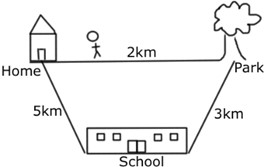
Jerry walked from home to school, then from the school to the park. What is his total displacement?

a)

2 km

b)

5 km

c)

8 km

d)

10 km

31.

Jerry walked from home to school, then from the school to the park. What is his total distance?

a)

2 km

b)

5 km

c)

8 km

d)

10 km

32.

A cat walks 3 meters toward a laser, then jumps 5 meters due south of the laser when it sees a thing. What is the displacement of the cat (to the nearest tenth)?

a)

3.0m

b)

5.0m

c)

8.0m

d)

5.8m

33.
65 miles per hour North is an example of an objects what?
a)
Speed
b)
Velocity
c)
Average Speed
d)
Constant Speed
34.
On a distance vs. time graph, the steeper the slope _____
a)
the slower the speed
b)
the faster the speed
c)
less acceleration
d)
greater acceleration
35.
Total distance divided by total time is
a)
average speed
b)
constant speed
c)
instantaneous speed
d)
acceleration
36.
What is speed?
a)
how far you go
b)
how much distance is covered over a period of time
c)
how fast you accelerate
d)
the change in the location of a object
37.
What is velocity?
a)
the quickness of an object
b)
the location of an object
c)
acceleration
d)
speed in a specific direction
38.
An elevator traveled 15 floors (150 ft) at a speed of 4.5 m/s. What additional information is needed to determine the velocity of the elevator?
a)
the direction the elevator traveled
b)
how long the elevator was stationary
c)
how many times the elevator stopped
d)
the total distance the elevator traveled
39.
Speed is different from velocity because
a)
Velocity has a direction
b)
Speed uses Distance /Time
c)
Velocity doesn't include time
d)
Velocity doesn't include distance
40.
_____ is how fast an object moves in a specific direction.
a)
velocity
b)
speed
c)
displacement
d)
distance
41.
Acceleration is defined as the CHANGE in 
a)
time of motion to another place. 
b)
velocity 
c)
distance 
d)
speed
42.

The rate at which something moves is what?

a)

time

b)

space

c)

sound

d)

speed

43.

What is motion?

a)

the stopping of an object to a frame of reference

b)

a change in position relative to a frame of reference

c)

the middle ground between light and shadow, between science and superstition, and it lies between the pit of man's fears and the summit of his knowledge

d)

a change in the time in which it takes to get an office referral

44.
Ms. Bush drives 50 miles. What does Ms. Bush need to figure out her speed?
a)
The type of car she drives
b)
Her heart rate as she drives
c)
The time she has driven
d)
The direction she was going
45.
A value that only has magnitude (a number)
a)
Scalar
b)
Vector
c)
Speed
d)
Velocity
46.
Of the following, which is a vector?
a)
Mass
b)
Time
c)
Speed
d)
Velocity
47.
A golf ball accelerates off a tee at 15m/s2, changing its velocity from 0m/s to 50 m/s down the fairway. How long did it take the golf ball to accelerate?
a)
750 seconds
b)
35 seconds
c)
0.3 seconds
d)
3.3 seconds
48.
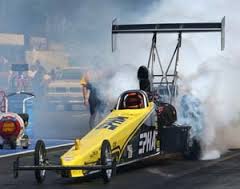
A drag racer accelerated from 0 m/s to 200 m/s in 5 s.  What was the acceleration?
a)
0 m/s
b)
40 m/s2
c)
-40 m/s2
d)
40 m/s
49.
A dog runs with an initial speed of 7.5 m/s on a waxed floor.  It slides to a stop in 15 seconds.  What is the acceleration?
a)
-7.5 m/s
b)
-7.5 m/s2
c)
-0.5 m/s2
d)
7.5 mi//hr
50.
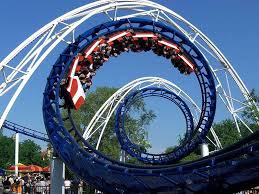
A roller coasters accelerates from an initial velocity of 6.0 m/s to a final velocity of 70 m/s over 4 seconds.  What's the acceleration?
a)
24 m/s2
b)
18 m/s2
c)
16 m/s2
d)
16 m/s
51.
In each of the following cases, determine where the car has no acceleration ?
a)
A car shortly after a stoplight turns green.
b)
A car approaching a red light
c)
A car with the cruise control set at 80 km/h
d)
A car turning a curve at a constant speed
52.
Acceleration can be classified as _______________
a)
Speeding up
b)
Slowing Down
c)
Changing directions
d)
All of the above
53.
Acceleration only takes place when things speed up. 
a)
True
b)
False
54.
Acceleration is defined as the CHANGE in 
a)
time it takes for one place to move to another place. 
b)
velocity of an object.
c)
distance divided by the time interval 
d)
velocity divided by the time interval 
55.
Calculate the average speed (in meter/sec) if a cheetah runs 180 meters in 10 seconds.
a)
198 m/sec
b)
170 m/sec
c)
12 m/sec
d)
18 m/sec
56.
When a car goes around a corner at 20 mph, why do we say it  accelerates?
a)
The car is accelerating because of the velocity is constant
b)
The car accelerates because it's going 20 mph
c)
Cars always accelerate when they are in motion
d)
The car is accelerating because it's changing direction
57.
What is velocity?
a)
the quickness of an object
b)
the location of an object
c)
acceleration
d)
speed in a specific direction
58.
Can be measured in meters per second (m/s)
a)
Distance
b)
Time
c)
Speed
d)
Acceleration
59.
Which of the following is a unit for acceleration?
a)
km/s
b)
m/s2
c)
mi/hr
d)
ft
60.
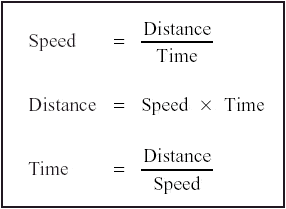
What is the formula to calculate speed?
a)
Speed = time/distance
b)
Speed = distance/time
c)
Speed = distance x time
d)
Speed = time x distance
61.

In which of the following situations would a car be speeding up while traveling forward?

a)

positive velocity and positive acceleration

b)

positive velocity and negative acceleration

c)

negative velocity and positive acceleration

d)

negative velocity and negative acceleration

62.

In which of the following situations would a car be slowing down while traveling backwards?

a)

positive velocity and positive acceleration

b)

positive velocity and negative acceleration

c)

negative velocity and positive acceleration

d)

negative velocity and negative acceleration

63.

A sports car can accelerate from 0 m/s to 28 m/s in four seconds. What is the acceleration of the car?

a)

24s

b)

7 m/s

c)

7 m/s2

d)

24 m/s

64.

When an object resists change, like a body in a turning car, it is called ________________.

a)

inertia

b)

force

c)

friction

d)

drag force

65.
For every action, thereʼs an equal and opposite reaction. *Action-Reaction*
a)
Newton's First Law
b)
Newton's Second Law
c)
Newton's Third Law
d)
force
66.
A force that results from two objects rubbing past each other.
a)
Gravity
b)
Friction
c)
Inertia
d)
Force
67.
The force that pulls objects towards Earth.
a)
Gravity
b)
Friction
c)
Inertia
d)
Force
68.
What is Force?
a)
A Push
b)
A Pull
c)
Jumping
d)
Either a push or pull
69.
 What is the unit called that measures force?
a)
Isaac
b)
Yee
c)
Newton
d)
kilogram
70.
The scientist who is most famous for developing the Laws of Motion is _____.
a)
Albert Einstein
b)
Stephen Hawking
c)
Sir Isaac Newton
d)
Galileo Galilei
71.
An object will accelerate in the direction of the force applied to it.
a)
Newton's 1st Law
b)
Newton's 2nd Law
c)
Newton's 3rd Law
d)
Newton's 4th Law
72.
Which one is balanced?
a)
top
b)
bottom
c)
both
d)
neither
73.

Product of mass of body and acceleration is called

a)

Displacement

b)

Force

c)

Load

d)

Momentum

74.
A 20 kg bike accelerates at 10 m/s2.  what was the force
a)
25
b)
200 N
c)
20 N
d)
10 N
75.
A magician pulls a tablecloth out from under dishes and glasses on a table without disturbing them.
a)
Newton's 1st Law
b)
Newton's 2nd Law
c)
Newton's 3rd Law
76.
This person bought coffee and put it on the seat next to them. If they stopped quickly and the coffee spilled which law would that represent?
a)
Newton's 1st Law
b)
Newton's 2nd Law
c)
Newton's 3rd Law
77.
In the picture, the blocks are flying out of the truck based on which of Newton's laws?
a)
Newton's 1st Law
b)
Newton's 2nd Law
c)
Newton's 3rd Law
d)
Newton's 6th Law
78.
In the picture, the vehicle will move because of...
a)
Newton's 1st Law
b)
Newton's 2nd Law
c)
Newton's 3rd Law
d)
Newton's 9th Law
79.
What law?
a)
1st
b)
2nd
c)
3rd
80.
8 N to the left , and 4 N to the right. Find the net force. Is this balanced?
a)
12 N Right  No
b)
4 N Left  No
c)
12 N Right  Yes
d)
4 N Left  Yes
81.
With unbalanced forces, the object will move in the direction of the _______ force.
a)
larger 
b)
smaller 
c)
equal 
82.
Force pair that has a net force of zero.
a)
Balanced force
b)
Unbalanced force
83.
Which one is balanced?
a)
top
b)
bottom
c)
both
d)
neither
84.
What is the net force?
a)
5000 N right
b)
4000 N right
c)
40 N left
d)
4000 N left
85.
What is the magnitude (size) and direction of the net force?
a)
15 N to the left
b)
15 N to the right
c)
1 N to the left
d)
1 N to the right
86.
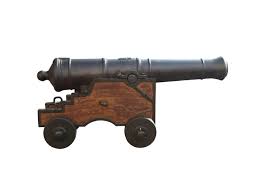
When a cannon fires a cannonball we observe Newton's third law. Which force is the reaction force?
a)
The cannon moving forward
b)
The cannonball moving forward
c)
The cannon moving backward
d)
The cannonball moving backward
87.
According to Newton's second law, if you increase the force applied to an object :
a)
it accelerates more
b)
it doesn't move
c)
you get more inertia
d)
it decelerates
88.
A 20 kg bike accelerates at 10 m/s2.  What was the force?
a)
25 Newtons
b)
20 Newtons
c)
200 Newtons
d)
10 Newtons
89.
Matt measured a small rubber ball and made 3 other balls of the same diameter from lead, foam, and wood. Which has the greatest inertia?
a)
rubber ball
b)
lead ball
c)
foam ball
d)
wood ball
90.
According to Newton’s first law of motion, a moving object that is not acted on by an unbalanced force will
a)
remain in motion.
b)
eventually come to a stop.
c)
change its momentum.
d)
accelerate.
91.
If there are two forces going in the same direction how would you find the net force?
a)
Subtract
b)
Add
c)
Neither
d)
Multiply
92.
In any collision (crash) the ______ is ALWAYS constant
a)
Total Momentum
b)
total speed
c)
total Velocity
d)
Energy
93.
When the speed of an object is doubled, its momentum
a)
remains unchanged in accord with the conservation of momentum.
b)
doubles
c)
quadruples
d)
decreases
94.
Which object listed below has the greatest momentum?
a)
A 0.05 kg object rolling at 0.2 m/s.
b)
A 0.15 kg object rolling at 2 m/s.
c)
A 0.15 kg object rolling at 1 m/s
d)
A 0.4 kg object rolling at 2 m/s.
95.
Which of the following has the least amount of momentum?
a)
An ant walking along the ground
b)
An ant at rest
c)
An elephant walking
d)
An elephant running
96.
What is the unit for momentum?
a)
m/sec
b)
kg/sec
c)
kg/m
d)
kg m/sec
97.
What is the unit for velocity?
a)
m/sec
b)
kg/sec
c)
kg/m
d)
kg m/sec
98.
What is the unit for mass?
a)
m/sec
b)
kg/sec
c)
kg
d)
kg m/sec
99.
Momentum is a ____________________ quantity
a)
science
b)
scalar
c)
vector
d)
energy
100.
Determine the momentum of 1000-kg car moving northward at 20 m/s......... 
a)
20000 N
b)
20000 Joules
c)
20000 Kg * m/s
d)
20000 kg * m/s north
101.
A 0.250 kg cart moving at 0.400 m/s has how much momentum?
a)
0.1 kg-m/s
b)
1 kg-m/s
c)
10 kg-m/s
d)
100 kg-m/s
102.
When two objects collide, the Pbefore is ____________ the Pafter.
a)
more than 
b)
less than 
c)
equal to
d)
unrelated to
103.
A 2.5 kg ball moving at 5 m/s collides with a 2.5 kg stationary ball in a perfectly elastic collision.  What is the velocity of the second ball after the collision? 
a)
5 m/s
b)
2.5 m/s
c)
10 m/s
d)
7.5 m/s
104.
A 9300 kg railroad car traveling at a velocity of 5 m/s strikes a second boxcar that weighs 5000 kg at rest. At what speed will the second boxcar move?
a)
18.6 m/s
b)
9.3 m/s
c)
7.5 m/s
d)
1.86 m/s
105.
A boy kicks a football with a force of 20 N, the time the force acts for is 0.3 s.
Calculate the impulse on the ball.
a)
1 N*s
b)
6 N*s
c)
33.3 N*s 
d)
None of these
106.
The impulse is ______ the change in momentum
a)
Greater than
b)
Equal to
c)
less than
d)
always double
107.
The momentum of an object depends upon the object's ___________&_____________.  
a)
size and shape
b)
mass and speed
c)
mass and veloctiy
d)
mass and energy
108.
The equation to calculate momentum is
a)
p=mv
b)
p=1/2mv2
c)
p=mgh
d)
p=mg
109.
Which has more momentum: a car stopped at a red light or a bike moving at 15 mph?
a)
car
b)
bike
c)
they are equal
d)
cannot determine using the info provided
110.
Determine the momentum of 1000-kg car moving southward at 20 m/s......... 
a)
20000 N
b)
20000 Joules
c)
20000 Kg * m/s south
d)
10000 kg * m/s south
111.
Which of the following has the greatest momentum? 
a)
a scurrying cockroach
b)
a parked semi-truck
c)
more information is needed
112.

Which of the following is not used to reduce friction

a)

wheels

b)

sandpaper

c)

bumpy rocks

d)

bacon grease

113.

The weight of an object varies with the:

a)

pull of gravity

b)

dimensions of the object

c)

volume of the object

114.

Which of the following is not considered a “fluid

a)

air

b)

jean britches

c)

water

d)

flap-jacks

115.

Which of the following best describes two surfaces that are in contact with each other but are not in motion?

a)

kinetic friction

b)

static friction

116.

Which of the following represents a glider going through the air?

a)

fluid friction

b)

static friction

c)

emotional friction

117.

A boat going through the surface of a lake is an example of which type of friction?

a)

rolling

b)

emotional

c)

sliding

d)

fluid

118.

A red 2008 Dodge Ram 1500 driving north bound on I-35 en route home from Kearney Junior High in Kearney Missouri on a warm Wednesday in March in the year 2019 is an example of what type of friction?

a)

emotional

b)

fluid

c)

rolling

d)

sliding

119.

What is static friction?

a)

the friction between two objects that are not moving

b)

friction between a rolling object and the surface that it is rolling on

c)

friction is friction where an object rubs against another surface

d)

friction of something going through any type of liquid or air

120.

What is rolling friction?

a)

friction between two surfaces that aren't moving relatively to each other

b)

friction between a rolling object and the surface that it is rolling on

c)

friction where an object rubs against another surface

d)

friction of something going through any type of liquid or air

121.

What is fluid friction?

a)

friction is friction between two surfaces that aren't moving relatively to each other

b)

friction between a rolling object and the surface that it is rolling on

c)

friction where an object slides rubs against another surface

d)

friction of something going through any type of liquid or air

122.

What is sliding friction?

a)

friction between two surfaces that aren't moving relatively to each other

b)

friction between a rolling object and the surface that it is rolling on

c)

friction where an object rubs against another surface

d)

friction of something going through any type of liquid or air

123.

How could you reduce fluid friction?

a)

add bacon grease to the object

b)

streamline the object

c)

add sandpaper to the object

d)

make the object heavier

124.

How could you reduce sliding friction?

a)

add wheels to the object

b)

add bacon grease to the object

c)

add glue to the object

d)

add motor oil to the object

e)

add bearings to the object

125.

The amount of sliding friction depends on which things?

a)

acceleration

b)

type of surface

c)

weight of the moving object

d)

the rotundness of the man on the pogo stick