
 Worksheets
Physical Science - Motion
Total questions: 130
Worksheet time: 2hrs 59mins
What term is used to describe the speed and direction of an object?
velocity
average speed
instantaneous speed
displacement
Distance and direction of an object's change in position from a starting point
displacement
distance
motion
reference point
Displacement and distance are always the same number
true
false
Scott travels north 5 miles and then goes west 3 miles before coming straight back south 2 miles. What is his distance?
10
7
8
6
Jermaine runs exactly 2 laps around a 400 meter track. What is the displacement?
800
400
0
200
David walks 3 km north, and then turns east and walks 4 km. What is the distance?
7 km
3 km
4 km
1 km
Bill runs 400 meters to Andy's house, turns around, and runs 400 meters back home. What is Bill's distance?
0 meters
400 meters
800 meters
1600 meters
Bill runs 400 meters to Andy's house, turns around, and runs 400 meters back home. What is Bill's displacement?
0 meters
400 meters
800 meters
1600 meters
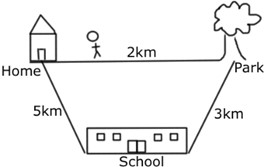
Jerry walked from home to school, then from the school to the park. What is his total distance?
2 km
5 km
8 km
10 km
Jerry walked from home to school, then from the school to the park. What is his total displacement?
2 km
5 km
8 km
10 km
A person walks 50 meters directly north, stops, and then travels 32 meters directly south. What is their displacement?
82 meters
18 meters
28 meters
A persons walks 50 meters directly north, stops, and then travels 32 meters directly south. What is their distance traveled?
82 meters
18 meters
32 meters

What is this graph showing?
Constant Speed
Acceleration (speeding up)
Deceleration (slowing down)
No motion

from 3rd second to 5th second, the object is
moving at a constant speed
speeding up
not moving
slowing down
Velocity is
speed
direction
speed with a direction
scalar
On a distance vs. time graph, the steeper the slope _____
the slower the speed
the faster the speed
less acceleration
greater acceleration

What is this object doing?
speeding up
slowing down
not moving
moving at a constant velocity
What does the slope of a position vs. time graph represent?
the car was going up a hill
the velocity of the object
how far the car moved
how long it took the car
A vehicle travels 2345 m in 315 s toward the evening sun. What is its speed?
7.44 m/s
0.13 m/s
738,675 m/s
7.44m
What distance will a car traveling 65 km/hr travel in 3 hours?
11,700 km
195 km
21.7 km
2.77 km
Jose wandered 4 km at 2 km/hr. How long did Jose wander?
2 hours
8 hours
0.5 hours
2 km
What distance will be traveled if you are going 120 km/hr in 0.50 hours?
3600 km
60 km
4 km
40 km
A train travels 120 km in 2.5 hours. What is its average speed?
60 km/hr
240 km/hr
48 km/hr
300 km/hr
Which of the following statements about speed and velocity is correct?
Velocity only describes an object’s rate of motion.
Speed describes how an object is changing its velocity.
Speed and velocity both describe how an object is speeding up.
Only velocity includes the direction an object is traveling.
How far will a person go if they jog for 2 hours at a speed of 12 km/hr?
6 km
0.5 km
10 km
24 km

A runner races in the 100 meter dash. It takes her 10 seconds to finish. What is her average speed?
10 m/s
1000 m/s
100 seconds
10 seconds

Velocity is different from speed because...
Velocity is distance/time. Speed is displacement/time.
Velocity is speed in a certain direction and can be positive or negative.
Speed is velocity in a certain direction. Both can only be positive.
Velocity is how much speed changes over time.

The slope of this position vs time graph is?
Constant
Increasing
Decreasing
0

The slope of this position vs time graph is...
Constant
Increasing
Decreasing
0
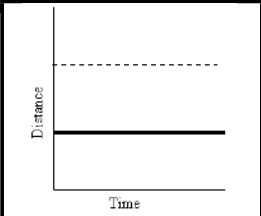
What does this graph represent?
Constant speed
Acceleration
Not moving
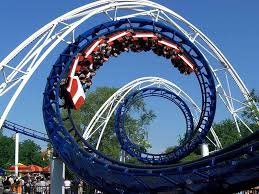
A roller coasters accelerates from an initial velocity of of 6.0 m/s to a final velocity of 70 m/s over 4 seconds. What's the acceleration?
24 m/s2
18 m/s2
16 m/s2
16 m/s

A box sliding down an inclined plane attains a velocity of 27 m/s in 3 seconds from rest. Find the acceleration.
30 m/s
24 m/s2
9 m/s2
81 km/hr
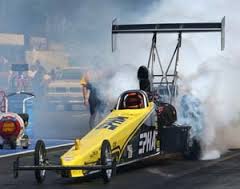
A drag racer accelerated from 0 m/s to 200 m/s in 5 s. What was the acceleration?
0 m/s
40 m/s2
-40 m/s2
40 m/s

A golf ball accelerates off a tee at 15m/s2, changing its velocity from 0m/s to 50 m/s down the fairway. How long did it take the golf ball to accelerate?
750 seconds
35 seconds
0.3 seconds
3.3 seconds
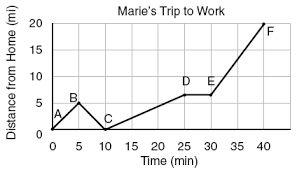
When was Marie driving the fastest?
C to D
D to E
E to F
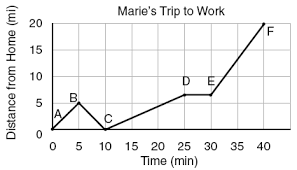
During what period of time was Marie stopped?
0-5 minutes
5-10 minutes
10-25 minutes
25-30 minutes
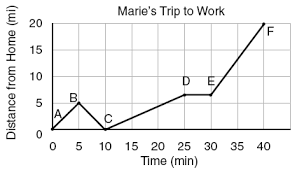
How does her speed at 3 minutes compare with her speed at 7 minutes?
She is driving faster at 3 minutes.
She is driving faster at 7 minutes
She is driving forward at 3 minutes and back at 7.
She is moving up at 3 minutes and down at 7 minutes

This position vs. time graph shows an object...
not moving
moving with constant velocity
moving with changing velocity

This position vs. time graph shows an object...
not moving
moving with constant velocity
moving with changing velocity

This position vs. time graph shows an object...
not moving
moving with constant velocity
moving with changing velocity

This velocity vs. time graph shows an object...
(Hint: For this graph, the velocity is 0 m/s!)
not moving
moving with constant velocity
moving with changing velocity

This velocity vs. time graph shows an object...
not moving
moving with constant velocity
moving with changing velocity

This velocity vs. time graph shows an object...
not moving
moving with constant velocity
moving with changing velocity

This position vs. time graph shows an object...
not moving
moving with constant velocity
moving with changing velocity

This position vs. time graph shows an object...
not moving
moving with constant velocity
moving with changing velocity

This velocity vs. time graph shows an object...
not moving
moving with constant velocity
moving with changing velocity
Which of these position vs. time graphs shows an object changing direction?


This position vs. time graph shows an object...
speeding up
slowing down

This position vs. time graph shows an object...
speeding up
slowing down

The velocity vs time graph below shows an object that is
speeding up
slowing down
moving at a constant velocity
not moving

The velocity vs time graph below shows an object that is
speeding up
slowing down
moving at a constant velocity
not moving

The velocity vs time graph below shows an object that is
speeding up
slowing down
moving at a constant velocity
not moving

The velocity vs time graph below shows an object that is
moving to the left and speeding up
moving to the left and slowing down
not moving
moving at a constant velocity

The velocity vs time graph below shows an object that is
moving to the left and speeding up
moving to the left and slowing down
moving with a constant velocity
not moving

The velocity vs time graph below shows an object that is
moving to the right at a constant velocity
moving to the left at a constant velocity
not moving

A car is moving to the left and speeding up as shown by its velocity versus time graph below. It's acceleration is_____
positive acceleration
negative acceleration
zero acceleration

Refer to the velocity - time graph of a fast moving car below. At what time did the car reverse direction?
at 2 seconds
at 4 seconds
at 6 seconds
at 7 seconds

Refer to the velocity - time graph of an ultra fast moving car below. In which segment is it not moving?
Segment B
Segment D
Segment F

Refer to the velocity - time graph of an ultra fast moving car below. In which segment is it moving with a constant velocity?
Segment B only
Segments F only
Segments B and F only
Segment B, D, and F

Refer to the velocity - time graph of an ultra fast moving car below. In which segment is the car moving to the left (west) and slowing down?
Segment B
Segment D
Segment E
Segment G
What does a flat horizontal line mean on a position vs time graph?
moving fast
object in motionless
gettin faster
coming back to start
Which of the following accurately contrasts velocity and speed?
speed is distance traveled in a certain amount of time. Velocity is time traveled in a certain distance
speed is distance traveled in a certain time. Velocity is speed in a specific direction
Velocity is distance traveled in a certain time. Speed is velocity in a certain direction
velocity is distance traveled in a certain time. Soeed is how fast you're going

Acceleration is defined as the CHANGE in
time it takes for one place to move to another place.
velocity of an object.
distance divided by the time
velocity divided by the time


Where is Cart 1 in relation to Cart 2 when they begin their motion?
Cart 1 is three meters ahead of Cart 2
Cart 1 and 2 are at the same position to start
Cart 1 is three meters behind Cart 2

What is the distance the mouse travelled? What is the mouse's displacement?
7 m; -1 m
-1 m; 7 m
8 m; 0 m
0 m; -1 m
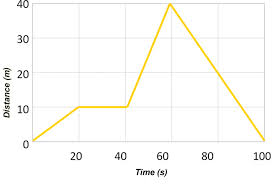

What is a difference between distance and displacement
Distance is measured in seconds and displacement is measured in meters
Distance is always shorter than displacement
Displacement can be equal to zero if the object ends in the place it began in; distance counts every step taken
Distance can be equal to infinite when only a small distance has been travelled
An astronaut travels at a speed of 400 m/s for 250 seconds, what is the total distance he traveled?
0.625 m
100,000 m
1.6 m
650 m
A horse follows a dangling carrot for 20 m, if it took her 50 seconds to reach it, what was her average velocity?
1,000 m/s
2.5 m/s
0.4 m/s
20 m/s
1. Amy runs 2 miles south, then turns around and runs 3 miles north. What is her displacement?
5 miles
1 miles
2 miles
3 miles
1. Amy runs 2 miles south, then turns around and runs 3 miles north. What is her distance?
5 miles
1 miles
2 miles
3 miles
The unit for acceleration is
m2/s
m/s
m/s2
m/s3
If velocity and acceleration are in the same direction an objects ____________.
speeds up
slows done
stops
turns
If velocity and acceleration are in the opposite direction, the object _________.
stops
none
slows down
speeds up
What is the speed of a runner who runs 400 meters in 40 seconds?
10 meters/second
40 meters/second
100 meters/second
1,600 meters/second



When an object’s distance or direction changes from the place where it started, we can say that ________ has occurred.
motion
force
reference point
An original starting point is called a ____________ and it helps us know HOW the object is moving .
reference point
displacement point
motion point
_____ is the total amount of length traveled.
Distance
Displacement
Velocity
Describing the speed of an object often does not completely describe its motion. To accurately describe the motion, we would need to use speed AND direction, which is ________.
velocity
acceleration
reference points
When velocity changes (either the speed, direction, or both) we refer to this change as ________, which is a measure of the change in velocity over a certain period of time.
acceleration
speed
velocity
Jermaine runs exactly 2 laps around a 400 meter track. What is the displacement?
800 meters
400 meters East
0 meters
200 meters SW
from 3rd second to 5th second, the object is
moving at a constant speed
speeding up
not moving
slowing down
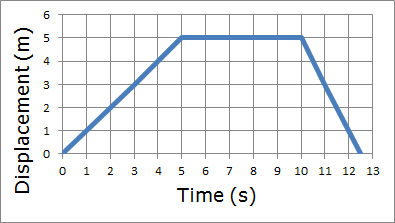
According to the graph how far does the person travel in the first 5 seconds?
2 m
10 m
0 m
5 m
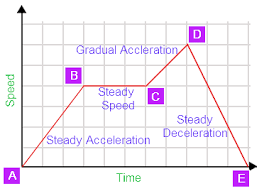
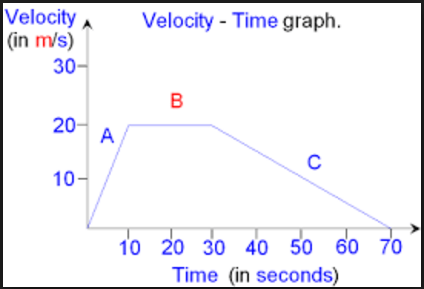
At what point is the speed the greatest?
C-D
B-C
A-B
D-E

What is happening during point A to B?
not moving
increasing speed at a constant rate
moving at a constant speed
moving at 10 m/s2 acceleration

What is happening during point C to D?
not moving
increasing speed at a constant rate
moving at a constant speed
moving at 0 m/s2 acceleration
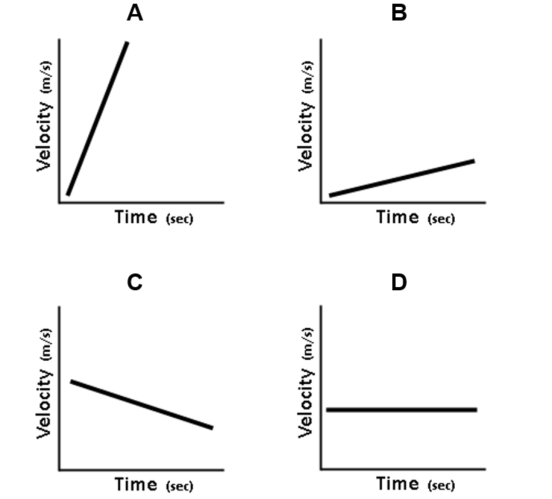
Match the graph to the description:
"The car is traveling at a constant speed."
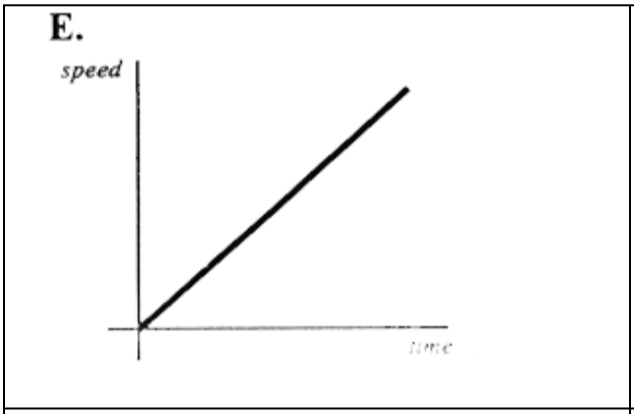
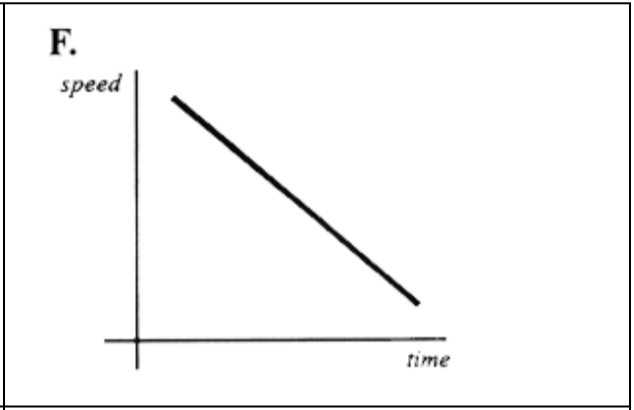
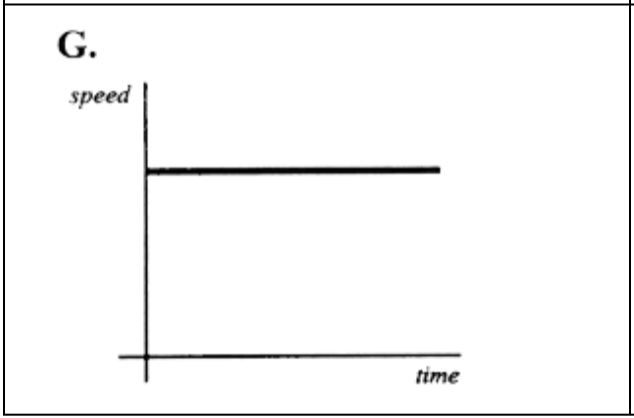
Match the graph to the description:
"The car is accelerating."
Mark slams on the brakes after traveling 25 m/s. It takes him 3 seconds to come to a complete stop. What is his acceleration?
8.33 m/s2
-8.33 m/s2
75 m/s2
-75 m/s2

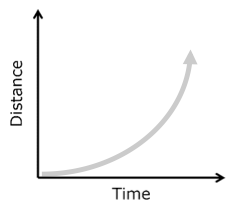

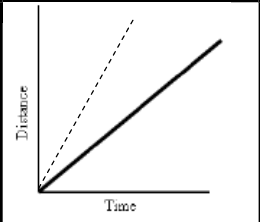
Which swimmer swam the farthest in the time interval?
Swimmer A
Swimmer B
Swimmer C
A _______ line on a distance-time graph means the object is not moving. It is stationary.
horizontal
vertical
The slope of a velocity-time graph is
acceleration
average speed
distance
displacement
Which of the following describes an object's position?
where the object is relative to a reference point
the speed of the object in a particular direction
the line or path along which the object moves
the change in the object's velocity over time
Select the equation for acceleration.


This chart represents the velocity of a motorcycle over time. Select the correct statement regarding the motorcycle's movement.
The motorcycle is speeding up.
The motorcycle has 0 acceleration.
The motorcycle is slowing down.
The motorcycle has constant acceleration.
Which of these objects is NOT accelerating?
A plane slowing down to land
A rocket taking off into space
A hiker moving at the same speed for hours
A rollerblader heading downhill
Velocity has a negative /positive sign for _________, but speed does not.
magnitude
direction
meters
time
What is the speed of a car travelling 50m in 4s?
200 m/s
12.5 m/s
12.5 m
200m
How far does a lorry move if it is travelling at 12m/s for 180s?
2160 m
0.06 m
15 m
21.6 m
How long does it take a car to travel 40m at 12m/s?
4.8 s
480 s
3.33 s
33.3 s

