Wayground logo

Free Printable Worksheets

Font size

S
M
L
XL
Worksheets

Trimester 2: Final Review

Total questions: 46

Worksheet time: 2hrs 32mins

Name
Class
Date
1.
During a physics lab, a plastic strip was rubbed with cotton and became positively charged. The correct explanation for why the plastic strip becomes positively charged is that ...
a)
the plastic strip acquired extra protons from the cotton.
b)
the plastic strip acquired extra protons from the charging process 
c)
protons were created as the result of the charging process
d)
the plastic strip lost electrons to the cotton during the charging process 
2.
Consider the conduction charging shown. 
a)
Electrons move from the insulating stand into the sphere.
b)
Protons move from the bar into the sphere.
c)
Electrons move from the charged metal bar into the sphere.
d)
Protons move from the sphere into the negatively charged bar.
3.
A negatively charged plastic comb is brought close to, but does not touch, a small piece of paper. If the comb and the paper are attracted to each other, the charge on the paper
a)
must be positive
b)
must be negative
c)
may be neutral or negative
d)
may be neutral or positive 
4.
Two electrically charged identical-sized metal spheres, A (charge of -4) and B (charge of +8). If the spheres are brought into contact, which sphere will have a net gain of electrons?
a)
both A and B
b)
neither
c)
only A
d)
only B
5.
When a plastic rod is rubbed with wool, the wool acquires a positive charge because
a)
protons are transferred from the wool to the rod
b)
protons are transferred from the rod to the wool
c)
electrons are transferred from the rod to the wool
d)
electrons are transferred from the wool to the rod
6.
Two electrically neutral metal spheres, A and B, on insulating stands are placed in contact with each other. A negatively charged rod is brought near, but does not touch the spheres, as shown in the diagram below. How are the spheres now charged?
a)
A is positive and B is positive.
b)
A is negative and B is positive.
c)
A is positive and B is negative.
d)
A is negative and B is negative.
7.
Electrostatic force F exists between two point charges. If the both charges are doubled, the force between the charges will be
a)
F
b)
4F
c)
2F
d)
F/4
8.
Which of the following is a false statement about electrostatic force.
a)
Bringing charges closer together strengthen the force.
b)
The electrostatic constant remains the same.
c)
The values of the two charges is always the same.
d)
Electrostatic force can be attractive or repulsive
9.

Electric lines of force about negative point charge are

a)

Circular, anticlockwise

b)

Circular, clockwise

c)

Radial, outward

d)

Radial, inward

10.

Figure shows the electric lines of force emerging from a charged body. If the electric field at A and B are EA and EB respectively and if the displacement between A and B is r then

a)

EA > EB

b)

EA < EB

c)

EA = EB / r

d)

EA = EB / r2

11.
At which point is the electric field the strongest
a)
A
b)
B
c)
C
d)
D
12.
At which point is the electric field the weakest?
a)
A because it is the furthest away
b)
A because the field lines are further apart
c)
C because the field lines are further apart
d)
C  because it is the furthest away
13.
Consider the electric field lines shown in the diagram below. From the diagram, it is apparent that object A is ____ and object B is ____.
a)
+,+
b)
+,-
c)
-,+
d)
-,-
14.
A small, positively charged object near a positively charged sphere is moved closer to the sphere. The electrical potential energy of the small object 
a)
stays the same. 
b)
decreases. .
c)
increases
15.
If two negative charges are held close together and then released, the charges will 
a)
accelerate toward each other.
b)
 accelerate away from each other. 
c)
not move.
d)
move at a constant speed away from each other
16.
This type of circuit only has one path for current to flow. 
a)
series
b)
parallel
c)
combination
d)
split
17.
Which best describes a parallel circuit?
a)
Electricity flows along one pathway.
b)
The flow of electricity comes from one source. 
c)
Electricity flows along more than one pathway. 
d)
The flow of electricity comes from more than one source. 
18.
What kind of circuit is this?
a)
Series
b)
Consecutive
c)
Parallel
d)
Training
19.

What is the total resistance of this circuit

a)

.18Ω

b)

5.45Ω

c)

60Ω

d)

6000Ω

20.
a)

.012Ω

b)

85.9Ω

c)

400Ω

d)

150Ω

21.

What is the total resistance of the circuit?

a)

100Ω

b)

200Ω

c)

.063Ω

d)

15.8Ω

22.

Find the total resistance of the circuit

a)

25Ω

b)

75Ω

c)

100Ω

d)

18.75Ω

23.

Choose right option

a)
b)
c)
d)
24.

Choose the right option.

a)
b)
c)
d)
25.

What will the magnets in the picture do?

a)

Attract

b)

Repel

c)

Neither attract nor repel

d)

Both attract and repel

26.

Magnetic fields are strongest _______.

a)

at both poles

b)

at the north pole

c)

at the south pole

d)

between the poles

27.

Why does a compass needle point north?

a)

because north is up

b)

it lines up with Earth's magnetic field

c)

because of magic

d)

the compass is programmed to do so

28.

Opposite charges _____ and like charges ____.

a)

attract, repel

b)

repel, attract

29.

Are the magnets in this picture attracting or repelling?

a)

Attracting

b)

Repelling

30.

In what direction is the electric current flowing according to right hand rule 2?

a)

Up

b)

Down

c)

Left

d)

Right

31.
The equation to calculate momentum is
a)
p=mv
b)
p=1/2mv2
c)
p=mgh
d)
p=mg
32.
Determine the momentum of 1000-kg car moving southward at 20 m/s......... 
a)
20000 N
b)
20000 Joules
c)
20000 Kg * m/s south
d)
10000 kg * m/s south
33.
A 2.5 kg ball moving at 5 m/s collides with a 2.5 kg stationary ball in a perfectly elastic collision.  What is the velocity of the second ball after the collision? 
a)
5 m/s
b)
2.5 m/s
c)
10 m/s
d)
7.5 m/s
34.
A 9300 kg railroad car traveling at a velocity of 5 m/s strikes a second boxcar that weighs 5000 kg at rest. At what speed will the second boxcar move?
a)
18.6 m/s
b)
9.3 m/s
c)
7.5 m/s
d)
1.86 m/s
35.
Momentum is a ____________________ quantity
a)
science
b)
scalar
c)
vector
d)
energy
36.
A boy kicks a football with a force of 20 N, the time the force acts for is 0.3 s.
Calculate the impulse on the ball.
a)
1 N*s
b)
6 N*s
c)
33.3 N*s 
d)
None of these
37.
The impulse is ______ the change in momentum
a)
Greater than
b)
Equal to
c)
less than
d)
always double
38.
In any collision (crash) the ______ is ALWAYS constant
a)
Total Momentum
b)
total speed
c)
total Velocity
d)
Energy
39.
When the speed of an object is doubled, its momentum
a)
remains unchanged in accord with the conservation of momentum.
b)
doubles
c)
quadruples
d)
decreases
40.
A 0.250 kg cart moving at 0.400 m/s has how much momentum?
a)
0.1 kg-m/s
b)
1 kg-m/s
c)
10 kg-m/s
d)
100 kg-m/s
41.

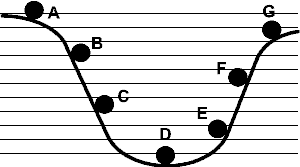
At which point does the ball has the greatest gravitational potential energy (GPE)?

a)

A

b)

G

c)

D

d)

C

e)

G

42.

You throw a ball into the air as shown in the diagram. At what point does the ball have the most gravitational potential energy?

a)

W

b)

X

c)

Y

d)

Z

43.

Calculate the gravitational potential energy of a 0.88kg bird flying at an altitude of 550m.

a)

4.74 x 10³ J

b)

2.80 x 10³ J

c)

Both answers are correct

d)

None of the answers are correct

44.

What is the Total Mechanical Energy at point A?

a)

500,000 J

b)

400,000 J

c)

200,000 J

d)

50,000 J

45.

What is the Kinetic Energy at point D?

a)

500,000 J

b)

250,000 J

c)

300,000 J

d)

50,000 J

46.
You drop a 5 kg ball from a height of 2 m. Just before it reaches the ground, how much kinetic energy does it have?
a)
10 J
b)
100 J
c)
7 J
d)
20 J