wayground logo

Free Printable Worksheets

Font size

S
M
L
XL
Worksheets

Chemistry Review

Total questions: 75

Worksheet time: 3hrs 30mins
Name
Class
Date
1.

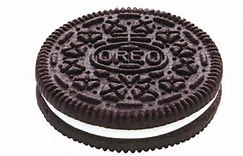
An oreo cookie has a mass of 20 grams. It gets crushed into crumbs for a recipe. What is the mass of the crumbs?

a)

15 grams

b)

25 grams

c)

20 grams

2.

If reaction starts with 20g of reactants, it will produce ---

a)

a total of 40g of product

b)

a total of 10g of product

c)

a total of 80 g of product

d)

a total of 20g of product

3.

How many molecules are represented in the formula 3CO2?

a)

3 carbon, 2 oxygen

b)

6 carbon dioxide

c)

3 carbon dioxide

d)

3 carbon, 6 oxygen

4.

What will have more mass when a chemical change is complete: the reactants before the chemical reaction or the product after the reaction is complete?

a)

They both will have the same mass

b)

The product always has more mass than the reactant

c)

The reactant will have more mass than the product

d)

They both will lose mass after the reaction

5.

Which of the following is NOT part of the Law of Conservation of Matter?

a)

Matter cannot be created or destroyed

b)

Matter can be rearranged

c)

Fire converts matter to heat

d)

Matter can change phase; go from a solid to a liquid to a gas

6.

How do particles move if in a solid?

a)

Not at all.

b)

Quickly

c)

Slow

d)

They don't move they vibrate

7.

What state is ice?

a)

solid

b)

liquid

c)

gas

8.

What happens to a peice of ice when it is heated?

a)

melts

b)

freezes

c)

evaporates

9.

What state of matter is this?

a)

solid

b)

liquid

c)

gas

10.

Does a solid have a fixed shape?

a)

yes

b)

no

11.

Does liquid have a fixed shape?

a)

yes

b)

no

12.

Does gas have a fixed shape?

a)

yes

b)

no

13.

What state of matter is this?

a)

solid

b)

liquid

c)

gas

14.

What happens to liquid when it is heated?

a)

freezes

b)

turns to gas (water vapor)

c)

nothing

15.

What are the three states of matter?

a)

solid, liquid, gas

b)

soft, hard, medium

c)

pink, purple, blue

16.
Properties of matter that do not change the matter into something else. Odor, smell, color.
a)
Physical Properties
b)
Physical Education
c)
Physical Changes
17.
Cutting a carrot, melting an ice cube, sanding wood are...
a)
malleability
b)
physical changes
c)
ductility
18.
The ability of a substance to be pounded or rolled into thin sheets.
a)
ductility
b)
solubility
c)
malleability
d)
density
19.
The ability of a substance to be pulled into a wire.
a)
thermal conductivity
b)
melting
c)
ductility
20.
A change in matter that does not change the identity of the matter. Ice melting, bending a nail.
a)
physical change
b)
physical property
21.

Which is a chemical property of matter?

a)

Reactivity

b)

Color

c)

Density

d)

Solubility

22.

Which is NOT an example of a chemical property?

a)

Water is a liquid at room temperature.

b)

Vinegar bubbles when baking soda is added.

c)

Wood burns when exposed to fire.

d)

Apple slices turn brown.

23.
The definition: Two or more atoms bonded together, representing the smallest unit of a chemical compound that can take part in a chemical reaction, best matches
a)
molecule
b)
atom
c)
mixture
d)
element
24.
The definition: an expression which states the number and type of atoms present in a molecule of a substance, best describes 
a)
chemical formula
b)
chemical symbol
c)
chemical equation
d)
group or family
25.
In Cl2, the 2 is known as
a)
the subscript.
b)
the coefficient.
c)
the molecular mass.
d)
the number of protons.
26.
N2, Cl2, and O2 are all 
a)
gases.
b)
solids.
c)
in the same family.
d)
safe to breathe.
27.
N2, Cl2, and O2 are all 
a)
diatomic molecules.
b)
ionic bonds.
c)
of equal mass.
d)
solids.
28.
Oxygen is commonly found as 
a)
a solid-O
b)
a gas-O2
c)
unknown
29.
Chlorine, bromine, fluorine, and iodine are all 
a)
nonmetals and good conductors.
b)

nonmetals and halogen.

c)
metals and bad conductors.
d)
metals and malleable.
30.
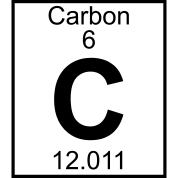
What does the 6 represent?
a)
atomic mass
b)
atomic number
c)
element name
d)
chemical symbol 
31.
What does 12.011 represent?
a)
atomic mass
b)
atomic number
c)
element name
d)
chemical symbol 
32.
What does the C represent?
a)
atomic mass
b)
atomic number
c)
element name
d)
chemical symbol 
33.
These are found on the Periodic Table.
a)
Compounds
b)
Elements
c)
Mixtures
34.

the basic structural unit of matter

a)

atom

b)

matter

c)

element

d)

nucleus

35.

a collection of atoms of one type that cannot be broken down into simpler substances by ordinary chemical or physical means

a)

element

b)

subatomic particle

c)

electron

d)

matter

36.

the positively charged subatomic particle contained in the nucleus of an atom

a)

proton

b)

neutron

c)

electron

d)

matter

37.

a subatomic particle, contained in the nucleus of an atom, having the same mass as a proton but no electrical charge

a)

proton

b)

neutron

c)

electron

d)

matter

38.

a negatively charged subatomic particle that orbits the nucleus of an atom

a)

proton

b)

neutron

c)

electron

d)

matter

39.

a unique number for each element that equals the number of protons in an atom of that element

a)

element name

b)

element symbol

c)

atomic number

d)

atomic mass

40.

the mass of an atom, calculated by adding the number of protons and neutrons

a)

atomic mass

b)

element symbol

c)

atomic number

d)

mass number

41.
The atomic number of this pictured element is
a)
28
b)
58.6934
c)
Ni
d)
Nickel
42.
What is the atomic mass of Neon?
a)
10
b)
30
c)
10.18
d)
20.18
43.
How many protons are in this element?
a)
79
b)
196
c)
117
d)
Cannot be determined
44.

What is the mass number?

a)
79
b)
196
c)

197

d)

196.967

45.
How many neutrons are in a Gold atom?
a)
79
b)
196
c)
118
d)
275
46.
The horizontal row on the periodic table is called a
a)
group
b)
family
c)
period
d)
atomic number
47.
A vertical column is called...
a)
group
b)
tower
c)
period
d)
crew
48.
Pure forms of these elements are stored in oil so they won't react with oxygen and water in the air.
a)
Alkali Metals
b)
Alkaline-earth metals
c)
Halogens
d)
Noble Gases
49.
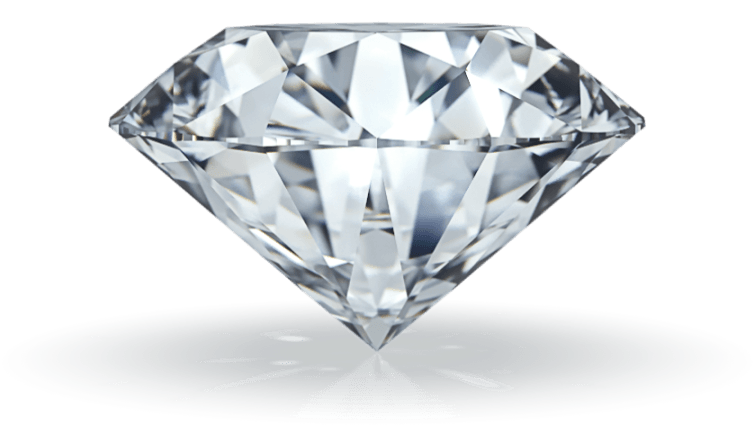
Diamonds are a pure form of what element?
a)
Carbon
b)
Oxygen
c)
Silicon
d)
Silver
50.
What group of elements don't have individual names?
a)
Alkaline-earth Metals
b)
Transition Metals
c)
Alkali Metals
d)
Halogens
51.
Most of the elements on the periodic table are classified as _____.
a)
Metals
b)
Nonmetals
c)
Metalloids
d)
Periods
52.
This class of elements are sometimes called "semiconductors."
a)
Metals
b)
Nonmetals
c)
Metalloids
d)
Groups
53.

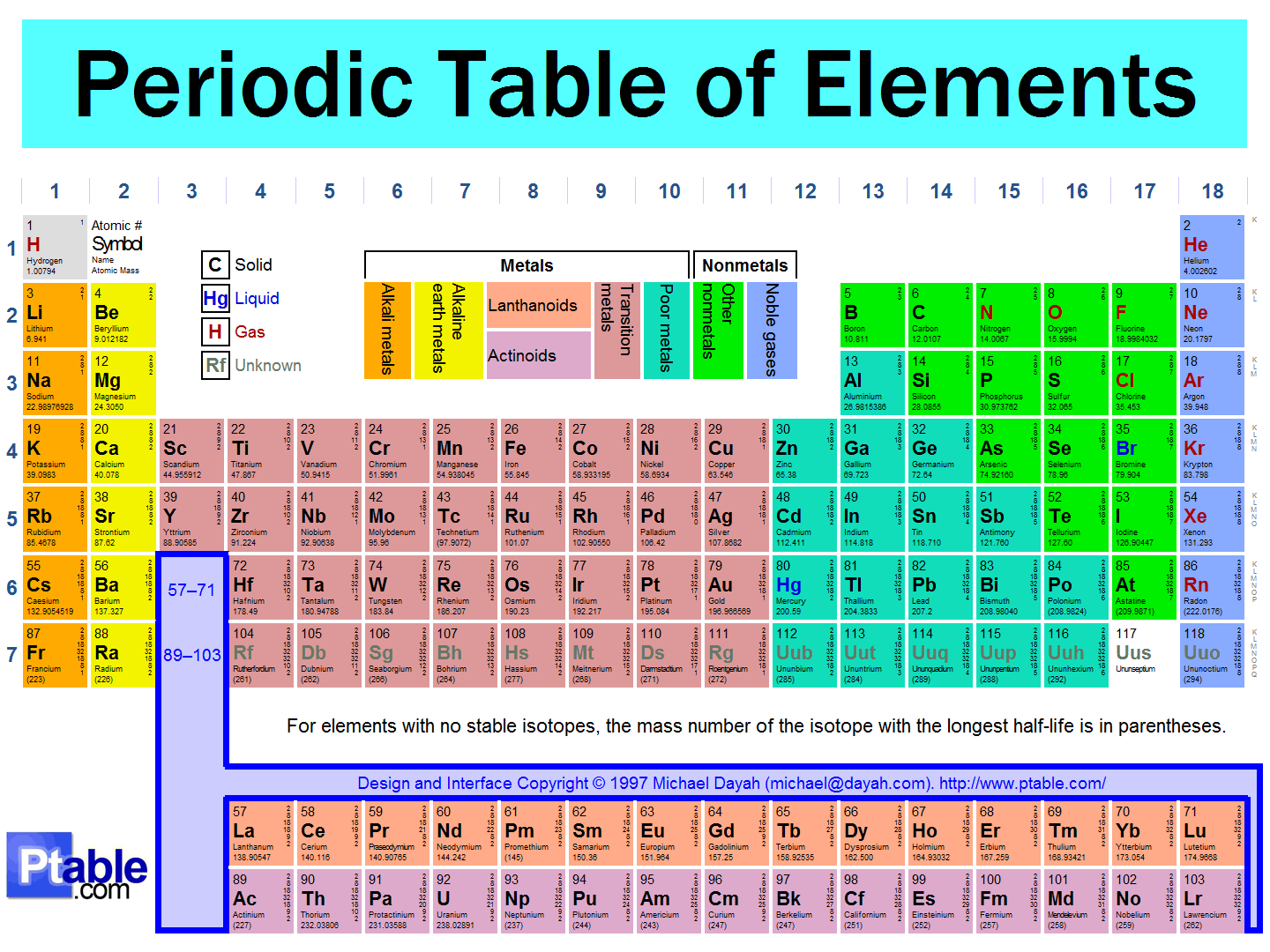
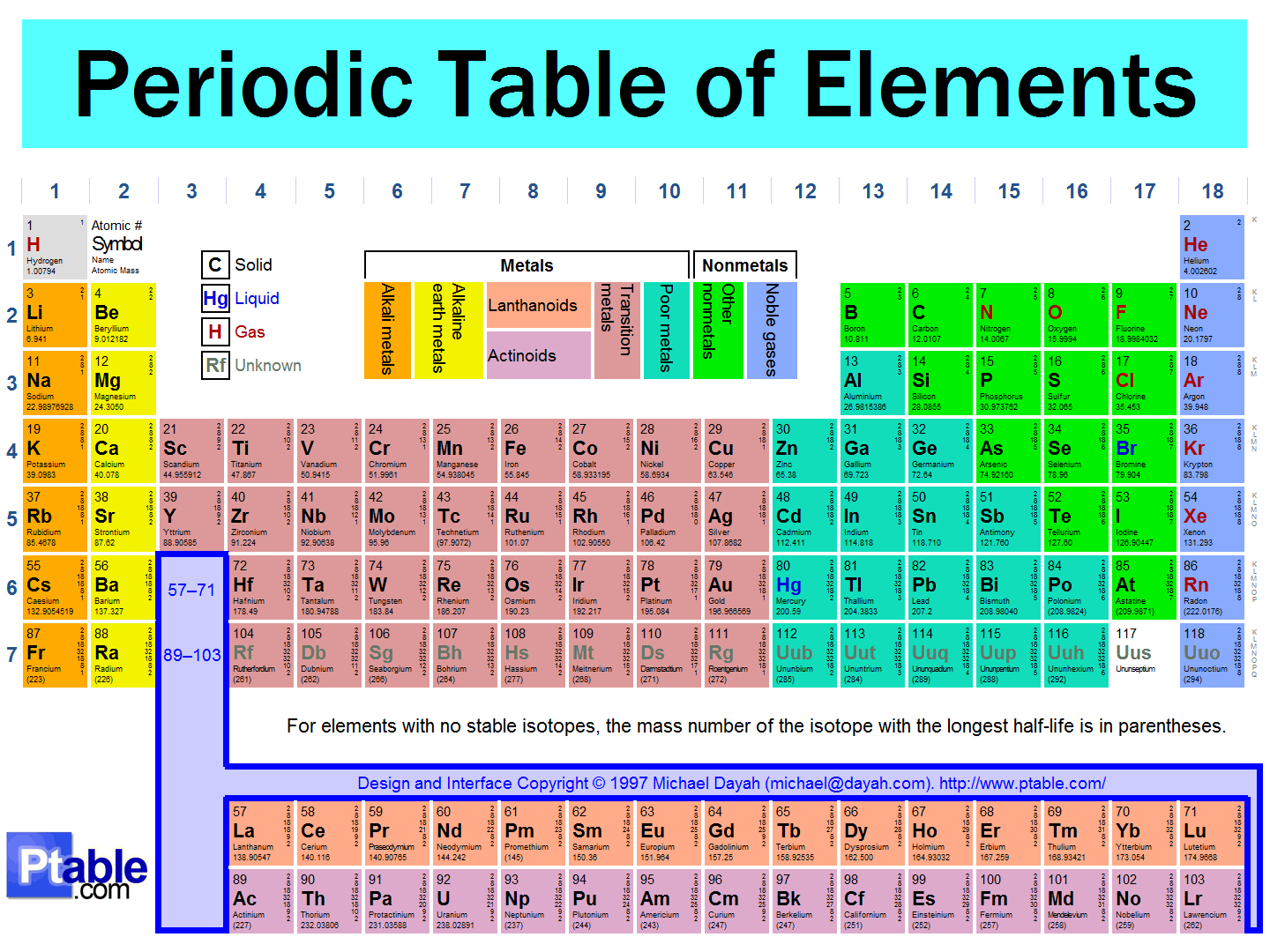
What is the name of the element? (Periodic table will be needed)

a)

sodium

b)

magnesium

c)

vanadium

54.

What group and period does this element belong in? *

a)

period 1 and group 3

b)

period 3 and group 1

c)

period 2 and group 3

d)

period 3 and group 2

55.

How many protons and electrons does nickel have?

a)

28

b)

58.69

56.

What is the atomic mass?

a)

59

b)

58.693

c)

28

57.
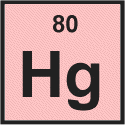
What is the atomic number of this element?
a)
4
b)
80
c)
79
d)
8
58.
What is the symbol for Potassium?
a)
P
b)
K
c)
Pb
d)
Pd
59.
What is the symbol for Carbon?
a)
C
b)
Ca
c)
Cl
d)
H
60.
What is the name of this element?
a)
Helium
b)
Rubidium
c)
Hydrogen
d)
Mercury
61.
Which one of these is not a noble gas?
a)
Helium
b)
Radon
c)
Iodine
d)
Krypton
62.
What is the atomic number of Rubidium?
a)
37
b)
44
c)
45
d)
86
63.
What is the atomic number of Oxygen?
a)
6
b)
7
c)
8
d)
9
64.
Which one of these is the symbol for lead?
a)
Rb
b)
Pb
c)
Li
d)
Au
65.
Which one of these elements is found in electrical cord?
a)
Cu
b)
H
c)
Kr
d)
Br
66.
What family is Sodium a part of?
a)
Transition Metals
b)
Halogens
c)
Alkali Metals
d)
Alkaline Earth Metals
67.
What two elements come together to make this substance in the picture?
a)
Oxygen and Carbon
b)
Sodium and Calcium
c)
Sodium and Chlorine
d)
Helium and Nitrogen
68.
If you were working out you would be "pumping _______."
a)
I
b)
Fe
c)
Mg
d)
Y
69.
What family is silver a part of?
a)
Transition Metals
b)
Noble Gases
c)
Alkali Metals
d)
Alkaline Earth Metals
70.
What family is Cadmium a part of?
a)
Noble Gases
b)
Metalloids
c)
Transition Metals
d)
Actinoids
71.
Silicon is a 
a)
Metal
b)
Nonmetal
c)
Metalloid
d)
Halogen
72.
__________ would have some characteristics of metals and some characteristics of nonmetals.
a)
Gold
b)
Sodium
c)
Arsenic
d)
Bismuth
73.
___________ is the only metal that is a liquid at room temperature.
a)
Platinum
b)
Water
c)
Tin
d)
Mercury
74.
Which element that starts with a B is an Alkaline Earth Metal?
a)
Barium
b)
Boron
c)
Bread
d)
Bromine
75.
What element is this?
a)
Silver
b)
Silicon
c)
Sulfur
d)
Selenium