wayground logo

Free Printable Worksheets

Font size

S
M
L
XL
Worksheets

Macroevolution Review

Total questions: 60

Worksheet time: 4hrs 25mins

Name
Class
Date
1.

Who is most closely related to Taxidea taxus?

a)

Lutra lutra

b)

Panthera pardus

c)

Canis latrans

d)

Canis lupus

2.

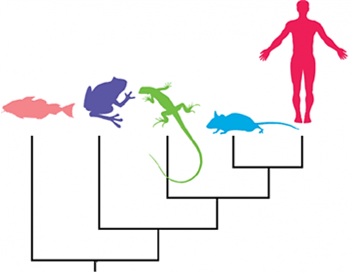
According to this phylogenetic tree, which creature is the least related out of all pictured?

a)

Fish

b)

Frog

c)

Salamander

d)

Human

3.

Which of these animals does not have/produce an amniotic egg?

a)

Turtle

b)

Leopard

c)

Lamprey

d)

All three of these animals produce the amniotic egg

4.

What is the name for the "trait" shown on these tree, such as "egg shells" and "four limbs"?

a)

Derived characteristics

b)

Trait nodes

c)

Branching elements

d)

Harmonious changes

5.

According to this image, when did the ancestors of Indohyus and Pakicetus diverge?

a)

52 million years ago

b)

56 million years ago

c)

25 million years ago

d)

47 million years ago

6.

The lizard has all these derived characteristics EXCEPT

a)

Jaws

b)

Lungs

c)

Bipedal

7.

You look at two species and see very similar DNA. What does this likely tell you?

a)

These are the same animal.

b)

These animals are not likely related.

c)

These animals have a common ancestor.

8.

What number is the common ancestor of C and D

a)

1

b)

2

c)

4

9.

What is the common ancestor of Letters A, B, C, D, E?

a)

1

b)

2

c)

3

10.
Two organisms that are closely related would have
a)
very similar DNA sequence
b)
exactly the same DNA sequences
c)
no proteins in common
d)
completely different DNA sequence
11.
The diagram shows fossils in different rock layers. Which of these statements about the age of these fossils is most likely correct?
a)
Fossil A and C are the same age
b)
Fossil B is older than fossil C
c)
Fossils A is older than fossil B
d)
Fossil D is older than fossil C
12.

What is common ancestry?

a)

When a species no longer exists

b)

When organisms are descended from a single ancestor
13.
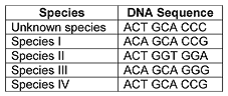
According to this data, the unknown bacterial species is most closely related to: 
a)
Species I
b)
Species II
c)
Species III
d)
Species IV
14.

What biome is this?

a)

Taiga

b)

Desert

c)

Tundra

d)

grassland

15.

What biome is this

a)

tundra

b)

deciduous forest

c)

desert

d)

grassland

16.

What biome is this?

a)

deciduous forest

b)

taiga

c)

desert

d)

grassland

17.

What biome is this?

a)

Deciduous forest

b)

Rain forest

c)

Taiga

d)

Tundra

18.

This biome is very hot all year long, found close to the equator, and has high amounts of rain fall.

a)

Rain forest

b)

Deciduous forest

c)

Taiga

d)

desert

19.

This biome has very little rainfall, also extremely cold temperatures for most of the year, and frozen soil makes ponds form.

a)

Deciduous forest

b)

Tundra

c)

rain forest

d)

Grassland

20.

This biome has trees that lose their leafs in the winter, experiences four seasons, and gets enough rain to support the growth of trees.

a)

Rain forest

b)

Taiga

c)

Grassland

d)

Deciduous forest

21.

This biome has very little precipitation throughout the year, often experiences big differences in temperature from day to night, and has very little plant or animal life.

a)

Tundra

b)

Taiga

c)

Rainforest

d)

Desert

22.

Age of a rock compared to the ages of other rocks, such as "this rock is older than the rest in the area".

a)

Absolute Age

b)

Law of Superposition

c)

Relative Age

d)

Unconformity

23.

In undisturbed horizontal layers of sedimentary rock, the oldest rocks are found at the bottom. Each higher layer is younger than the layer(s) below it.

a)

absolute age

b)

law of superposition

c)

relative age

d)

unconformity

24.

Radiocarbon dating is more exact than relative dating (ex: law of superposition)

a)
True
b)
False
25.
Scientist think the Earth is ___ years old.
a)
4,500
b)
45,000
c)
4.5 million
d)
4.5 billion
26.
  A _____________________ is the remains or evidence of an   ancient organism.
a)
paleontologist 
b)
 fossil
c)
preserved
d)
extinct
27.
T/F? The climates change over time.
a)
True
b)
False
28.
The bottom layer is listed as the oldest. The top layer is listed as the youngest. What is this called?
a)
mineral content
b)
radioactive decay 
c)
the law of superposition 
d)
the principle of unconformity 
29.
Which type of cell came first?
a)
Eukaryotic
b)
Prokaryotic
c)
Plant
d)
Both Eukaryotic and Prokaryotic cells evolved around the same time
30.

Earliest traces of life found

a)

2.1 billion years ago

b)

3.5 billion years ago

c)

4.6 billion years ago

d)

5.3 billion years ago

31.

If two organisms are closely related, then they will

a)

share more characters

b)

have a distant common ancestor

c)

have a recent common ancestor

d)

share few characters

32.

What were the first forms of life?

a)

Stromatolites

b)

Bacteria

c)

Sponges

d)

Trilobites

33.

Cells with a defined nucleus are

a)

brown algea

b)

prokaryotes

c)

green algea

d)

eukaryotes

34.
Which period are we currently in?
a)
Quaternary
b)
Holocene
c)
Jurassic
d)
Tertiary
35.

The earliest stages of development in a chicken and fish have gill slits and a tail.

a)

fossil evidence

b)

analogous structures

c)

biochemical/molecular evidence

d)

comparing embryo structure

36.

The leg bones of a whale are present, even though they are no longer in use.

a)

similar embryos

b)

vestigial structures (comparing anatomy)

c)

comparing cell structures

d)

comparing biochemistry/molecular evidence

37.

The flipper of a whale and the arm of a human have a similar bone structure, but different functions.

a)

similar cell structures

b)

homologous structures (similar anatomy)

c)

similar embryos

d)

biochemical/molecular evidence

38.

Some humans have a non-functional muscle in their arm(s) called the palmaris longus.

a)

analogous structures

b)

molecular evidence

c)

vestigial structures

d)

comparing embryos

39.
According to the theory of biological evolution, most present-day species of organisms... 
a)
developed from similar, smaller prehistoric organisms 
b)
have always existed in the form they have today 
c)
developed from fossils of the other organisms 
d)
descended from earlier, different species of organisms
40.

The base sequence in the DNA of chimpanzees and humans is 99% similar.

a)

biochemical/molecular evidence

b)

comparing anatomy

c)

comparing embryos

d)

fossil evidence

41.

Which can be used as evidence for evolution (change over time)?

a)

Fossils

b)

Homologous Structures

c)

Embryo Similarities

d)

Biochemical Analysis

e)

All are examples of evidence of evolution

42.
Whales are aquatic mammals that contain a pelvis bone.  Even though it does not aid in its movement, the function must have been used by a common ancestor of the whale.  Thus, the pelvis is referred to as a(n)
a)
vestigial structure
b)
analogous structure
c)
homologous structure
43.
How would you describe this evolution?
a)
Homologous structure
b)
Analogous structure
c)
Structural adaption
d)
Functional adaption
44.
When scientists compare animals currently living on different continents, they often find those with similar characteristics, who are not actually close relatives, living in similar environmental conditions even though they are geographically very distant. One example is the Anteater/Armadillos of the Americas and the Pangolin of Africa. What can we deduce from this evidence?
a)
Living things can adapt similarly to similar environments over time.
b)
Living things do not change over time
c)
They must all have the same recent common ancestor
d)
I don’t know
45.
The Table below shows the # of differences in amino acids in a protein called “Cytochrome C” when comparing humans to other organisms. 
List the 4 closest human relatives based on this biochemical comparison.
a)
chimpanzee, horse, rattlesnake, snapping turtle
b)
chimpanzee, gorilla, rhesus monkey, horse
c)
fruit fly, bread mold, tuna fish, snapping turtle
d)
gorilla, rhesus monkey, rattlesnake, gorilla
46.
When scientists compare the amino acid sequences for the red blood cell protein hemoglobin between various species, what can they determine about the evolutionary relationship between the species?
a)
It can be determined how efficient hemoglobin is for different species
b)
It can provide evidence about the relatedness of the different species: if they are more similar they have a more recent common ancestor.
c)
It cannot determine relatedness between different species, only individuals of the same species
d)
It can show which species evolved first
47.
The diagram above shows an embryo of different vertebrates at different stages of development. Which field of study would support the similarities in development as evidence for evolution?
a)
comparative biochemistry
b)
paleontology
c)
comparative biogeography
d)
comparative anatomy
48.
How do fossils provide evidence that evolution has happened on Earth?
a)
Fossils show how the sizes of certain animals has changed drastically over millions of years
b)
Fossils show that some species have gone extinct
c)
Fossils show how life forms present today are different than those from the past
d)
Different sedimentary rock layers provide evidence for how the environment has changed over time
49.
Scientists compare organisms' DNA to support the theory that all species share a common _________________
a)
separation
b)
ancestor
c)
population
d)
environment
50.

Recently, scientists have been able to use ___________to find common proteins and amino acids to determine how closely related species are.

a)

DNA

b)

Vestigial structures

c)

Fossils

d)

Homologous structures

51.

The three species pictured do not share a common ancestor, yet have evolved to have a similar anatomy and life style. This is an example of ?

a)

Homologous Structures

b)

Divergent Evolution

c)

Vestigial Organs

d)

Convergent Evolution

52.

The three species pictured share a common ancestor and have adapted so that each lives in a different environment. This is an example of

a)

Law of Superposition

b)

Evolutionary Arms Race

c)

Divergent Evolution

d)

Convergent Evolution

53.

The yucca moth depends on the small soap weed for food, and the small soap weed is only pollinated by the yucca moth. This is an example of

a)

Evolutionary Arms Race

b)

Convergent Evolution

c)

Coevolution

d)

Adaptive Radiation

54.
In convergent evolution, organisms share physical similarities because they 
a)
have a common ancestor
b)
live in the same enviornment
c)
develop homologous structures
d)
are closely related 
55.
a)
The image shows analogous structures.
b)
The image shows convergent evolution.
c)
The image shows adaptive radiation. 
d)
The image shows organisms that are not closely related.
56.
What type of evolution where there is a sudden, rapid change then no change for a long time?
a)
Co-Evolution
b)
Punctuated Equilibrium
c)
Divergent Evolution
d)
Convergent Evolution
57.

Evolution occurring quickly due to catastrophic events

a)

Homeostasis

b)

Gradualism

c)

Statsis

d)

Punctuated Equilibrim

58.
a model that describes evolution as a slow, ongoing process by which one species changes to a new species. 
a)
osmosis
b)
gradualism
c)
homologous
59.

Gradualism occurs when geologic and climatic conditions are _______________.

a)

stable

b)

unstable

c)

long

d)

short

60.

Which form of evolution can occur quickly?

a)

gradualism

b)

punctuated equilibrium

c)

allopatric speciation

d)

sympatric speciation