
 Worksheets
Introduction to matter
Total questions: 110
Worksheet time: 1hrs 11mins

Characteristics of substances that can be observed without changing it into another substance.
physical properties
chemical properties
molecular properties
elemental properties

A mixture in which you can usually see the different parts and they can easily be separated out.
heterogenous
homogenous
hemigenous
halogenous

Weight is the measure of the force of _______ on an object.
gravity
mass
air
molecules

The basic SI unit for measuring the volume of a solid.
cubic meter ( m3 )
milliliter ( mL )
cubic centimeter ( g/cm3 )
gram ( g )

Length x width x height =
volume of a solid
density of a solid
volume of a liquid
density of a solid

Baking a cake is an example of a
chemical reaction
physical reaction
homogeneous reaction
heterogeneous reaction

The measure of how hot or cold an object is.
temperature
electrolysis
tarnishment
molecular density
The way a substance feels is called _____________.
texture
soft
squishy
bumpy
Weather a substance is a solid, liquid or gas is a way to describe the substances________________ ___________.
Physical State
Chemical Properties
Physical Change
Ice, water, water vapor
The __________________ at which a substance changes its state of matter is called the freezing, melting or boiling point.
Celsius
Farenheit
Thermometer
Temperature
Luster is a physical property of matter that describes how ______________ the substance is.
fancy
hard
metally
shiny
__________________ describes how tightly packed the particles are within a substance.
Density
Mass
Weight
Volume
___________ is a physical property of matter that describes the smell of a substance.
stinky
fumes
odor
really stinky
____________________- is how well _____________ and heat pass through a substance.
conductivity
heat
radiation
electricity
Magnetism- The ability of a substance to be ______________ and __________ by a magnet.
attracted
pushed
repelled
opposites
A ____________ __________________ of matter is a characteristic that can only be observed by changing the chemical make up of a substance.
Physical Property
Inherited Trait
Hydrogen Gas
Chemical Property
A ____________ __________________ of matter is a characteristic that can be observed without changing the chemical make up of a substance.
Physical Property
Chemical Property
magnetic attraction
new type
Weight measures ________________.
density
gravitational force
pressure
mass
The amount of space that an object occupies.
density
mass
volume
weight
Anything that has a mass and takes up space.
density
mass
matter
volume
Amount of matter in an object
density
mass
volume
weight
Find the mass of an object having 2.75 cm^3 volume and 3.25 g/cm^3 density.
8.38 g
8.94 g
6.37 g
6.38g
How will you measure volume of an irregular shape object?
by using a ruler
by using a weighing scale
by using water displacement
by using a thermometer
Formula used to solve volume?
V= l+w+h
V= lw/h
V= M/D
V = h/lw
Which of the following instrument you will used to measure mass?
ruler
thermometer
triple beam balance
graduated cylinder
Which quantity is not changing in any location?
mass
weight
gram
measurement
__________ is a measure of the gravitational force on an object.
weight
mass
matter
volume
What happens to a substance with an increase in temperature?
it gains energy
it loses energy
its energy stays the same
Which of the following is not a physical property?
hardness
flammability
texture
malleability
Which of the following is a chemical property?
magnetism
luster
ductility
acidity
What is the simplest, pure substance that cannot be broken down into another substance?
element
atom
mixture
compound
Coffee is a ___________________.
homogenous mixture
heterogeneous mixture
Chicken broth is a _______________.
homogenous mixture
heterogeneous mixture
Spaghetti and meatballs is a ___________________.
homogenous mixture
heterogeneous mixture
Chocolate milk is a ______________.
homogenous mixture
heterogeneous mixture
George is writing a newspaper article about the fire at the local library. His introductory paragraph has an example of conservation of mass. "Our town library dealt with a terrible fire in one of its rooms over the weekend. The room contained much-loved books and magazines. Firefighters rushed to the scene, but were too late. All that remained of the books and magazines were ash, water vapor, and carbon dioxide fumes. The mayor arrived soon afterward and urged everyone to donate to help rebuild this important community building." Which sentence has an example of the law of conservation of mass?
All that remained of the books and magazines were were ash, water vapor, and carbon dioxide fumes.
Firefighters rushed to the scene, but were too late.
The room contained much loved books and magazines.
Martina is camping and needs wood for a cooking fire as well as for shelter. She gathers a variety of logs and branches from the surrounding area. She chops and shapes some of the larger pieces of wood into uniform shapes to build her shelter. What kind of change is taking place as the wood is chopped?
physical change
chemical change
Fill in a word that correctly completes the sentence. Martina is camping and needs wood for a cooking fire as well as for shelter. She gathers a variety of logs and branches from the surrounding area. She burns some of the smaller twigs and branches to start a fire in order to cook her dinner. Burning wood is an example of a _______________change.
physical
chemical

2.7 g/cm3
7.14 g/cm3
1.2 g/cm3
8.14 g/cm3
sharpening a pencil
physical change
physical property
chemical change
chemical property
flammability of a substance
physical change
physical property
chemical change
chemical property
size of an object
physical change
physical property
chemical change
chemical property
freezing point
physical change
physical property
chemical change
chemical property
corrosion of a bicycle frame
physical change
physical property
chemical change
chemical property
formation of water when hydrogen burns
physical change
physical property
chemical change
chemical property
boiling water
physical change
physical property
chemical change
chemical property
a burning candle
physical change
physical property
chemical change
chemical property
a change in size, shape, or state of matter
physical change
physical property
chemical change
chemical property
a characteristic that indicates whether a substance can change to another substance
physical change
physical property
chemical change
chemical property
a change of one substance to another
physical change
physical property
chemical change
chemical property

A combination of substances that can be physically separated from one another
mixtures
compound
element
molecule
a substance in which the parts are clearly different shapes and colors; different throughout
mixture
homogeneous
heterogeneous
element
a substance in which all of the parts are the same throughout
homogeneous
element
heterogeneous
pure substance
A substance that can be dissolved by a solvent to create a solution.
solvent
solute
solution
mixture
An _______________ is made up of one or more of the same kind of atom chemically combined.
atom
element
molecule
compound
A ______________ is made up of different kinds of atoms chemically combined.
element
compound
mixture
molecule
Elements are broadly classified as metals, nonmetals, and _________________.
compounds
organic
metalloids
Metallica
In a ______________, one substance is dissolved in another substance.
solution
suspension
colloid
Fruit Loops, pizza, and Skittles are examples of ____________________ mixtures.
heterogeneous
homogeneous
pure
Coffee, mouthwash, and vinegar are examples of __________________ mixtures.
heterogeneous
homogeneous
pure
Which of these is an element?
Salt (NaCl)
Water (H20)
Oxygen (O)
Carbon Dioxide (CO2)

How to separate pebbles and water?
Decantation
Filtration
Evaporation
Sieving
How to separate salt and water?
Decantation
Filtration
Evaporation
Sieving
How to separate needles and toothpicks?
Decantation
Distillation
Magnetic Attraction
Sieving
How to separate sugar and water?
Decantation
Distillation
Filtration
Evaporation
How to separate coffee beans and coffee liquid?
Distillation
Filtration
Evaporation
Sieving
Which is not one of the main factors that determine the state of matter?
particle size
particle forces
particle motion
In which state of matter do particles vibrate in place?
gas
solid
liquid
In which state of matter do molecules interact to create surface tension?
gas
solid
liquid
In which state of matter are the particles furthest apart?
gas
solid
liquid
A (a) is matter that has a definite shape and a definite volume.
Matter with a definite volume but no definite shape is a (a) .
A (a) is matter with no definite shape and no definite volume.
The energy an object has due to its motion.
thermal energy
temperature
kinetic energy
Change from a liquid to a gas.
condensation
vaporization
sublimation
Change from a gas to a liquid.
condensation
vaporization
sublimation
Deposition is a change from a
gas to a solid.
solid to a gas.
liquid to a gas.
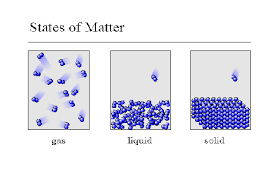
liquid
What is condensation?
water vapor turns to gas
Gas turning into liquid
Liquid turning into a water vapor
Solid turning into gas
The colder the temperature, the _______ the particle's motion.
Faster
Slower
Smaller
Larger
When the temperature increases, the pressure ____.
Decreases
Stays the Same
Increases
Need more information
Two or more materials mixed together that can be easily separated are
solvents
mixtures
compounds
density
A combination of two or more substances that cannot easily be separated--
mixture
solution
solute
solvent
What is a substance that is made of only one atom?
element
solution
compound

